The general public often treats postmodernist practices with a certain lack of seriousness—since historical religious dogmas can be ironically and bizarrely combined with thoroughly cynical modern “business pragmatism.” However, the growing number of victims of these postmodernist wars is all too real.
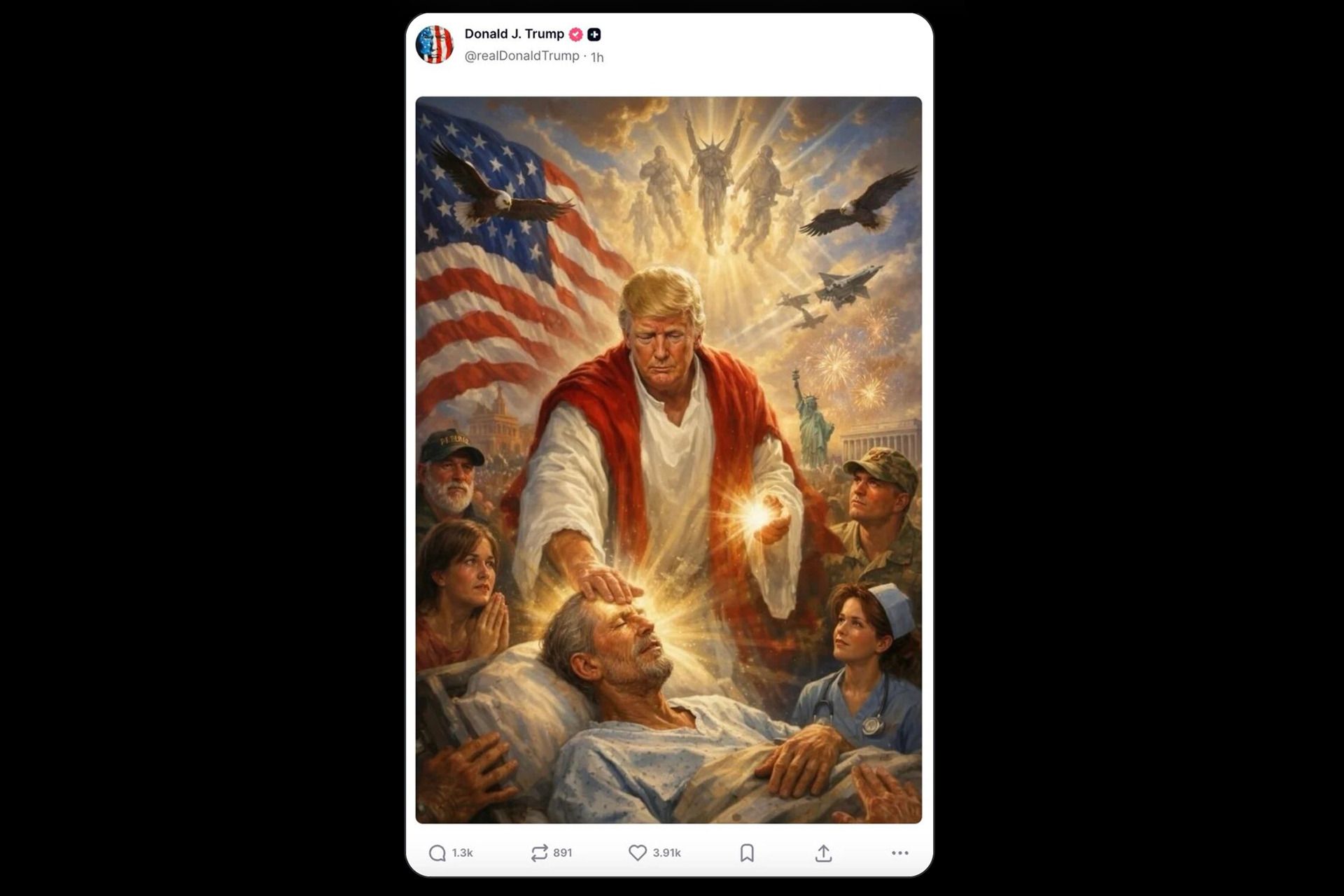
In the picture, Donald Trump, depicted as a messiah, heals the sick. Image: Donald Trump’s account on the social network X
The division between the two opposing blocs in World War II, in their orientation toward either archaism or progress, seemed obvious.What united the Axis countries? Nazism ideologically relied on ancient myths about the “Aryan race.” Mussolini openly cosplayed the Roman Empire. Japan also tried to revive its imperial dominance of previous centuries in the Asia-Pacific region.
On the other hand, the United States sought to continue and develop modernity. And the USSR embraced the utopia of a communist future. Nevertheless, despite the “class” contradictions between them, what brought them closer together and ultimately united them in a single military coalition was a shared reliance on the progressive principles of the Enlightenment.
Today, such a dual ideological difference is impossible to speak of. For example, the opposing United States and Iran are both in the same religious-conservative mode. But that is not all.
Trump allows himself to lecture the Pope on “true” Christianity, and presents himself in an image resembling a biblical healer. Yet in his policies, he primarily demonstrates the interests of a billionaire businessman.
And even Khamenei Jr., who seems to have come to power in Iran, is not only humbly studying Islamic theology, but, according to a Bloomberg investigation, owns an entire network of elite real estate in the UK, Germany, Mallorca, and Dubai.
This could be explained as a “mixing of narratives,” as Jean-François Lyotard described the state of postmodernism.
The general public often treats postmodernist practices with a certain lack of seriousness—since historical religious dogmas can be ironically and bizarrely combined with thoroughly cynical modern “business pragmatism.” However, the growing number of victims of these postmodernist wars is all too real.
The Spiritual Pillars of Deathnomics
Putin’s Russia is especially illustrative in terms of political postmodernism. Its official ideology, replacing the forgotten Soviet “progress,” has effectively become “traditional values,” “spiritual bonds,” and the “Russian world.”
But when the World Russian People’s Council, overseen by Patriarch Kirill, blesses the war against Ukraine and even calls it “holy,” this actually breaks all the spiritual traditions of Christianity. And the organization’s claim that “the entire territory of present-day Ukraine must fall under the exclusive influence of Russia” openly shows that all the “spirituality” of today’s Russian Orthodox Church consists only in serving the imperial interests of the Kremlin.
Another tragic paradox: under the slogan of the “Russian world,” the Russian army is bombing and even wiping off the map precisely the Russian-speaking cities of eastern Ukraine. And it is suffering unprecedented losses. In just the first year of the full-scale war, according to historians’ estimates, Russia lost more soldiers in Ukraine than the USSR did in all its wars after World War II. And today these figures have already exceeded a million people.
Kremlin ideologists like to call “family values” one of the main Russian traditions. But in reality, they have cynically transformed them.
The phenomenon of deathnomics has emerged—when mothers and wives literally sell their sons and husbands to the state for this war, hoping for multi-million “death benefits” if they are killed. Such a moral catastrophe has seemingly never happened before in Russian history. So much for all the family love supposedly sanctified by the Russian Orthodox Church.
And in the spirit of postmodernist narrative mixing, the state intends to fine Russians for images of churches without crosses.
Nonlinear Progressivism
So which countries today can be called supporters of progress, resisting pseudo-religious obscurantism?
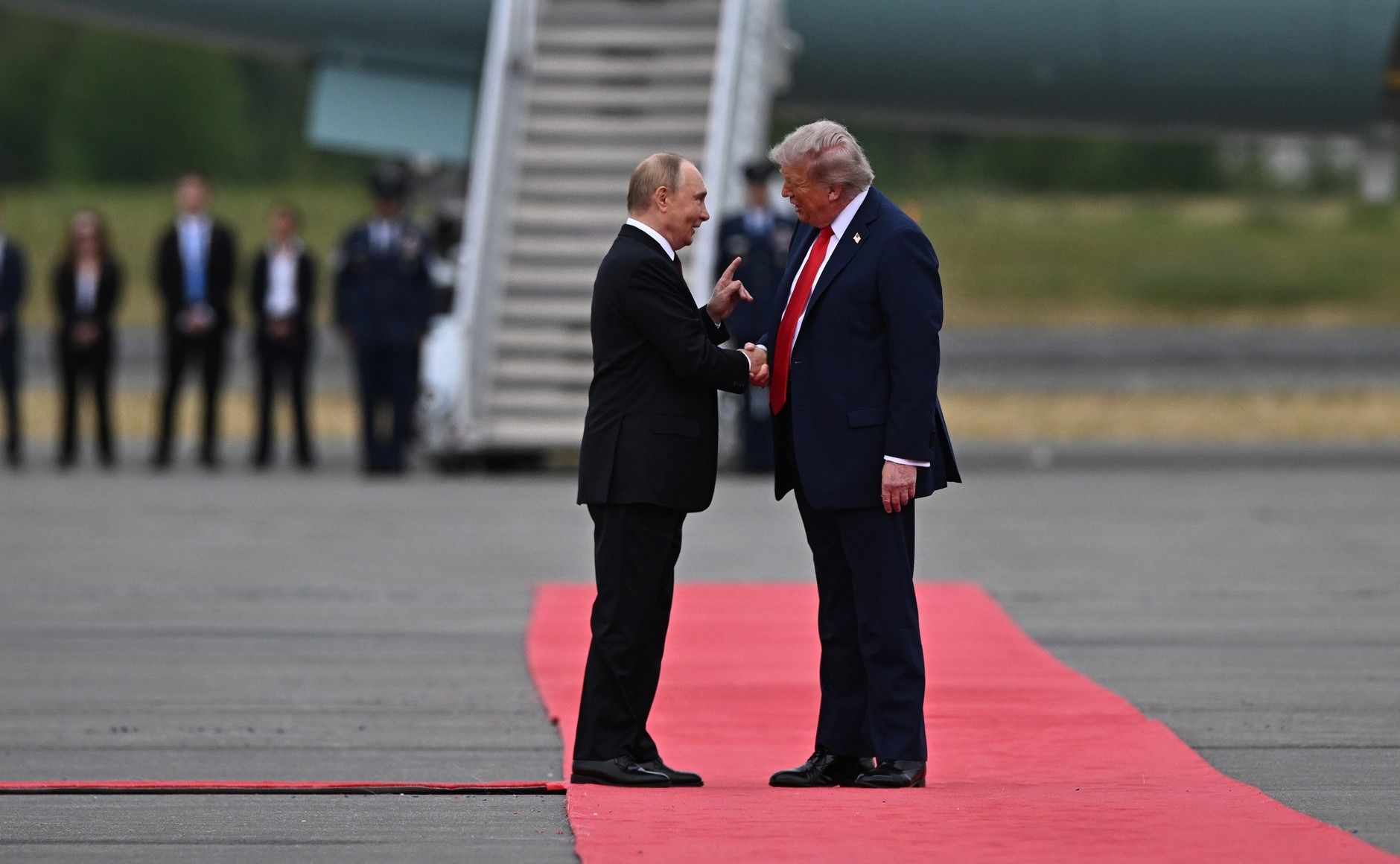
Meeting between Vladimir Putin and Donald Trump in Anchorage, August 15, 2025. Photo: kremlin.ru
The first of them is undoubtedly Ukraine. Of course, there are processes of national cultural revival there, but they do not descend into a self-serving restoration of the past. On the contrary, at least since the Revolution of Dignity in 2014, Ukraine has firmly set itself on the path of European integration, which has significantly modernized the country in many areas and created a sharp contrast with Russia and its archaic-imperial “spiritual bonds.” This is evident even in military technology. Today, Russian occupiers can hardly advance, as any movement is blocked by a “wall of drones.” In general, Ukraine’s drone technology already far surpasses Russia’s. Just recall last year’s “Web” operation, when AI-powered drones struck Russian strategic bomber airfields in the Murmansk and Irkutsk regions, thousands of kilometers from Ukraine. And today’s reality is even more like science fiction—Ukraine is defended by ground drones that have managed to capture Russian soldiers on their own.
Many observers today discuss the growing popularity of far-right parties in Europe. However, the recent defeat of Viktor Orbán in Hungary has dispelled this stereotype. It showed that Europe remains a globally attractive union focused on progressive development, and the support of the former prime minister by Trump and Putin did not help him at all.
And strangely enough, China is now on the side of global progress.
Mainly because, ideologically, it does not try to impose its “traditional values” on Europe, but offers cooperation in modern technology, supplying electric vehicles, wind turbines, and so on. And although many in the EU fear “Chinese penetration,” this is normal economic competition among progressive countries, not an attempt to “restore our glorious past,” as seen in the American MAGA movement or among Russian empire restorers.
However, it is impossible today to divide countries too linearly into those striving for progress or archaism, as in the past era. For example, the EU and China are unlikely to become political allies, just as fundamentalist Iran and conservative Trump’s America will not. What emerges are rather paradoxical intertwinings of interests. Since China buys about 90 percent of Iranian oil and supplies many of its goods in return, Chinese atheists are happy to cooperate with Iranian ayatollahs.
Such a situation leads many observers to lose rational understanding of what is happening. But the era of postmodernist wars is fundamentally based on irrationalism. And on complete unpredictability.
Free history, of course, must be unpredictable—otherwise humanity would fall into some kind of totalitarian predetermination. The trouble, however, is that this unpredictability in the 21st century has once again become predominantly military. And even includes discussions of the possibility of global nuclear war, with which Russian ideologists are already directly threatening Europe. Although during the Perestroika era it seemed that the planet had been freed from this apocalyptic prospect forever.
If you enjoyed this article, consider making a donation — one-time or, even better, monthly. Your support helps us motivate our authors and become better with every article.
Our organization is recognized by the Internal Revenue Service (IRS) as a 501(c)(3) tax-exempt, charitable organization, which means that all contributions made to us are tax-deductible to the fullest extent permitted by U.S. law. Individuals may generally deduct charitable contributions of up to 60% of their Adjusted Gross Income (AGI) for cash donations made to qualifying 501(c)(3) organizations. For donations of appreciated assets (such as stocks or other long-term capital assets), the deduction is typically limited to 30% of AGI, based on the fair market value of the asset. C-corporations may deduct charitable contributions of up to 10% of their taxable income for donations made to eligible charitable organizations.
By submitting a donation, you confirm that you have read and accept the following documents: Privacy Policy and User Agreement, and also give consent to the processing of your personal data.
If you would like to unsubscribe from a monthly donation, please email us at: [email protected]