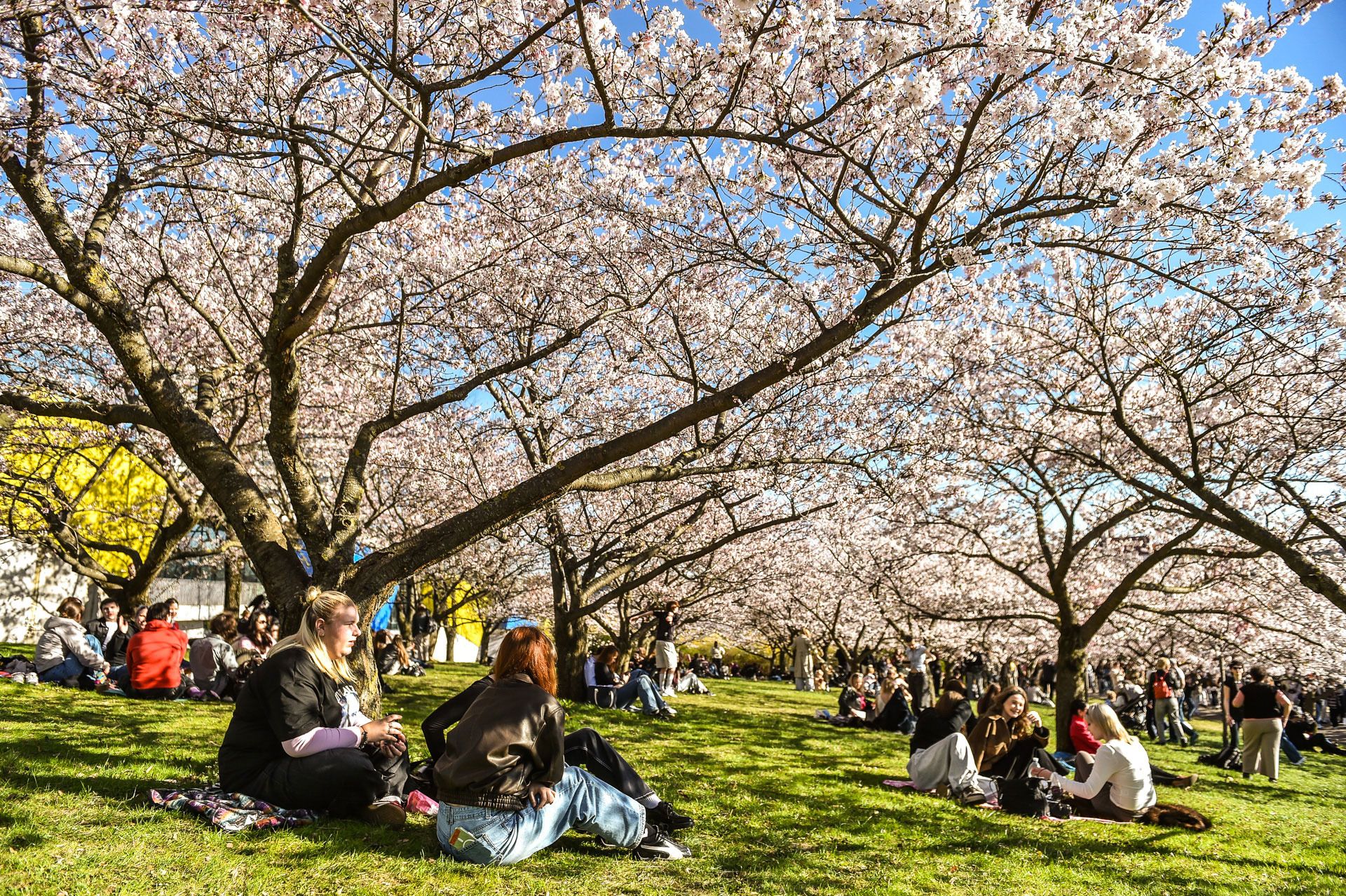
In April 2026, in Vilnius, on the right bank of the Neris, next to the National Art Gallery, the cherry blossoms bloomed once again. Two hundred Japanese cherry trees, planted here a quarter of a century ago in the Chiune Sugihara Park, turned the riverbank into a cloud of white and pink. The name of the Japanese diplomat inscribed on a stone at the park entrance connects the history of this small Baltic country with the history of a Jewish community that was almost entirely destroyed. And it is also the story of a man who saved thousands of desperate people, defying bureaucratic orders.
Chiune Sugihara Sakura Park. Photo by Anna Gavrilova
To understand the scale of what happened in Kaunas in the summer of 1940, one must recall what Lithuania—and especially Vilnius—meant to the Jewish world. Vilnius, or Vilna, as it was called in Yiddish, was known as the “Jerusalem of the North”—“Yerushalayim de-Lita.” It was one of the main centers of Jewish civilization in Europe—a city where, in the eighteenth century, the Vilna Gaon, the greatest authority on rabbinic Judaism of his time, lived and taught; a city where in 1925 YIVO, the Institute for Jewish Research, the world’s leading Yiddish academic institution, was founded. By the start of World War II, about a quarter of a million Jews lived in Lithuania. Jewish newspapers were published in Yiddish and Hebrew, schools of all ideological directions operated—from Bundist to Zionist—as well as theaters, libraries, and printing houses. Vilna was a city where Jewish tradition and Jewish modernism coexisted more organically than anywhere else in Europe.
Kaunas, the temporary capital of independent Lithuania (Vilnius was under Polish control until 1939), was a smaller and politically simpler city, but it too had a significant Jewish community. It was in Kaunas, in the autumn of 1939, that a young Japanese diplomat arrived—to open the consulate.
An Orthodox Japanese in Lithuania
Chiune Sugihara was born on January 1, 1900, in the small town of Yaotsu in Japan’s Gifu Prefecture—literally on the first day of the new century. His father, a tax bureau official, dreamed his son would become a doctor. But young Chiune, as family legend has it, deliberately did poorly on his entrance exam. According to some versions, he simply left the exam sheet blank—and chose international relations instead of medicine. This was the first time Sugihara consciously went against the path set for him—and not the last.
In the early 1920s, Sugihara entered the diplomatic service and was sent to Harbin—in Manchuria, which at the time was a zone of sharp conflict among Japanese, Russian, and Chinese interests. There he learned Russian so well that he could later conduct high-level negotiations in it, as well as German.
He married a Russian woman, converted to Russian Orthodoxy, and received the baptismal name Sergei Pavlovich. The marriage was short-lived, but his fluency in Russian made Sugihara one of the Japanese Foreign Ministry’s top experts on the Soviet Union.
In 1932, he negotiated the purchase of the North Manchurian Railway from the USSR by Japan. This deal required both diplomatic finesse and a deep understanding of Soviet bureaucracy.
But in 1934, Sugihara made a move that again derailed his career. He resigned from his post as Deputy Foreign Minister of the puppet state of Manchukuo—in protest against the cruel treatment of the local Chinese population by Japanese soldiers. This act is worth remembering: long before Kaunas, Sugihara had already shown he could put conscience above career.
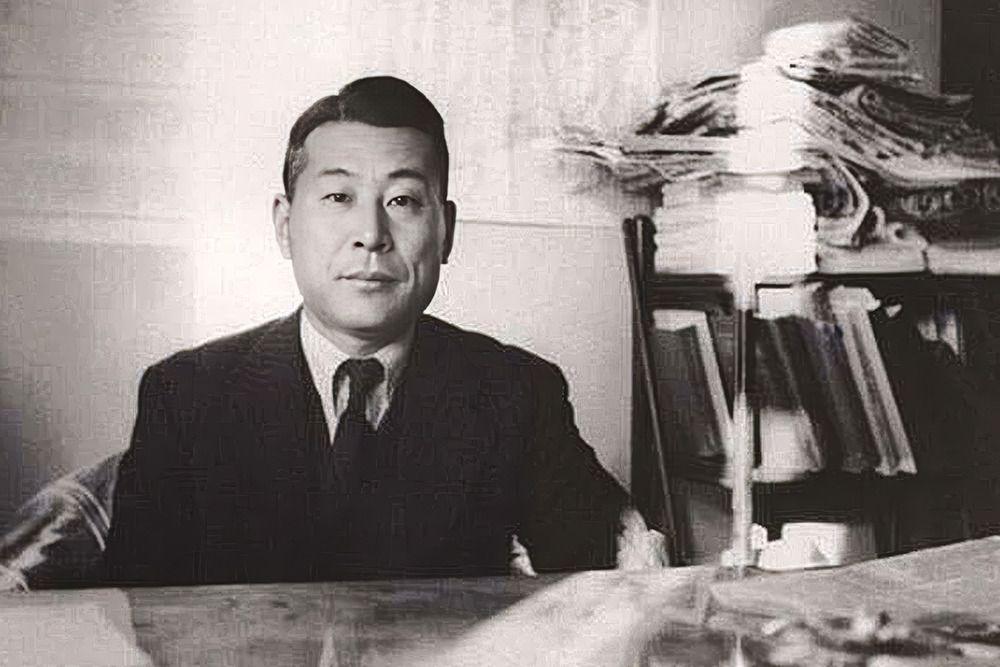
Portrait of Chiune Sugihara. Photo: Wikimedia
Returning to Japan, he remarried—to Yukiko Kikuchi, the woman who would become his closest ally and without whom the story of the “visas for life” would not have been possible. Short assignments in Helsinki and Stockholm, work in the information department of the Ministry of Foreign Affairs—and then in the autumn of 1939, when Nazi Germany and the Soviet Union had already divided Poland, Sugihara received an unexpected appointment: to open the Japanese consulate in Kaunas.
At first glance, the appointment seemed odd. Lithuania—a small Baltic country with virtually no trade or political ties with Japan. The Sugihara family were the only registered Japanese citizens in the entire country. But the consulate’s true purpose was intelligence gathering.
Tokyo wanted an observation post at the intersection of German and Soviet spheres of influence. Sugihara, fluent in Russian and German, was ideal for the role. He was to monitor the movement of German and Soviet troops and report back to Tokyo.
The first year in Kaunas passed relatively peacefully. Sugihara and Yukiko had their third son, Haruki (a boy who would die of leukemia at age seven, after the war, in devastated Japan). The family lived in a beautiful art deco house that would later become the Sugihara Museum—one of the most visited memorials in Kaunas.
But the world around them was changing rapidly.
The Last Consul in Vilnius
After the partition of Poland in September 1939, tens of thousands of Polish Jews fled east—to Lithuania, which was still independent at that time. According to Lithuanian state archives, about twelve thousand Polish Jews found temporary refuge on Lithuanian territory. They came from Warsaw, Lodz, Bialystok—cities where Nazi terror had already become the norm. Many settled in Vilnius, which Lithuania regained in autumn 1939 under an agreement with the USSR. They lived as refugees: without permanent housing, jobs, or any idea of what would come next.
On June 15, 1940, Soviet troops entered Lithuania after an ultimatum. The country was occupied, and soon annexed by the Soviet Union. For Jewish refugees, this meant they were caught between two regimes—Nazi and Soviet.
Just a year later, in June 1941, Nazi Germany would launch Operation Barbarossa—a massive attack on the Soviet Union. German troops would advance rapidly, and Lithuania would fall under their control within days. Soviet rule would collapse as quickly as it had been established a year earlier. In its place would come the Nazi regime, which would prove far more brutal, especially for the Jewish population.
The Soviet occupation authorities demanded the closure of foreign consulates in Kaunas. Diplomats were given a few weeks to pack. Most left immediately. Sugihara requested a delay—and received it. He remained the last foreign consul in the city, apart from the Dutch honorary consul Jan Zwartendijk, director of the local Philips office.
Then one morning—according to Sugihara and his family, at the end of July 1940—the diplomat pulled back the curtain and saw that the street in front of his house was filled with people. At first dozens, then hundreds of men, women, and children stood by the consulate fence. All these people had come for visas.
Among those who organized this delegation was Zerah Warhaftig—a Jewish community leader who would later become a minister in the Israeli government. Warhaftig and other community leaders devised a desperate escape plan: through the Soviet Union, via the Trans-Siberian Railway, to Japan—and from there, anywhere further. For this they needed transit visas through Japan, and for Japanese visas—a final destination. Here the Dutch consul Zwartendijk stepped in: he began issuing certificates stating that no visa was required to enter Curaçao (a Dutch colony in the Caribbean). This was formally correct, but misleading: entry to Curaçao was only possible with the governor’s personal permission, which no one intended to give. The certificate was a paper fiction, but it provided the pretext for a second document—a Japanese transit visa.
Sugihara asked Tokyo three times for permission to issue visas to these people. Three times the Foreign Ministry replied with a categorical refusal: visas could only be issued to those with proper documents, a confirmed final destination, and sufficient financial means. The refugees at the gate had none of these. And so Sugihara made his decision.
A Month That Saved Six Thousand Lives
What happened next is described in much the same way by all sources—each new source adding a detail that takes your breath away.
From July 31 to September 4, 1940—just over a month—Sugihara wrote visas by hand. Eighteen to twenty hours a day. According to some accounts, he issued up to three hundred visas a day—a volume that under normal conditions would have been a month’s quota for the consulate. Yukiko sat beside him, stamping the documents with the consular seal. By evening, Sugihara’s hand would cramp so badly that his wife had to massage his wrists so he could continue the next morning.
Fragment of the list of people who received transit visas issued in 1940 by Japanese diplomat Chiune Sugihara in Kaunas. Source: Wikimedia
According to Sugihara’s official list, he issued 2,139 visas. But since each visa covered an entire family, the real number of people saved is much higher—estimates range from six to ten thousand. Today, it is believed that more than forty thousand descendants of those refugees live around the world.
When the consulate was finally closed and Sugihara was ordered to leave, he continued writing visas at the hotel where his family had moved. According to survivors, he wrote visas on the platform at the Kaunas train station, standing by the train car. And, according to one of the most famous stories, when the train started to move, Sugihara handed the consular seal to one of the refugees through the window and shouted, “Forgive me for not being able to write more! I did everything I could. Forgive me!”
Yukiko, his wife, later recalled: “My husband and I discussed the visas before he started issuing them. We understood that neither the Japanese nor the German governments would approve of our actions. But we did it anyway.”
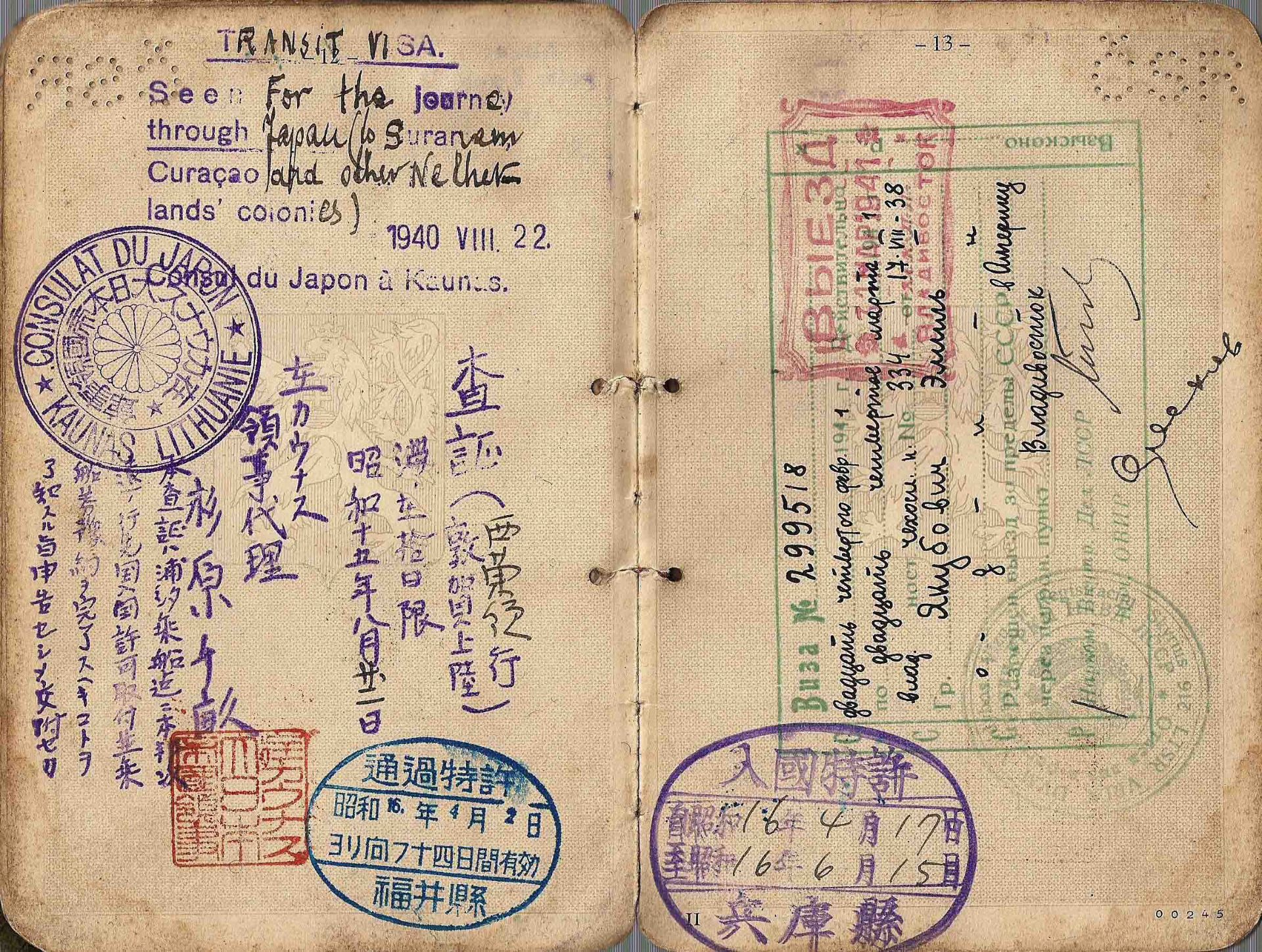
With their visas, the refugees set out on a journey that seems incredible in itself. With Lithuanian travel documents and Japanese transit visas, they crossed the Soviet Union—on the Trans-Siberian Railway, across all of Siberia—to Vladivostok. From there, by sea to the Japanese port of Tsuruga. In Japan, most of them were able to move on: to Shanghai, Palestine, the US, Canada, Australia.
Czechoslovak passport with a transit visa issued in 1940 in Lithuania by Japanese diplomat Chiune Sugihara. Source: Wikimedia Commons
One of those saved was a boy named Leibl Melamed from Bialystok—he was seven when his family fled Poland. His father received a Sugihara visa, and the family traveled across Russia, through Japan—and eventually ended up in the United States. Leibl became Leo Melamed—chairman of the Chicago Mercantile Exchange, creator of financial futures, one of the most influential people in global finance. In 2017, the Emperor of Japan awarded Melamed the Order of the Rising Sun—in part for his lifelong dedication to telling the world about Sugihara’s heroism.
Among those saved were rabbis and yeshiva students—entire religious schools that moved from Lithuania to Shanghai and from there dispersed around the world. Thanks to Sugihara, entire branches of Lithuanian Orthodox Judaism survived that would otherwise have been destroyed along with the 195,000 Lithuanian Jews who perished under Nazi occupation from 1941 to 1944.
And what about Sugihara himself? From Kaunas he was sent to Königsberg (now Kaliningrad), then to Bucharest.
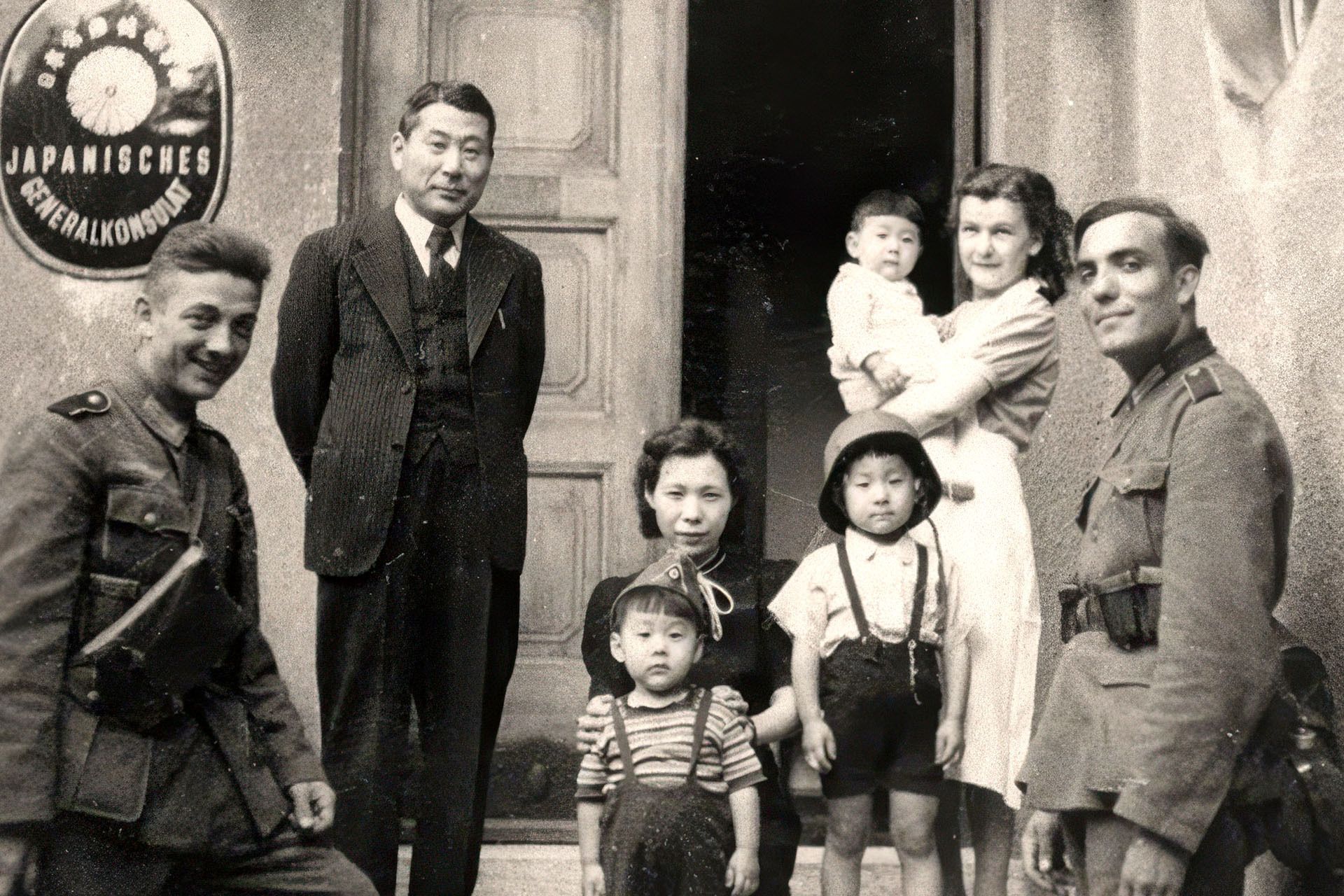
The Sugihara family (second from left) and two soldiers pose on the steps of the Japanese consulate in Königsberg (1941). Photo: United Holocaust Memorial Museum
When the Soviet army occupied Romania in 1944, Sugihara and his family were interned. A year and a half in a Soviet internment camp. Then—a long journey home, through Siberia, through Vladivostok, along the same route as the refugees he had saved years before.
The Japan he returned to in the spring of 1947 was devastated. Hiroshima and Nagasaki had been turned to radioactive ash. The country was under American occupation. The diplomatic service was being downsized. Sugihara reported to the Foreign Ministry, where he was politely asked to resign. The official reason: staff reductions. But the Sugihara family always believed the real reason was punishment for his disobedience in Kaunas. A few months later, his little son Haruki died—he was only seven.
Then came years of obscurity. Without savings or connections, Sugihara survived on odd jobs. Later, thanks to his knowledge of Russian, he found work with a trading company and moved to Moscow. There he lived for sixteen years under the pseudonym Sempo Sugiwarа. All that time, he told no one what he had done in Kaunas. He did not know if his visas had helped or if anyone had survived.
In 1968—twenty-eight years after that summer in Kaunas—the Sugihara family’s Tokyo apartment received a call from the Israeli embassy. An Israeli diplomat named Yehoshua Nishri was looking for Sugihara. Nishri pulled a battered document from his briefcase—a transit visa written in Sugihara’s hand in August 1940. That visa had saved his and his brother’s lives.
The meeting stunned Sugihara. For the first time in nearly three decades, he learned that his visas had worked, that people had reached Japan and survived.
In 1985, Yad Vashem—the Israeli Holocaust memorial center—awarded Sugihara the title of “Righteous Among the Nations.” He was the first and for a long time the only Japanese citizen to be so honored. Sugihara was already gravely ill. He died on July 31, 1986—exactly forty-six years after the day he sat down to write the visas.
The scale of what he had done became known to neighbors only at his funeral. When a large delegation from Israel, including the Israeli ambassador, arrived at the Sugihara home, the residents of his neighborhood realized for the first time that a man who had saved thousands of lives had lived among them all these years.
Two Hundred Trees as a Gift of Memory
In 2001, to mark the centenary of Sugihara’s birth, the Japanese government gave Lithuania two hundred Japanese cherry saplings. They were planted in Vilnius, on the right bank of the Neris, near the White Bridge and the National Art Gallery. The location was no accident—it is the city center, one of its liveliest corners, a space through which thousands of people pass every day.
Yukiko Sugihara and Lithuanian President Valdas Adamkus at a memorial event honoring Chiune Sugihara (cherry tree planting) in Vilnius, 2001
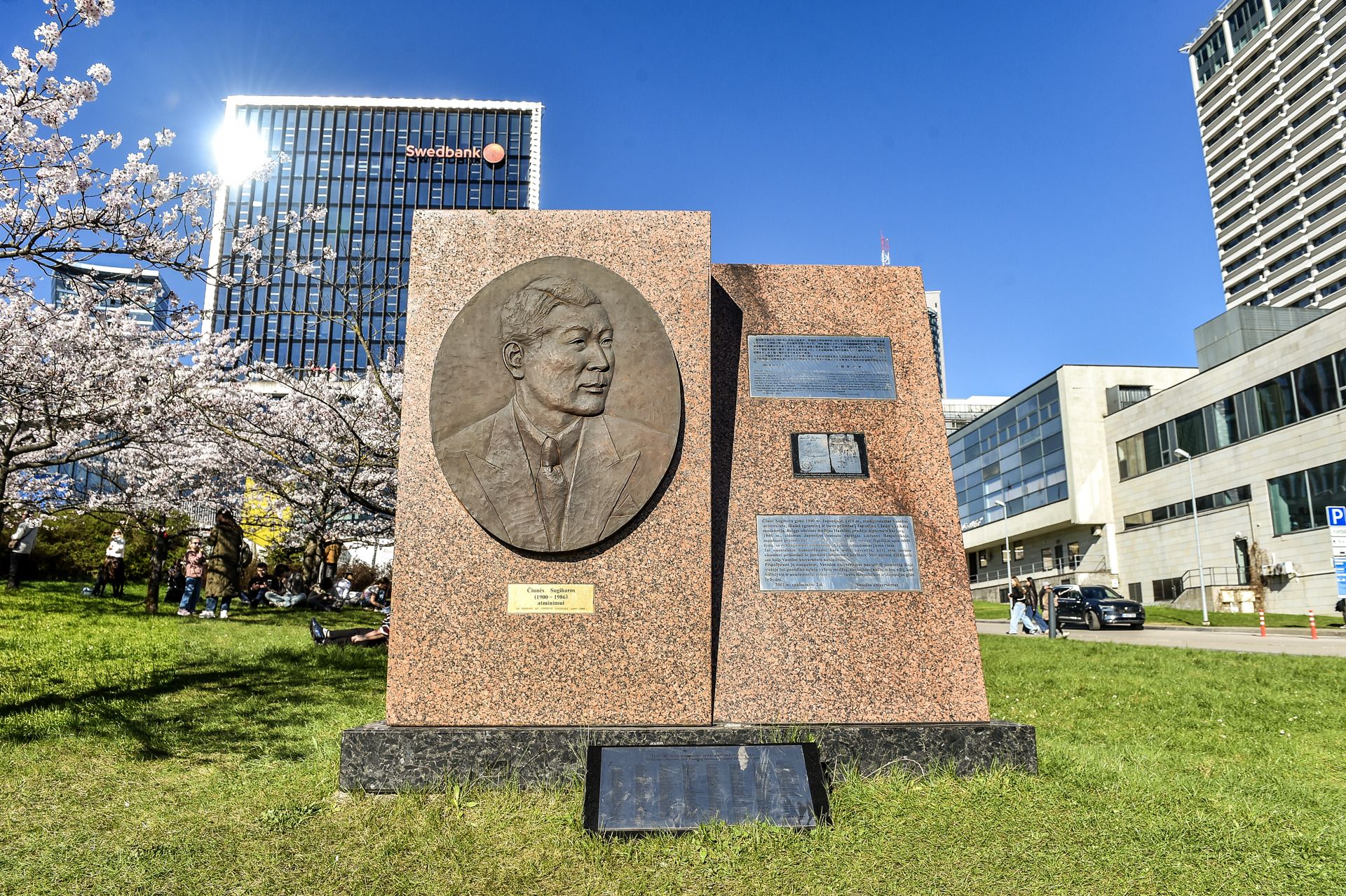
On the stone at the park entrance is inscribed: the trees are a gift from the Japanese people to Lithuania as a sign of strengthening friendship between the two countries and in memory of the man who saved more than six thousand lives.
Every spring, usually in the second half of April, the trees bloom. The flowering lasts only one or two weeks. Vilnius residents come here for hanami—the Japanese tradition of admiring cherry blossoms. They spread blankets on the grass, take photos, drink coffee.
In April 2026, according to Vilnius media, the first buds opened as early as April 14, a bit earlier than usual. The park filled with people again. Locals chase the blossoms as they chase the first snow or white nights—with that special feeling that beautiful and fleeting things bring.
The Japanese call the moment when the wind scatters the petals and they swirl in the air like pink snow “sakura-fubuki,” a cherry blossom blizzard. There is something deeply fitting in the fact that this image—beauty existing on the brink of disappearance—became the symbol of memory for a man who fought against the disappearance of people.
The story of Sugihara, like most stories of rescue during the Holocaust, is not without its contradictions and unresolved questions. Researchers debate the exact number of visas issued: the official list contains 2,139 names, but some historians believe the real number was much higher. In 2018, Sugihara’s son Nobuki discovered forged visas in the Lithuanian state archive—documents with stamps and signatures that did not match the genuine consular ones. Who forged them and why remains unknown. Perhaps someone tried to save even more people using Sugihara’s name after the consulate closed.
There is also a critical perspective: some researchers point out that in recent decades the Japanese government has actively used Sugihara’s story to shape a positive international image, sometimes embellishing or dramatizing certain details. In 2018, the Tokyo Board of Education published a school brochure presenting Sugihara as a model of “the achievements of our predecessors,” intended to “increase students’ pride in being Japanese.” Historian Hillel Levine, author of the biography “In Search of Sugihara,” noted that there is no simple connection between a person’s biography and their moral choices—compassion remains a mystery, not subject to formula.
Monument to Chiune Sugihara. Photo by Anna Gavrilova
All of this is true. But so is this: thousands of people who should have died survived. And the park in Vilnius is not a memorial to abstract virtues. It is a monument to a specific decision made by a specific person at a specific moment, when the cost of that decision was clear and high.
Speaking of Sugihara, one must mention his Dutch partner. Jan Zwartendijk, director of the Lithuanian branch of Philips and honorary consul of the Netherlands, was the second key link in the rescue chain. He was the one who issued those very “Curaçao certificates” that provided the formal basis for Sugihara’s transit visas. Without these certificates, Sugihara would not even have had a bureaucratic pretext to issue the visas.
Zwartendijk, according to his own postwar memoirs, did not really believe the Curaçao certificates would bring anyone true freedom. But he issued them anyway—feverishly, one after another. After the war, he told no one what he had done in Lithuania. He returned to work at Philips, moved to Greece. His role in the rescue only became known in the early 1960s, when the first publications about the “visas for life” appeared in America. In 1997, Zwartendijk was posthumously recognized by Yad Vashem as “Righteous Among the Nations.”
Lithuania as a Refuge
Lithuania declared 2020 the “Year of Chiune Sugihara.” In Kaunas, a memorial house-museum operates—the very same art deco villa where the consulate was located. Before the pandemic, eighty-five percent of the museum’s visitors were Japanese tourists—a fact that in itself shows how important Sugihara’s story is in Japanese national consciousness. In 2020, when the pandemic deprived the museum of almost all its income, it was Japanese organizations and individuals who reached out to help.
But Sugihara’s story is not only about the past. It speaks of the kind of moral choice that small countries on civilizational fault lines are forced to make again and again.
In recent years, Lithuania, a country with a population of less than three million, has become a refuge for tens of thousands of people fleeing war and authoritarian regimes.
Ukrainians. Since the start of Russia’s large-scale war against Ukraine in February 2022, Lithuania has received one of the largest waves of Ukrainian refugees in Europe (per capita). According todata from the Lithuanian Migration Department, as of January 1, 2026, about 80,000 Ukrainian citizens had residence permits in the country—a year earlier there were 77,000. Of these, more than 53,000 were war refugees under temporary protection; their number grew by ten thousand over the year. In total, more than 97,000 Ukrainians have been registered in Lithuania since the start of the war. Lithuania has extended the temporary protection mechanism until March 2027. The Ukrainian community is the largest foreign diaspora in Lithuania and continues to grow.
Belarusians. After the rigged presidential elections in Belarus in August 2020 and the brutal suppression of protests, Lithuania became the main center of the Belarusian democratic opposition in exile. Sviatlana Tsikhanouskaya, whom many consider the real winner of those elections, lived and worked in Vilnius for five years as an “official guest of the state.” Lithuania accredited the Belarusian democratic representation, and Vilnius became for the Belarusian opposition what London was for the governments of occupied countries during World War II—a capital of resistance in exile.
However, recent trends have been mixed. At its peak in 2023, more than 62,000 Belarusian citizens lived in Lithuania. By January 1, 2026, their number had dropped to about 50,300—a record outflow of more than 7,200 people left the country in 2025. Some went to Poland, some returned to Belarus. Nevertheless, the Belarusian community remains the second largest foreign community in Lithuania, and a significant part of it consists of people fleeing political repression.
In early 2026, Tsikhanouskaya moved most of her activities to Warsaw. This happened after the new Lithuanian government reduced her security detail, transferring responsibility from the State Security Service to the police bureau. However, part of Tsikhanouskaya’s team continues to work in Vilnius, and Lithuania remains one of the main centers of the Belarusian democratic movement.
Russians. About 13,700 Russian citizens lived in Lithuania at the start of 2026—the third largest foreign community, though shrinking (a year earlier there were almost 15,000). Among them are opposition activists and journalists who left Russia after the war began, though most have lived in Lithuania for a long time, since Soviet times. The stories of those who left Russia recently are a reminder that borders do not guarantee safety. In March 2024, Russian opposition figure Leonid Volkov was attacked with a hammer in Vilnius. In summer 2025, members of a Russian far-right groupcame to the Vilnius home of activist and writer Sasha Kazantseva, declared a “foreign agent” in Russia and sentenced in absentia to nine years in prison; Kazantseva contacted Lithuanian police, and the investigation crossed national borders. Both cases showed that authoritarian regimes do not view state borders as an obstacle to reprisals.
Lithuania, meanwhile, has introduced restrictions for Russian and Belarusian citizens. In 2023, a law was passed limiting access to visas and residence permits for citizens of Russia and Belarus. In 2025, it was expanded to allow revoking temporary residence permits from Russians who regularly visit Russia or Belarus without valid reasons. It is a difficult balance: helping those truly fleeing the regime, while being cautious about those who could pose a security threat.
Is there a direct line between Sugihara and modern Lithuanian asylum policy? It would be naive to claim that Lithuanian politicians of the 2020s made their decisions inspired by the example of the Japanese diplomat of 1940. Geopolitics, EU and NATO membership, relations with Russia—all these factors weigh more than historical memory. And yet there is something in common between these stories,
Lithuania knows what it means to be wiped off the map. Lithuania knows what it means to lose a significant part of its population—the Jews, murdered by the Nazis with the painful acknowledgment of some Lithuanian complicity. Lithuania knows what it means to live half a century under occupation. And perhaps it is this knowledge that makes it today a country where a refugee from Kharkiv, an activist from Minsk, and a dissident from Moscow can find, if not a warm welcome, at least safety and legal protection.
Sugihara was not Lithuanian. He spent less than two years in Lithuania. But his story has become part of Lithuanian identity—perhaps because it happened here; perhaps because it speaks of things that are existentially important to Lithuania: of a small person standing up to a big system; of a choice that can be made even when everything says “don’t do it.” And of how sometimes a signature on a piece of paper is the only thing that stands between life and death.
***
Every April, when the cherry trees bloom in Sugihara Park, Vilnius residents and visitors come to admire them—often without knowing who the place is named after. They spread blankets, photograph children against the pink branches, drink lattes from trendy cafés around the corner.
There is nothing sad about this. On the contrary—there is a kind of quiet rightness in it. Sugihara did not issue visas so that people would remember his name forever. He wrote them so that people could live. So they could have children and grandchildren. So that one day, one of those grandchildren could come to a park on the riverbank in a city Sugihara hardly knew—and just sit under the blooming trees, thinking about nothing at all.
Perhaps this is what victory looks like—not an anthem or a salute, but an ordinary April day when you can simply leave your house and walk to the park. Just because you are alive. Just because, once, one person decided that rules matter less than people.
Chiune Sugihara Sakura Park. Photo by Anna Gavrilova
If you enjoyed this article, consider making a donation — one-time or, even better, monthly. Your support helps us motivate our authors and become better with every article.
Our organization is recognized by the Internal Revenue Service (IRS) as a 501(c)(3) tax-exempt, charitable organization, which means that all contributions made to us are tax-deductible to the fullest extent permitted by U.S. law. Individuals may generally deduct charitable contributions of up to 60% of their Adjusted Gross Income (AGI) for cash donations made to qualifying 501(c)(3) organizations. For donations of appreciated assets (such as stocks or other long-term capital assets), the deduction is typically limited to 30% of AGI, based on the fair market value of the asset. C-corporations may deduct charitable contributions of up to 10% of their taxable income for donations made to eligible charitable organizations.
By submitting a donation, you confirm that you have read and accept the following documents: Privacy Policy and User Agreement, and also give consent to the processing of your personal data.
If you would like to unsubscribe from a monthly donation, please email us at: [email protected]