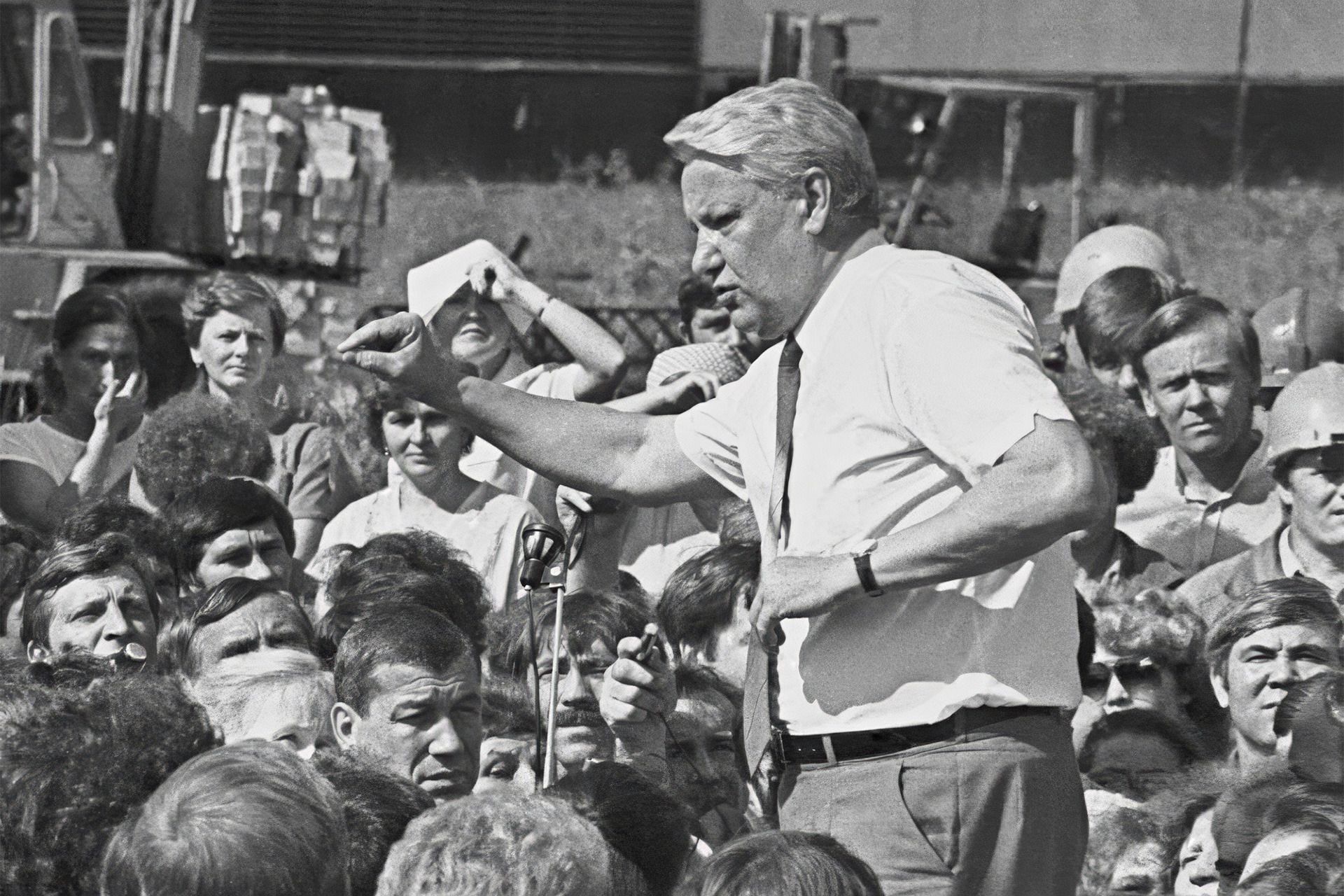
Speaking in Kazan on August 6, 1990, the head of the Supreme Soviet of the RSFSR, Boris Yeltsin, uttered the classic phrase: “Take as much sovereignty as you can swallow”. Back then, at the end of Perestroika, the Supreme Soviets of all the union and autonomous republics of the USSR proclaimed their state sovereignty. And some later declared independence as well. But does anyone really think that this experience can be repeated today?
Boris Yeltsin speaks to the residents of Kazan, August 6, 1990. Photo: Yeltsin Center
Political émigré movements such as the Forum of Free States of Post-Russia and the League of Free Nations constantly declare the need for, and even the inevitability of, the “collapse of Russia”. I completely agree with the idea of the de-imperialization and decolonization of Russia, only perhaps I would not use the word “collapse” — it sounds frightening to most Russians.
Of course, only the de-imperialization and decolonization of the country would make it possible to stop the imperial wars unleashed in the post-Soviet era. And especially the war in Ukraine, where the death toll has already surpassed one million. (Post-)Russian regions would focus on their own problems and development instead of the absurd external expansion imposed by the Kremlin. But there is an important practical, even technical, question: how do you do it? Speaking in Kazan on August 6, 1990, the head of the Supreme Soviet of the RSFSR, Boris Yeltsin, uttered the classic phrase: “Take as much sovereignty as you can swallow”. Back then, at the end of Perestroika, the Supreme Soviets of all the union and autonomous republics of the USSR proclaimed their state sovereignty. And some later independence as well. But does anyone really think that this experience can be repeated today? Yes, in September there will be elections for 11 governors and 39 regional parliaments. But first, all current governors are in effect appointed from the Kremlin and are completely dependent on it politically and financially. And second, the same party, United Russia, absolutely dominates the regional parliaments. All regional parties in Russia have been banned since 2001.
Under such conditions, what “collapse” can we even talk about? It remains merely wishful thinking, a case of wishful thinking among some political émigrés.
Yes, some activists have created, for example, a “government of independent Tatarstan in exile”. But how can it influence the real situation in their republic? And there, incidentally, drones are being produced that attack Ukraine every day. The number of contract soldiers from Tatarstan is also among the highest in Russia. There is the “Free Ingria” movement, created by émigrés from St. Petersburg. A wonderful idea, of course. But if you walk along Nevsky Prospekt and ask ten people whether they know the word “Ingria”, only two or three will answer positively. I conducted such an improvised sociological experiment myself 10 years ago. In political émigré circles there are also the movements “Free Bashkortostan” and “Free Buryatia”. Their activists proclaim beautiful declarations about the future independence of their republics, but seem not to notice that today the number of contract soldiers from them going to war in Ukraine is constantly growing.
The “Free Udmurtia” movement is even preparing to hold elections to the “Constitutional Assembly of the Udmurt Republic” and is already nominating candidates on social media. The only problem is that both this movement and these candidates are outside the Russian Federation. And therefore they cannot have any real influence on the situation in their republic. Udmurtia is currently governed by acting head of the republic Olga Abramova, who took office on July 29, 2026, after the sudden resignation of the long-time governor Alexander Brechalov. But both of them are members of United Russia — and in the regional parliament this party continues to dominate. One can also recall the situation with the “Free Kalmykia” movement, which as early as autumn 2022 adopted a “Declaration of Independence of the Republic”. So what? Where is that independence? It seems most residents of Kalmykia did not even learn about this initiative by political émigrés.
In short, we seem to be witnessing a clash between the virtual world of political émigrés and the concrete Russian political reality. Regionalist émigrés demand independence, but their wishes run up against what is happening “in real life”.
You can draw beautiful flags and maps of “future independent countries”, but today the reality is that these regions, instead of developing themselves, are sending thousands of people to a senseless war.
Citizens of democratic countries can influence their governments. In the early 1970s, mass antiwar demonstrations in the United States forced the authorities to end the war in Vietnam. In 1989, protests against the Afghan war forced Mikhail Gorbachev to withdraw troops from that country. But the full-scale war against Ukraine, unleashed in 2022, began without any consent from the authorities or the population. And those Russian citizens who protest against it do not influence the authorities; on the contrary, they themselves become subjects of administrative or criminal cases. In my view, relying solely on an “ethnic” solution to the problem will not work. Non-Russian peoples in today’s Russia make up, by various estimates, 20-25%. That is clearly not enough to bring down the empire. Residents of Russia’s Russian-majority territories and regions must be involved in regionalist activity. Here I have special hopes for Siberia. There, imperial policy from Moscow has always been viewed critically. We need to demand the free election of regional parliaments with the participation of all regional parties. And then — whether they want to proclaim a new federation, a confederation, or full independence, that is their own business. Let’s not stand in their way!
If you enjoyed this article, consider making a donation — one-time or, even better, monthly. Your support helps us motivate our authors and become better with every article.
Our organization is recognized by the Internal Revenue Service (IRS) as a 501(c)(3) tax-exempt, charitable organization, which means that all contributions made to us are tax-deductible to the fullest extent permitted by U.S. law. Individuals may generally deduct charitable contributions of up to 60% of their Adjusted Gross Income (AGI) for cash donations made to qualifying 501(c)(3) organizations. For donations of appreciated assets (such as stocks or other long-term capital assets), the deduction is typically limited to 30% of AGI, based on the fair market value of the asset. C-corporations may deduct charitable contributions of up to 10% of their taxable income for donations made to eligible charitable organizations.
By submitting a donation, you confirm that you have read and accept the following documents: Privacy Policy and User Agreement, and also give consent to the processing of your personal data.
If you would like to unsubscribe from a monthly donation, please email us at: [email protected]