At the beginning of July, historian Konstantin Pakhalyuk’s book “In Search of ”Russian Antiquity“” was included in the longlist for the “Provetitel” prize. With the kind permission of the publisher Chișinău: The Historical Expertise, which republished the book after its de facto ban in Russia, we are publishing the chapter “State Memory Policy in the Conditions of the ‘Conservative Turn’ (2012 — early 2022)”, which explains why cynical Russian politicians and bureaucrats needed events from long ago.
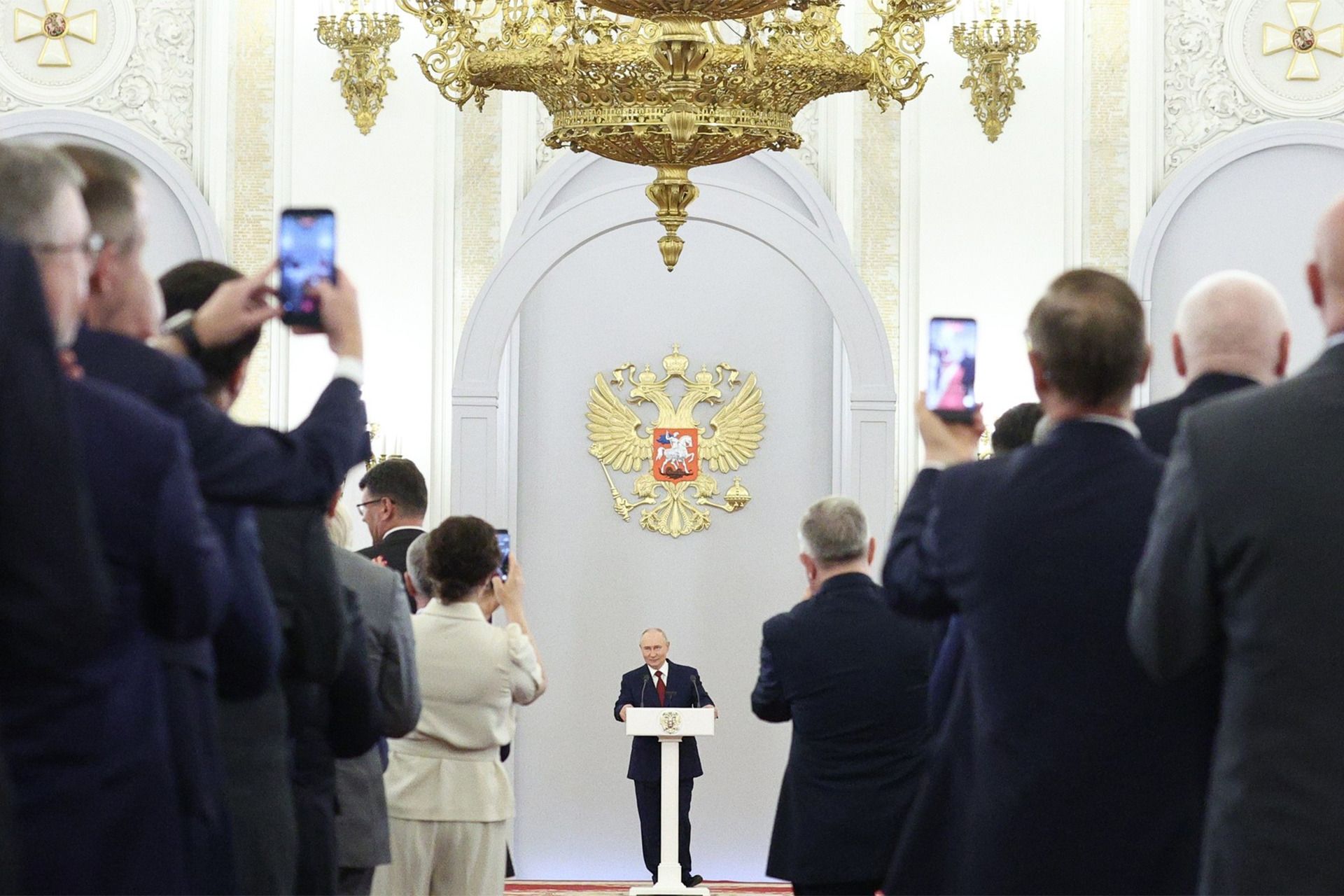
Vladimir Putin at a meeting with deputies of the State Duma of the eighth convocation in the Kremlin, July 27, 2026. Photo: kremlin.ru
A chapter from Konstantin Pakhalyuk’s book is published with minor cuts and divided into parts for ease of reading.
The interest of modern Russian authorities in the past has been growing since the mid-2000s and over the following 15 years has developed into an extensive memory policy. Compared with the 1990s, the changes appear radical: both in terms of the systematic nature of the state’s work with the past, and in terms of the acceptance as supposedly obvious of the idea that history can and should be a matter of special state care. If in 1997 the State Duma rejected the Moscow City Duma’s proposal to criminalize the justification of Nazism, then in 2014 a similar memorial law was adopted without serious objections (at least from the participants in the political process).
The reasons why the authorities turned to history, and specifically to it, require clarification: why did events from long ago suddenly become necessary for rather cynical Russian politicians and bureaucrats? What benefit did they see in them for themselves?
This process can quite possibly be understood as part of the construction of a macro-political identity according to the model of producing “national unity”. Political theorist Bernard Yack, overcoming to a large extent the scholastic difference between civic and ethnic understandings of the nation, emphasized: any national community is built on a shared inheritance, which requires the creation of a coherent historical narrative. Such a view is quite possible, however it does not explain why the state so zealously intensified its efforts on the “historical front”.
Cultural theorist Aleida Assmann argued that since the end of the 20th century a special memorial culture has been forming in European countries, within which the past is no longer simply a relic whose preservation is necessary to smooth out accelerating processes of modernization; on the contrary, it continues to exist now, shaping identity and meanings: the collapse of the image of the future undermined the temporal regime of the modern era, and the “expanding present” sought support in the past.
Russia of the 2010s fits into this pan-European trend, and therefore one could simply claim that the Russian authorities “fell in love” with history because they were not ready to outline the future for Russians. In this formulation, the thesis does not explain why it was precisely history that was turned into the main source of borrowing and justification of values in the political space, something that political scientist Leonid Blyakher was among the first to notice, though he did not develop this thought further.
Speaking about the political significance of the past, I propose turning to the theoretical framework offered by post-foundationalist philosophers, who distinguished the production of legitimacy at the level of the politics (actual politics) and the polity (the political system), or between politics and the political. Unlike anti-foundationalists such as, for example, Frank Ankersmit, post-foundationalists, while recognizing the impossibility of cementing society once and for all on a single basis, focused on how ruling elites try to carry out the process of “founding”, that is, creating the symbolic foundations of overall political unity. As Leonid Blyakher wrote: “The legitimation of power from transcendence sets the semantic context of society’s existence, directly linking participation in the highest value with participation in power”.
If specific political actions are carried out without reference to transcendence, this leads to the dominance of bureaucratic instrumental rationality, where politics is replaced by state management. On the other hand, the experience of the Hitler and Stalin political regimes, by contrast, demonstrates how fascination with a “value language” can lead to the generation of totalitarianism.
This makes it possible to distinguish two interconnected but still different complexes of problems: on the one hand, the justification of political actions, the provision of legitimacy to specific institutions or elites; on the other, the formation in citizens of a sense of belonging to the political community as a whole, which requires commitment to certain minimal, basic foundations of the political order that do not require revision. The latter was more relevant than ever for Russia after 1991, since the country found itself within new borders and with a completely new political system — both required legitimation.
Traditional answers through appeals to ethnic and religious unity in Russia did not work for obvious reasons, and threatened to intensify separatism (that is, actions aimed at revising the political order).
One could have gone by the path of appealing to universal values and, starting from them, building some unified political-symbolic space, however turning to existing ideological systems proved difficult, since a public appeal to universal values also creates a situation of obligation for the speaker.
The collapse of the USSR and its socialist model made it difficult to construct a macro-political identity on the basis of left-wing ideas, the rehabilitation of which would require significant investment. Liberal-democratic ideas were partly perceived as placing Russia in a supposedly dependent position on the “imagined West”, and partly were themselves discredited in the eyes of a significant part of the population in the 1990s, since the gap between what was proclaimed from the podium and what was observed in everyday life was too large.
However, this initially rather inconsistent desire of the federal authorities to express something unifying for 147 million Russians scattered across 1/6 of the land surface manifested itself sometimes in calls to invent a “national idea” (under Boris Yeltsin), sometimes in fascination with such concepts as “sovereignty”, “patriotism”, and “spiritual bonds” (already under Vladimir Putin). Political scientist Svyatoslav Kaspe in 2012 was perhaps the only one who, with full determination, raised the question of searching for the value foundations of modern Russia and those actors who would become participants in a “political-cultural synthesis”.
As political philosopher Leonid Fishman wittily noted regarding “spiritual bonds”, this concept refers not to the problem of spirituality (a person’s communion with God), but to the absence of “social capital”, that is, moral norms and social institutions that produce trust in society and ensure the stability of social ties.
However, gradually the answer was found in turning to history.
The past as the basis for politics in the present
If in the mid-2000s everything was mainly reduced to debates about the content of textbooks, the celebration of the 60th anniversary of Victory, and “memory wars” with Georgia, the Baltic states, and Ukraine, then gradually the appeal to the “common past” became the key way of introducing a value dimension into the political sphere and expressing the “ideal foundations” that turn Russians into members of one nation. As early as 2009, President Dmitry Medvedev limited himself to a formality — he created the Commission to Combat Falsification of History, yet in 2020 the updated Constitution included the phrase that the Russian Federation is united by a “thousand-year history”.
Why history, specifically? First of all because talking about it did not seem like something detached and theoretical. In one way or another, historical images are widespread in Russian society, and therefore constitute a kind of “common knowledge” (many can take part in the discussion or find something “their own” in it). Moreover, history has an advantage: it refers to what was real, what existed or happened. True, this leads to two contradictions that have run as a continuous line through the entire memory policy for almost two decades.
The first is as follows. The fact that some events happened in the past does not deny another fact: they are absent from our reality, and we access them through sources that require systematization and interpretation. Thus history, which was intended to be given the status of the foundation of macro-political identity, slips away, because politicians have access to interpretations that represent the past.
The power rhetoric of “protecting our past”, “preserving”, and “preventing falsifications” precisely indicates that history is conceived as something objectively accessible, really existing here and now, and therefore in need of care. The desire to fix it through an ever-growing number of monuments, legislation, and museums reflected the authorities’ wish to resolve this contradiction in a practical way. I also associate with this the growth of performative practices that turn the past into an object of anything whatsoever, but not critical reflection and debate. That is why, even after the full-scale attack on Ukraine in February 2022, Putin imagines himself the arbiter of history, propaganda offers this image to Russians, and at the same time the state erects hundreds of monuments — to veterans of aggression and not only — on its own and occupied territories, thereby blurring the boundaries between past and present.
The second internal contradiction: whatever goals we may pursue when turning to history, it is anything but transcendence or a source of higher values. This contradicts the principle of historicism, embedded in the foundations of historical science, which at present claims to produce the most authoritative statements about the past: to consider human actions in the context of their time.
In other words, by turning the past into the foundation of the Russian polity, the Russian authorities tried to present the particular as universal. Yes, particular actions can embody the desire to follow universal standards, however they are not their source. The answer to this problem was found technically:
the Russian authorities merely declared the existence of a “single 1000-year history”, but did not show much interest in taking responsibility for expressing it in expanded, narrative form — on the contrary, they selected the “usable past” and, in the Soviet tradition, turned it into “examples to follow”.
Images of the past helped speak to Russians through the prism of the ethics of virtues (“correct” behavior), rather than universal values.
Memory policy itself turned out to be at once a political language, a discourse through which a value dimension was introduced into political life. It was a way of speaking to Russians directly or indirectly about the sublime, the degree of persuasiveness of which varied.
For example, operating with “facts” or references “to archival documents” was a deliberate rhetorical strategy of Vladimir Putin, Sergei Naryshkin, and Vladimir Medinsky (three key federal politicians — speakers of the 2010s on historical topics) in order to give their speeches weight, yet in doing so they claimed a degree of authority they did not possess (since they were not members of the academic community). And the inaccuracies and errors they allowed, on the contrary, called into question not only the validity of specific statements, but the entire state memory policy as a whole.
Manipulation of stability
Outlining the internal contradictions that follow from the very desire to make history the foundation of Russian statehood, I propose taking a closer look at the broader political context. After all, it was this that set the conditions for this activity. As political scientist Vladimir Gelman noted, the general line of development of the political regime in the 1990s-2010s consisted of expelling publicity from politics and gradually rolling back democratic practices, which by no means denies the elites’ interest in public opinion polls and their desire to rely on them, adjusting public moods through media tools.
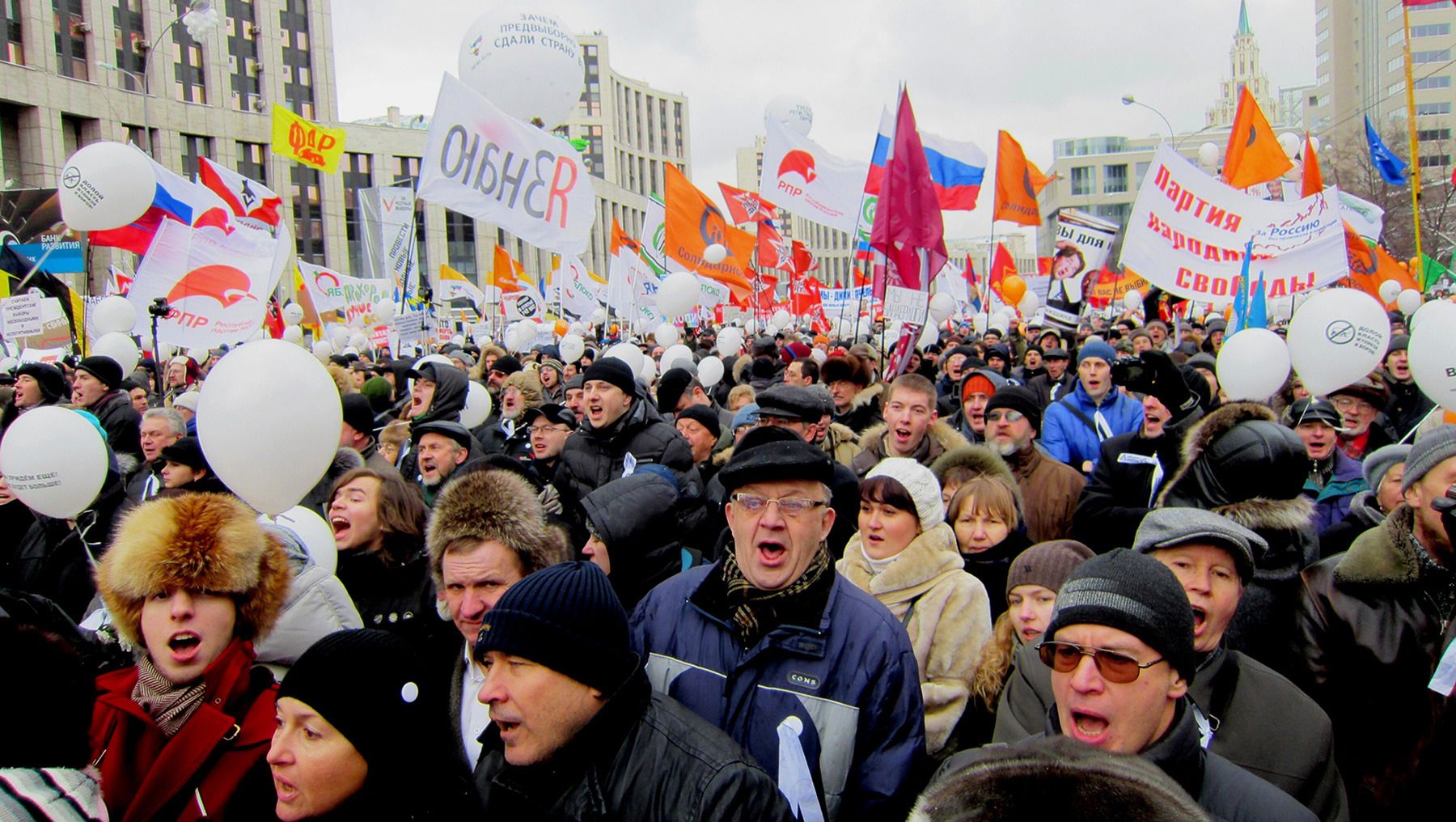
The turning point was the mass protests of 2011-2012, which became the starting point of the “conservative turn” in Russian politics.
Rally on Sakharov Avenue, December 24, 2011. Photo: Wikipedia / Bogomolov.PL. / CC BY-SA 3.0
In particular, as leftist political philosopher Ilya Budraitskis argued, the “conservative turn” was expressed in the politicization of culture: the legitimacy of power was built through identifying the state and the ruling elites with “real”, “timeless”, “fundamental” values. Criticism of power began to be denounced by propagandists as supposedly opposing the very foundations of the nation. Thus the rise of authoritarianism was accompanied simultaneously by the politicization of issues of culture, religion, and history and by the depoliticization of the socio-economic agenda.
In the mid-2010s, sociologist Leonty Byzov also recorded, on the basis of public opinion polls, a revival of archetypal mass consciousness, manifesting itself “in the values of strengthening the state, anti-Westernism, the Russian world. The mood of society as a whole began to take on a more radical character than the official policy of the authorities”. True, he noted that the fascination with conservative values is largely declarative, if only for the reason that 67% of respondents refused to sacrifice personal well-being for socially important goals.
At the same time, sociological surveys and focus groups from 2017-2019 led Leonty Byzov to assert that the “Crimean consensus” had entered a pre-crisis state: growing disappointment with what was happening, the rise of counter-elite populism and a demand for change that “has not yet acquired any political „flesh”“. This last remark seems fundamentally important to me: the point of the “conservative turn” was not that there was no discontent at all (in the case of unpopular reforms, such as pension reform, its growth is quite expected), but that it became impossible to articulate it politically, generating networks of solidarity and conditions for collective action.
That is why public space was deliberately filled with discussion of “problems” that did not directly concern the everyday lives of Russians or were not connected with real intra-elite political processes (strategies of economic development, foreign policy, etc.). It is precisely here that I see the main driving force of state memory policy and the explanation for its omnivorousness:
potentially, very much was permissible, the main thing was that it should not obviously call into question the existing political order. However, in this way the historical past, intended to answer the question of what exactly unites all Russians, increasingly turned into an instrument for legitimizing specific political power.
There are also more specific studies demonstrating how the “conservative turn” “worked”. Thus, sociologist Nikita Zubarev showed a statistically significant relationship between, on the one hand, the growth of Russians’ subjective well-being in the 2010s, and on the other, the growth of national pride and trust in Putin. This records an authoritarian model of perception, where personal success, pride in the country, and support for the president are tied together.
Political scientist Yuri Korgunyuk studied in detail how the conservative agenda, concerned with questions of worldview and foreign policy, from the mid-2010s actively entered political rhetoric and led to the fact that such concepts as “sovereignty”, “great power”, and “empire” began to play a leading role in structuring political debates30. Political scientist Kirill Telin drew attention to the manipulative use of the concept of “stability”, which began to be imagined almost as a value in itself (essentially in authoritarian tones), not requiring decoding through an understanding of the real balance of institutions and often opposed to the idea of reforms.
I also draw attention to the book by film critic Anton Dolin, who studied in detail how completely different films of the 2000s-2010s — about gangsters, science fiction, melodramas, etc. — imposed on Russians the acceptance of an authoritarian model of power where there is no place for independent collective action.
The intensification of state memory policy also became one of the consequences and manifestations of the “conservative turn”, reinforcing the trends described above. However, within this system the turn to the past was less meaningful: the concept of the “conservative turn” makes it possible to conceptualize external effects, but for understanding the internal logic of the functioning of state memory policy in the period under consideration I still prefer to turn to the actor-institutional approach, since it is hardly appropriate to speak of a single state memory policy in Russia.
A springboard for careers
First of all, it is worth noting the transformation of history into a kind of rent resource for achieving private goals — for example, making it part of a public image or, on the contrary, turning it into a mechanism for advancing one’s interests. Thus, two key memory institutions, the Russian Historical Society (RIO, since 2012) and the Russian Military-Historical Society (RVIO, since 2013), were under the patronage of two major political figures, Sergei Naryshkin and Vladimir Medinsky respectively, largely ensuring their political careers.
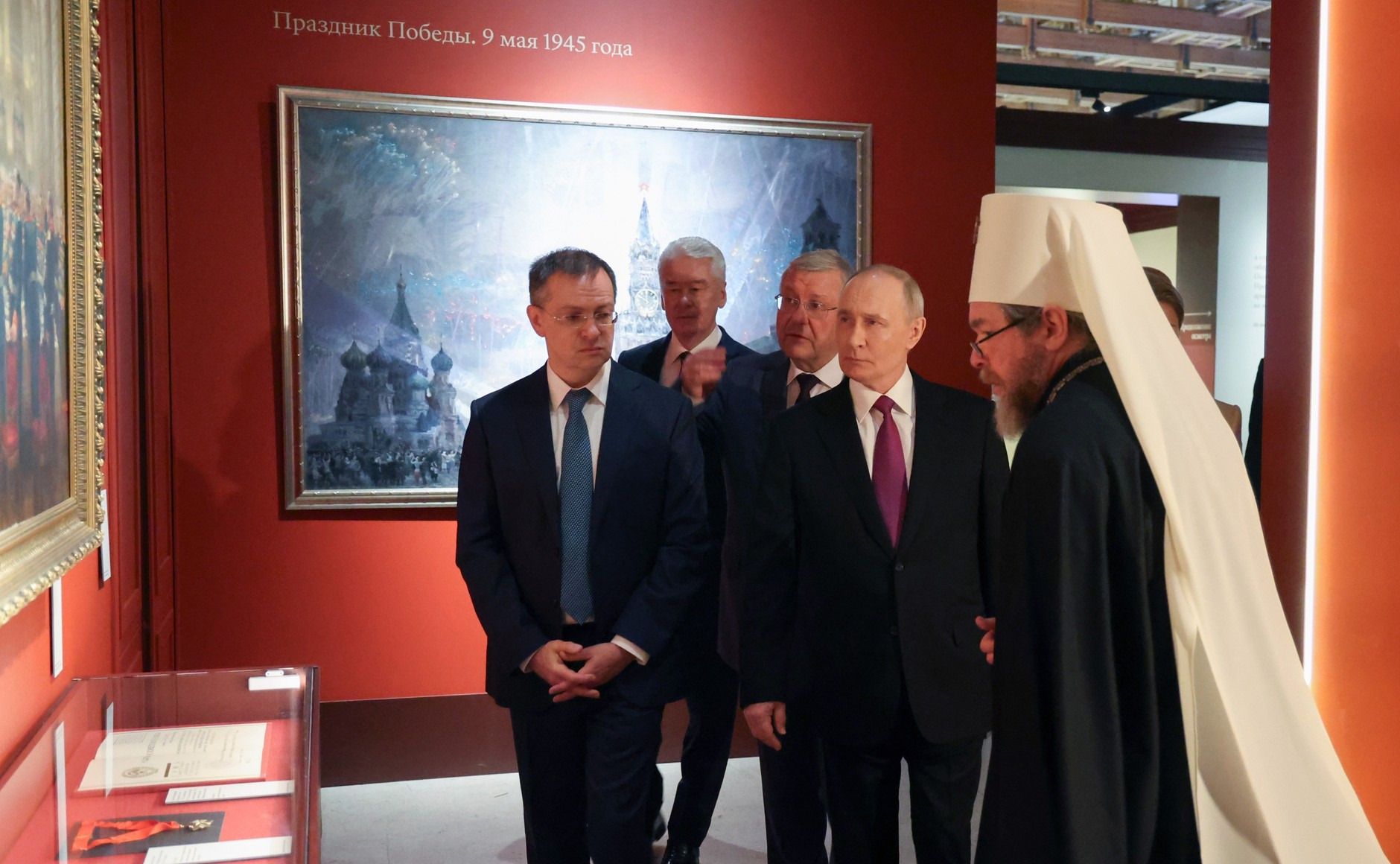
Inspection of the exhibition of the historical-documentary project “Great Victory. Russia is My History” in the Manege as part of the church-public exhibition-forum “Orthodox Rus’ — for the Day of National Unity”. From left to right: Presidential aide Vladimir Medinsky, Moscow Mayor Sergei Sobyanin, head of Rosarkhiv Andrei Artizov, Metropolitan Tikhon of Simferopol and Crimea. November 4, 2025. Photo: kremlin.ru
Another example is the strategy of a number of regional authorities to lobby for their “ancient anniversaries” (1,000 years of Yaroslavl, 1,100 years of Smolensk, etc.) at the federal level in order to receive special funding for various cultural, social, and infrastructure projects.
The search for rent profit through history automatically led to preference being given to non-controversial pages of history: why spend effort on the cultural working-through of such a difficult topic as Stalinist repression (especially since it is linked to the issue of the responsibility of the authorities and the security services), if one can talk about a heroic past or cultural heritage?
On this basis, an extensive network of memory policy actors formed, consisting of no fewer than 20 federal agencies or special memory institutions. By actors, I mean not the situational participation of certain agencies and organizations in solving “historical issues” (any speeches or approvals for museum construction, holding events, etc.), but the presence of relatively consistent and systematic activity in this area.
First of all, these are specialized memory institutions alongside those listed above: the “Historical Memory” Foundation (in the period under consideration affiliated with the Office for Interregional and Cultural Relations of the Presidential Administration); the “History of the Fatherland” Foundation (controlled by RIO); the public movement “Immortal Regiment”; the Search Movement of Russia; the public movement “Volunteers of Victory” (all three in one way or another linked to the Presidential Administration) — five actors.
Among the federal agencies that began or continued to systematically engage in historical policy: the Ministry of Defense, the Ministry of Foreign Affairs and its subordinate Rossotrudnichestvo, the Ministry of Culture, the Ministry of Education, and the Federal Security Service.
Memory policy is also in the focus of attention of other organizations closely linked to the Presidential Administration, but not engaged exclusively in commemoration issues. If RVIO was initially affiliated with the Ministry of Culture, then since 2020 — with the Department for Coordination of State Policy Issues in the Historical and Humanitarian Spheres within the Office of Public Projects of the Presidential Administration. This department was Medinsky’s “apparatus” and did not have a monopoly on all historical projects of this Office (for example, the “Without Statute of Limitations” project or funds allocated to propaganda internet content through the Internet Development Institute), so the latter should be recognized as a separate actor.
Also, the Presidential Grants Foundation allocates funds under the special nomination “Historical Memory”. Certain participation in the implementation of memory policy is taken by the Human Rights Council and the National Security Council. A separate category should include the system of Cossack organizations, including the Council under the President for Cossack Affairs and the Federal Agency for Nationalities Affairs that oversees this area (until 2015 — a ministry).
Federal actors whose activities give historical memory a special “religious coloring” include the Russian Orthodox Church, the Andrew the First-Called Foundation (Vladimir Yakunin), and the Imperial Orthodox Palestinian Society. Among political parties, the Communist Party of the Russian Federation (CPRF) shows a stable interest in history, not limited merely to rhetoric.
Thus history turned into a kind of “market”, which to an outside observer could seem like a single state policy because in the media field participants preferred to speak the same language.
The public conversation about what Russia is was replaced by a conversation about the historical past, and in this optic it was reduced to state forms. The triumph of the ethics of virtue over moral reflection based on universal principles corresponded to authoritarian tendencies. This led to the “normalization” even of such figures marked by mass crimes against subjects/citizens as Tsar Ivan the Terrible and Joseph Stalin.
Pressure on the Memorial society, which studies Stalinist crimes, gradually increased. A number of laws were also adopted introducing administrative or criminal liability for the “rehabilitation of Nazism”, by which the denial of the decisive role of the USSR was in fact meant. As historian Nikolai Koposov emphasized, these innovations turned out to be an instrument not of protecting victims, but of memory wars, because they protected the Stalinist legacy.
The expansion of the “current past” toward the Russian Empire and the refusal to publicly work through the reasons why the Soviet Empire collapsed in 1991, in turn, pushed Russians toward the possibility of revising the current political order: after all, if macro-political identity is built through historical plots where “our history” unfolds on the territory of now independent states, then efforts are needed to realize that now “we, Russians” have nothing to do with them. By constantly telling Russians how, for example, the Red Army during the Second World War liberated “our cities of Kyiv and Minsk”, the Russian authorities strengthened the imperial complex and thereby undermined the legitimacy (at the level of the polity) of the Russian political system.
The fact that state memory policy was gaining ground in the second half of the 2000s due to “memory wars” with Eastern European countries not only led to the securitization of public history, but also additionally contributed to the strengthening of the belief among the political elite and intellectual circles close to them that Russia has a legitimate right to interfere in how history is interpreted in former Soviet republics; as if Russians had special rights there.
As early as April 2005, in his address to the Federal Assembly, Vladimir Putin stated that “the collapse of the Soviet Union was the greatest geopolitical catastrophe of the century”. This seemingly subjective assessment clearly indicated Putin’s and, at the very least, part of the elites close to him’s unwillingness to leave the Soviet Union in the past. This probably stems from the unwillingness of the Russian elites to truly invest resources in working through the events of 1991-1993.
All this fed imperial-nostalgic illusions that might have weakened with generational change, but in reality, on the contrary, were fed by assorted conservatives and nationalists. As Ukrainian historian Yuri Latysh noted: “Ukrainian statehood existed in the life of every person in the form of government bodies, the republican Communist Party with its congresses and Politburo, and clearly defined borders of the republic. Although this statehood was fictitious, and key decisions were made in Moscow, all the attributes of an independent state were present... In the consciousness and everyday life of the inhabitants of Russia there was no RSFSR at all, they lived as if directly in the USSR... For this reason, the collapse of the USSR became the heaviest tragedy and trauma for Russia and Russians. They suddenly realized that their country had shrunk, had “lost” many territories“.
Crimea and Donbas in the mythology of the far right
The occupation and annexation of Crimea in 2014 not only led to the rise of nationalism and imperial sentiments, but also created a corresponding precedent: it turns out that borders can be revised. Moreover, as sociologists Mikhail Alekseev and William Pyle prove, since the 1990s Russians to a significant extent shared attitudes of “blind patriotism”, namely they stated “a willingness to support their country’s policy even if it is wrong; to view an international conflict as an inevitable consequence of defending national interests; to approve an increase in military spending even during periods of serious economic difficulties”. Undoubtedly, the dominance of such attitudes facilitated the pursuit of forceful foreign policy, and they themselves were reinforced by memory policy.
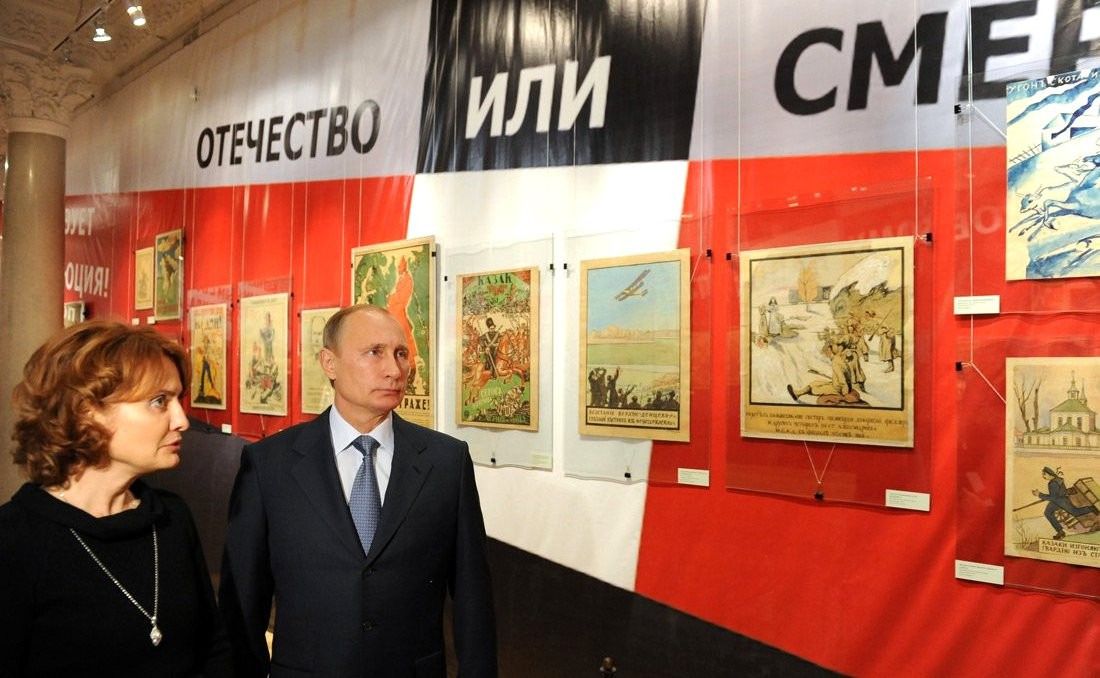
Vladimir Putin in the halls of the Museum of Modern History of Russia with the museum director Irina Velikanova, November 5, 2014. Photo: kremlin.ru
At the level of symbolic politics, the state sought to закрепить the idea of the “historical naturalness” of Crimea’s being part of Russia. Therefore, the fifth anniversary in 2019 passed almost unnoticed, and the peninsula was actively incorporated by state memory policy actors into the space of exclusively national history — the Crimean and Second World Wars, one of the stages of the end of the Civil War, and the adoption of Christianity by Prince Vladimir in the 10th century. The conflict with Ukraine unfolding simultaneously was also presented in the media through the images of the “Great Patriotic War” and the Cold War.
In the second half of the 2010s, the war in Donbas remained part of the media agenda, but not a subject of state memory policy, which practically did not notice it, nor the Russians who went to fight in 2014. After returning, they created their own heroic mythology around the figure of Igor Girkin (Strelkov), presenting, in particular, the defense of Sloviansk as the key heroic plot that made the separatist Donbas possible.
One of the organizers of the pro-Russian rallies, Pavel Gubarev, created a detailed historical narrative about Donbas, where only Russians and empire had a place: a former imperial periphery, developed by Russians in the 18th-19th centuries and becoming one of the centers of industrialization under Stalin. The rallies of 2014, and then the separatist actions, were seen by Gubarev as a form of opposition to global financial capital in order to create a “Russian republic”, which would become the starting point from which the “rebirth” of all Russia would take place. The actions of the Russian state, including participation in the Minsk agreements, Gubarev called a betrayal of the Russian idea.
Later, the right-nationalist publishing house “Black Hundred” published several memoirs of “Russian volunteers” from 2014 that developed this image. All these writings undermined the thesis of Russian propaganda about the fighting in Donbas as an “internal Ukrainian civil war”, and also contradicted the logic of the “conservative turn”: the latter presupposes political passivity, whereas here Russian nationalists not only imagine themselves as an independent subject of political action, but also act in the name of the “Russian idea”, not the state.
Alongside all this there existed autonomous or independent institutions that to one degree or another opposed the logic of the “conservative turn”. At the federal level they were mainly associated with such historical plots as the memory of perestroika, political repression, and the Holocaust, and in the latter case, thanks to translated works, the field for discussing questions of guilt and responsibility expanded.
However, as public opinion polls showed, for 90% of Russians history, along with culture and a strong army, remained the main object of pride. In that same 2016, according to data from the Levada Center52, about 56% of respondents regretted the collapse of the USSR, and 58% would like to see it restored. True, only 14% considered this realistic. Moreover, in comparative perspective since the 1990s, roughly half the population consistently regretted the destruction of the Soviet Empire, and at the turn of the millennium there were more such people than in the mid-2010s (about 65-75%).
The “nostalgia for greatness”, which the state itself actively demanded, fundamentally contradicted the authorities’ calls, especially to the younger generation, to rely on the heroic past for creative work in the name of the future. Studies showed that in the youth environment this led to an increase in infantilism and weakened the sense of personal responsibility for the fate of the country.
***
Thus, in the 2010s the Russian state turned history into one of the key “quasi-value languages” of Russian politics, creating a corresponding rent market with a fairly significant number of institutional players in it. The promotion of images of military glory and service to one’s country were simultaneously meant to become an expression of the “ideal foundations” of Putin’s Russia, a mechanism for alienating citizens from real politics, and a way of competing for the corresponding financial resources. The thesis of a “1,000-year unified history” in this respect is quite convenient because it is broad and gives many players, including at the regional level, the opportunity to take part in this budget-symbolic game.
If you enjoyed this article, consider making a donation — one-time or, even better, monthly. Your support helps us motivate our authors and become better with every article.
Our organization is recognized by the Internal Revenue Service (IRS) as a 501(c)(3) tax-exempt, charitable organization, which means that all contributions made to us are tax-deductible to the fullest extent permitted by U.S. law. Individuals may generally deduct charitable contributions of up to 60% of their Adjusted Gross Income (AGI) for cash donations made to qualifying 501(c)(3) organizations. For donations of appreciated assets (such as stocks or other long-term capital assets), the deduction is typically limited to 30% of AGI, based on the fair market value of the asset. C-corporations may deduct charitable contributions of up to 10% of their taxable income for donations made to eligible charitable organizations.
By submitting a donation, you confirm that you have read and accept the following documents: Privacy Policy and User Agreement, and also give consent to the processing of your personal data.
If you would like to unsubscribe from a monthly donation, please email us at: [email protected]