All mass migrations always have completely specific causes: war, mass famine, natural disasters, and the like. Is any of that happening in Morocco right now? Obviously, nothing.
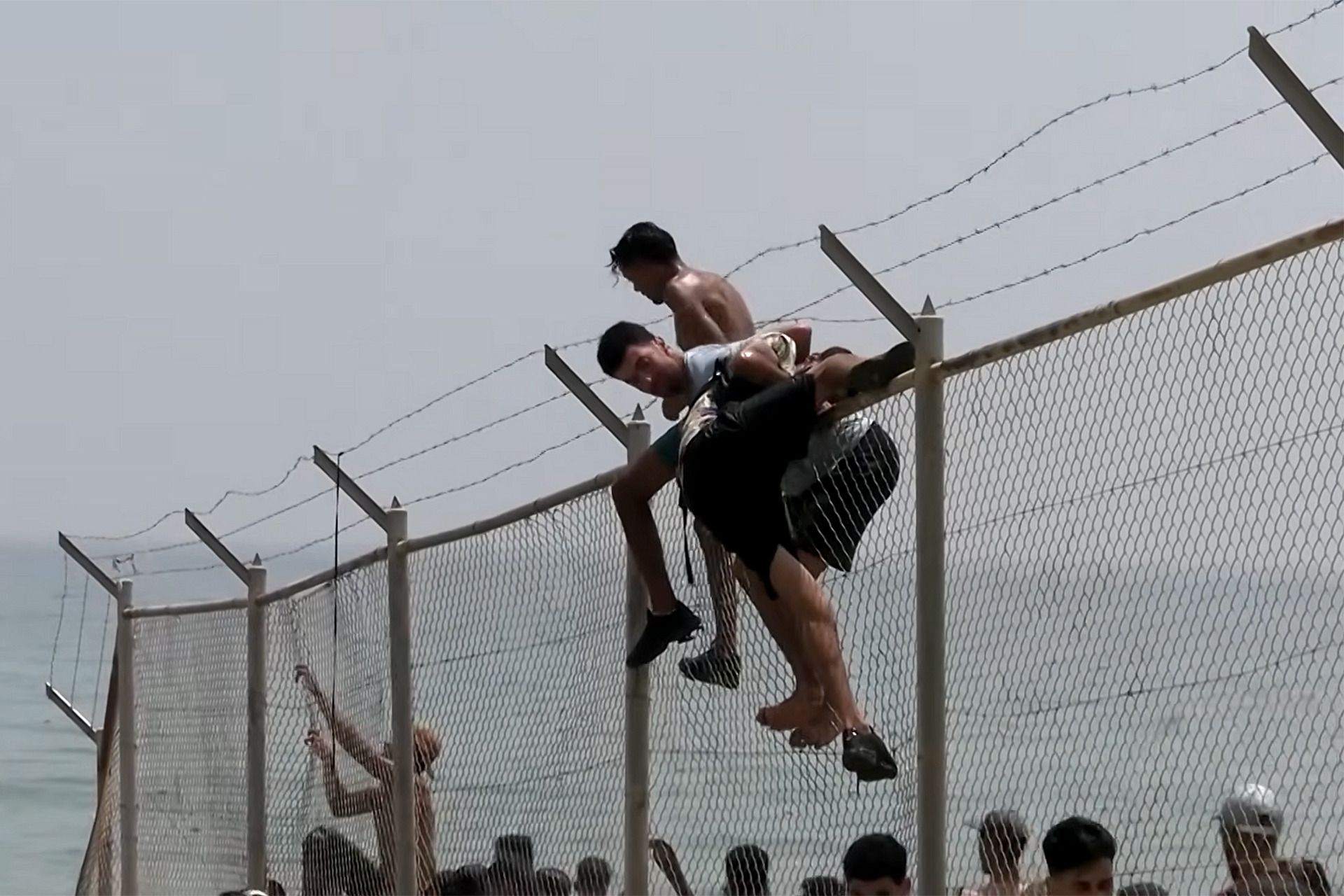
Frame from video: Reuters via YouTube
The migration crisis in Spanish Ceuta ended just two days after it began in the most prosaic way. Tens of thousands of migrants calmly returned to their native Moroccan land through the very same gates of the border checkpoint through which they had broken into Spain two days earlier, among other places.
The brief results of this crisis are as follows.
On July 30, about 50,000 (according to other data, about 60,000) Moroccans broke through the border by land and sea into Spanish territory. About 100 of them drowned while trying to reach the city by swimming.
And already on August 1, about 48,300 people returned back to Morocco.
As of August 3, between 1,200 and several thousand Moroccans remained in the city, 750 of them minors. The latter cannot be repatriated immediately. Spanish and European laws do not allow this.
According to a recent decision by the Spanish Supreme Court, which partly triggered the current crisis, those migrants who were detained at sea also cannot be deported immediately.
Overall, the situation in Ceuta has now normalized. City residents compassionately feed the hungry migrants sleeping in parks and on the beach. However, the questions — what was that, and who benefits from it — remain.
Right-wing politicians and observers reacted to the events in Ceuta in their usual way. For them, everything has long been clear: there are millions of “blacks” who want to seize and enslave beautiful white Europe and impose their own rules on it. The reason for this is their bad character and innate maliciousness.
The new European right-wing “crusade” was led by Italian Prime Minister Giorgia Meloni, who until recently had shown both pragmatism and rationality on other issues of world politics.
At the height of the crisis, Meloni called for an unprecedented step: to suspend the Schengen Agreement with respect to one of the EU countries, namely Spain. After that, Italy unilaterally suspended the Schengen Agreement with Spain, closing entry, ports, and airports to arrivals from Spain.
The actions of the Italian government were also supported by Finnish Interior Minister Mari Rantanen.
At the same time, the head of the Estonian government, Kristen Michal, who signed a letter from the leaders of 22 European countries to the President of the European Commission, the President of the European Council, and the President of the EU calling for support for Spain and its government’s actions to overcome this migration crisis and prevent a repeat in the future, nevertheless disagreed with Italy’s position.
“None of us wants to go back to the days when traveling by land to Central Europe required passing more than five exhausting border checks. The Schengen area is a great value that must be preserved”, said Michal.
Let us try to understand the causes of what happened. 1. Ceuta is a Spanish city with a population of 84,000, located in North Africa, on the African shore of the Strait of Gibraltar opposite the Iberian Peninsula. Getting into this overseas territory of Madrid does not guarantee entry into the European Union, because politically Ceuta is Spain, but geographically it is Africa, and migrants there need to obtain permission to enter the EU.
2. An important point that none of the commentators somehow paid attention to. Practically none of the “refugees” had personal belongings. Some are seen with only small shoulder bags.
That is, the absolute majority of the 50-60 thousand “ran” literally in just shorts. How is that even possible?
All mass migrations always have completely specific causes: war, mass famine, natural disasters, and the like. Is any of that happening in Morocco right now? Obviously, nothing.
The economic situation is so-so, but there is no mass famine. Everything is calm in Rabat.
But if so, then before parting with their homeland, one could at least pack a backpack. But no. It’s as if they were heading to a football match, not emigration. No belongings.
Let us agree that this is somewhat strange.
Ukrainians, at the start of the war, left with their belongings loaded into personal cars, carrying suitcases in their hands and backpacks on their shoulders. In the same way, in the autumn of 2022, Russians fled mobilization through Upper Lars. Even earlier, Syrians fled in the same way, with a lot of belongings on their backs and in their hands.
And here there is nothing like that at all.
Very unusual and suggests a premeditated one-time action.
3. Another important point: the contingent. In almost all videos and photos of this “migration crisis”, you can see that most participants are boys and young men. Excuse me, but where are the women with children?
4. The role of the Moroccan government in this crisis.
There are now a number of video confirmations that this “crisis” was in one way or another managed by the Moroccan authorities. In particular, on July 30, border control was inexplicably relaxed on the Moroccan side.
Ceuta’s mayor Juan Jesús Vivas said in an interview with El País: “People believe that if it wasn’t organized, then at least it was encouraged or allowed by Morocco”.
In one video, a Moroccan border guard calmly watches as dozens of “refugees” jump out of a huge truck and run off somewhere in an organized manner.
The Guardian, in an article devoted to the events in Ceuta, quotes one of the Moroccans who fell for a massive campaign on social networks and messengers calling for an assault on the Spanish border. 28-year-old Ashraf told the publication: “Moroccan police were pushing us toward the water and shouting: ‘Swim! Swim!’”
It is obvious that mobilizing 50-60 thousand people all at once is impossible without government help.
To be honest, the first thought that came to mind when looking at the crowds of people breaking through the Moroccan-Spanish border: Moscow was involved here somehow.
To avoid being unfounded, I will quote a statement made on December 27, 2024, by one of Putin’s main allies, Dmitry Medvedev:
“...Europe must be punished by all means available to us: political, economic, and all kinds of hybrid ones. And therefore we need to support any destructive processes in Europe. Long live the aggressive rioters in its historic streets! Glory to the migrant crowds who commit outrages and with hatred destroy the rainbow European values”.
You have to admit, this sounds like a “road map”, a plan of action.
Ukraine’s Foreign Minister Andrii Sybiha wrote on social media that more than 1,500 posts dedicated to the events in Ceuta were identified in pro-Russian information networks. “We discovered a large-scale Russian propaganda campaign across Europe, using photos from Ceuta to destabilize the situation”, he said.
One can also recall how the Russian Federation, through Lukashenko, tried to send Syrian migrants into Poland via Belarusian territory. Nevertheless, I have not yet found evidence in open sources for the version that Moscow stands behind the migration crisis in Ceuta.
But if Moscow did not initiate this crisis, then who did, and why?
Morocco is a constitutional monarchy known in the world mainly for its tangerines and phosphates (70% of global reserves). 32% of the population is illiterate. Unemployment is 23%.
To make it clear: unemployment at the level of 5-6% is considered dangerous for social stability in a country. And here it is 23%.
In addition, Morocco has long and unsuccessfully claimed Western Sahara, occupying part of this territory. The inhabitants of Western Sahara are demanding independence. They are supported in this by Morocco’s neighbor — huge and much richer Algeria.
Official Rabat reacts to contacts between foreign governments and Western Sahara just as nervously as China reacts to other countries’ contacts with Taiwan.
Meanwhile, 10 days before the attempt at the “mass migration” of Moroccans to Ceuta, the head of the Spanish government, Pedro Sánchez, went on a state visit to Algeria, where he said that relations between his country and Algeria are strategic in nature. For an outside observer, there is nothing criminal in this statement, but for the Moroccan authorities it is a knife to the heart.
Algeria, which shares a nearly 1,600-kilometer border with Morocco, is categorically opposed to Rabat’s claims to Western Sahara. Relations between the neighbors on this issue are so strained that in 2021 Algeria recalled its ambassador from Morocco because of Western Sahara.
And so, against this background, Sánchez proclaims a course toward strategic cooperation with Algeria. One can understand him. Algeria, unlike Morocco, is a large country with rich mineral resources. In terms of gas reserves, it ranks third in the world. Plus significant oil reserves.
The Russian resource ordomundi.ru reported that Pedro Sánchez visited Algeria for the first time in four years “accompanied by the heads of the energy companies Naturgy, Repsol and Enagás. The main topic was gas supplies: in the first half of 2026, Algeria provided about a third of Spain’s natural gas imports, and Madrid expected to increase volumes via the Medgaz pipeline”.
It is obvious that Madrid’s and Algeria’s “strategic cooperation” is impossible without Spain adopting the Algerian position on Western Sahara, which is that the people of this territory have the right to their own state.
At the same time, until recently the Spanish government supported the Moroccan view on this issue (Western Sahara autonomy within Morocco). And then suddenly such a turn: face to Algeria, back to Morocco.
And then, to make matters worse, right after Sánchez’s visit to Algeria, where he proclaimed a course toward strategic cooperation with that country, and therefore, as we understand it, support for its position on Western Sahara, the valiant army of the Sahrawis (the Polisario Front) twice shelled the positions of the “Moroccan occupation troops”. Sahrawi resources assure that there are losses among the latter.
What is left for the “poor” king of Morocco in this situation?
The only way out is to start spinning patriotic themes, mixed in this case with an anti-colonial agenda. Ceuta, Melilla (another Spanish exclave in North Africa near Ceuta) — are “ours”. In other words, Moroccan.
And this despite the fact that Ceuta has been part of Spain for more than 600 years, and Melilla for more than 500. Not to mention that a state like Morocco did not even exist then...
To make it clear to the Russian-speaking reader: if someone were to start making territorial claims against Russia within such a time frame, it would have to give up not only Siberia, Kazan, Astrakhan, Novgorod, and Smolensk, but even Tver.
In that case, Turkey would have to leave Istanbul, and as for the United States and Australia, there is no need even to mention them.
If a state can offer its citizens nothing within the country, it recalls history, including invented history, and shifts their attention from real internal problems to imagined external ones.
If the Moroccan government is unable to cope with either high unemployment, or poverty in the country, or neighboring, much more powerful Algeria, or the Western Saharan rebels, or, all the more so, Spain, then why not use its young, poorly educated citizens by dumping them into Spanish Ceuta?
And then insist — it wasn’t us! We’re not there.
Well, and of course, it’s all the fault of the cursed colonial past and the current heirs of the colonial empires.
If you enjoyed this article, consider making a donation — one-time or, even better, monthly. Your support helps us motivate our authors and become better with every article.
Our organization is recognized by the Internal Revenue Service (IRS) as a 501(c)(3) tax-exempt, charitable organization, which means that all contributions made to us are tax-deductible to the fullest extent permitted by U.S. law. Individuals may generally deduct charitable contributions of up to 60% of their Adjusted Gross Income (AGI) for cash donations made to qualifying 501(c)(3) organizations. For donations of appreciated assets (such as stocks or other long-term capital assets), the deduction is typically limited to 30% of AGI, based on the fair market value of the asset. C-corporations may deduct charitable contributions of up to 10% of their taxable income for donations made to eligible charitable organizations.
By submitting a donation, you confirm that you have read and accept the following documents: Privacy Policy and User Agreement, and also give consent to the processing of your personal data.
If you would like to unsubscribe from a monthly donation, please email us at: [email protected]