Today, many representatives of national-regional movements in political exile have a clear disappointment in the Russian federal project, since it has repeatedly (both after 1918 and after 1991) led only to yet another revival of a centralist empire. Therefore, they find no common ground even with the new liberal opposition, which in its dreams of a beautiful future Russia sometimes oddly repeats Kremlin unitarist ideas.
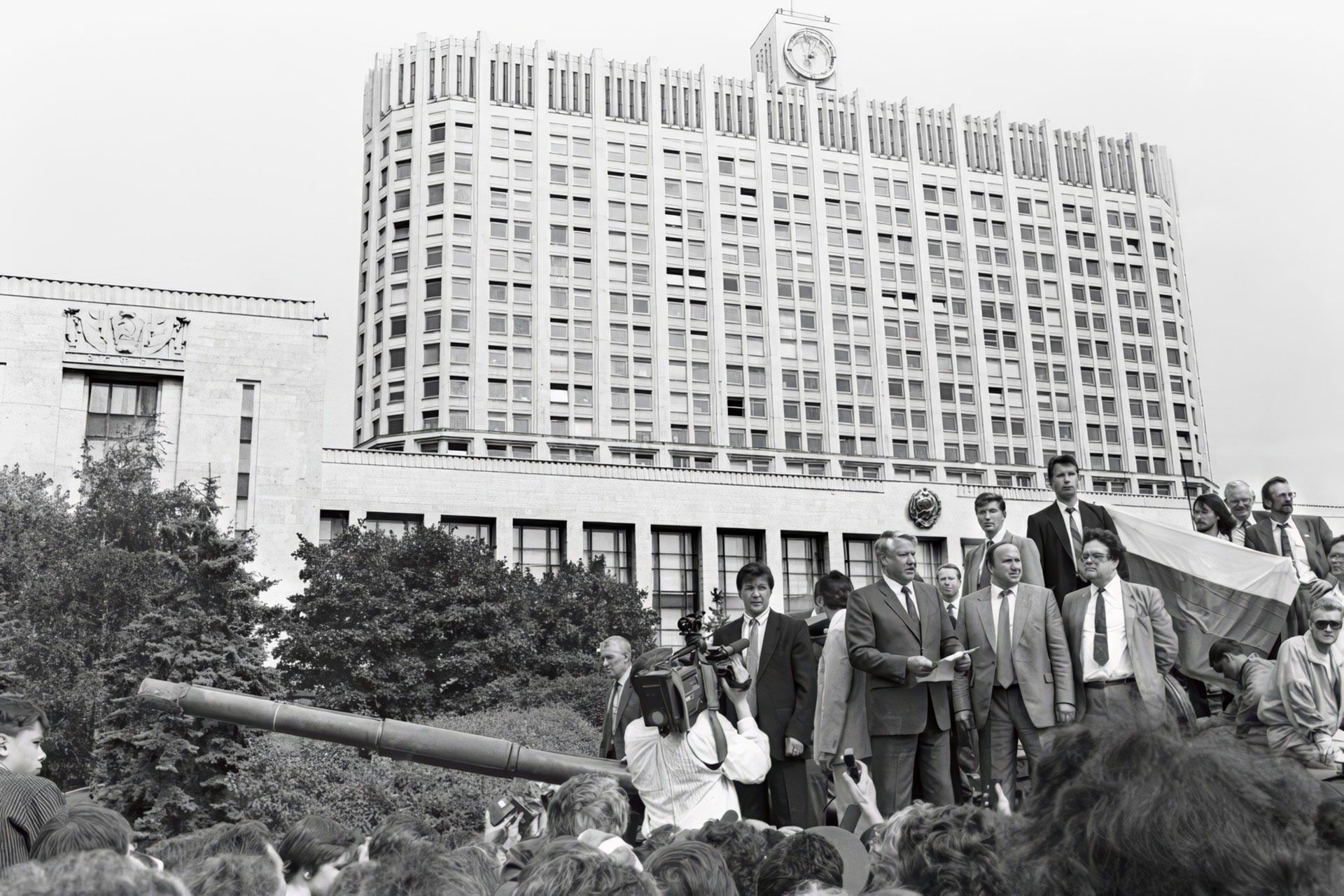
Boris Yeltsin addressing the people from a tank turret near the building of the Supreme Soviet of the RSFSR, Moscow, August 19, 1991. Photo: Yeltsin Center / Valentin Kuzmin / TASS Photo Chronicle
In July, ordered to establish a “Day of the Languages of the Peoples of Russia” and to celebrate it annually. This looks like blatant political schizophrenia: back in 2018 the mandatory study in schools of various republics of the Russian Federation of their local languages was abolished by the Russian president himself.
Putin proposed to celebrate this holiday annually on September 8, the birthday of Rasul Gamzatov. It should be noted that the famous Avar poet experienced a deep linguistic duality. For example, he spoke of the Russian language in a lofty and passionate way:
And with all my heart, a son of the mountain, I am accustomed
To consider that great language my native tongue
But at the same time, he worried about the fate of the language in which he grew up:
And if tomorrow my language disappears, Then I am ready to die today.
The sharpness of this problem was heightened in 2019 by the self-immolation of Udmurt scholar Albert Razin near the building of the republican parliament. In his hands, he held a poster with lines from Gamzatov about the disappearance of his native language.
Carnival dances instead of republican self-government
Although by the laws of the republics their languages formally continue to have state status, in most cases they are actually deprived of it. Because the current Russian republics do not possess any real statehood, although all of them adopted their Declarations of State Sovereignty in 1990. Just as all regional heads were forbidden to call themselves presidents, arguing that “in Russia there can be only one president,” so all republican “statehood” became completely conditional.
Today no head of a republic controls either local security forces or even economic ministers – they are all appointed by Moscow.
As for republican languages, they can now be studied in schools as “native” (not state) languages only upon parental request. Moreover, there is another catch here – graduates still have to take the Unified State Exam in Russian upon finishing school. This exam is not provided for in any other languages of the Russian Federation.
So the “Day of the Languages of the Peoples of Russia” will most likely become, figuratively speaking, carnival dances in grandmother’s sarafans instead of building a real federation, which is based primarily on regional political self-government. Various national activists who consider the language issue “the most important” resemble those who put the cart before the horse. Because in reality, only freely elected parliaments can restore full state status to republican languages, not Moscow, which, on the contrary, strives for complete political unitarism.
Back in 2004, the Constitutional Court ruled that the only unified graphic basis for all republican languages must be Cyrillic. This seemed an incredible absurdity for a huge country located on two continents, where hundreds of very different cultures coexist.
By the way, this is exactly why Karelia, the only one among all the republics of the Russian Federation, never received the right to make its language a “second state language,” because Karelian is based on the Latin alphabet. This inevitably affected demographics – if in the 2002 census more than 93 thousand people identified as ethnic Karelians, by the 2021 census their number had dropped threefold to about 30 thousand.
Nevertheless,
a true, equal federation is still built not on the ethnic origin of its inhabitants but on how much its subjects possess real civic self-government and freedom to elect their authorities.
The US states and the federal states of Germany, as the most famous world federations, enjoy such self-government to the maximum extent. No US president would dream of “removing” and “appointing” governors. And in Germany, all school programs are written and approved at the state level, not by some Berlin officials.
How were the Bolsheviks and Yeltsin similar?
In Russia, a full transformation of the former empire into a federation historically never succeeded. Although the Constituent Assembly in January 1918 managed to proclaim Russia a symmetrical “democratic federal republic,” it was soon dispersed by the Bolsheviks. They preserved the federal principle of statehood and even included it in the official name of their state (RSFSR), but interpreted it in an absolutely asymmetrical and ethnic way. Fully-fledged subjects of the federation were considered not all former provinces but only newly created autonomous republics on a national basis.
This was explained quite simply –
the Bolsheviks very much wanted to attract the peoples of the empire to their side and were therefore ready to share increased powers with them.
The very first Soviet autonomy in 1919, with which the Kremlin signed contractual federal relations, was Bashkiria, led by the scholar and military leader Ahmet-Zaki Validi. However, he soon opposed the Bolsheviks when they effectively began to revive the imperial-centralist model, canceling federal equality.
Interestingly, the same process of new imperial centralizationrepeated itself in another historical cycle – in the post-Soviet Federative Treaty of 1992. A couple of years before that, in the political struggle with Gorbachev, the head of “new Russia,” Yeltsin, also sought to attract Russian autonomies to his side by promising them “as much sovereignty as you can swallow.” And the Federative Treaty indeed granted national republics more rights and powers than “ordinary” regions and territories. But then the same evolution toward Moscow centralism began, and Yeltsin's “successor” pursued an openly imperial policy.
However, Putin did not suddenly jump out like a “devil from a box.” The gradual centralization of Russian politics was already happening under Yeltsin. It is enough to compare the republican sovereignties of the early 1990s and the proclamation of the Ural Republic in 1993 with the already very centralist government of Primakov, which came in 1998. Only one step remained before building a total “vertical of power.”
Ethnic overseasoning
Today, many representatives of national-regional movements in political exile (Forum of Free Peoples of Post-Russia, League of Free Nations, etc.) have understandable disappointment in the Russian federal project, since it has repeatedly (both after 1918 and after 1991) led only to yet another revival of a centralist empire. Therefore, they do not find common ground even with the new “liberal opposition,” which in its dreams of a beautiful future Russia sometimes oddly repeats Kremlin unitarist ideas.
Various national movements can be called the “salt” of the decolonization process – they sharply feel not only political and economic but also cultural oppression of their republics, which undoubtedly intensifies their protests. But when they focus solely on ethnic problems, it results in overseasoning that ignores political reality. For example, those who blame the generalized “Russians” for everything, finding some criminal justifications for this, deprive themselves of possible allies in Russian regions and territories, many residents of which are also dissatisfied with Moscow’s hypercentralism.
Moreover, “overseasoning” nationalists make their victory very unlikely because the entire population of national republics comprises only about 20% of the all-Russian population. Therefore, it is hard to expect that they will be the main subject of the “collapse of the Russian Federation” they dream of. In the last Soviet census of 1989, Russians and non-Russians were roughly equal in number, so the USSR broke up relatively easily.
Furthermore, the population of most current Russian republics is far from monoethnic. For example, in the 2021 census, only 31 percent of Bashkortostan residents identified as Bashkirs, while 37% as Russians and 24% as Tatars. In Buryatia, 59 percent of the population identified as Russians, and 30% as Buryats. Therefore, attempts to create political movements solely on an ethnic basis, especially of a non-majority ethnicity, will inevitably lead to interethnic conflicts within these republics themselves.
It seems that the current Russian authorities deliberately incite such conflicts through security services to then condescendingly mediate them and prevent the emergence of strong civic movements for regional self-government. So that their potential participants drown in irresolvable disputes about the past and in determining who is “more indigenous” than others instead of focusing on modern political projects.
A native of Kazan and descendant of the famous artist Mark Shishkin gave a vivid illustration of this thesis on social networks. A multinational regionalist group interested in developing the social and cultural identity of Tatarstan and promoting new brands of the republic gathers. And it seems some joint projects are even developed – but suddenly some character inevitably appears who starts dividing the attendees by ethnicity. Many even quite advanced individuals with academic degrees fall for this. The discussion immediately collapses into a war of ethno-historical myths. All creative mood and futuristic drive evaporate, and personal relationships break down.
In the article “Why Does Tatarstan Need Regionalism?” Shishkin argues: “Any model of ethnic statehood (“province within the Russian state” or “Tatar state”) in the conditions of Tatarstan will lead to discrimination against significant groups of the population and may result in open conflict. Regionalism, as opposed to ethnic nationalism, lies in a different coordinate system. Regionalists focus on territorial solidarity arising from neighborhood, personal interconnectedness, and shared space. Figuratively speaking, regionalism concentrates on a specific socio-cultural landscape with its roughness and contrasts, not on the universal grammar of the national language, carefully purified of all “alien” impurities.“
A very indicative regionalist perspective was the speech of civic activist Aruna Arna at a recent large protest rally in Gorno-Altaysk – against the liquidation of local self-government and the arbitrariness of Kremlin appointees. She spoke “not only on behalf of the Altaians but of all peoples living in the Altai Republic.”
Russians are different everywhere
Ethnic nationalists from the republics often insist on their own cultural uniqueness and consider Russians “the same everywhere.” Or simply attribute some “innate chauvinism” to all Russians, as is typical of bloggers of the League of Free Nations. Yet, for example, in terms of geographic thinking, residents of Kaliningrad (Königsberg) and the Far East differ roughly as much as Canadians from New Zealanders. The former live in an enclave in the middle of Europe, and local regionalists aim for integration with the EU. The latter contemplate their future relations with Japan and South Korea. Yes, Kaliningraders and Far Easterners speak the same language, but these are prototypes of very different nations – if the word “nation” is understood precisely in the international sense as a civic community, not in the Soviet-passport sense as an ethnic “nationality.”
Real decolonization of (post)Russian spaces seems impossible without involving residents of various Russian regions and territories, who have many of their own regional interests.
Although by aggregate statistics residents of Russian regions and territories make up about 80% of the Russian Federation’s population, it is interesting to note that most often they do not voice any ethno-nationalist slogans. If we recall the loudest and most massive civic protests against Kremlin arbitrariness in various regions in recent pre-war years, these were protests against the Moscow garbage landfill in Shies, Arkhangelsk Oblast, and for freedom of elections in Khabarovsk Krai. All local residents participated in these actions regardless of their ethnic origin.
Conversely, reducing their politics to solely “the struggle for ethnic rights” by many national movements provokes mirror reactions – similar to the chauvinistic and FSB-linked “Russian Community.” Such a development seems inevitable in conditions where discussions about political federalism in Russia are effectively banned and displaced by ethnic and linguistic “showdowns.”
Nationalists from Russian republics in their dreams of privileges for the “indigenous population” like to refer to the experience of the Baltic countries – as if the ethnic factor prevailed there in the post-Soviet period. But this is not quite a correct analogy.
Firstly, the Baltic countries had 20 years of independence experience between the world wars of the 20th century, most families remembered it, and this historical experience awaited its awakening in the new era. In the perestroika year 1990, when repression against supporters of independence completely ceased, descendants of pre-war Estonian citizens elected their Congress, which aimed to restore republican citizenship.
But it was renewed not on an ethnic but on a political basis – only those who supported the restoration of state independence. By the way, not all ethnic Estonians were like that – for example, the first secretary of the Central Committee of the Communist Party of Estonia in 1978-88, Karl Vaino, would hardly have received citizenship of independent Estonia because he demanded that Gorbachev send troops into the republic “to suppress separatist sentiments.” But Gorbachev sent no troops and instead removed Vaino from office. The retired party secretary moved to Moscow, and today his grandson Anton heads Putin’s administration. Such is the cycle of imperial nomenclature.
Many Russian residents of the republic, even if they or their parents moved there during Soviet times, could in 1990 receive a “green card” from the Estonian Congress, granting the right to subsequent citizenship acquisition. For this, only an oral statement supporting the country's independence was required. Those who did not wish to declare it remained in 1991 citizens of the vanished USSR and became “non-citizens” for Estonia. However, today Estonian authorities actively pursue an integration policy, so only 4.39% of the population are “non-citizens.” Despite Russian propaganda’s ostensible concern for them, they for some reason do not hurry to move to their historical homeland from “discriminating” Estonia.
Overall, the Russian language in Eurasian spaces has acquired roughly the same status as a lingua franca as Latin did in medieval Europe after the fall of the Roman Empire. It continued to be used by diplomats, scholars, and doctors from various new countries. This simply ensured convenience for communication and mutual understanding, so no one fought against Latin.
English plays the same role as a lingua franca in today’s multiethnic and multiracial USA. But a language does not belong to any state but only to those who speak it. Therefore, identifying the Russian language with the current Kremlin regime is rather foolish. Sometimes amusing situations arise when representatives of some national republics of the Russian Federation complain about “Russification” in Russian on political exile forums because they have not yet mastered English.
What will post-Russia be like?
It also looks foolish to strive to build “post-Russia” as some kind of archipelago of tribal reservations. This would completely contradict the integration trends of the modern world, which demand maximum freedom of movement of people and simplification of economic exchanges. Libertarian economist Hans-Hermann Hoppe notes in his works on European regionalism that betting on local ethnocracy does not work in the long term. A region where some rigid ethnic regulation is attempted will be abandoned by its own business, scientific, and cultural elites, who feel more comfortable in conditions of global openness. Ultimately, such a region risks turning into a self-enclosed autarky, of little interest to the surrounding world.
The problem of many current national movements in Russian republics is that they have no political dimension. Because politics is, first of all, the struggle for the right to freely elect authorities in their republics.
Their now consciously “forgotten” Declarations of Sovereignty of 1990 were based precisely on civic self-government and equal bilingualism. Paradoxically, in the autonomies of the then RSFSR, the approach was more inclusive and modern – these republics introduced their own citizenship, open to all peoples, i.e., based on legal norms rather than ethnic privileges.
Today, the heads of Bashkiria, Khabirov, and Buryatia, Tsydenov, massively send their compatriots to war, generously paying them from republican budgets, and “shahids” who attack Ukraine are gathering in Alabuga, Tatarstan. Yet some nationalists still call these imperial wars “Russian.” If Bashkir, Buryat, and Tatar movements first advocated for free elections of their republican parliaments with the participation of all currently banned regional parties, they could truly be called political. But for now, they prefer dreamy wishful thinking about their future rise to power…
Moreover, proactive politics means negotiability with neighboring regions, and the pervasive “victim complex” typical of many nationalists does not work here. Whether a true federation will be built in these spaces is a debatable question, but in any case, without the basic principle of federalism as equal interregional dialogue, any (post)Russian future threatens to become another embodiment of Lenin’s thesis on the “transition from imperialist war to civil war.”
If you enjoyed this article, consider making a donation — one-time or, even better, monthly. Your support helps us motivate our authors and become better with every article.
Our organization is recognized by the Internal Revenue Service (IRS) as a 501(c)(3) tax-exempt, charitable organization, which means that all contributions made to us are tax-deductible to the fullest extent permitted by U.S. law. Individuals may generally deduct charitable contributions of up to 60% of their Adjusted Gross Income (AGI) for cash donations made to qualifying 501(c)(3) organizations. For donations of appreciated assets (such as stocks or other long-term capital assets), the deduction is typically limited to 30% of AGI, based on the fair market value of the asset. C-corporations may deduct charitable contributions of up to 10% of their taxable income for donations made to eligible charitable organizations.
By submitting a donation, you confirm that you have read and accept the following documents: Privacy Policy and User Agreement, and also give consent to the processing of your personal data.
If you would like to unsubscribe from a monthly donation, please email us at: [email protected]