After the resignation of the head of the State Committee for National Security of Kyrgyzstan, Kamchybek Tashiev, President Sadyr Japarov has begun a sweeping purge of officials. The apparent goal is to bring the entire system of state governance under his control and become the sole center of power. Achieving this won’t be easy: over the past five years, Tashiev concentrated a significant share of managerial and economic decisions in his own hands, and it’s far from clear that Japarov will be able to fill this vacuum—or hold on to power.
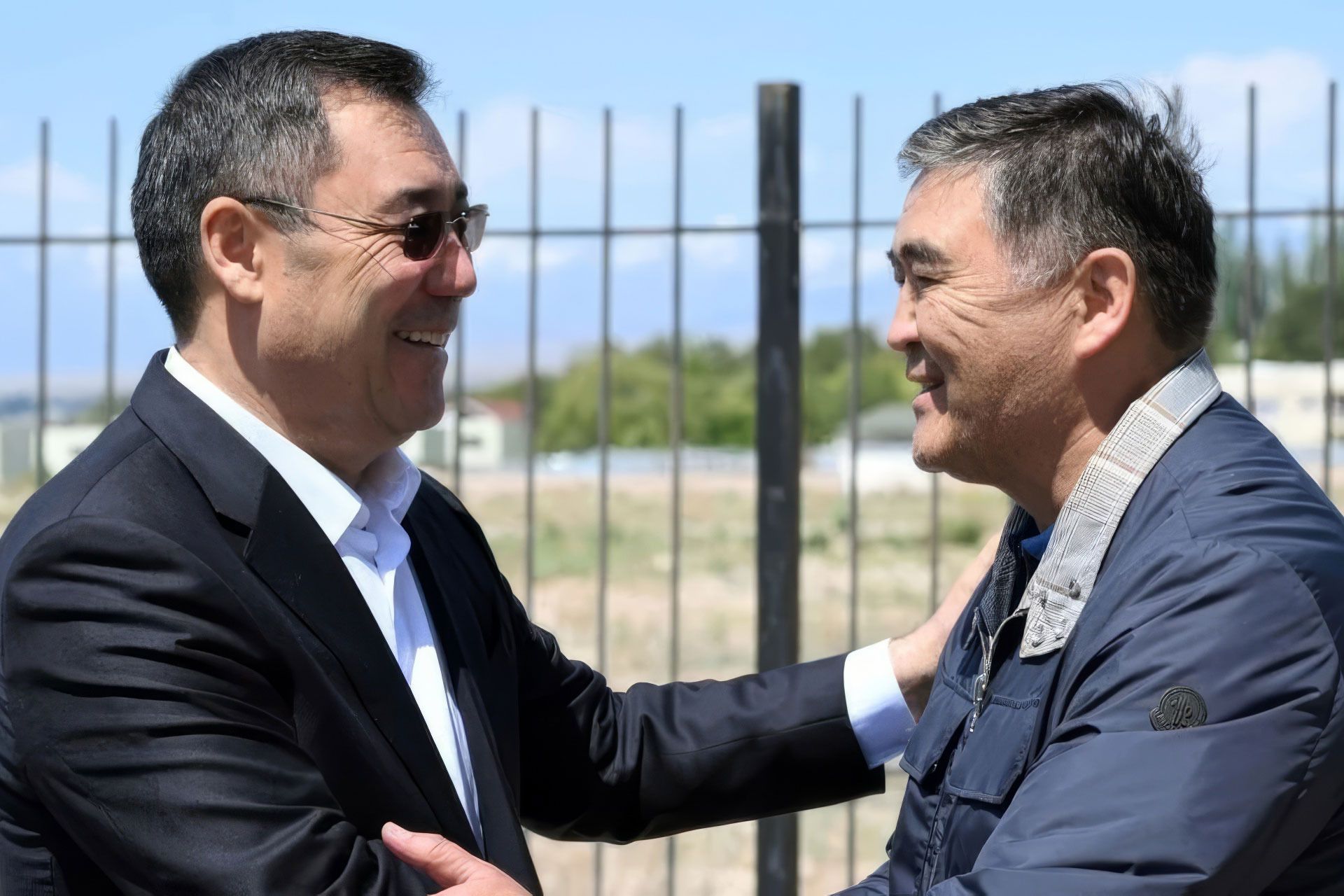
Issyk-Kul, June 2023. President of Kyrgyzstan Sadyr Japarov (left) and chairman of the State Committee for National Security Kamchybek Tashiev. Source: Telegram channel “24KG Kyrgyzstan News”
The ongoing purges and arrests of people linked to Tashiev have sparked fears: will he himself be arrested? So far, the former head of the GKNB has returned home after surgery in Germany and even met with the president. “Rest, my friend, take care of your health, be at ease,” Japarov recounted their conversation, clarifying that he does not intend to bring Tashiev back into public service. Aside from expressing confusion about his resignation the day after the president’s decision, Tashiev has not commented further on his removal. Moreover, a few days after returning, he again left the country—reportedly temporarily.
Japarov has also said that Tashiev neither before nor after his departure met with the authors of the Letter of 75—activists, public figures, and former officials who signed an appeal to the president in early February. The letter stated that although the president was elected under the old constitution, which set a six-year term, he is now serving under the new one, which limits the term to five years. If so, the president’s term has expired, and the authors proposed holding early elections to avoid legal ambiguity.
On the face of it, this seemed a legitimate citizen appeal. At first, the president himself reacted calmly—asking the Constitutional Court for clarification. However, it was right after this that Tashiev resigned, and the authors of the letter were arrested or at best summoned for questioning. Authorities unexpectedly claimed that the activists were trying to destabilize the country, using Tashiev’s name—who, according to officials, might not have even known his name was being used.
The dismissal of the GKNB head was followed by the resignations of three of his deputies and regional department heads. At the same time, law enforcement agencies were restructured: the border service was separated from the GKNB and made a standalone agency, and a new presidential security service was created, reporting directly to Japarov. The new head of the GKNB is Jumgalbek Shabdanbekov, the president’s former personal bodyguard chief.
The purges also reached the government: ministers of emergencies, natural resources, and transport—all linked to Tashiev—were dismissed. Parliament was not spared. The speaker’s post was vacated by Nurlanbek Turgunbek uulu, considered close to Tashiev. The former GKNB chief’s brother, Shairbek Tashiev, who won the most votes in the last elections, may also give up his parliamentary mandate. Meanwhile, no politician or security official who kept their post has publicly defended Tashiev—a clear sign of how quickly the balance of power has shifted.
“The People’s General”
In the Japarov-Tashiev tandem that came to power in 2021, Tashiev was the more prominent figure. According to polls, his support grew—from 14% in 2022 to 22% in 2024, while trust in President Sadyr Japarov hovered around 35–37%.
Tashiev’s growing popularity was due to his activities beyond the GKNB. He intervened in social and economic issues, helped large families and the needy, got involved in the work of parliament and the courts, redirecting resources from other state institutions to the GKNB. He controlled several media outlets through which he cultivated his image as a tough but “fair” enforcer and defender of ordinary citizens.
He also gained points for his anti-corruption campaign. Constant inspections of businesspeople suspected of tax evasion or illicit enrichment, public arrests and interrogations, reports of funds returned to the treasury—for years as head of the GKNB, he returned 300 billion soms ($3.4 billion) to the state. This created the image of a fighter against lawlessness, even though not a single businessman or official actually went to jail—after compensating for what was stolen, they were released.
While Tashiev focused on domestic affairs, Japarov handled foreign policy, lawmaking, international contacts, and institutional reforms, maintaining a more restrained image.
For a long time, the president tolerated the fact that Tashiev’s popularity eclipsed his own. But the “People’s General”—as Tashiev was called—took on the dirty work.
In five years, all significant opponents of the regime ended up in prison or abroad, including supporters of former presidents and civil activists. Tashiev also personally ordered the elimination of influential crime boss Kamchi Kolbaev, known as Kolya-Kyrgyz—allowing the president to stay out of the high-profile killing, although since 2011 there had been rumors of a close relationship between Japarov and Kolbaev.
There were contradictions in the tandem as well. Tashiev’s hardline nationalist rhetoric regularly complicated diplomacy: during territorial disputes with Uzbekistan and Tajikistan, his statements repeatedly threatened negotiations led by the president. On another occasion, during a winter energy shortage, Tashiev demanded cutting power to cafes and restaurants after 10 p.m.—Japarov publicly objected, saying “you can’t go too far.” Yet whenever disagreements spilled into the open, the two would appear together, showing a united front.
Still, their alliance was always pragmatic—dating back to the 2000s, when both served in parliament representing the nationalist Ata-Jurt party. Even then, they skillfully divided roles: the sharp and impulsive Tashiev pushed forward the calmer and more publicly appealing Japarov. October 2020 became a springboard for both: protests after parliamentary elections brought them to the top—Japarov became president, Tashiev took over the GKNB.
However, from the start, their tandem contained risks: Japarov’s legitimacy rested on popular elections, while Tashiev’s influence depended on control of the security apparatus and his personal alliance with the president.
According to unofficial sources, the friends agreed to alternate the presidency: the first term for Japarov, the next for Tashiev.
After Tashiev’s resignation, Japarov publicly denied any such agreements. “Kyrgyzstan is a democratic country. Who will govern the state is decided not by a handful of people, but by the people of Kyrgyzstan,” he declared.
Business Redistribution
The purges apparently won't stop at the security bloc—the next target is likely business linked to Tashiev. Over years of joint rule, major assets and financial flows in the country were divided up between the president’s and GKNB head’s circles. Officially, neither owned large businesses—assets were registered to relatives and trusted associates. Japarov’s circle was linked to construction companies, mining projects, and trade-logistics businesses. Tashiev was associated with the fuel business in the south: oil depots, petroleum supply in Jalal-Abad region, and infrastructure projects in Bishkek.
There was also outright business expropriation: assets of major entrepreneurs were forcibly transferred to state control. Factories, plants, land plots, and apartments were targeted. Officially, this was called the return of stolen property, but in many cases the assets ended up with people close to Tashiev or Japarov.
Now Tashiev’s weakening will almost inevitably trigger a new redistribution. The only question is scale: will the review be limited to the immediate circle of the ex-GKNB head, or will it affect the interests of major financial players aligned with Tashiev?
Notably, Japarov long avoided open conflict with Tashiev—regularly publishing joint photos and pretending not to notice his antics: neither business crackdowns, nor criticism of MPs, nor violence toward subordinates. Nevertheless, a break became inevitable, apparently due to several factors.
The main one is the upcoming presidential election. The Constitutional Court ruled that Japarov’s six-year term ends early next year. If he hadn’t gotten rid of Tashiev now, Tashiev could have run in the election—and as a political strategist and campaigner, the general is quite skilled. All his recent activity is hard to interpret as anything but a campaign buildup—though Tashiev himself denied presidential ambitions.
Tashiev’s health also played a role: a heart condition limits his ability for active political struggle. The sudden resignation caught the elites off guard. Facing the threat of losing everything, most chose to side with the president. For now, this consolidation is held together by fear, but Japarov apparently hopes to gradually strengthen his position. The president also benefited from having increased his supporters’ presence in the last parliamentary elections.
The external environment is also favorable for now. Relations with Central Asian neighbors are stable, and it’s unlikely anyone will want to interfere in Kyrgyzstan’s internal affairs. Japarov is also comfortable for Moscow. Since 2022, Kyrgyzstan has become a key hub for gray imports to Russia, and the president regularly criticizes the West for double standards in trade with Russia—a line that suits the Kremlin. Tashiev, by contrast, was increasingly irritating Moscow—especially after employees of Rossotrudnichestvo were detained in April 2024 for recruiting Kyrgyz nationals to fight in Ukraine.
Meanwhile, there are no guarantees for the stability of the new setup. It’s still unclear whether Japarov can single-handedly build an equally effective system—he lacks Tashiev’s managerial grip.
The question of Tashiev himself also remains open. Has he accepted his resignation, or will a man used to being at the center of events eventually step out of the shadows? Even staying out of the spotlight, he could become a rallying point for the discontented—and their numbers will grow as the redistribution of property and spheres of influence affects more people, especially with presidential elections on the horizon. Tashiev knows how to organize such people.
Moreover, in the public mind Tashiev is seen as someone who did everything for his friend—who then betrayed him, and at the very moment the general was in the hospital. Japarov, it seems, will do everything to keep Tashiev from returning to public politics. But the fear of his possible comeback will weigh on the president—and push him toward ever tougher decisions. But going too far with toughness in Kyrgyzstan is risky: there are plenty of examples in the country’s history of attempts to monopolize power ending in collapse.
If you enjoyed this article, consider making a donation — one-time or, even better, monthly. Your support helps us motivate our authors and become better with every article.
Our organization is recognized by the Internal Revenue Service (IRS) as a 501(c)(3) tax-exempt, charitable organization, which means that all contributions made to us are tax-deductible to the fullest extent permitted by U.S. law. Individuals may generally deduct charitable contributions of up to 60% of their Adjusted Gross Income (AGI) for cash donations made to qualifying 501(c)(3) organizations. For donations of appreciated assets (such as stocks or other long-term capital assets), the deduction is typically limited to 30% of AGI, based on the fair market value of the asset. C-corporations may deduct charitable contributions of up to 10% of their taxable income for donations made to eligible charitable organizations.
By submitting a donation, you confirm that you have read and accept the following documents: Privacy Policy and User Agreement, and also give consent to the processing of your personal data.
If you would like to unsubscribe from a monthly donation, please email us at: [email protected]