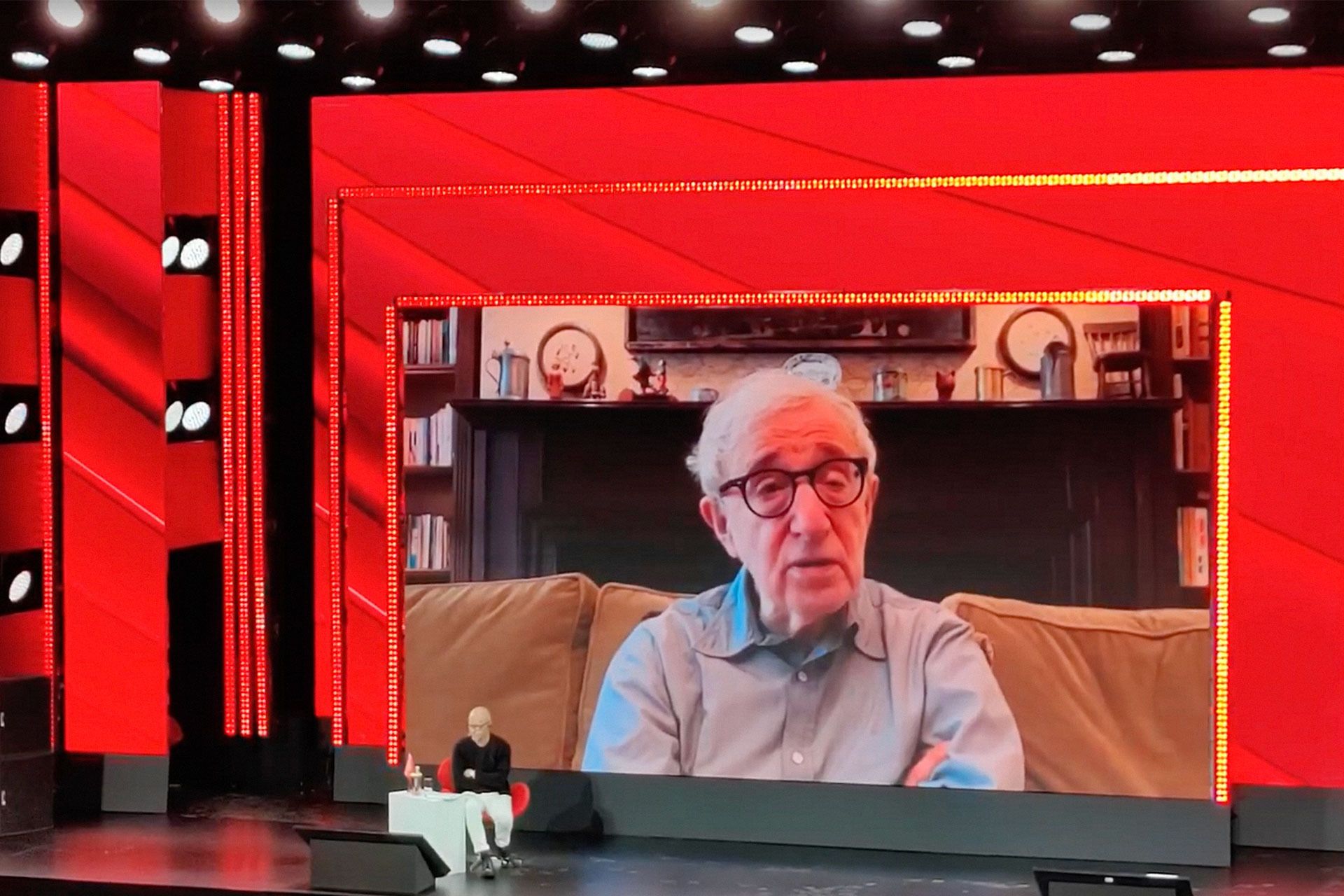
The Woody Allen case, who participated online in a certain Moscow film week and gave a video interview to Fyodor Bondarchuk, once again raised the question of moral and immoral behavior during a military and humanitarian catastrophe, about detachment from events and involvement in them, about toxicity—or, on the contrary, the necessity of cultural and interpersonal contacts.
Woody Allen and Fyodor Bondarchuk at the Moscow International Film Week, August 2025. Frame from video: YouTube
It’s unlikely that the very elderly director, located thousands of kilometers from the epicenter of events, understood that he was not communicating with an ordinary Russian filmmaker, but with one of the key “meaning-makers” of the Putin regime. After all, as Allen himself said, he likes Bondarchuk’s work, albeit the elder one: the cinematic epic “War and Peace.” Why not, in this logic, talk to the offspring of a respected family? And surely the creator of “Annie Hall” and “Match Point” did not suspect he was being used in someone else’s game—to improve relations between Putin and Trump, to break through the international isolation of the Russian autocrat.
A certain coordination of actions by Russian political technologists was evident in a surprising event: on one of the Russian TV channels, where all foreign and any somewhat meaningful domestic content has been purged except for very third-rate forgotten detective shows, Woody Allen’s “Midnight in Paris” was suddenly aired. It’s like suddenly including exquisitely served foie gras or a Pavlova dessert in a soldier’s or prisoner’s ration. It turns out this was not a random incident caused by oversight, but an active operation integrated into the larger “deal” project between Putin and Trump, with Bondarchuk’s incidental involvement.
So—defending Woody Allen: he couldn’t have guessed these political technology maneuvers. Although, arguably, should he have? That’s the question…
Of course, the director could have refused the conversation simply on a geographical-political basis—he was interviewed from Russia. But here, judging by the director’s subsequent self-justification, he had his own logic: breaking cultural, that is, human ties hardly helps resolve conflicts. In a way, Allen helped the Russian audience form a sense of normality in life despite its unpleasant military backdrop. And that is exactly what people in the very same Moscow need, which has already distanced itself from what is happening in the world and in the country.
By the way, about nothing
The unwillingness to engage in thoughts about what is happening is a psychological defense mechanism, but obviously, it’s not a good thing. Simply the fact of such a dialogue with an outstanding director, one of the symbols of Western civilization, emphasized the fundamental desire of this audience that refuses to think and wants to be entertained for peace and a normal life. The urban Moscow audience in their thoughts, desires, and lifestyle is no different from a similar audience in New York, Paris, Venice; they sincerely want to return to some time before February 2022. Probably, Allen took this into account when agreeing to talk about cinema.
Nevertheless, there is another argument against. Umberto Eco once expressed the idea that a public intellectual, especially of global scale, acts as a socially significant figure, not just as a writer, artist, musician, or filmmaker. Therefore, he must understand the measure of responsibility.
But there is the same simple answer from Allen: destroying bridges between people is not the best way to resist madness.
Can Woody Allen support Putin? Of course not. Can he not grieve over the terrible slaughter? Certainly, with all his life experience and creativity, he opposes barbarism. He is for people and about people. Death appears from time to time in his plots, but it can be tricked and outplayed in chess. His death is more bungling than frightening. “Analyzing Woody,” one can find the same thing we have always found in him: a city intellectual-neurotic in a tweed jacket and corduroy trousers. At nearly 90 years old, as he wrote in his autobiographical book “A Propos of Nothing,” he’s still “a little boy who loves movies, women, sports, hates school, and has a fondness for dry martinis.”
Woody Allen doesn’t need to adapt to a monstrous political regime or be a collaborator: he lived his life in America, not the USSR or China. True, he lived to see Trump. But even about people like the 47th U.S. president, Allen said long before everything happened: “Your father supports the right wing of the Republicans, and I think they’re crazy psychopaths, but that doesn’t mean we don’t respect each other, right?” Or: “At one time I dated a woman from the Eisenhower administration. I found it funny that I was trying to do with her what Eisenhower did to the country for the past eight years.” Or: “She’s magnificent. It’s hard to believe a Republican can be so sexy.” His irony destroyed autocrats retrospectively but remains quite relevant today: “I can’t listen to Wagner for long. I get an irresistible urge to attack Poland.”
The Wind from Manhattan
Allen apparently did not joke about Putin. But likely the Russian autocrat is very distant from him, outside the interests of a New Yorker. For Woody Allen, as became clear after his relatively old interview with Ekaterina Kotrikadze in early 2021, Russia is Moscow and Petersburg, Tolstoy and Dostoevsky. And he hardly thinks these two writers bear some responsibility for the mental aberration that led to the special military operation and the learned indifference of the majority of the nation.
Did Allen legitimize Putin’s Russia by talking with Bondarchuk? It seems not. Probably neither did those in Moscow who gathered to listen to him in search of normalcy in everyday life. In this, a significant part of the audience was like Allen—they never thought that Bondarchuk, the conversation itself, or the film week had anything to do with the background “special operation” with barely visible subtitles. This is the moral problem. But it is also reality.
Allen has a controversial reputation due to sexual scandals. Sometimes a few gems in his work are accompanied by a lot of rubbish. But even in forced jokes and worst films, there is a recognizable and beloved intonation. And this forcedness and shoddiness can be forgiven—for that very intonation. In his films, everything is recognizable, like in a cozy home where jazz plays and there is absolutely no place for horrors and “high” ideas that lead to those horrors. And the worst rumors about Woody are hard to believe.
Allen made a faux pas, undoubtedly. Nevertheless, people love and hate him not for that.
In a way, he broke through the iron curtain, but on his own behalf, not on Bondarchuk’s, who serves the possible “big deal” between Putin and Trump. He, of course, addressed people and didn’t think he was talking to a political regime.
Allen’s appearance on the big screen during the video call is not a victory for Putin nor help for Trump. On the contrary, the incredible efforts of the cumbersome state machine aimed at isolating the country were suddenly interrupted for a while. And it turns out that for the service of the Putin regime, it is terribly important to pretend they are recognized by one of the most significant Western authorities in art worldwide.
It turns out that the West still means a great deal to the Kremlin, and Russia, even Putin’s Russia, is obsequiously seeking contact and approval—not from the East, but from Manhattan.
Thus, the regime reveals itself completely—it is Americocentric, measuring its greatness and power through conflict with America and simultaneously through friendship with it. Again and again it cites Moscow and Petersburg, Tolstoy and Dostoevsky as justification. Here’s what else can be discovered in this story if one puts the authors of the mise-en-scène with Allen on a psychoanalyst’s couch: complexes, the inescapable Russian complexes…
What, after all, does this regime want—self-isolation or recognition by the West? To control art like Stalin, but receive recognition from Woody Allen? The answer is yes, it wants both.
Everything is very complicated in this mysterious Russian soul. As Woody Allen said: “I can’t stand Russian plays. Nothing happens, but they charge like it’s a musical.”
If you enjoyed this article, consider making a donation — one-time or, even better, monthly. Your support helps us motivate our authors and become better with every article.
Our organization is recognized by the Internal Revenue Service (IRS) as a 501(c)(3) tax-exempt, charitable organization, which means that all contributions made to us are tax-deductible to the fullest extent permitted by U.S. law. Individuals may generally deduct charitable contributions of up to 60% of their Adjusted Gross Income (AGI) for cash donations made to qualifying 501(c)(3) organizations. For donations of appreciated assets (such as stocks or other long-term capital assets), the deduction is typically limited to 30% of AGI, based on the fair market value of the asset. C-corporations may deduct charitable contributions of up to 10% of their taxable income for donations made to eligible charitable organizations.
By submitting a donation, you confirm that you have read and accept the following documents: Privacy Policy and User Agreement, and also give consent to the processing of your personal data.
If you would like to unsubscribe from a monthly donation, please email us at: [email protected]