The Malian military junta is losing control of the situation in the country. This does not mean its rapid or inevitable fall, but the fragmentation of Mali into zones of influence controlled by various groups—where no laws apply—has already taken place. And it seems that Russian military presence has failed to prevent this disintegration.
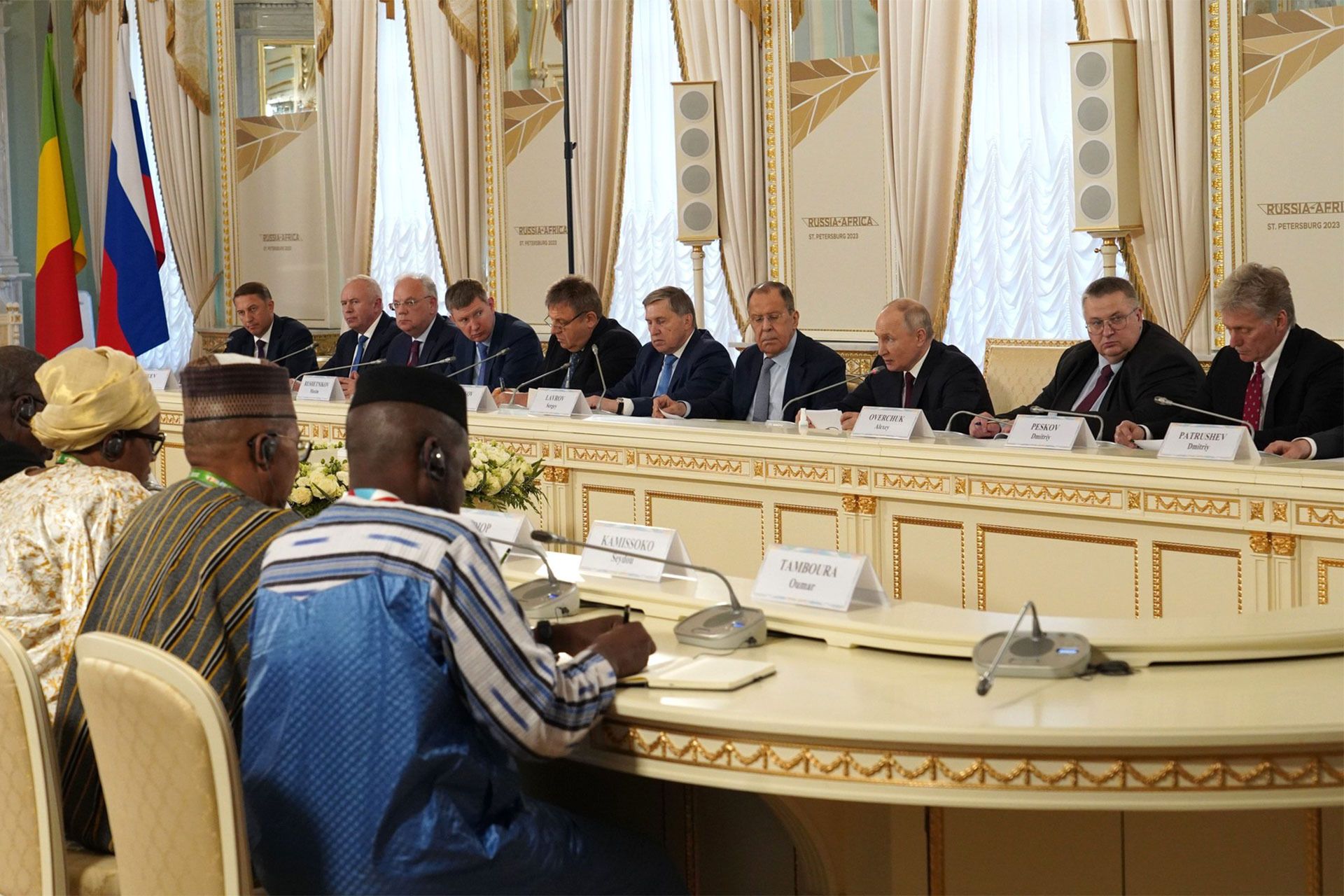
Meeting between Vladimir Putin and Mali’s transitional president Assimi Goïta. Photo: kremlin.ru
At the end of April, reports emerged from Mali about successful attacks by anti-government forces on positions held by the Malian army and units of the Russian Ministry of Defense’s Africa Corps. It is important to note that any information from this region should be treated with skepticism. There are no conditions for independent journalists or fact-checkers to work on the ground, so understanding what is really happening is only possible through news from conflict participants—while keeping in mind their obvious bias. Nevertheless, comparing different sources makes it possible to highlight several key details of the events with a high degree of probability.
First, the attack was organized jointly by two different rebel forces, something that had never happened before. We are talking about radical Islamists from the JNIM group, who have declared allegiance to al-Qaeda, and separatists from the FLA (Azawad Liberation Front), who seek to create an independent state in northern Mali, in the historical Tuareg lands. These movements had previously been at odds, but this time they united to oppose a common enemy: the Malian military junta, which is directly supported by Russia.
The very fact that this alliance has formed is bad news for both Bamako and Moscow.
Second, the takeover of Kidal—a city in northeastern Mali—by anti-government forces can be considered a fait accompli, confirmed by footage of Russian troops leaving the city and by statements from the Russian Ministry of Defense. Kidal has important symbolic and strategic significance for the rebels. It is potentially the capital of independent Azawad, a new self-proclaimed Tuareg state, if it ever comes to be. Kidal has always been the main center of separatism—the heart of the struggle for Mali’s territorial integrity. When in 2023 the Malian army took Kidal with the help of Russian Wagner Group mercenaries (later reorganized into the Russian Ministry of Defense’s Africa Corps), it could be seen as an unquestionable success for Bamako’s military junta and its bet on cooperation with Russia. Now, it looks like an equally clear defeat.
Third, anti-government forces launched coordinated attacks in various parts of Mali. At the same time as the Kidal assault, there were reports of an attack on Kati, a suburb of Bamako where military junta leaders lived, believing themselves safe. As a result of this attack (apparently a suicide bombing), Malian Defense Minister Sadio Camara—one of the regime’s key figures and architect of military cooperation with Russia—was killed. The distance between Kati and Kidal is over 1,500 kilometers.
Taking into account reports of other successful rebel actions in different parts of Mali, this appears to be a well-prepared and large-scale operation, quite different from previous isolated attacks.
These and many other signs indicate that the Malian military junta is losing control over the country. This does not mean its quick or inevitable collapse. It is clear that the rebels are not yet able to threaten the capital Bamako, with its population of over 3 million, since residents are not inclined to welcome either Islamists or separatists. Carrying out successful attacks is not the same as being ready to govern the country or even the capital. But the fragmentation of Mali into zones controlled by various groups—where no laws apply—has already happened. And Russian military presence seems to have failed to prevent this disintegration.
What Russia Is Doing There
The destabilization of Mali began in January 2013, when armed groups of radical Islamists attacked the capital, Bamako. The Malian government officially requested French assistance. Paris received UN Security Council authorization for military intervention, which it successfully carried out in Operation Serval. Within weeks, special forces based in Niger and Chad defeated jihadist units and liberated all major towns in northern Mali.
Later, in August 2014, France replaced the purely military Operation Serval with a more complex and multilateral initiative called Barkhane, which involved all Sahel countries in the fight against radical Islam. The strategic goal of Operation Barkhane was to unite regional efforts so that, over time, they could ensure the region’s security themselves, with limited French support. Unfortunately, this plan failed.
As Mali’s internal crisis worsened, there were two consecutive military coups in 2020 and 2021. Power was seized by a military junta led by Colonel Assimi Goïta, who promised peace and order. The new regime, using anti-French rhetoric and blaming the former colonial power for inefficiency and neocolonialism, saw its solution in rejecting French help in favor of an alliance with Russia.
These years marked the peak of Wagner Group’s international activity, mainly in Africa, so it’s no surprise that events in Mali did not escape Moscow’s attention. Russian authorities were confident that Yevgeny Prigozhin had found an effective way to expand influence on the continent, partly repeating Soviet methods: ensuring the security of ruling regimes (always unstable and corrupt) in exchange for political loyalty and economic projects.
Prigozhin’s downfall in 2023 did not end this approach but led to organizational changes: private military companies became suspect to the Kremlin, and the baton was passed to the Russian Ministry of Defense, which created the Africa Corps.
The withdrawal of France from Mali and the arrival of Russian forces were seen in Moscow as a small victory over a weakened West in the hybrid war.
Mali’s junta leader Colonel Assimi Goïta was an honored guest at the Second Russia-Africa Summit in July 2023 in St. Petersburg, and Vladimir Putin even invited him on a boat trip on the Neva River with four other selected African leaders.
It is remarkable that the Russian president, who constantly speaks of the “illegitimacy” of the 2014 Kyiv revolution (despite two rounds of subsequent presidential elections recognized worldwide), warmly welcomed the self-proclaimed president of Mali, whose authority is not even recognized by most African countries.
The Legitimacy Problem
The military coup in Mali, which promised peace and order, actually triggered further fragmentation of the country, if not its outright collapse. The ambitious officers who came to power clearly relied mainly on force. While they promised elections, they gave little importance to electoral procedures, especially since Mali’s history is hardly a model of democracy. One might think that, faced with painful sanctions from neighboring countries in the ECOWAS regional bloc, as well as from the African Union, the military junta might have realized the many negative consequences of abandoning the constitution. But there was no way back. Organizing elections—even fake ones—would have required at least some degree of consent from part of the opposition.
However, neither the coup leaders nor Russian political strategists were willing to try to give the regime an appearance of legitimacy. Relying on the logic of a military takeover, they considered establishing a dictatorship sufficient, but underestimated the power of resistance.
It is obvious that the legitimacy of Colonel Goïta was the least of Moscow’s concerns. But the problem is that, even agreeing on this point, both sides likely had different ideas about what cooperation meant. If Mali expected Russia to deliver a crushing blow to Islamists and separatists, Moscow’s ambitions went no further than maintaining a few safe zones—while, presumably, making sure to benefit financially.
Meanwhile, Mali is twice the size of any major European country, such as France or Ukraine. Clearly, restoring unity to such a large country would require many resources, not just military but also political. Negotiations about broad autonomy might have been possible with the Tuaregs, who declared independence—but not with an illegitimate junta.
Colonel Assimi Goïta did not address the nation immediately after the series of rebel attacks, and the death of his key minister Sadio Camara was only briefly mentioned on official television. A few days later, the Malian government published a photo from a meeting where the junta leader discussed current events with the Russian ambassador to Mali and Russian military officers.
It is unlikely that such messages can inspire the country’s population, which suffers from economic decline, the paralysis of basic state institutions, and the constant threat of armed groups with unclear demands. The Russian military presence has not improved the situation.
The Prospects for Mali
There are two possible scenarios for future developments, but neither bodes well for Russia’s presence in Mali.
The first scenario is the ongoing long-term fragmentation of the country, where different parts are stably controlled by various armed groups. Most of them do not share the regime’s sympathy for Russia. For now, Russian troops can, of course, guard the government quarter in Bamako, but such work is almost pointless. Either they must fight the rebels or withdraw. Meanwhile, according to rumors, the retreat from Kidal happened after a deal between Russian forces and the attackers, without Malian army involvement.
The second scenario involves creating a new coalition capable of preserving Mali’s unity. The problem is that, in the current situation, it would inevitably have to include Islamists, leading to the disappearance of the (still) secular state in favor of a more or less radical version of a caliphate. Such a development is unlikely to be compatible with Russian military presence.
Moscow hoped to establish a friendly bloc of countries in the heart of Africa to expand its influence and continue its hybrid war with the West. But the deep internal crisis in Mali, as well as in neighboring Burkina Faso and Niger, cannot be overcome by limited military interventions—especially when accompanied by hopes of making money on the side. Russia is falling into the same trap as in Syria, even if the comparison is imperfect. An illegitimate regime relying on an unreliable army and ambiguous Russian support, as practice shows, cannot withstand pressure from Islamists and separatists, nor can it negotiate with them. Of course, Moscow has many other concerns now, and its rapid loss of influence in Mali will not be a top worry in the Kremlin. But it is unlikely to teach them anything, either.
If you enjoyed this article, consider making a donation — one-time or, even better, monthly. Your support helps us motivate our authors and become better with every article.
Our organization is recognized by the Internal Revenue Service (IRS) as a 501(c)(3) tax-exempt, charitable organization, which means that all contributions made to us are tax-deductible to the fullest extent permitted by U.S. law. Individuals may generally deduct charitable contributions of up to 60% of their Adjusted Gross Income (AGI) for cash donations made to qualifying 501(c)(3) organizations. For donations of appreciated assets (such as stocks or other long-term capital assets), the deduction is typically limited to 30% of AGI, based on the fair market value of the asset. C-corporations may deduct charitable contributions of up to 10% of their taxable income for donations made to eligible charitable organizations.
By submitting a donation, you confirm that you have read and accept the following documents: Privacy Policy and User Agreement, and also give consent to the processing of your personal data.
If you would like to unsubscribe from a monthly donation, please email us at: [email protected]