Continuation of hybrid warfare, direct invasion, or a deterrent strike: we examine three of the most realistic scenarios.
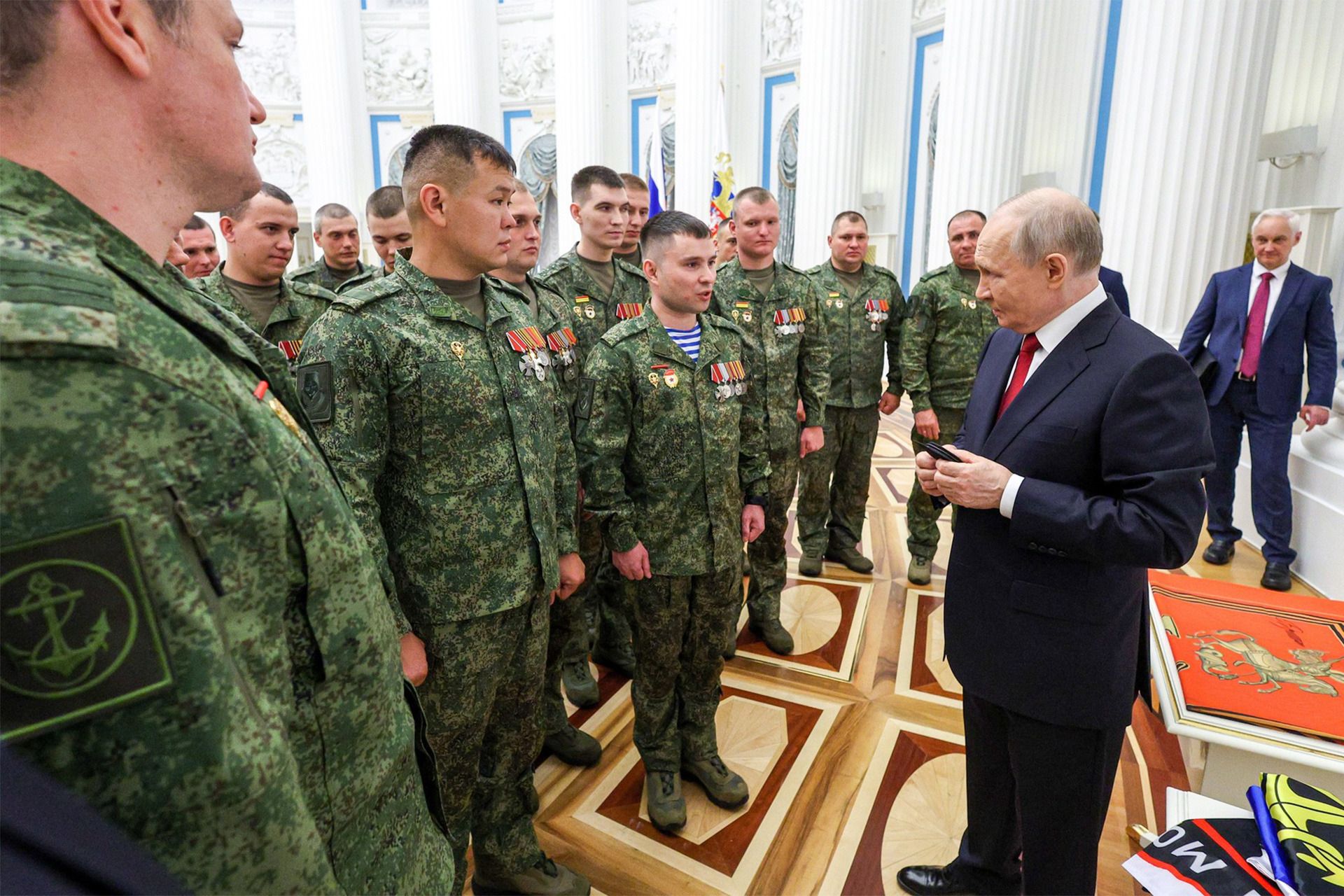
Vladimir Putin meets with servicemen participating in the special military operation. Moscow, Kremlin, June 12, 2026. Photo: kremlin.ru
Threats from Moscow against Western countries and, in particular, the NATO bloc began immediately in the first days after the Russian invasion of Ukraine and have never ceased. Both President Putin and the most hawkish ministers or deputies, as well as propagandists in his service, never tired of publicly reminding everyone of the devastating power of Russian missiles, of their flight time to European capitals, while thoughtfully speculating about the consequences of using nuclear weapons, as if this were just a possible next move, one of many others. Of course, in the West these statements were always understood as an element of blackmail aimed at weakening support for Ukraine at war and sowing division among its allies.
At the same time, the very fact of open Russian aggression against a neighboring state moved the discussion of a possible Russian attack on another neighboring state from the realm of the speculative into the realm of the entirely relevant. Clearly, the Baltic states, because of their geographic position and historical fate, looked like the most likely target. At the same time, they had wisely managed to join NATO, unlike Ukraine, and the main question was how quickly and effectively the allies in NATO would be ready to come to their aid.
Over the more than four years since then, much has changed on the front line in Ukraine. Trench warfare has turned into drone warfare, comparisons with the First World War have been forgotten, and the confrontation between the two armies is taking place, to a significant extent, in the realm of technological solutions, where Ukraine’s position today looks, at the very least, no weaker. All these circumstances allow us to take a new look at Russian threats to NATO, especially the Baltic states, in order to assess their capacity for resistance and the presumed reaction of NATO allies if Moscow decides to move from words to deeds.
Below, an attempt will be made to consider some possible scenarios, but first two important assumptions must be made.
The first assumption concerns the position of the United States. It is known that previous American administrations gradually reduced their attention to Europe in favor of the complex of relations with China and affairs in the Middle East. But President Trump’s contribution to this shift is unmatched. He constantly criticizes European allies and is never satisfied with them. It is obvious that in Trump’s continuous stream of statements there is not always any meaning, and a US withdrawal from NATO appears, for many reasons, problematic and unlikely. Nevertheless, contradictions within the Alliance are objectively increasing, which is unlikely to inspire confidence among the residents of Tallinn or Riga.
Based on the above, it can be assumed that
in the event of Russian aggression in Eastern Europe against one of the NATO countries, the United States will make every effort to avoid the participation of American soldiers in combat and will try to shift all responsibility onto the Europeans. At the same time, they will provide support in the areas of communications, intelligence, and logistics — roughly the same way they do in Ukraine and perhaps even more.
Washington will seriously warn Moscow through diplomatic channels about the consequences of a strike on American bases in Europe and the deaths of American citizens. Otherwise, Europeans will have to rely on themselves.
The second assumption is the hypothesis that Ukraine will hold out and Putin’s plans to subjugate it will not come to pass. Russian troops will not reach the borders of Poland and Romania. At the same time, it is hard to say how Moscow might reconcile the desire to test the Baltic states with the situation on the Ukrainian front: does the Kremlin believe that concluding a ceasefire with Kyiv is necessary before a new campaign can begin, or, on the contrary, does it proceed from the assumption that the more chaos is sown in the West, the better. In any case, in considering the scenarios, the existence of an independent Ukraine, with its experience of years of war using the latest technologies, is an essential part of the initial data.
It is obvious that the reaction of NATO countries to a hypothetical new act of Russian aggression in the Baltic direction will depend on the form in which Moscow carries it out. At the same time, the Kremlin’s motivation is irrelevant — it does not really matter why the decision to attack is made. Three main likely courses of action can be identified: hybrid warfare, direct invasion, and a deterrent strike.
Hybrid Warfare
In essence, it has been going on for a long time, and various episodes of it from the recent past, from the influx of migrants from Russian or Belarusian territory to the discovery of severed cables in the Baltic Sea, were easily read as the Kremlin’s plan to destabilize Europe by organizing low-cost sabotage. Cyberattacks were a separate and serious threat. In some cases Moscow’s hand was beyond doubt; in others its trace could only be guessed at — but there were never any loud responses from the affected states, and even less any kind of collective NATO reaction. This is not surprising: hybrid wars fall, to a large extent, within the competence of intelligence services, which like to organize asymmetric responses through others’ hands and rarely speak publicly about their activities. One can assume, for example, that the Ukrainian drone attack on the Baltic Fleet in Kronstadt, which is not a priority target for Kyiv, may have been a favor rendered to some NATO countries. In any case, all of this is, of course, speculation.
Does Moscow have the means to increase the intensity and sensitivity of its pinpricks within the framework of hybrid warfare? To some extent, probably yes. Unidentified drones may more often disturb the airspace of neighboring countries, and cyberattacks may become more frequent and more visible. Nevertheless, at this level there is no need to sound the alarm across NATO, and that is precisely the calm we have observed in recent years. Russian provocations draw a response in the form of a protest note, and we know nothing reliable about other reactions.
At the same time, there is a direction of hybrid warfare that Moscow has not yet fully used, although it alludes to it with its law on protecting Russian citizens from persecution abroad and complaints against the Baltic states over the status of Russian-speaking populations.
This refers to an attempt to create some rebellious self-proclaimed entities in Narva or Daugavpils, analogous to Donetsk and Luhansk. The likelihood of such a choice for the Kremlin appears low.
The residents of territories bordering Russia, whatever their (real or imagined) sympathy for Moscow, are unlikely to see the experience of Donbas separatism as an attractive example. However offended they may be by the oppression of their governments (real or imagined), they understand that they would lose more than they would gain from the adventure of rebellion.
The Kremlin can count, at best, on a few marginal elements, but the governments of Estonia and Latvia will most likely handle them on their own through police methods.
Thus, the option of hybrid warfare does not disappear from the agenda, but it remains a peripheral area of activity for the intelligence services and does not require a NATO response. Clearly, there will be no missile strikes on Moscow in response to a drone that flew somewhere off course. In the framework of hybrid warfare alone, there will be no need to fight for Narva.
Direct Invasion
A Russian attack on one or several Baltic states can be imagined as:
a) a massive drone and/or missile attack on certain military targets that Moscow, for some reason, will declare legitimate;
b) crossing the border with tanks and artillery in order to occupy as much territory as possible;
c) a combination of these actions.
However, these plans, if they exist, may run into a number of obstacles.
First, the Baltic states are not sitting idly by, but are building fortifications on the border, conducting exercises with Ukraine and NATO allies, and carefully studying Ukrainian experience. It can be assumed that Russian forces will not have an easy walkover.
Second, Moscow is hardly in a position to count on surprise. All NATO intelligence services are closely watching its actions, and the concentration of forces near the western borders will not go unnoticed. This will entail both counter-preparations and warnings through confidential channels containing weighty arguments in favor of abandoning the attack. Of course, until this is confirmed in practice, no one knows the exact price of these words, but it is wrong to think that they mean nothing at all.
Third, NATO military units are already stationed in the Baltic states, albeit in small numbers. The most illustrative example is the deployment in Lithuania of a German brigade of up to 5,000 personnel, which is expected to be completed soon. This is a fully autonomous combat unit capable of fighting on its own, which, according to current regulations, is there to repel aggression within the framework of NATO and EU alliance obligations.
Of course, one can be skeptical about the Lithuanian mission of the German brigade and believe that its soldiers will surrender at the first shots fired by Russian soldiers. In reality, the brigade, equipped with everything necessary, is obliged to enter combat in the event of an enemy attack, and the military command of Germany and NATO is precisely programming its deployment in Lithuania that way.
But that is not all. By rotation, small NATO contingents are stationed in the Baltic states (including, incidentally, American ones), paying special attention to airspace patrols, which after 2014 were supposed, according to the plan, to deter Russia’s aggressive intentions by acting in a sense as a “human shield”. From the standpoint of military confrontation, it is hardly possible to speak of any significant importance of these forces. Meanwhile, in the event that American, British, French, or other NATO soldiers are killed as a result of Russian bombardments, even if it is due to an accident, public opinion in Europe will most likely shift from its current restraint and desire to avoid war at any cost to a demand not to yield to the aggressor.
Even with the United States in an ambiguous position, NATOhas several options for a strong response while still remaining within the framework of conventional action and without provoking escalation.
First, there is the use of the air force of leading European NATO countries, which are capable of suppressing Russian air defenses and inflicting significant damage both on frontline logistics and on oil terminals near St. Petersburg, not to mention other targets. The example of Iran shows us that modern aviation still works well, and the effect of its actions exceeds the results of even the most massive drone attacks.
Second, the Russian enclave in Kaliningrad is extremely vulnerable from a military point of view, and an attempt to occupy Narva could trigger, as an asymmetric response, an invasion by NATO forces from Poland and Lithuania into the Kaliningrad region. The Kremlin is hardly unaware, just in case, of such a possible development of events.
Third, Ukraine’s experiencein creating a kill zone on the front line and destroying nearby logistics with drones will also be used.
How much resolve and political will will European countries have to confront Russia? It can be assumed that the main argument for or against will be the solidarity of EU leaders.
It is one thing if, in defense of the Baltic states, aircraft take to the skies, say, from Sweden alone (which would allow the Kremlin to designate Sweden as the sole main enemy), and quite another when a joint air operation is carried out by the combat aviation of five leading European NATO countries.
If the possible deaths of German soldiers trigger the same reactions in Paris and London as in Berlin, then the forces of the “coalition of the willing” within NATO will be deployed without the permission of the United States and without Portugal’s opinion. We should not forget about Ukraine either: in one form or another, by reopening a “second front” in Donbas or delegating its specialists in “drone warfare” to the Baltic states, Kyiv will not remain on the sidelines of the conflict. If the Kremlin’s advocates of a rational approach to politics still have any influence, they should understand that “Tallinn in three days” is even less achievable than Kyiv was four and a half years ago.
Deterrent Strike
This could involve the use of tactical nuclear weapons (most likely in Ukraine), or a massive conventional missile strike against targets in Europe that are clearly unable to go unanswered. This would mean that all previous rules of deterrence have ceased to work, and Russia has consciously chosen maximum escalation, ignoring warnings not only from NATO countries, but also from China, India, and the entire Global South. Such actions will provoke understanding from no one in the world, with the possible exception of North Korea. This time Russia will find itself in complete and real isolation.
An escalation of this magnitude has no precedent in history, and the course of events cannot be predicted. Nevertheless, two assumptions seem reasonable.
First, Russia will not be able to win the whole game with one strike and so frighten the West that it will be paralyzed and agree to surrender on Moscow’s terms. The leading NATO countries know well and remember that they still have very substantial means of response at any level.
Second, by taking up the challenge, NATO will try to avoid a full-scale nuclear war and observe proportionality in its response. At the same time, all measures of pressure on the Kremlin will be used, including the physical elimination of its most hawkish inhabitants, in an effort to stop the worst-case scenario from unfolding.
At the same time, it must be admitted that the fate of Estonia or Latvia as individual states, if they were suddenly to find themselves at the epicenter of events, could be tragic.
If you enjoyed this article, consider making a donation — one-time or, even better, monthly. Your support helps us motivate our authors and become better with every article.
Our organization is recognized by the Internal Revenue Service (IRS) as a 501(c)(3) tax-exempt, charitable organization, which means that all contributions made to us are tax-deductible to the fullest extent permitted by U.S. law. Individuals may generally deduct charitable contributions of up to 60% of their Adjusted Gross Income (AGI) for cash donations made to qualifying 501(c)(3) organizations. For donations of appreciated assets (such as stocks or other long-term capital assets), the deduction is typically limited to 30% of AGI, based on the fair market value of the asset. C-corporations may deduct charitable contributions of up to 10% of their taxable income for donations made to eligible charitable organizations.
By submitting a donation, you confirm that you have read and accept the following documents: Privacy Policy and User Agreement, and also give consent to the processing of your personal data.
If you would like to unsubscribe from a monthly donation, please email us at: [email protected]