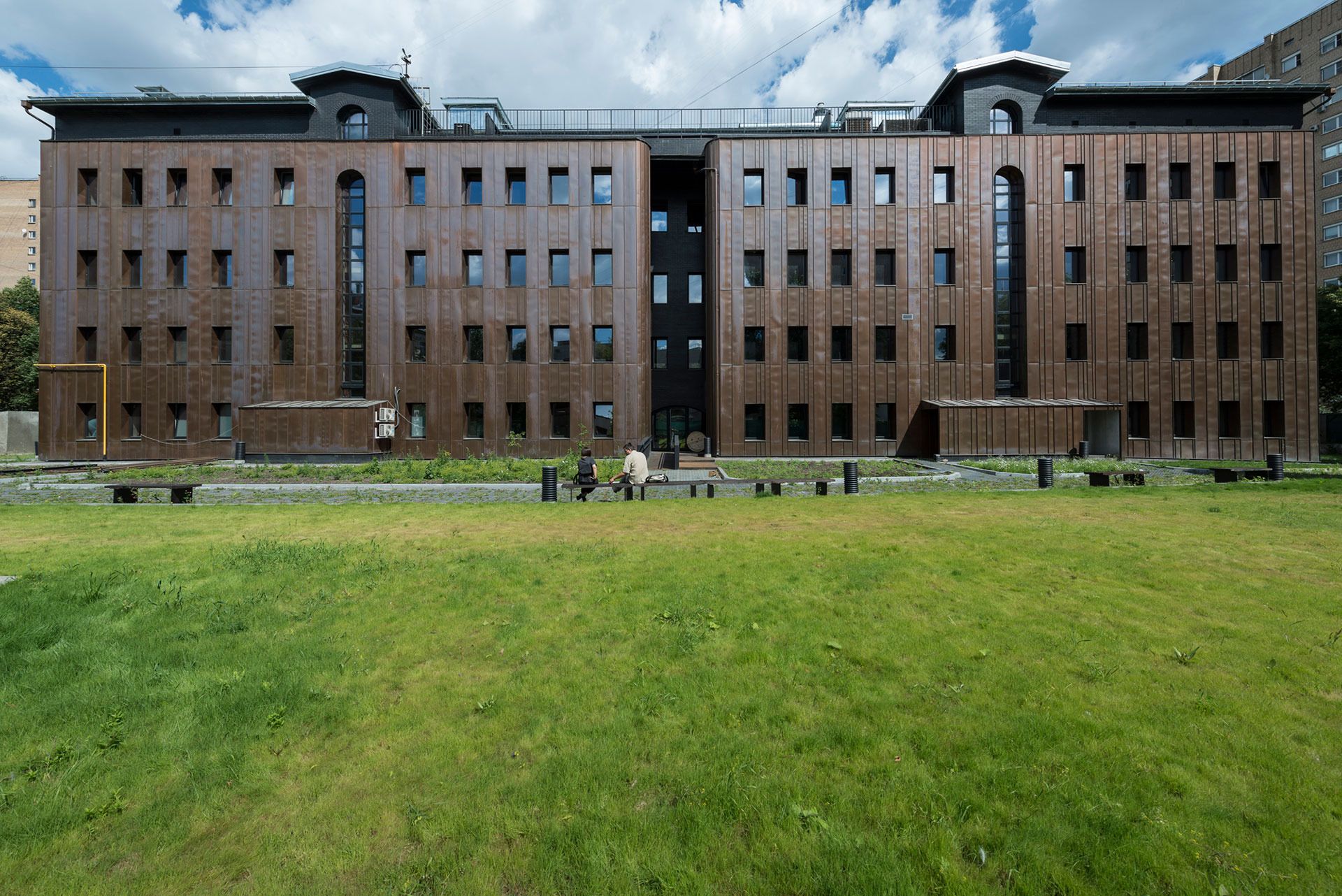
In the place of the closed GULAG Museum in Moscow, a “Museum of the Genocide of the Soviet People” is being created. If we didn't know what a kingdom of crooked mirrors Russia is today, this could even be welcomed — after all, there really was genocide in the USSR. However, it was not at all the kind that the Russian authorities mean today.
Facade of the GULAG History Museum building, 2015. Photo: Wikipedia / Annarapeyko / CC BY-SA 4.0
“A Museum of Memory will open in Moscow. It will be dedicated to the memory of the victims of the genocide of the Soviet people. The exhibition will cover all stages of Nazi war crimes during the Great Patriotic War,” reported Interfax at the end of February, citing the website of the mayor and government of Moscow. That is, the ideological direction of the new museum has been predetermined: the villains who committed crimes against the Soviet people will be exclusively foreign (German, Western) invaders, since “a Russian person is not capable of such a thing.” In general, everything is predictable. Meanwhile, it really would be worth creating a museum of the genocide of the Soviet people. However, it should cover not only the years of the Second World War, but a much broader time frame. And the main perpetrators are by no means only the Nazi invaders.
Statistics of the Catastrophe
In February 2017, the State Duma held parliamentary hearings on “Patriotic Education of Russian Citizens: 'The Immortal Regiment',” where it was stated: “According to declassified data from the USSR State Planning Committee, the losses of the Soviet Union in World War II amounted to 41 million 979 thousand, not 27 million as previously thought.” This figure was then repeated, during his first term, by Donald Trump as well.
Meanwhile, the total number of human losses of the USSR during the Great Patriotic War is well known and was established back in the Gorbachev era. In 1989, a special Commission of the CPSU Central Committee was created for the relevant calculations, which included representatives of the State Statistics Committee, the Academy of Sciences, the Ministry of Defense, the Main Archival Directorate under the Council of Ministers of the USSR, and the Committee of War Veterans.
There were no longer political obstacles for the work of this Commission — it was a time of freedom, which today in Russia one can only dream of again. Almost all archives previously closed were opened. The Commission did a great job, at the end of which the figure was announced for the demographic losses of the Soviet Union during the Great Patriotic War:26.6 million people.
Data on the population losses of the Soviet Union during WWII were obtained by subtracting from the pre-war population of the country (196.7million people as of June 1941) the number of its postwar residents (170.5million people as of the end of 1945).
In turn, the figure for the postwar population was obtained by reverse calculation from the 1959 Census. It could not be obtained otherwise — from 1939 to 1959, no population censuses were conducted in the USSR.
The difference between 196.7 million and 170.5 million is 26.2 million people.
To this number is added the increased child mortality during the war. This gives the final total of 26.6 million human losses of the USSR in WWII.
However, the figure of over 40 million victims, announced at the Duma hearings, did not arise out of nowhere either. The question is, victims of whom (or what)?
If we are talking about genocide in the USSR, then to the 26-27 million victims of the Great Patriotic War, we must also add the number of victims of the massive famine of 1932-33 in the USSR — 8.7 million [data source: O.P. Rudnytsky, A.B. Savchuk, Famine of 1932-1933 in Ukraine in Demographic Terms. Materials of the International Scientific Conference, Kyiv, November 20-21, 2013. Famine in Ukraine in the First Half of the 20th Century: Causes and Consequences (1921-1923, 1932-1933, 1946-1947].
To this, we must add the victims of political terror — 2,618,858 people. Of these, 1,012,110 people were executed and 1,606,748 people died in camps.
Let's not forget the victims of forced deportations of the peoples of the Soviet Union. Here, the number of those who actually died is harder to calculate. But there is a fairly accurate figure for the mortality of Chechens and Ingush forcibly resettled to Kazakhstan. Out of 485 thousand people during this deportation and as a result, within the first four years, 123 thousand Vainakhs died, that is, about a quarter.
According to some sources, it is said that only during the violent actions, including mass killings at the beginning of the deportation, unbearable conditions of transportation in winter in cattle cars, as well as during the first months of life in new places, about 70 thousand people died from hunger, cold, and disease. In the next four years their number decreased by another 60 thousand people
Since forced deportation on ethnic grounds was carried out according to roughly the same scheme, we can extrapolate this scale of deaths (a quarter of the number of those repressed on ethnic grounds) to all deported peoples.
It is important to note that this is a very conservative estimate. For a number of peoples, for example, Greeks, Finns, Estonians, who were subjected to repression as early as 1937-38, the number of those killed was incomparably higher and reached up to 80% of those repressed out of the total number subjected to repression.
Accordingly, given that about 2.5 million people were subjected to deportations on national grounds in the USSR, the number of those who died as a result of the punitive measures of the Stalinist state against this part of the population can be estimated at no less than 600 thousand people.
Let's also not forget the deportations on class grounds, the so-called “kulak” exiles of the early 1930s. These affected 1.8 million peasants. Given that the scale and methods of these forced relocations were comparable to the deportations of peoples, the result of the forced resettlement of peasants was at least comparable to them. According to Doctor of Historical Sciences Viktor Zemskov, during the “kulak” exile from 1930 to 1933, about 600 thousand people died or committed suicide.
We should also include Soviet soldiers who died as a result of the aggressive Winter War of the USSR against Finland in 1939-40. According to the most conservative estimates, there were about 130 thousand of them[source — Soviet-Finnish War 1939-1940. Anthology, editor-compiler A.E. Taras, Minsk, Harvest, 1999, p. 454].
Thus, over 30 years of Stalin's rule from 1923 to 1953, we get a figure of more than 39 million people killed in the USSR. That is, aboutthe very 40 million victims announced in the Duma on February 14, 2017.
A counterargument popular not only among Stalin's admirers, but even some of his opponents: the human losses suffered by the peoples of the Soviet Union during WWII, as well as those who died from the famine of 1932-33, cannot be attributed to the victims of the Stalinist regime. However, the facts say otherwise.
Since Stalin's personal guilt for the Great Terror of 1937-38 has been proven many times (his personal visa appears on lists of 40 thousand people sentenced to death, see), let's focus on other issues. For example, on establishing the generalissimo's guilt in the mass famine of 1932-33.
The Great Famine of 1932-33
The above figures of 8.7 million peasants dying during the famine of 1932-33 in Ukraine, the North Caucasus (Kuban), the Don, the Volga region, and Kazakhstan are generally not disputed by professional researchers. The main disagreements arise in the assessment of the causes and perpetrators of this tragedy.
Russian-language Wikipedia emphasizes “objective” factors of the mass famine. One of the key ones is the Soviet Union's need for accelerated industrialization, which, according to supporters of the traditional Soviet point of view, spurred the forced collectivization of 1929.
Supposedly, for the noble goal of industrialization, it was necessary to urgently drive peasants into collective farms. Well, and in the process of such a necessary collectivization, it just so happened that some mistakes and excesses were made (of course, mainly at the local level). Hence the famine.
These theses were an unshakable axiom of later Soviet historiography of the 1960s-80s, and then almost unchanged migrated into modern Russian historical science. But were accelerated industrialization and collectivization really necessary at that time?
Recall that the first attempts at collectivization of the peasantry were made in Soviet Russia during the Civil War (1918-1920). At that time, the Soviet government relied more on positive example than on coercion. Model collective farms, rural communes, and state farms were created to demonstrate to private peasants the advantages of collective farming.
The experiment was unsuccessful. Most of these collective farms collapsed by the end of the Civil War, and they were not restored. The main problem for the peasantry at that time was not collectivization, which, as noted, was carried out on a limited scale, but prodrazvyorstka, by which all food was taken from the peasants for the needs of the army and to supply the cities, including the grain they set aside for future sowing, as well as all other food products.
The ban imposed on peasants to freely sell the products of their labor finally turned them against the new government.
These measures were later called “war communism.” It was precisely these measures that caused the famine and mass peasant uprisings of the early 1920s. As a result, prodrazvyorstka was abolished in March 1921. Instead, a food tax was introduced, later replaced by a monetary tax. The country's economy gradually began to recover. In January 1923, the already ill Lenin dictated the article “On Cooperation,” in which he said that “we are forced to recognize a fundamental change in our entire view of socialism.”This fundamental change in his view of socialism consisted in the fact that now, “the simple growth of cooperation for us is identical (...) to the growth of socialism.” Another task he formulated in this article was to teach peasants to be cultured “traders.” To trade not in an Asian way, but in a European way.
There are no plans for forced collectivization and industrialization in this, one of Lenin's key articles of his last years.
The main argument of those who in the late 1920s — early 1930s considered it necessary to force industrialization and collectivization was military. Allegedly, the backward country of socialism, surrounded by hostile powers, was threatened with destruction. It sounds familiar and seemingly convincing.
But if things were really so alarming, why did the Leninist government, after the Civil War, reduce the size of the Red Army from 6 million to less than 600 thousand, that is, by ten times? And was the Soviet Union really so helpless at that time?
It is worth recalling that the Russian Empire entered World War I not with a plow and a peasant's horse. By 1914, the Russian army, for example, had 263 airplanes, 4,037 automobiles, nearly 8,000 artillery guns. By 1917, Russia had already produced 5,600 airplanes , and the army had 300 armored cars and 7 armored trains. The navy at that time had 12 battleships and battlecruisers, 3 dreadnoughts, 11 cruisers, 71 destroyers, 47 torpedo boats, 30 submarines .
It is usually objected that a significant part of this military equipment was purchased abroad. But the fact is that even after the forced industrialization of the 1930s, which, together with collectivization, cost the country millions of lives, the Soviet Union still had to purchase in huge quantities through Lend-Lease abroad tanks, airplanes, and other military equipment during World War II.
Thus, during WWII, the Soviet Union, among other things, received 433,967 vehicles from the USA via Lend-Lease, while it produced only 266,000 vehicles during that period. About 18% of tanks, self-propelled guns, and armored vehicles, and about 15% of combat aircraft were also supplied to the Red Army by the Allies.
Undoubtedly, by 1927, when the program of forced industrialization was adopted, the USSR lagged behind some of the world's most advanced countries in a number of areas. However, this gap could have been overcome by much more gentle methods. Nikolai Bukharin proposed the idea of “calico industrialization,” which involved the development primarily of light and food industries, which themselves, in turn, relied on the development of agriculture, whose basis at that time was the middle peasant (about 70% of all peasants in 1926).
At the end of 1926, two opposing approaches to the further development of the country emerged in the ruling Communist Party of the Soviet Union.
The first, the so-called “genetic” approach, championed by Bukharin, implied that “every problem is studied from the point of view of its origin and past development. This type of planning relies on previous experience and
is carried out from the bottom up.“ The opposite was the position of Leon Trotsky and his supporters, in particular economist Yevgeny Preobrazhensky, who adhered to the teleological approach (teleology — a method explaining development in the world by means of ultimate goals). They believed that the party should proceed from a plan for future changes in society, as well as the necessity of producing certain products and strict discipline.
In 1924-25, Preobrazhensky developed the concept of forced “super-industrialization“ at the expense of the countryside, which he called “initial socialist accumulation.” Trotsky and Preobrazhensky proposed imposing higher taxes on peasants, plus buying bread from them at a fixed low price, and selling them the necessary industrial goods (from shovels and pitchforks to fertilizers and tractors) also at a fixed but inflated price (this was called “price scissors”). In addition, forced state loans were envisaged for the kulaks.
Bukharin, quite rightly, accused Preobrazhensky and his supporting “left opposition” in the persons of Trotsky, Pyatakov, Radek, and a number of other Communist Party figures, of imposing “military-feudal exploitation of the peasantry” and “internal colonialism.” Stalin supported Bukharin in this.
By the 10th anniversary of the October Revolution in October 1927, the “united opposition” led by Trotsky tried to organize rallies and demonstrations of its supporters. But it was too late. The oppositionists were dragged from the podiums, booed, and beaten. Trotsky was then expelled from the party, sent into exile in Alma-Ata in 1928, and forcibly expelled from the USSR in 1929.
At the same time, by the end of 1927, Stalin in matters of industrialization and collectivization became more of a “Trotskyist” than Trotsky himself, that is, he began to support “super-industrialization” and accelerated collectivization of agriculture. Moreover, in the methods of collectivization, he went further than Trotsky. That is, he not only resorted to mandatory grain procurements at fixed low prices, but also restored prodrazvyorstka, which had led to mass famine in 1921-22. At the same time, the Stalinist government in 1927 set clearly inflated plans for mandatory grain deliveries, both by individual farms and collective farms.
And all this took place against the backdrop of artificially stoked anxiety in the spirit of “enemies everywhere.”
The Military Scare of 1927
In January 1927, Chinese troops, which at that time included both Kuomintang and Chinese Communist Party units (with Soviet military advisers), seized the territories of British concessions — joint Anglo-Chinese companies in the cities of Hankou and Jiujiang. Support for the Chinese comrades from the USSR was then, naturally, carried out within the framework of the struggle against imperialism for the world socialist revolution.
After the events in Hankou and Jiujiang, British Foreign Secretary Joseph Chamberlain demanded that the Soviet government stop anti-British propaganda and support for the Chinese Communist Party.
The Soviet government, in a note dated February 26, 1927, refused to comply with this demand. The British conducted searches at the Soviet-British trading company “ARCOS,” discovering documents that exposed an underground Comintern network operating against Britain and China. Arrests were carried out among the company's employees. Two weeks later, the British government announced the severance of trade and diplomatic relations with the USSR.
Other international incidents in 1927 were of roughly the following nature: two Polish spies were captured at the border with Poland; on June 4-5, in two incidents, three terrorists from the Russian All-Military Union (ROVS) were eliminated; on June 6, 1927, a bomb was thrown into the OGPU pass office in Moscow; on June 7, in a railway accident, the deputy plenipotentiary representative of the OGPU for the Belarusian Military District, I. Opansky, died. The government bulletin called this accident the result of a terrorist act by enemies of the revolution. No evidence for such claims was presented. Soviet people were supposed to believe the reports of the party and government.
In July, at an extraordinary plenum of the All-Union Communist Party (Bolsheviks), Lev Kamenev stated: “War is inevitable, the likelihood of war was visible three years ago, now we must say — inevitability.”
At the same time, in July 1927, the director of the Institute of World Economy and World Politics, Valerian Obolensky (N. Osinsky), in a series of publications in the central Soviet newspaper Pravda, argued the thesis of the USSR's strong lag behind the leading world powers.
As American journalist Louis Fischer later recalled, Soviet Foreign Minister Georgy Chicherin told him that when he remarked that there was no hostile bloc of imperialists against the Soviet Union, nor any threat of war with it, one of his colleagues at the commissariat replied that all this hysteria was needed to fight Trotsky.
Hysteria in the Soviet press about the imminent invasion of imperialist powers reached workers and peasants. The latter, in the face of low state grain prices, began to withhold sales to the state. Shops in cities and villages emptied — the population, expecting war, bought up food.
As a result of this skillfully orchestrated nationwide panic, theStalinist leadership made decisions on forced collectivization in the countryside and accelerated industrialization. It was these decisions that ultimately led to the artificially organized famine of 1932-33, in which more than 8 million people died.
Russian historian Viktor Kondrashin wrote: “In the context of the hungry years in Russian history, the peculiarity of the famine of 1932-1933 lies in the fact that it was the first “organized famine” in its history, when the subjective, political factor was decisive and dominated all others. … Among the causes, there was no natural factor as significant as in the famines of 1891-1892, 1921-1922, 1946-1947. In 1932-1933, there were no natural disasters like the great droughts of 1891, 1921, or 1946.“
Mass famine began when most peasants had already been driven into collective farms, which speaks to the “effectiveness” of both mass collectivization and the methods of managing “socialized” agriculture.
And regarding Stalin's personal responsibility for the deaths of millions of peasants during the Holodomor of 1932-33. Maybe, as the generalissimo later claimed, it was all due to “excesses at the local level,” and he, poor thing, was simply misled? No. He knew everything perfectly well.
When his favorite writer Mikhail Sholokhov sent him a letter describing the horrors of the new prodrazvyorstka in the countryside, the torture of peasants to force them to hand over “hidden” grain, which they often simply did not have, Stalin replied that, in his opinion, “the respected grain growers were essentially waging a 'quiet' war against Soviet power. A war of attrition, dear comrade Sholokhov”… Well, in war as in war.
Let me give one illustrative episode. When the leaders of the Orekhovsky district of Dnepropetrovsk region allowed collective farms to keep seed funds and fill the insurance fund, which is quite normal practice in agriculture, Stalin reportedly flew into a furious rage. On December 7, 1932, he sent a circular to all party bodies in which he called these leaders “party deceivers and crooks who skillfully carry out kulak policies under the flag of their 'agreement' with the party's general line.” In this circular, hedemanded “immediately arrest and punish them as they deserve, that is, give each of them 5 to 10 years in prison”.
As a result, the district agronomist was shot, the district party secretary and four other responsible party and Soviet workers were sentenced to 10 years in camps. Fourteen members of the district committee received sentences from three to eight years in camps.
These and similar cases show that there can be no talk of Stalin's “ignorance” of what was happening on the ground. He knew everything and was the main initiator of the “excesses” that led to the deaths of millions from hunger in the USSR.
If you enjoyed this article, consider making a donation — one-time or, even better, monthly. Your support helps us motivate our authors and become better with every article.
Our organization is recognized by the Internal Revenue Service (IRS) as a 501(c)(3) tax-exempt, charitable organization, which means that all contributions made to us are tax-deductible to the fullest extent permitted by U.S. law. Individuals may generally deduct charitable contributions of up to 60% of their Adjusted Gross Income (AGI) for cash donations made to qualifying 501(c)(3) organizations. For donations of appreciated assets (such as stocks or other long-term capital assets), the deduction is typically limited to 30% of AGI, based on the fair market value of the asset. C-corporations may deduct charitable contributions of up to 10% of their taxable income for donations made to eligible charitable organizations.
By submitting a donation, you confirm that you have read and accept the following documents: Privacy Policy and User Agreement, and also give consent to the processing of your personal data.
If you would like to unsubscribe from a monthly donation, please email us at: [email protected]