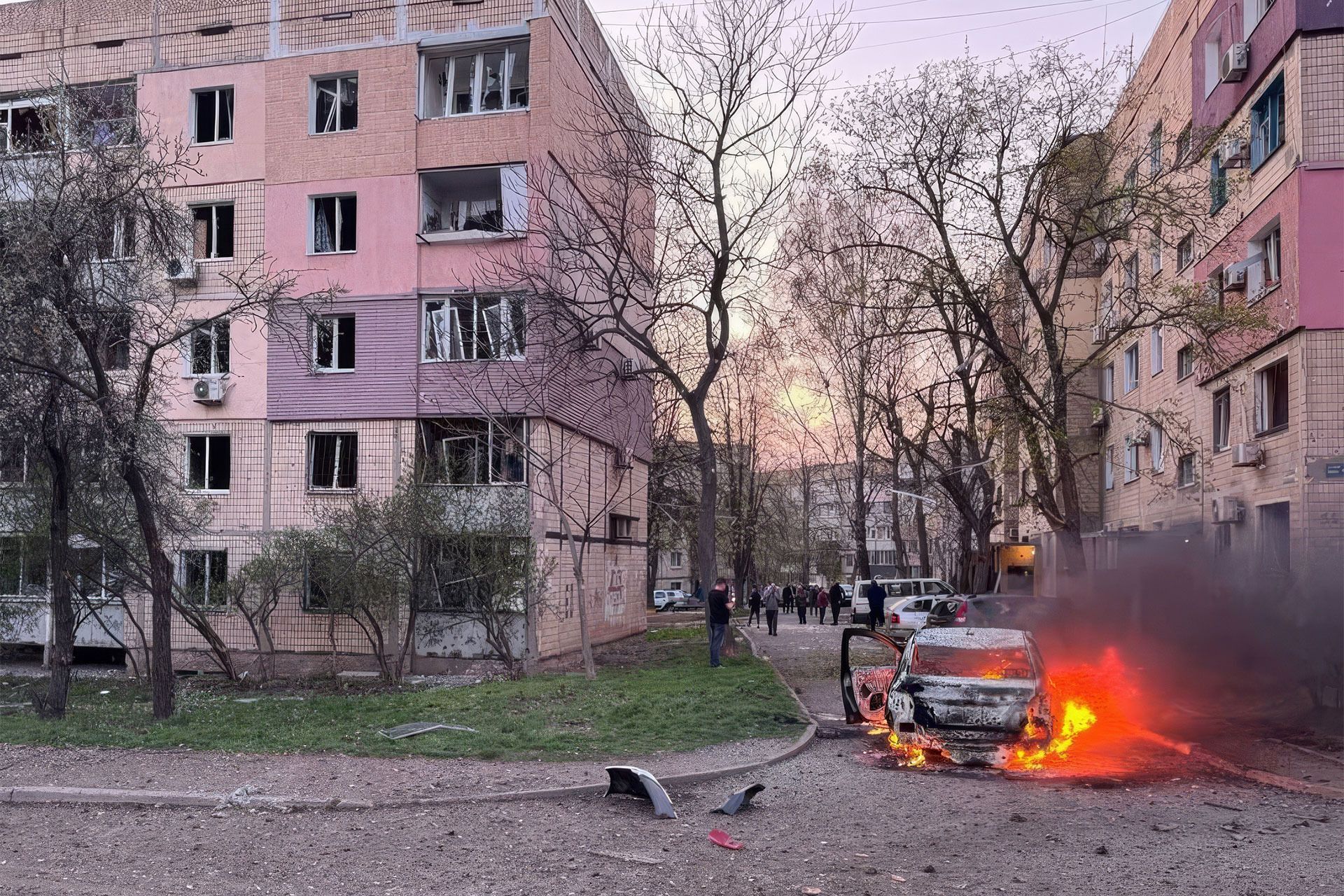
Today marks exactly one year since the Russian missile strike on Kryvyi Rih. This indiscriminate attack with numerous civilian victims—just one of many of its kind—last spring shattered the fragile hopes that had emerged for a quick end to the war in Ukraine. On this somber anniversary, it's worth remembering: war is not about internet blockades, oil prices, or the ruble exchange rate. War is death every day. Including for those who neither participate in it nor can participate: women, children, and the elderly left behind the front lines.
Photo: “Sistema”
1. Strike on Kryvyi Rih, April 4, 2025
Location: city of Kryvyi Rih (Dnipropetrovsk region), children's playground and park next to the RoseMarinerestaurant
Casualties: 20 killed (including nine minors), 75 injured
Details. The attack occurred around 7:00 p.m. A ballistic missile struck the residential area in the northeast of the city near Sodruzhestva Street, according to Kryvyi Rih Defense Council head Oleksandr Vilkul—an “Iskander-M” with a cluster warhead. Independent analysts and pro-war bloggers who disagreed with him claimed the missile carried not a cluster, but a high-explosive fragmentation warhead: otherwise, multiple smoke trails would have been recorded, not just a single large one. In any case, almost all commentators agreed that the Russian military deliberately equipped the missile to avoid hitting a specific infrastructure target and instead kill as many people as possible.
I saw children being carried out unconscious. We often walk at that playground ourselves, today [April 4, 2025] we just happened to be home sick. There are always lots of kids there, it's very popular in our area
- Iryna, eyewitness
According to city officials, the April 4 attack damaged 34 apartment buildings and six nearby educational institutions. But the main result was the death of 18 random people—mostly children and teenagers playing or walking in the local park nearby. Dozens of residents with injuries of varying severity were also hospitalized. Doctors were unable to save two of them.
Alternative Russian version. That same evening, April 4, the Russian Defense Ministry explained the strike on Kryvyi Rih as allegedly eliminating a group of Ukrainian Armed Forces officers and their Western instructors. It was claimed that Russian troops hit “up to 85” enemy commanders who had supposedly gathered for a banquet at a restaurant near Sodruzhestva Street.
OSINT experts found only one such establishment near the “Iskander” explosion site calledRoseMarine. According to numerous social media accounts, on that day it was hosting a beauty industry workers' forum and a child's birthday party. The restaurant itself suffered minimal damage from the airstrike, and street cameras near it did not record anyone resembling military personnel.
Nevertheless, three weeks later, Russian President Vladimir Putin personally repeated the obvious lie about a military banquet after the Kryvyi Rih strike: “They hold gatherings, meetings, conferences, celebrate something, drink vodka, and so on in the restaurant. Well, a strike was delivered there too. Are these civilian objects? Yes, civilian. But what is the target? Military.”
2. Strike on Sumy, April 13, 2025
Location: central part of Sumy city, near the Congress Center of Sumy State University
Casualties: 35 killed (including two minors) and 129 injured
Details: The strike on Kryvyi Rih coincided with intense peacemaking efforts by the team of U.S. President Donald Trump. By spring 2026, this may have been forgotten, but a year ago many believed the new (old) U.S. leader would quickly end the war in Ukraine—Trump himself repeatedly hinted it was a matter of weeks. Against this backdrop, the militarily pointless attack on the Kryvyi Rih park seemed like an unfortunate excess, completely unnecessary for Putin, whom Trump supporters would let end the war on his own terms. So after the April 4 tragedy, some pro-war channels even accused the Ukrainian Armed Forces: allegedly, Kyiv authorities provoked the incident to derail peace.
But on April 13, just nine days after the Kryvyi Rih attack, the Russian army launched a new strike on Ukrainian civilians. Around 10:15–10:20 a.m., two “Iskander-M” missiles hit the historic center of Sumy within minutes of each other. Dozens of people died instantly. Many were on their way to church—the killing happened on Palm Sunday (Entry of the Lord into Jerusalem), one of the main Christian holidays.
The first “Iskander” struck one of the Sumy State University buildings. The second hit near a nearby residential building, hitting a passing trolleybus. The driver and most passengers died instantly, the vehicle's doors jammed. The few survivors managed to escape thanks to the composure of 13-year-old Kyrylo Ilyashenko—the teenager, riding with his mother, managed to break the glass.
They [the passengers] hardly screamed, because they were in shock. When I started helping people out, I saw my mom, her face was covered in blood. I was very scared for her
- Kyrylo Ilyashenko
Alternative Russian version. As in Kryvyi Rih, the Russian Defense Ministry predictably claimed it was targeting military objectives. “A strike on the meeting site of the Ukrainian operational-tactical group 'Seversk' command, more than 60 Ukrainian soldiers destroyed.” But the reaction to the new tragedy in Ukraine was unexpected—some responsibility was shifted to local authorities.
Verkhovna Rada deputy Maryana Bezuhla and Konotop mayor (second city of Sumy region) Artem Semenikhin blamed the regional authorities. According to them, the enemy was provoked by regional military administration head Ihor Artyukh. On the morning of April 13, he scheduled an awards ceremony for territorial defense fighters—right in the ill-fated Congress Hall—and failed to ensure the safety of ordinary residents. President Volodymyr Zelenskyy indirectly acknowledged Bezuhla and Semenikhin's point: two days later, he dismissed Artyukh.
However, this does not legitimize the Russian strike on Sumy. The overwhelming majority of victims were civilians, including well-known local figures—for example, the local philharmonic organist Olena Kohut. There is no evidence that the “Iskanders” hit actual participants in the Congress Hall ceremony. Ukrainian journalist Yuriy Butusov later claimed that the territorial defense fighters came to the ceremony in civilian clothes and safely waited out the strike in the university.
Butusov acknowledged the deaths of only two military personnel, including the commander of one of the Ukrainian artillery brigades. He added that both were not at the ceremony, but were simply driving through Sumy at the fatal moment and were caught in the strike.
3. Strike on Yarova, September 9, 2025
Location: Yarova village, Kramatorsk district, Donetsk region
Casualties: 25 killed, 19 injured
Details. Over the past four years, everyone has become used to a grim paradox. Official Moscow stubbornly repeats its talk of “liberating Donbas,” but it is the residents of Donetsk region who suffer most from Russian Armed Forces actions—both in the occupied part (“DNR”) and in the roughly 20% of the region still held by Ukraine.
On September 9, 2025, a new tragedy unfolded in Yarova, 55 km north of the Sloviansk-Kramatorsk agglomeration. At that time, about 1,000 people remained in this frontline village —less than half the prewar population. Around 10:50 a.m., a Russian aircraft dropped a bomb on a mobile post office. There, by the Soviet Soldiers' Memorial Alley, a queue of residents had gathered. That day, postal workers were distributing pensions to local elderly people.
My husband went to get his pension, and I live nearby in the center. I heard the explosion. I ran over, he was still alive, he died in my arms. He was hit in the head by shrapnel. I called an ambulance, I thought I could still save him. When the rescuers arrived, it was too late. He was 72 years old
- Olga, local resident
Alternative Russian version. Moscow did not acknowledge responsibility for the September 9, 2025 strike on Yarova. Pro-Kremlin sources argued that the footage provided by the other side supposedly did not match the capabilities of FAB-500 and 250—the two main bombs used by Russian Aerospace Forces against Ukraine. They claimed the killing of civilians near Kramatorsk was part of “a campaign to reject negotiations and discredit Russia in order to blame Moscow for derailing a peaceful settlement.”
In November 2025, the discussion around the Yarova events took an unexpected turn. On a Hungarian podcast Magyar Jelen appeared a woman named Elina, who introduced herself as a nurse from the same village. Two months earlier, a medical worker with that name had indeed been mentioned by Ukrainian media covering the aftermath of the airstrike. Elina told the Hungarian audience that the attack on Yarova was actually a Ukrainian provocation.
According to her, the authorities—via messages in a local Telegram channel—deliberately gathered a queue of local elderly people on the morning of September 9. The military and medics were deliberately removed from the village, and before the bombing, the nurse allegedly saw a Ukrainian reconnaissance drone hovering over the village. However, Elina provided no evidence—no photos from the scene, no chat messages or screenshots. International observers such as the HRWagency or the UN Office for Human Rights classify the Yarova strike as a crime by the Russian army.
Strike on Ternopil, November 19, 2025
Location: city of Ternopil, area around the former “Orion” factory
Details. Early in the morning on November 19, Russian forces carried out an exceptionally large-scale raid on Ukraine. According to defenders, the enemy attacked the country with at least 470 drones and 48 missiles of various types.
At about 6:40 a.m., one of the missiles, a Kh-101 cruise missile, struck far-from-the-front Ternopil. The projectile hit two neighboring nine-story residential buildings at 15 April Street, 31 and Vasyl Stus Street, 8. The second building took a direct hit. The building essentially collapsed, with the third through ninth floors turning into a pile of rubble. Dozens of peacefully sleeping people were buried under the debris.
On the first day after the tragedy, Ternopil authorities announced 26 dead. But, as often happens in such situations, the death toll soon multiplied: rescuers found more bodies under the rubble, and not all those pulled out could be saved by doctors. For Ternopil residents, the living symbol of what happened on November 19 became 16-year-old Eva Unolt. The girl lost her mother and sister in the missile strike, underwent ten complicated surgeries herself, and survived.
Alternative Russian version. The Russian Defense Ministry hid the attack on Ternopil behind vague wording.“A strike was delivered on an assembly workshop, storage and launch sites [for UAVs] and unmanned boats, energy and transport infrastructure facilities of Ukraine [...] in 156 districts.”
Strangely enough, Ukrainian journalists partially confirmed the enemy's claim. They admitted that next to the two apartment buildings there really is the Orion defense plant. However, with an important caveat: since the collapse of the USSR, the enterprise has not functioned, and in recent years the premises have been rented by small local businesses. So the November strike on the Galician city had no military purpose.
Series of attacks on Ukrainian energy infrastructure in winter 2026
Location: energy infrastructure facilities across Ukraine
Casualties: the exact number of victims is impossible to determine. In totalduring the winterover 500 people died from Russian strikes on Ukraine's rear. It is estimated that another 200 residents may have died from overall hypothermia in their homes and at least 18 from carbon monoxide poisoning while trying to keep warm.
Details. At the end of the calendar year—after obvious failures with the “sanitary zone” in Sumy and Kharkiv regions and the Ukrainian Armed Forces' breakthrough in Donbas—the Russian command decided to return to an idea seemingly abandoned long ago. This was the plan from the first winter of the war to cause a complete blackout and simultaneous freeze of Ukraine by constant attacks on the country's energy infrastructure.
During the winter of 2026, the Russian Aerospace Forces carried out at least 14 massive airstrikes on Ukrainian energy facilities, not counting hundreds of individual attacks. The aim was to keep constant pressure on the enemy, overload air defense systems, and simultaneously destroy all power generation along with the power grid. On January 16, 2026—the exact midpoint of winter—Energy Minister Denys Shmyhal admitted that Ukraine no longer had a single undamaged power plant.
By February, the situation resembled a monstrous social-anthropological experiment. Against a backdrop of sustained frosts of —20 to —25°C, the Russian army methodically knocked out Ukrainian CHP and HPP plants. Most residents were left to solve the problem of physical survival in conditions where heat and light appeared in homes only sporadically for several days. Every night, new “Zircons,” “Kinzhals,” and “Iskanders” flew over the cities.
Nevertheless, the tactical successes of Russian troops in this “campaign” did not translate into a military-political victory. Ukrainian energy workers, through heroic efforts, prevented a total blackout and the collapse of Ukraine's energy system. Nor did the will of the rear break—Kyiv did not agree to “peace” on the enemy's terms.
Alternative Russian version. It would have been pointless for Moscow to try to hide the attacks on Ukrainian energy infrastructure—given their unprecedented scale. So Vladimir Putin, his press secretary Dmitry Peskov, and other Kremlin officials usually admitted the fact of missile and drone strikes, but dryly described them as purely military actions in response to Ukrainian drone strikes on Russian rear facilities.
The Kremlin could not even construct a successful propaganda image along the lines of: “Ukraine was abandoned by its allies, capitulation is inevitable.” In fact, at the height of the winter bombings, the EU allocated an additional €50 million to meet urgent energy needs. Finally, at the end of March, the authors of the pro-war channel “RIA Katyusha” openly asked:“Why, after many months of widely publicized strikes on the enemy's energy infrastructure, does it still exist and show no obvious signs of disappearing?”
If you enjoyed this article, consider making a donation — one-time or, even better, monthly. Your support helps us motivate our authors and become better with every article.
Our organization is recognized by the Internal Revenue Service (IRS) as a 501(c)(3) tax-exempt, charitable organization, which means that all contributions made to us are tax-deductible to the fullest extent permitted by U.S. law. Individuals may generally deduct charitable contributions of up to 60% of their Adjusted Gross Income (AGI) for cash donations made to qualifying 501(c)(3) organizations. For donations of appreciated assets (such as stocks or other long-term capital assets), the deduction is typically limited to 30% of AGI, based on the fair market value of the asset. C-corporations may deduct charitable contributions of up to 10% of their taxable income for donations made to eligible charitable organizations.
By submitting a donation, you confirm that you have read and accept the following documents: Privacy Policy and User Agreement, and also give consent to the processing of your personal data.
If you would like to unsubscribe from a monthly donation, please email us at: [email protected]