In the previous text, we discussed that migrants in Europe are not “guests” at all. In Germany, where I (a migrant) live, 25-30% of all citizens have migrant roots. In this sense, Germany occupies in Europe the same place that America once did in the world. That is, a migrant is not a “wicked Chechen” who, in Lermontov's words, “crawls ashore, sharpening his dagger,” but an integral part of the German landscape. Now it is necessary to talk about the crime that migrants, according to the common opinion, bring with them (here, unfortunately, the common opinion is correct). And about the terrorism that is called “Islamic.”
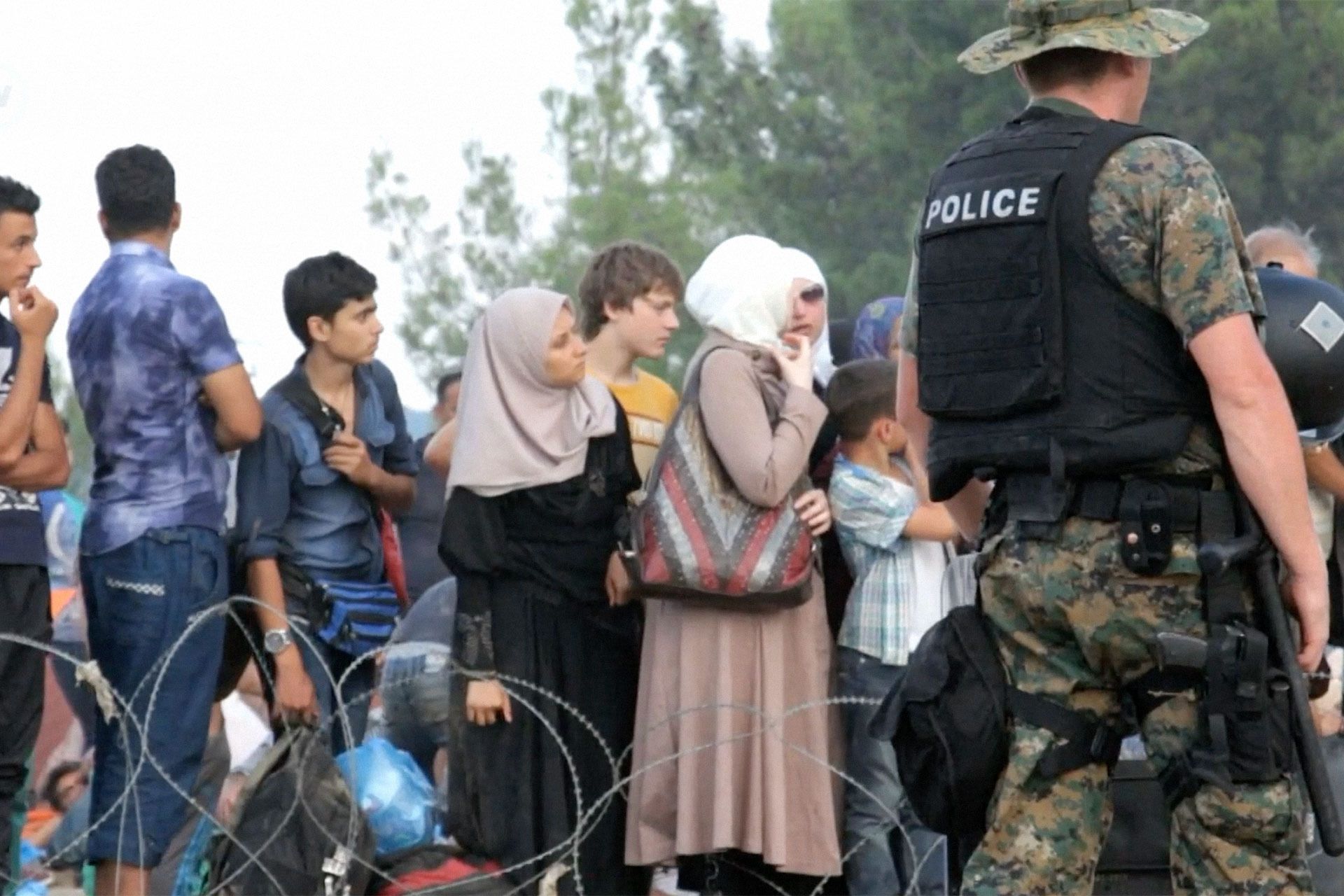
Screenshot from video: DW News / YouTube
The first publication in the series “Migrants: The End of Europe?” read here
I won’t mention the purely German terrorism carried out in the FRG in the 1970s by the Red Army Faction, when more than 30 people died, including 10 police officers. Nor will I mention the pure-blooded German (emigrants somewhat mockingly call such people “bio-Deutsche”) Gundolf Köhler, who detonated a bomb at Oktoberfest in 1980: 13 dead, 211 injured. Those are matters of the last century. I’ll focus on high-profile crimes from the last ten years or so.
March 2015. The co-pilot of a Germanwings Airbus 320 (a German of Iranian descent, Andreas Lubitz), barricaded himself in the cockpit and, shouting “Allahu akbar!”, crashed the plane into a mountainside. All 150 people on board died…
But don’t raise your eyebrows in surprise. I deliberately distorted the information. The pilot Andreas Lubitz really did kill himself, the passengers, and the crew. But he was a native German and did not shout “Allahu akbar!” Lubitz suffered from depression, which led him to such a terrible end. And even if he had shouted before his death, “In the name of the Father, the Son, and the Holy Spirit!”, he would hardly have been called a “Christian terrorist.” People would say: “He lost his mind...” But if it had turned out that Lubitz had recently converted to Islam, everyone would have immediately said, “Now it’s all clear.” He wouldn’t even have had to shout “Allahu akbar!”
At the same time, public murders committed by people from countries where Islam is practiced are regular in Germany. The most famous happened in December 2016, when a Tunisian asylum seeker drove a truck into a Christmas market in central Berlin, killing 12 people. Here are similar murders from the past five years.
June 2021, Würzburg: a Somali migrant attacks passersby with a knife. 3 dead.
January 2023, Kiel-Hamburg train: a Palestinian kills a random couple.
May 2024, Mannheim: an Afghan attacks rally participants; a police officer is killed.
August 2024, Solingen: a Syrian asylum seeker stabs people at a fair; 3 killed.
December 2024, Magdeburg: a migrant from Saudi Arabia drives a car into a Christmas market; 6 dead, over 300 injured
February 2025, Munich: an Afghan asylum seeker drives into a demonstration; 2 dead and over 40 injured.
However, only in one of the seven cases—in Mannheim—did the investigation classify the murder as a religiously motivated terrorist attack. In Magdeburg, the killer was known, on the contrary, for his anti-Islamist rhetoric. And almost always, the perpetrators had the same mental health problems as pilot Andreas Lubitz. Emigration does not benefit mental health.
I do not at all deny the correlation between emigration and crime. Syrian refugees in Germany were mostly single young men. This is generally a group with a higher crime rate. Watch the film “Solino” by Fatih Akin: it’s about Italian migrants in Germany. In one episode, an Italian teenager steals a camera in a wealthy German store. He can't resist.
Sometimes it is the German system itself that pushes people toward crime. Unlike Ukrainian refugees, who immediately received the right to work plus a large social assistance package (including social housing), the cases of Syrians, Afghans, and Pakistanis were considered for a long time. Sometimes—for years. Such people had no right to work. In the hostel, their allowance (as of 2026 standards, it used to be less) is about 400 euros. To put it mildly, that's tight. But theft or drug dealing doesn’t require a work permit...
Again: any mass migration goes hand in hand with crime. I have an acquaintance who is a sworn translator involved in investigations and trials. She said that theft in German stores during the mass emigration from the collapsing USSR was just as widespread: Soviet Germans and Soviet Jews were amazed by the abundance in open access (in Soviet stores, goods were behind the counter, and scarce goods were under the counter), and they didn’t know about surveillance cameras. Later, when they integrated, they moved on to insurance and pension fund fraud.
So the question is not whether migrant crime exists (it does). The question is whether it poses as much of a threat as people say.
I constantly hear that it has become scary to go outside in Germany. And it’s not just elderly ladies traditionally afraid of rapists—even Chancellor Merz said something vague but alarming about the changed Stadtbild, the cityscape. And although I, like Chancellor Merz, am prone to emotional outbursts, it is more reasonable to appeal to statistics.
The most dangerous type of crime is murder. Let’s see who leads here: migrants or Germans. I’ll only take high-profile murders that are reported on federal television, because it is these that shape public sentiment. The total number of deaths in the above-mentioned high-profile murders committed by migrants is 29. But this figure is far from the frightening record set by a 100% German, nurse Niels Högel, who was sentenced in 2019 to life imprisonment for killing 85 patients. There may be even more victims of the quiet pharmacist Peter Stadtmann, who for five years sold placebos instead of chemotherapy drugs. He received 12 years in prison, and to this day it is unclear how many placebos he sold: figures from 14 to 62 thousand have been mentioned.
It turns out that it makes more sense to fear German pharmacies and hospitals than street migrant crime. Although the most terrible terrorist attack ever planned in Germany in the 21st century was attempted by a migrant, but not of “Islamic”—rather, Russian origin: Sergey Wenergold. He wanted to blow up a bus with the Borussia football team, but fortunately miscalculated the strength of the explosion. However, two people were injured.
Discussions about migrant crime are almost always fueled not by actual harm, but by fear. We are much more afraid of airplanes than cars: cars are more familiar to us. It’s the same here: others have arrived in a familiar country. They dress differently, behave differently, speak unclearly, shout too loudly, pray to other gods, break our rules (because they are used to different ones)—and this is frightening. Fear, including fear of the dark, is almost always fear of the unknown. And here, perhaps, I’ll stop.
Next time, I’ll try to talk about how migrants influence national identity in Germany—and whether Merkel was right when she once said that multiculturalism “has completely failed,” “absolut gescheitert.”
By the way, she said this in 2010, and five years later opened Germany’s doors to the flow of Syrians.
If you enjoyed this article, consider making a donation — one-time or, even better, monthly. Your support helps us motivate our authors and become better with every article.
Our organization is recognized by the Internal Revenue Service (IRS) as a 501(c)(3) tax-exempt, charitable organization, which means that all contributions made to us are tax-deductible to the fullest extent permitted by U.S. law. Individuals may generally deduct charitable contributions of up to 60% of their Adjusted Gross Income (AGI) for cash donations made to qualifying 501(c)(3) organizations. For donations of appreciated assets (such as stocks or other long-term capital assets), the deduction is typically limited to 30% of AGI, based on the fair market value of the asset. C-corporations may deduct charitable contributions of up to 10% of their taxable income for donations made to eligible charitable organizations.
By submitting a donation, you confirm that you have read and accept the following documents: Privacy Policy and User Agreement, and also give consent to the processing of your personal data.
If you would like to unsubscribe from a monthly donation, please email us at: [email protected]