Right-wing populism is not a universal ideology, and everything beyond anti-globalist and anti-immigrant sentiments is subject to tactical moves that have their local characteristics depending on the local agenda. Yet, it is possible to highlight the reasons for the successes of right-wing populists using the example of Marine Le Pen's party in France.
Over the last 10 years, political forces that can broadly be called right-wing populists have been on the rise in the free world. Let's clarify the terminology right away: populists are not those who make many promises to voters. Democracy implies political competition, and within the framework of an election campaign, all candidates, from old and new parties alike, try one way or another to appeal to citizens and promise them prosperity under their own leadership. Of course, the more radical the movement, the wider the scope of promises usually is, but the main feature of populists is not here.
Populism, in its general interpretation, is usually understood as a political stance that opposes a virtuous but trusting people to corrupt and selfish elites who do not know the hardships of ordinary life and use power for their own interests. Naturally, expressing these views requires a direct connection with voters, bypassing all intermediary institutions (parliament, courts, press, etc.), where cunning elites can always distort the truth. The historical roots of populism can be found in antiquity and wherever public politics existed in any form. Populism is rooted in the very idea of democracy, where the source of power and its legitimacy is the people, and therefore someone can always claim to be a more honest and true representative than those already existing. However, each era draws its own lines of division between the people and elites, and our time has its own characteristics, in particular, the crisis of representative democracy and the spread of social networks, where more and more citizens distrust current political forces and official sources of information and disagree that old elites can represent the interests of ordinary people.
Meanwhile, the main success over the past ten years has fallen to right-wing populists. Among them, with varying degrees of justification, are Donald Trump in the USA, Nigel Farage in the UK, Marine Le Pen and her National Rally (RN) in France, the AfD party in Germany, Viktor Orbán in Hungary, and many others. Two main contemporary directions of right-wing populism can be identified that unite the programs of these leaders. In the broadest terms, these are isolationism based on, first, anti-globalist and, second, anti-immigrant sentiments. At the same time, the similarity of views is limited to these political points, while the economic positions of right-wing populists can be at different poles, from liberal to state-paternalistic.
Moreover, even symbolic details in the image of parties often do not coincide for different countries. For example, the collective prayer of the Trump administration is unimaginable in the execution of RN or AfD if they come to power in France or Germany. RN and AfD themselves also do not get along well, due to contradictory statements by some AfD leaders, which RN interpreted as neo-Nazi, unacceptable to French voters.
It is no surprise that the differences between such parties in different countries are greater than their similarities.
New Approaches
Unlike nearby European neighbors where right-wing populists often created new structures for political organization practically from scratch, RN is an “old party.” Jean-Marie Le Pen handed over to his daughter Marine a fully operational party mechanism, which, however, suffered from a number of shortcomings, in particular, insurmountable marginality. The National Front (FN) was a movement of affluent French nationalists and was perceived by society as a group of people with outdated views bordering on xenophobia. Le Pen’s entry into the second round of the presidential elections in 2002, where he suffered a crushing defeat, was both a matter of chance and the limit of his ambitions.
Marine Le Pen carried out significant work to transform the party, including renaming it from FN to RN (from National Front to National Rally), dismissed her father, and placed social issues at the center of her political program. While her father, in line with classic right-wing economic views, believed in a free economy, Marine Le Pen, having completely revised his positions, stood up to defend a system of broad social guarantees by the state. Contrary to obvious demographic trends and the pension fund deficit, she advocated lowering the retirement age. At the same time, she systematically criticized migration policy, seeing the cause of the French budget deficit and the growth of public debt in overly generous aid programs for migrants.
No one claims that the government does everything right, and RN has no grounds for its criticisms. What matters is different: unlike her father and his ideological positions, Marine Le Pen talks a lot about social problems.
French right-wing populists now do not just criticize the influx of migrants as a danger to national identity or expose the inefficiency of international structures and European bureaucrats—they directly link the difficulties of ordinary people to these two main causes.
At the same time, Marine Le Pen carefully avoids any statements that could be perceived as racist. She stands for all French citizens, regardless of their skin color. She opposes any discrimination but supports tightening migration rules. This is precisely what the average French person, tired of daily struggles, lack of prospects, and seeking simple explanations for their hardships, wants to hear.
It must be acknowledged that the level of optimism in French society is not very high. Economic growth rates have been quite low over recent decades, leading to accumulated dissatisfaction in society. Unlike the glorious 30 years (the 1950s, 60s, and 70s of the 20th century), a working career now rarely allows one to achieve a good standard of living, buy a home, or make substantial savings. Added to this is the degradation of the social sphere and rising crime, mainly linked to drug trafficking. Clearly, the rhetoric of right-wing populists falls on fertile ground under these conditions, especially if they manage to connect their traditional attacks on migrants and elites with the problems of ordinary people.
Who Votes?
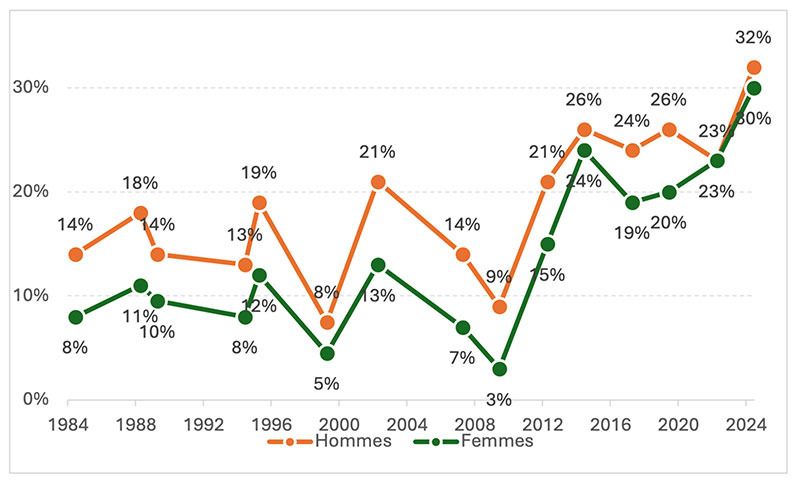
It must be said that Marine Le Pen has achieved good results across all population categories. Below is a chart showing voting data for men and women in the European Parliament elections, which is illustrative since they are conducted under a proportional system. It can be seen that in Jean-Marie Le Pen’s era, men were more sympathetic to his brutal program, while now preferences between men and women are roughly equal.
Source: jean-jaures.org
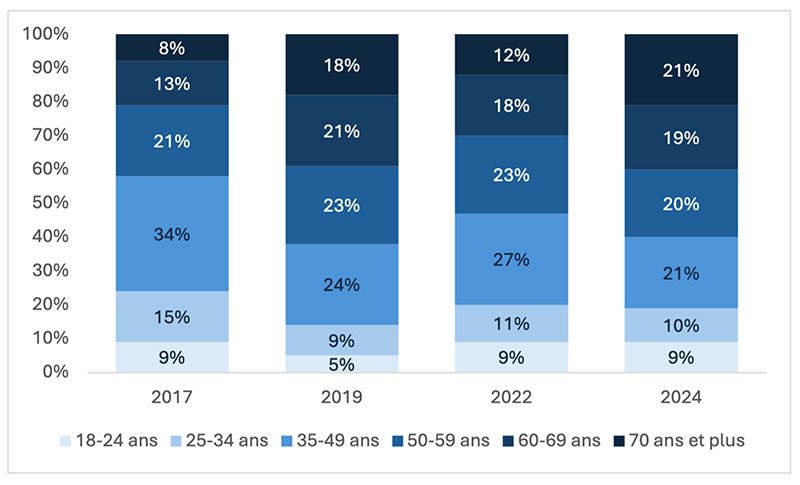
Similarly, there has been a more even distribution of votes among different age groups of citizens.
Source: jean-jaures.org
The sociological profile of the RN voter increasingly corresponds to the structure of French society. If about twenty years ago it could be reasonably asserted that Marine Le Pen’s electorate had regional and social specificity, now it can be stated that RN gathers more votes across all population categories than before.
There has been a qualitative change in citizens’ consciousness. For many years, any mention of Marine Le Pen and RN was accompanied by the label “far-right,” which immediately caused rejection among many French people. Marine Le Pen, however, did not despair and carried out significant work on the political “normalization” of both her image and the party as a whole, attracting new faces and avoiding statements that could be perceived as xenophobic.
The successful combination of the former anti-globalist and anti-immigrant rhetoric with attention to social problems and internal party reforms has borne fruit. RN is a serious political force and aims for power.
A separate question is how French citizens of foreign origin, in particular Russians, vote. There are no reliable studies on this, as it concerns a very heterogeneous social group of people who hardly have much in common. Russian emigration to France has several waves. Obviously, descendants of the first wave emigrants are unlikely to differ from native French people, while those who arrived relatively recently and have not fully assimilated may prefer a less strict migration policy than RN’s proposals.
The war in Ukraine may also influence these voters, as Marine Le Pen has not hidden her sympathies for. Despite the fact that she condemned Russian aggression, there is no certainty that if RN comes to power it will not seek some compromises with the Kremlin.
Where Are Your Allies?
This is a problem for populists at all times. It is no surprise that old parties and political elites, who, according to RN’s accusations, have failed in all areas, are reluctant to enter into coalitions with their accusers and continue to remind them of their “far-right” past. An alliance with left-wing populists is obviously impossible, and Marine Le Pen, despite all efforts, remains in frustrating isolation. Even gaining 30% of the vote in parliamentary elections, she cannot find allies to form a governing coalition. A similar scenario, but in a different configuration, was observed in the 2017 and 2022 presidential elections and is quite likely in 2027: Marine Le Pen confidently reaches the second round, but then all differences are set aside and everyone unites against her.
The strength of right-wing populists turns into their weakness. RN’s anti-system rhetoric may hit the mark and appeal to many citizens, but Western voters do not want revolutions and generally trust civil society institutions.
Marine Le Pen found herself in a difficult situation with a court case over the misuse of European Parliament funds. Her tactic was to portray herself as a victim of political persecution, but even her electorate is not ready to be lenient towards proven violations in court. It is no coincidence that RN abandoned the idea of calling for mass demonstrations in support of Marine Le Pen: most likely, the level of support would be very modest.
In essence, right-wing populists, having achieved relative success over recent years, face a difficult choice. On the one hand, they can try to take even more radical positions and win by force, following Donald Trump’s example, sweeping everything in their path. On the other hand, Europe’s political specifics dictate a different style, and the degree of societal polarization here is different. In this case, a “normalization” program is required, as successfully applied by Marine Le Pen, but it also limits the room for maneuver. The RN faction in the National Assembly is very large; its votes carry great weight both in the fate of the government and in the adoption of laws—but then one must acknowledge the fact that RN is now part of the system, bearing responsibility for its functioning, not a desperate opposition.
This tactical crossroads may well be decisive for the fate of right-wing populists as a significant political force in the West.
In the main photo — RN leaders Marine Le Pen and Jordan Bardella. Source: Marine Le Pen’s Instagram
If you enjoyed this article, consider making a donation — one-time or, even better, monthly. Your support helps us motivate our authors and become better with every article.
Our organization is recognized by the Internal Revenue Service (IRS) as a 501(c)(3) tax-exempt, charitable organization, which means that all contributions made to us are tax-deductible to the fullest extent permitted by U.S. law. Individuals may generally deduct charitable contributions of up to 60% of their Adjusted Gross Income (AGI) for cash donations made to qualifying 501(c)(3) organizations. For donations of appreciated assets (such as stocks or other long-term capital assets), the deduction is typically limited to 30% of AGI, based on the fair market value of the asset. C-corporations may deduct charitable contributions of up to 10% of their taxable income for donations made to eligible charitable organizations.
By submitting a donation, you confirm that you have read and accept the following documents: Privacy Policy and User Agreement, and also give consent to the processing of your personal data.
If you would like to unsubscribe from a monthly donation, please email us at: [email protected]