August 19-21, 1991, with each passing year, become an increasingly mythologized distant past. The current authorities generally prefer not to recall them at all, even though many of their representatives would never have reached their current heights without those historic days. A whole generation has already grown up that simply does not remember. And those who do remember are increasingly critical of these events. They say, well, what was achieved? Was it worth it? Believe me – it was.
Defenders of the White House on August 20, 1991. Photo: Oleg Klimov / Liberty.SU / CC BY-SA 4.0
Early in the morning on August 19, I was near the Australian embassy – I had some business nearby. At the entrance to the building stood a crowd: people had come to submit visa applications, but the embassy was closed. That’s where I learned that there were tanks in the city and a coup in the country. By the way, that day all foreign embassies in Moscow were closed.
I had to postpone my business and headed to the center. At Pushkinskaya Square – a tank with a frightened young man sticking out of the hatch, next to the tank – a TV reporter with a microphone, some woman with darting eyes was reciting rehearsed phrases about the need to restore order. I rushed home, to my mother and son. I barely got inside when a call came from a friend with whom we had attended meetings of the local Democratic Party cell. “What are you sitting for? All our people are going to the White House!” I got ready and went. There weren’t many people, everyone huddled in small groups, but more and more people kept arriving. They shared news. The mood was combative. A friend came up and scolded me for not bringing sandwiches, a thermos of tea, or an umbrella – they had promised rain. “But that’s tomorrow” – “Do you think it will all be over by tomorrow? We’ll be standing here a long time.” – “How long?” – “As long as necessary.” Yeltsin speaks – I can’t hear his speech because everyone is shouting joyfully.
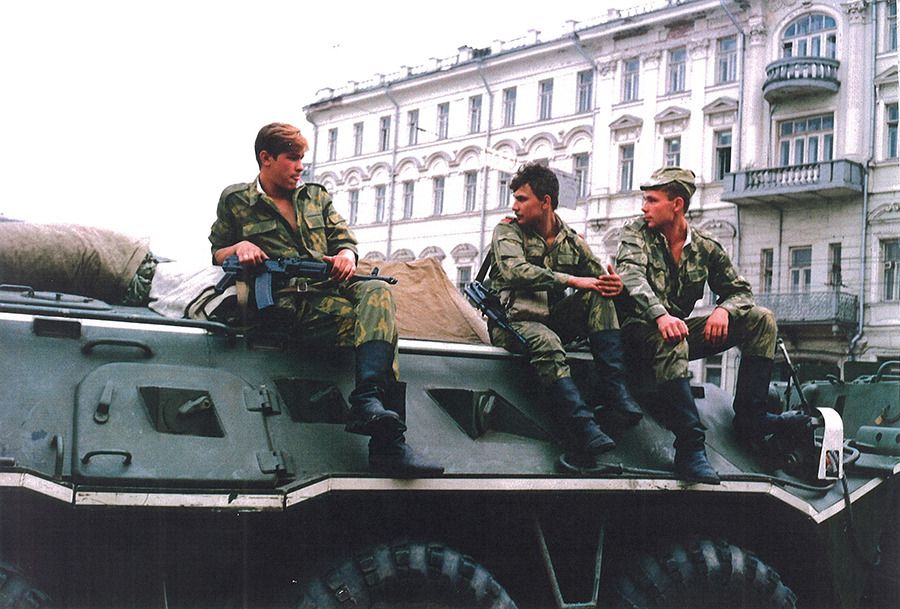
APC on Vozdvizhenka, August 20, 1991. Photo: Tove Knutsen / Wikipedia / CC BY-SA 2.0
***
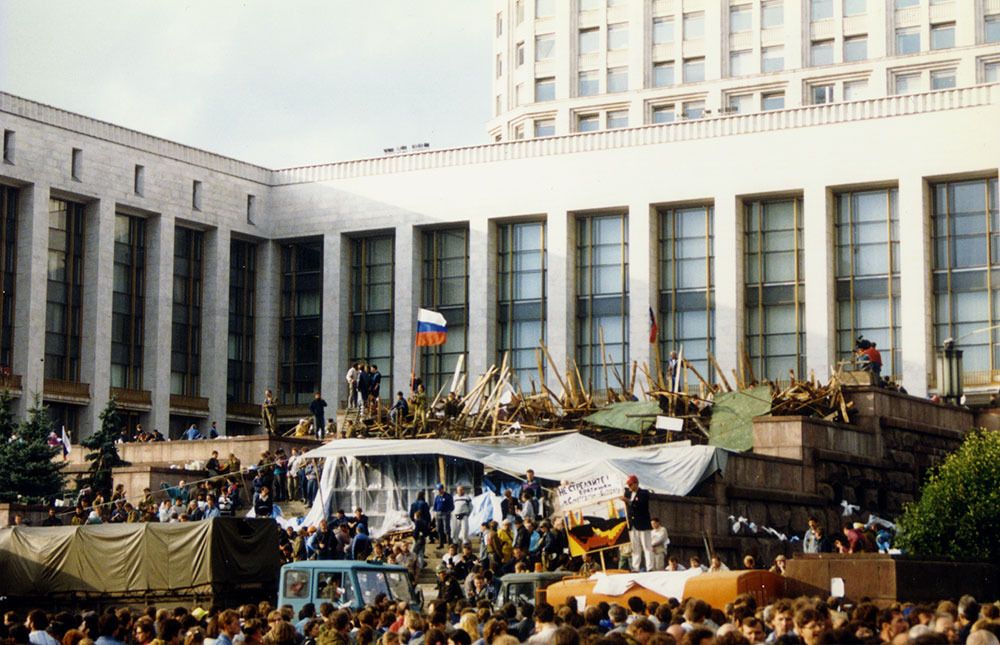
August 20. I have an umbrella, sandwiches, and a huge thermos-soup container – I went home during the night. Actually, only the umbrella is with me – I left everything else in a tent where water and food are delivered, and where there are medical workers with some medicines. The rain drizzles on and off. Clouds hang low, sometimes covering the airship hovering over the square. “That’s good, they won’t be able to use gas,” people say in the crowd. Everyone is a bit scared, but the mood is to stand until the end. On the left, guys are dragging some metal pieces – building a barricade. On the right, a barricade is already built, people are climbing it, fixing and reinforcing it. Everyone praises the staff of the American embassy – they parked their cars in such a way that you can’t drive onto the square in front of the White House. But it seems to me that the blue trolleybus, which also blocks the entrance, is a more serious obstacle for tanks. How did they even drag it here, there are no wires? The crowd is already very large. I sometimes leave my umbrella to save my spot and go look for acquaintances in the crowd. Nobody touches the umbrella, which is surprising for those times. And overall, the crowd is surprisingly friendly; I had never seen people treat each other so carefully before.
Barricades on Krasnopresnenskaya Embankment, August 1991. Photo: Ole Husby / Wikipedia / CC BY-SA 2.0
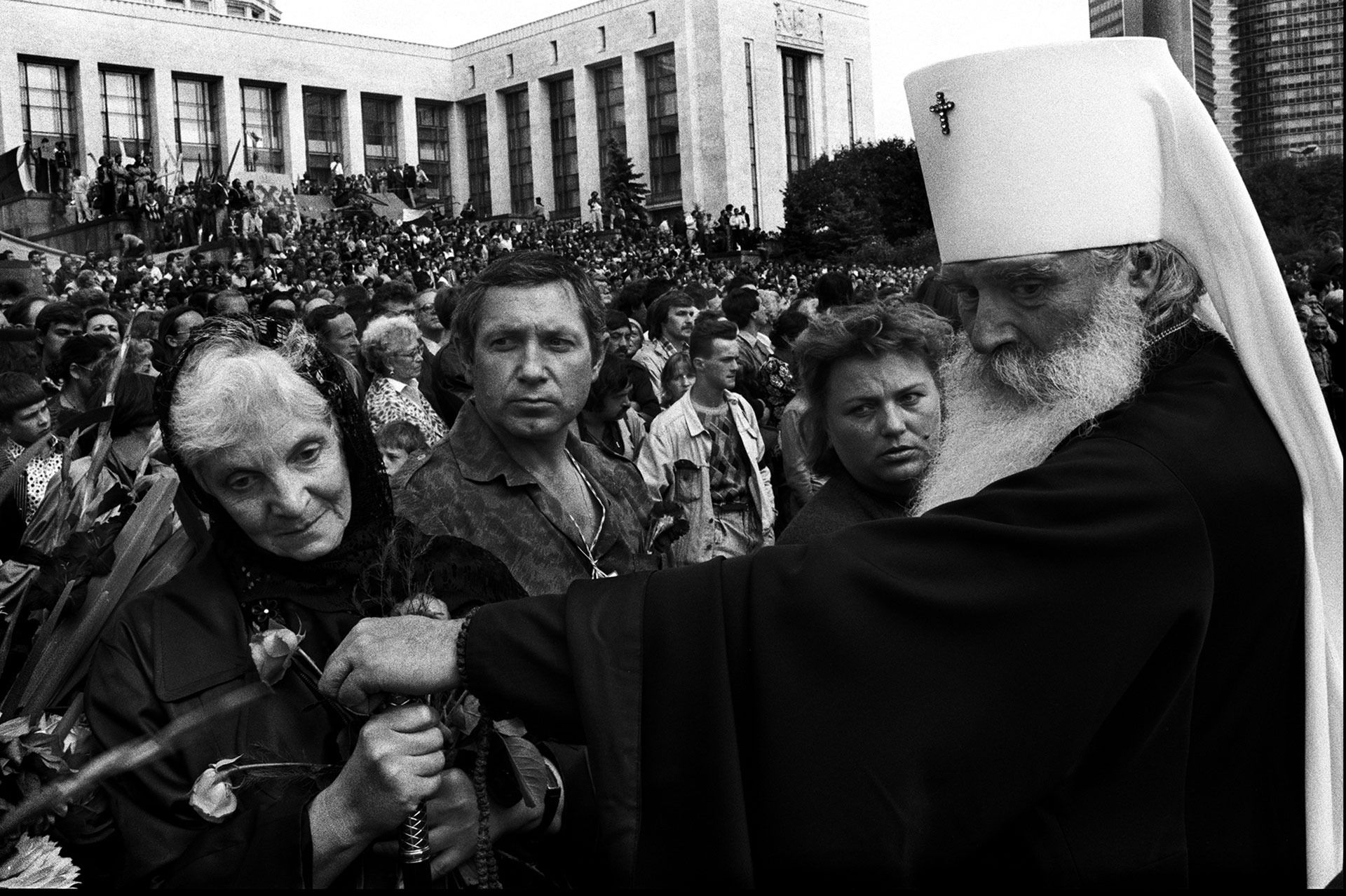
By evening, the situation heats up. Women begin to be pushed out – they say tanks are approaching, gas will be used soon. Women protest, but many still leave. The crowd remains huge, it even seems to have grown. Some priest walks among the crowd, talking to people, calming them, blessing those who want it. I didn’t know then that it was Gleb Yakunin. The sleepless night was taking its toll – I was sitting on someone’s folding chair, nodding off. They still sent me home: “You have a little son.” I still managed to return with my son to the bridge at 1905 Street. “Look,” I said to my five-year-old son. “Look and remember: even if we don’t succeed – we fought.” “Are you crazy, and with a child too? Go home!” men shouted at me from the barricade. When he was grown up, my son told me that this is how he remembered that day: the airship in the gray sky, barricades beneath it, and a sea of people. “I didn’t understand anything, but I felt that something very important was happening,” he said.
***
Barricades of the White House defenders, August 1991. Photo: David Broad / Wikipedia / CC BY 3.0
August 21. I barely make it to the square – tanks and barricades surround it, but the mood is already changing. There was no gas attack at night – everyone is sure that the clouds and the airship saved them. “The Virgin Mary has spread her veil,” a woman nearby hums. I look at the sky and feel she’s right. A rumor spreads through the crowd that General Lebed – the commander of the tank unit surrounding the square – has sided with the people. Everyone is still scared, but it seems the turning point has come. However, by evening, rumors spread that new columns are coming – and there are already casualties. The square quickly empties. We start hugging and saying goodbye. For me, this was the most frightening moment of those days.
***
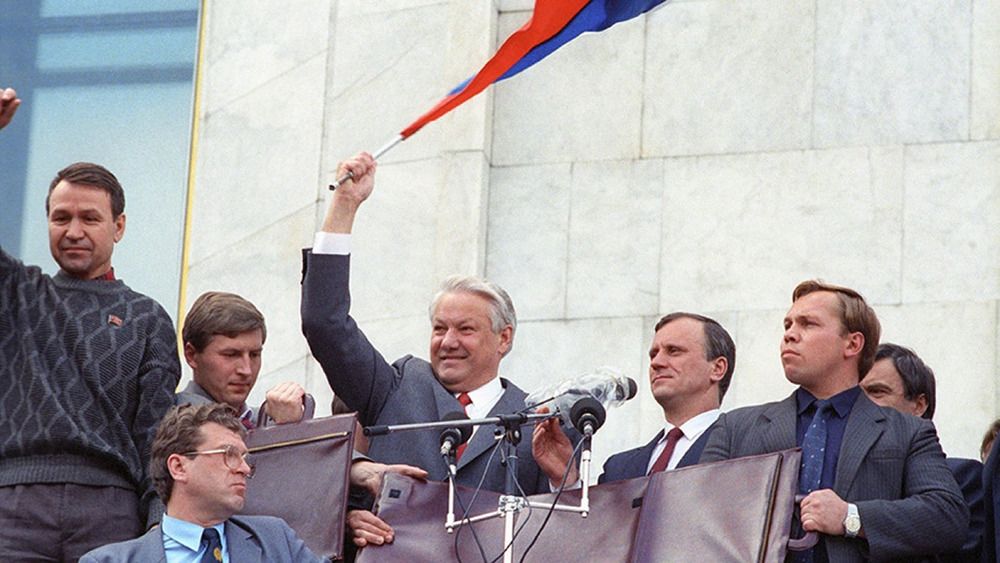
August 22. In the morning, it becomes known: the State Committee on the State of Emergency (GKChP) has been arrested! Gorbachev is returning from Foros to Moscow! I get a copy of the “Obshchaya Gazeta” (General Newspaper), which was produced during those days through the joint efforts of about ten editorial offices. Someone brought a radio receiver and we listen to “Echo.” Young girls climb on tanks to kiss the tankers. People begin to arrive again – and there are simply many more people than during all the previous days. The tent that served as the food distribution headquarters is being packed up, and I go to get my thermos. It’s no longer possible to get out – the crowd pushes me toward the headquarters bus. A guy named Igor pulls me inside. “Where have you been before?” hisses a plump girl at the crowd. Yeltsin speaks again, and the decision is made to go to Red Square.
Boris Yeltsin after the defeat of the GKChP, August 22, 1991. Photo: kremlin.ru
At that moment, a guy from the squad that stood in the tunnel on the Garden Ring breaks through to the headquarters bus. It was in their squad that three people died, whose names soon became known worldwide: Dmitry Komar, Vladimir Usov, and Ilya Krichevsky. It turns out that in the morning the city hall sent out watering trucks and wanted to open traffic on the Garden Ring, but the squad commander wouldn’t allow it. Igor and I run there. The commander is a tall, thin guy with sunken cheeks, hysterical: “Here is the blood of my guys,” he shouts, “and they decided to just wash it away?” We realize he’s right. But keeping the Garden Ring closed is impossible. Igor and I run back to the White House, trying to find someone from Yeltsin’s circle. Everyone is already gathering to lead the demonstrators’ column, confusion reigns. Finally, we catch some aide with a folder. We explain the situation, say we need to see Yeltsin or someone else to resolve the issue. The man assumes the posture of a speaker and delivers a five-minute speech full of smooth, rounded words, then skillfully slips away. Igor and I exchange glances. “Did you understand what he said?” – “Not a word. And you?” – “I didn’t either.” – “My God, these are the people who will govern us?” Fortunately, we catch the deputy Telman Gdlyan, famous then for the “Uzbek case.” He quickly runs off somewhere and returns with a ready decision: the column will stop at the place where the guys died, a prayer service will be held, flowers laid, and after the column passes, traffic on the Garden Ring will resume. The squad commander on the Garden Ring agrees to this. Gradually, the square empties – people have left with the column.
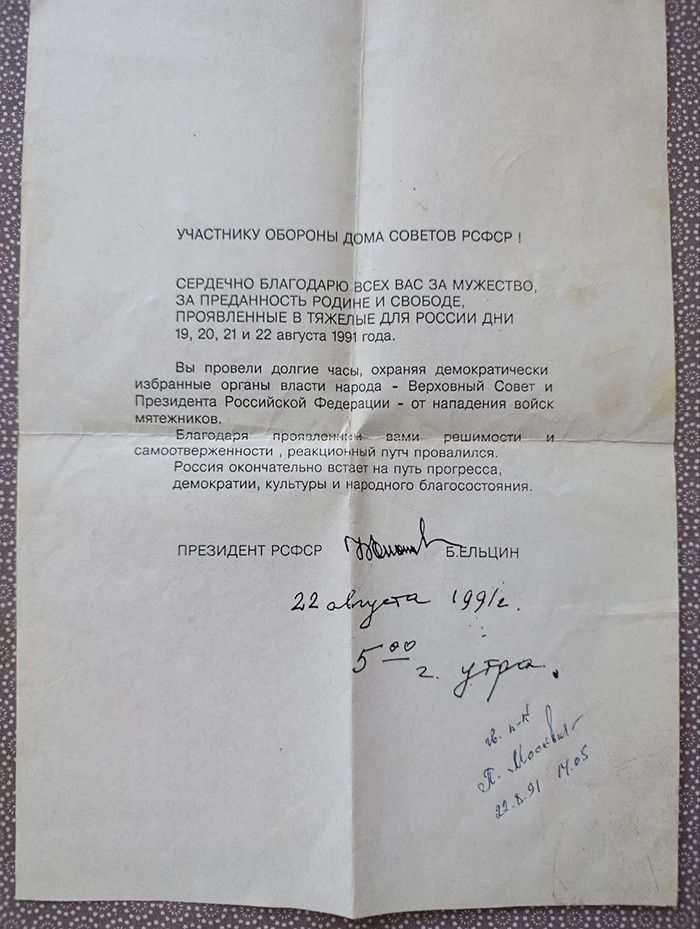
We say goodbye on the headquarters bus, exchanging phone numbers. I grab my thermos and a note of thanks for defending the White House signed by Yeltsin. Some military man also signed it as a souvenir. I have neither the strength nor the desire to go to the rally – I just want to sleep. In the grocery store in the nearest Stalin-era skyscraper, they are selling some unheard-of ham. I want to buy some – and then realize I’ve spent all these days completely without money. Luckily, I have metro tokens.
In the metro, I stand swaying from exhaustion, and the noise forms into a constant “hurrah, hurrah, hurrah.” I stand waiting for the train and suddenly... suddenly comes the moment when I realize what will happen next. That people like that smooth-talking guy with the folder, who knows how to speak beautifully but do nothing, will come to power. That most people will be with the winners, not with those who are right. That without money, no merits will help buy ham for breakfast. And that all this is inevitable and even normal. There’s nothing to be offended about – that’s life. But those three days of August – they will remain. They will flow into our blood, embed in our memory, soak into the earth – and will give seeds. Someday. And this moment of insight defined both my future life and my constant optimism. The seeds will sprout. It’s just that historical time moves slower than human time.
***
And when I returned home, I showed my mother the note of thanks from Yeltsin with restrained pride in response to her reproaches. My administratively savvy mother quickly looked at it and asked, “Where’s the seal?” There was no seal, and by bureaucratic standards without a seal – it’s just a piece of paper. But it’s not just a piece of paper. And August 1991 is not something that passed without a trace.
If you enjoyed this article, consider making a donation — one-time or, even better, monthly. Your support helps us motivate our authors and become better with every article.
Our organization is recognized by the Internal Revenue Service (IRS) as a 501(c)(3) tax-exempt, charitable organization, which means that all contributions made to us are tax-deductible to the fullest extent permitted by U.S. law. Individuals may generally deduct charitable contributions of up to 60% of their Adjusted Gross Income (AGI) for cash donations made to qualifying 501(c)(3) organizations. For donations of appreciated assets (such as stocks or other long-term capital assets), the deduction is typically limited to 30% of AGI, based on the fair market value of the asset. C-corporations may deduct charitable contributions of up to 10% of their taxable income for donations made to eligible charitable organizations.
By submitting a donation, you confirm that you have read and accept the following documents: Privacy Policy and User Agreement, and also give consent to the processing of your personal data.
If you would like to unsubscribe from a monthly donation, please email us at: [email protected]