«Sometimes, when you look at the representatives of the European Commission who write the sanctions text, you want to ask: what exactly were you trying to achieve?»
The founder of the “Iskra” association, Gera Ugryumova, has been fighting discrimination against Russians in exile since September 2023. Before that, in order to obtain political asylum in Italy, she spent a year and a half processing documents for residence in the European Union — and for some time lived in shelters without an identity document or a bank account. Now the 24-year-old human rights activist, together with her team, helps compatriots in similar situations, and “Iskra” works only thanks to donations from private individuals. Right now, Gera is pushing European authorities to amend a regulation that prevents thousands of Russians in exile from opening bank accounts in European banks.
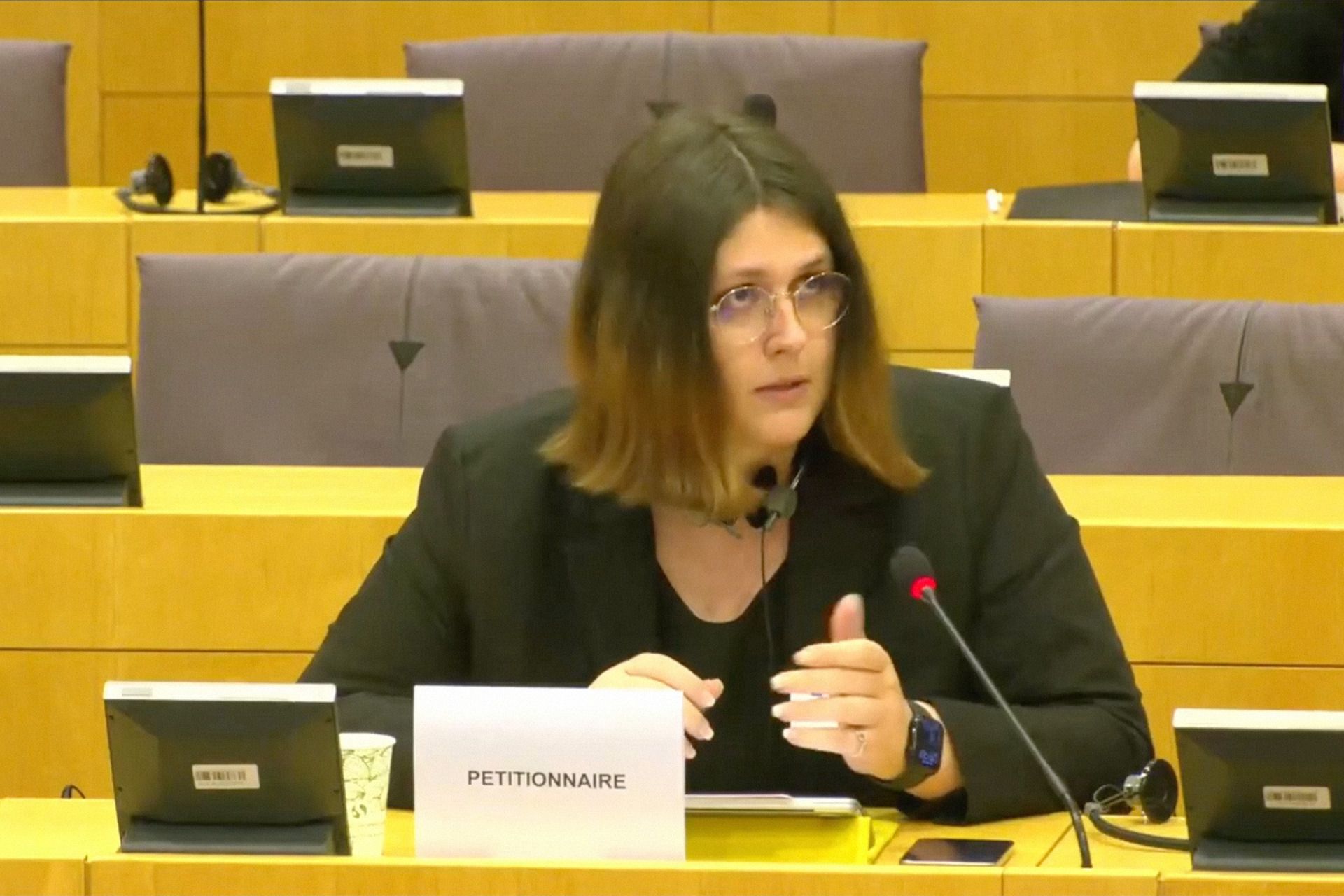
Gera Ugryumova in the European Parliament, July 15, 2026. Frame from video: Telegram / @piece_of_gera
- Recently you spoke in the European Parliament with proposals on how to stop discrimination against Russian emigrants in EU banks — and one of your opponents said something like “it’s unclear how you were even allowed into the European Parliament” (at least that’s how it sounded in the simultaneous auto-translation).
- Yes, that happened — although I also heard that remark in simultaneous translation, but the gist was that this MEP did not understand how Russians in 2026 come to the European Parliament and start talking about their rights. One could respond that these Russian citizens are residents of the European Union, and residents also have rights, and I am here because, as an EU resident, I have the right to do this and I want to tell you about our problem. In some countries, by the way, these Russians — residents of the European Union — can even vote for you, dear Members of the European Parliament, so please work for us as well. [This refers to the Netherlands, Belgium, Denmark, Sweden, Finland, and Lithuania, where Russian citizens with long-term or permanent residence status may take part in municipal elections — and vote for local lists of the same parties represented in the European Parliament. They cannot directly take part in European Parliament elections without EU citizenship — Most.Media]
- And which country did that woman represent?
- I think she was either from Greece or from Cyprus. We were much more interested in Mr. Gražulis from Lithuania and the reaction of the European Commission, because for the first time they admitted that the regulation written in October 2025 violates the EU directive on the basic right to bank accounts.
- This time you didn’t manage to lobby through the amendment to that very regulation on the first try — and all that really needed changing was literally one single magic word, after which all Russian emigrants in the EU would be able to open accounts normally. What do you think will happen first — the war in Ukraine will end, or the situation with bank accounts will be clarified?
- I think the bank account issue will be resolved much more easily and quickly, because the problem has already been acknowledged. And judging by the transcript of the meeting (during my speech I didn’t hear this), they will propose an amendment to the sanctions to the Council of the European Union. Apparently, it was already too late for the 21st package — I’d like to hope this will happen by the 22nd package. As I understand it, its draft should be ready in September, and it will be adopted in October.
In any case, if this is not adopted within a reasonable time, we plan to appeal to the Court of Justice of the European Union in Luxembourg. We can find a specific victim who will be ready to appear in court and demonstrate a personal interest in repealing this provision. That’s not a problem — we have many such victims.
- And why not to the European Court of Human Rights?
- That would also be possible, but for that you need to go through all the judicial instances in your own country, whereas here you can immediately file a lawsuit to annul the provision.
- In the European Parliament you proposed unfreezing frozen Russian assets in the EU in order to pay compensation under ECtHR judgments that Russia does not implement after leaving the Council of Europe. And what amount of money does Russia currently owe citizens under these judgments?
- According to estimates by various human rights organizations — 3 billion euros. And if you take Russia’s seized state assets and place them at the European Central Bank’s key interest rate, we would get 6 billion euros a year from interest income alone. That is twice as much. And interest is already being accrued on those funds, at an even higher rate.
- How interesting! And what is supposed to happen next with this interest income? Is it supposed to go to Russia, or what?
- Here’s how it works: all the interest currently accruing [on the seized assets of the Bank of Russia] is immediately frozen together with all the other assets. They just sit there and generate income, which, by the way, the European Commission representative mentioned right after my speech. And in principle, that income would be more than enough to cover Russia’s debts under ECtHR judgments. But for that, a mechanism for seizing it is needed. After all, these revenues have not been confiscated by the European Union — they are frozen. And they cannot confiscate them right now.
- Honestly, all of this looks absolutely Kafkaesque. For the fifth year, Russia has been waging war in Ukraine. More than 20 sanctions packages against Russia have already been adopted.Yes, obviously these sanctions are very inconvenient for the Russian government, Russian economic actors, and Russian citizens, but they do not stop the war. And those against whom these sanctions are directed still manage to circumvent them. One just wants to ask: what the fuck?
- Yes, sometimes you want to ask the representatives of the European Commission who write the sanctions text for approval by the Council of the EU: when you were adopting these restrictions, did you even think about what you wanted to achieve? Because in the end, all you achieved was that people leaving Russia cannot take their money out. When a hypothetical Vanya is waiting for a residence permit in the European Union and needs to move money out of Russia, he buys crypto there, transfers it to some cold wallet, and then he cannot bring it onto an exchange in the EU to convert it into euros — he is not allowed to, because he does not have a residence permit. At the same time, in order to pay for weapons, the Russian authorities just need to buy crypto in Russia and transfer it to the seller in the European Union, and the seller in the European Union will most likely list some dummy buyer so that a Russian company does not appear in the documents, and will simply cash out that crypto on their end without any problems whatsoever.
In moments like that, you ask yourself: what was the point? Who were you trying to stop? Because they [the Russian authorities] have no problems, but we do.It’s good that they have at least started acknowledging that these problems exist and need to be fixed.
- In the 21st sanctions package — a long list of Russian banks. At the same time, Russia has been cut off from SWIFT for more than four years and they cannot carry out international operations with the EU anyway. Is there any explanation for what the EU authorities wanted to achieve with this “list of ships”?
— By the way, Gazprombank still works with SWIFT — it was allowed to accept payments for gas and oil through it.In addition, there are Raiffeisenbank, OTP, UniCredit — all of these are European banks that operate in Russia and pay taxes in Russia. Moreover, Austria is now demanding that 2 billion euros be taken from Russian assets and given to “Raiffeisen”, because it paid 2 billion euros in fines in Russia. [Since 2025, Austria has been seeking the unfreezing of Russian company Rasperia’s assets located in the EU, worth about €2 billion, and their transfer to Raiffeisen Bank International in order to compensate the bank for funds recovered from its Russian subsidiary under a Russian court ruling in favor of Rasperia - Most Media ]. At the same time, Austria for some reason is not demanding that Raiffeisen stop operating in Russia and stop giving money to Russia.
- Yes, because Raiffeisen in Russia has super-profits, which since the start of the war kept growing until last year, when the fine issue arose.
- As for the banks that only now came under sanctions, they face asset freezes in the European Union, if they happened to have any. Although these are some completely tiny banks that many people have never even heard of, and some have already been through this a second time because they fall under various restrictions. Buying cash euros may also now be a problem for them.
- And have they been doing all this until now — buying cash euros, holding assets in the EU?
- [In the new sanctions list] there is a specific bank in which — this is known to me reliably — the parents of an acquaintance of mine were still buying cash euros, which, apparently, were legally purchased in the European Union and brought to Russia. Despite the fact that, as a reminder, officially Russians are not allowed to leave the EU for Russia carrying cash euros.
- You have been advocating for the interests of Russian emigrants in Europe for four years now. What do you see as the main problems in this field?
- There is a feeling that part of the Russian emigration unquestionably believes: if the European Union said it, then that’s how it is.First, people keep trying to tell me that no bank is obliged to open anything [for Russian citizens with EU residency], although objectively the law says otherwise. Second, there is the problem that people are not ready to defend their rights because they think: we’re kind of guests here and they’ve hosted us — thanks for that already. Thanks, of course, but obviously a bank account in today’s world is a basic thing, which, by the way, is also acknowledged by the EU authorities.
Without it, you simply cannot live now. So let’s at least make sure that your basic rights are respected.
- Literally this summer, the Russian authorities sharply tightened the conditions for opponents of the Russian government abroad — I mean the so-called civil death law, which effectively strips political emigrants of all basic rights under Russian citizenship. Many of them will soon no longer be able to renew their foreign passports. The question of issuing people in such a situation some kind of alternative European documents has been discussed for several years. What do you know about this?And are you contributing anything to this discussion?
- There are two approaches here. The first approach, realistic and quite feasible, is travel documents for foreigners. They exist in Italy, in Germany — in fact, in most EU countries, only not all of them issue them. I think that in about half of the European Union countries, Russians whose passports are not renewed will be able to obtain a foreigner’s travel document. Because the literal condition for obtaining it is the inability to get a passport from your own country.
But I don’t like this approach, because it begins to blur Russian emigration: here we are — from Germany, and we are here — from Italy, and we are here in France. And I have a feeling that it would be a good idea for the Russian opposition to seek some kind of document that might be issued only in one EU jurisdiction — or perhaps in all of them at once. After all, such a document should be issued by Russians to Russians; the EU can only facilitate it. But it should be an equivalent of a Russian Federation passport, not some foreigner’s travel document that in some countries will not even count as an identity document. In Italy, for example, with a foreigner’s document you can cross the border, but you cannot open a bank account or present it anywhere else to obtain other documents.
That is a good question that should be addressed. But so far, no one wants to go down that path. We ourselves once tried to negotiate with representatives of various opposition forces about these passports, because in one European country an institution was found that agreed to print passports with a European state emblem. Yes, we would then have had to seek recognition of this document, and that institution set a condition: we need to understand how many such passports need to be printed. But that did not work out for two reasons. First, we did not have sufficient funding. And second, we could not reach agreement with all opposition forces on recognizing such a passport. If someone like [Leonid] Volkov or Mikhail Borisovich Khodorkovsky comes along and says, “we don’t believe in these passports”, then the whole story loses all meaning.
Unfortunately, in some circles of the Russian opposition, people in principle do not want to go anywhere if there is no guarantee of victory. That is also a big problem.
- Oh, I know that very well myself, because when last year we at “Most” launched a petition to the US authorities against the deportation of Russian anti-war activists from Trump to Putin, only Ilya Ponomarev joined it from among the Russian politicians in exile. The rest either ignored us completely or replied that they saw no point in appealing to the current US administration — it wouldn’t lead anywhere anyway.Meanwhile, more than 30,000 people signed our petition in a month, people who, just like our editorial team, were outraged by the deportation to Russia of activist Leonid Melekhin. He was arrested immediately upon arrival, and he is now sitting on exactly the case from which he tried to obtain asylum in the United States. Our petition could not influence that, but at least it made the problem visible.
But I also want to remind you that there was no agreement in the first and second waves of Russian emigration in the 20th century either.And the Nansen passports were issued not by opposition politicians in exile by mutual agreement — it was a supranational humanitarian process.
- Yes, but the problem here is that this document was recognized as an identity document and could be used all over the world.
- Why are documents like the Nansen passport impossible now?
- For the European Union, this requires a unanimous decision by 27 member states. If it were a UN decision, for example, it would solve the problem across a much broader territory. In general, some kind of international agreement would be needed. But for now things remain as they are, because apparently no one considers this a major problem.
- In 2022 you left for exile while studying journalism at RUDN University — and because of personal circumstances you ended up doing advocacy. Have you managed to obtain any official qualification in this field?
- I have a problem: all my education documents are at RUDN University, and they are difficult to recover, so now I am trying to obtain a European qualification passport for refugees. With this document, I will be able to enter a European university. In the city where I live, there is a program I want to apply to. I think it will be law with a focus on European politics. Just a couple of months ago I was told that interviews for issuing these documents would soon resume, so for now I am waiting.
- “Iskra” was originally created as an independent organization that lives only on private donations. Is that principle still in force?
- Yes, we do not receive any grants — neither from the state nor from organizations. In Italy, NGOs are entitled to receive a percentage of tax payments — we also отказались from that. We are open to cooperation, to joint work and support, but all of this is based entirely on private donations. We decided this because we saw how some projects die simply because their funding was cut off. We think like this: if we have built up some foundation, it will not suddenly disappear all at once (obviously, unless we suddenly do something bad). So we decided that this model suits us better — it is simply more stable.
Right now, three people work for us on a permanent basis, including me. In total, there are eight permanent members in the organization, and there are also volunteers. About 250 people regularly send us donations through Patreon — that regularly adds up to about 1,500 euros. We collect everything else separately, with the help of streams. The minimum we need is about 4,000 euros per month. For fully functioning work, 8,000 is necessary, and in some months we have managed that much. More than 8,000 euros a month is not exactly hard to spend, but for reasonable purposes that amount would be enough.
- Do you have a strategy in case of an even further rightward shift in Italy and in the EU as a whole?
- You know, Italy does not fit the usual left-right division. Here, one left-wing politician, Giuseppe Conte, said: “we are now going to block aid to Ukraine and propose negotiations so that Putin can take the territories for himself”. To which the right-wing government said: have you all gone mad or what?
But there are also Putin supporters on the left, and Putin supporters on the right. The Russian embassy and Rossotrudnichestvo, of course, did a great deal to make such a situation possible. Here the left supports Putin because they think he wants to revive the Soviet Union, and the right supports Putin because they think he stands for traditional values.
So you have to maneuver. Be friends with the left, and with the right, and with others, and with centrists, and resolve issues like a human being over a cup of coffee.
- What is your strategy if the situation suddenly gets worse?
- Sue. Thank God there are laws that protect us.
- How would you generally assess the attitude toward Russian political emigrants in the European Union, and what has the dynamic been since the start of the war? It clearly hasn’t gotten better, has it?
- Well yes, probably it hasn’t gotten better. But it also can’t be said to have gotten much worse. There are certain pinpoint problems — humanitarian visas were closed in Germany, in France they are thinking about winding them down, all these everyday bank issues. But none of this was done with the aim of harming Russians. Europeans themselves say: we did not want you to face this problem, we wanted to hurt Putin, but we did not think through how this should be done, so it turned out the way it turned out. There is a feeling that dialogue needs to be conducted with representatives of national governments, because it is obvious that there is a lack of understanding of how they want to achieve certain goals.
- Don’t you have plans to naturalize in Italy? Opportunities for the same kind of advocacy would probably increase?
- No, personally I do not plan to obtain Italian citizenship. I want to remain a citizen of Russia, to remain within the context of the problems of Russian citizens, because this also concerns me. “Iskra” appeared precisely because I had problems that needed to be solved somehow — and then it turned out that these were mass problems and they could be solved by everyone together.
There are people who think: if I get Italian citizenship now, I won’t have any problems. But in Italy it’s much more interesting, because here, in addition to citizenship, your place of birth also matters — for example, the tax code contains an indication that a person was born in Russia. And Italian citizens who were born in the USSR, including ethnic Italians who were accidentally born outside Italy, also faced problems here. [After the start of the anti-war sanctions] at first, all account blocks went through the tax code, because Italian IT specialists then decided that the easiest thing was to filter out Russian citizens by their place of birth.
In short, you won’t avoid problems, you won’t run away from yourself. So I don’t even want to try.
If you enjoyed this article, consider making a donation — one-time or, even better, monthly. Your support helps us motivate our authors and become better with every article.
Our organization is recognized by the Internal Revenue Service (IRS) as a 501(c)(3) tax-exempt, charitable organization, which means that all contributions made to us are tax-deductible to the fullest extent permitted by U.S. law. Individuals may generally deduct charitable contributions of up to 60% of their Adjusted Gross Income (AGI) for cash donations made to qualifying 501(c)(3) organizations. For donations of appreciated assets (such as stocks or other long-term capital assets), the deduction is typically limited to 30% of AGI, based on the fair market value of the asset. C-corporations may deduct charitable contributions of up to 10% of their taxable income for donations made to eligible charitable organizations.
By submitting a donation, you confirm that you have read and accept the following documents: Privacy Policy and User Agreement, and also give consent to the processing of your personal data.
If you would like to unsubscribe from a monthly donation, please email us at: [email protected]