On Monday, the book by American journalist Evan Gershkovich, This Cursed Beautiful Land, appeared in U.S. bookstores. In it, the former Moscow correspondent for The Wall Street Journal рассказывает how, as a result of a provocation, he ended up as a hostage of the FSB, was sentenced to 16 years on espionage charges, and was released only thanks to an international prisoner exchange. The circumstances of this story are strikingly reminiscent of a Russian-American spy scandal from 40 years ago, which was resolved thanks to the intervention of Gorbachev and Reagan.
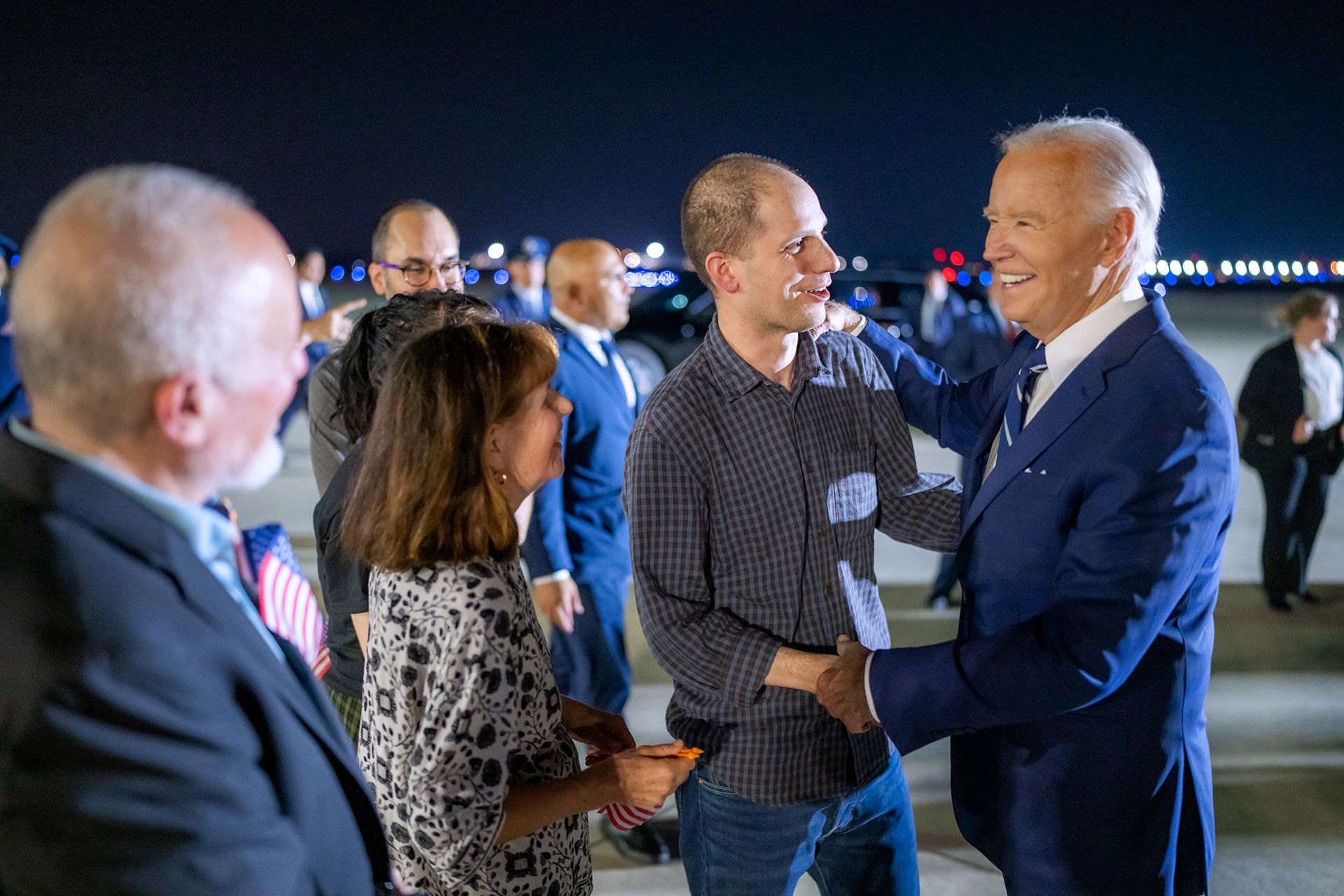
Evan Gershkovich (center), surrounded by his parents and U.S. President Joe Biden, August 1, 2024. Photo: White House website
“He’s an idiot, — Vladimir Putin told his interlocutor, slamming his fist on the table, — He gave himself away too obviously“. Gershkovich did not write in his book which world-famous politician was Putin’s interlocutor at that moment. All that is known is that the meeting took place shortly after the international exchange on August 1, 2024, as a result of which Evan got home. Before accusing Gershkovich of espionage, Putin gave his opponent a historical lecture lasting more than 60 minutes, ultimately concluding that the Wall Street Journal correspondent was undoubtedly working in the interests of the CIA.
This same version was soon repeated to Gershkovich, who by then had already been released, by Tucker Carlson, who during his interview with Putin in Moscow in February 2024 asked when Evan would leave the walls of the pretrial detention center. Putin said that something “bothers” him: why is the U.S. making so much effort to free basketball player [this refers to Brittney Griner, arrested in February 2022 during a layover at Sheremetyevo Airport for carrying a vape with hash oil], but doing nothing for a spy?“ Hearing this phrase, Gershkovich became convinced that for Moscow he was merely a surname from a long list of names in the ”exchange fund“, which on Lubyanka is sometimes called the ”currency exchange booth“.
As Evan now tells it in the pages of the book, the FSB was looking for “the most convincing way” to portray him as a spy, personally reporting to Putin about the arrest of a CIA secret agent. To do this, officers of Russia’s most powerful security service themselves organized the journalist’s first meeting with a provocateur — an obscure “activist” from the Ural trade union “Solidarity”, Pavel Sergienya.
“The FSB could go to Putin and present him with a version that would convince him that I really was a spy and give the green light for my arrest during the second meeting. Putin, it seems to me, fully believed this legend”, Gershkovich writes.
The Wall Street Journal correspondent was detained in Yekaterinburg in March 2023. On July 19, 2024, he was sentenced to 16 years in a penal colony in an espionage case, accused of collecting secret information about the work of Uralvagonzavod. The trial of Gershkovich was closed, but when the verdict was announced, the judge mentioned a man named Pavel Sergienya, to whom the material evidence — a phone seized by the FSB — had to be returned.
EvanGershkovich recalls how, during their meeting, Sergienya placed in his hand neatly handwritten papers in black ink, resembling official tables with production volume figures. These papers soon became the prosecution’s main evidence. The commission created by the security service recognized only one fact as state secret: information about the possible production capacity of the tank plant. Interestingly, according to Evan Gershkovich’s version, it was this very information that Pavel Sergienya himself offered to provide to the Wall Street Journal journalist.
Old-school methods
Let’s go back 40 years to New York. Here, on August 23, 1986, 39-year-old physicist Gennady Zakharov was detained near a subway station at the corner of 67th Avenue and Fresh Pond Road in Queens at the moment when he was handing over $1,000 in cash to an employee of a secret military company he had recruited, which manufactured components for jet engines and radars. A CIA-controlled “secret informant” handed Zakharov three secret documents in return.
FBI Deputy Director John Hogan stated at a press conference that the “physicist” was a career KGB officer. Gennady Zakharov was charged with espionage and faced life imprisonment in the U.S., since he had no diplomatic immunity. The FBI secret informant Likh Boge received $20,000 from the FBI for this operation — twice as much as Zakharov paid him over the three years it took to recruit him.
The KGB’s response came very quickly. On September 2, 1986, in Moscow, US News&World Reports correspondent Nicholas Daniloff, the grandson of a tsarist general and great-great-grandson of the Decembrist Alexander Frolov, was arrested on espionage charges. Eight KGB officers in plain clothes detained Daniloff on the Sparrow Hills immediately after his longtime acquaintance — a schoolteacher named Misha — handed the journalist an envelope with secret maps showing the deployment of Soviet troops in Afghanistan.
A year earlier, the KGB had already tried to recruit Daniloff. In January 1985, someone dropped an envelope into his mailbox containing “handwritten pages of a technical nature, where the word ‘rockets’ appeared many times”. The sender was Priest Roman Potemkin, a deacon of one of Moscow’s churches, who allegedly wanted to tell Daniloff “the whole truth about the Russian Orthodox Church”. The journalist handed “Father Roman’s” letter to the embassy, and there they decided to play for high stakes.
Soon “Father Roman” was called by diplomat Paul Stombaugh, a CIA agent, who introduced himself as “Nicholas’s friend” and offered to meet immediately.The ending of this story was once described by my friend and colleague, the “golden pen” of Russian New York, Vladimir Kozlovsky, who has been writing about crime and espionage for more than 40 years: “Stombaughbrought to the meeting with the priest a typed letter, which Daniloff would later be shown by the KGB as material evidence. It said: ‘Dear friend, we inform you that your letter, passed through the journalist, has reached the addressee you specified. We highly appreciate your work.’ The letter contained instructions on how to get in touch with the CIA.
As it later turned out, the KGB informant “Father Roman” took this letter to his handler. But he failed to recruit Nicholas Daniloff. And then “schoolteacher Misha” appeared, who politely and promptly, but under the supervision of eight KGB officers, brought the journalist secret military maps of Afghanistan. “Schoolteacher” Misha Luzin was a career officer of the KGB of the USSR with the rank of senior lieutenant, but his biography had a “second bottom”.
After the KGB and the CIA, acting on personal instructions from Mikhail Gorbachev and Ronald Reagan, agreed to exchange Daniloff for Zakharov, the fates of the heroes of this detective story turned out very differently. Daniloff happily returned to New York, while Zakharov did not want to return to the USSR. He offered his services to the FBI and immediately gave up three Soviet intelligence officers who worked at the UN headquarters. But in the end, Zakharov was deported.
Priest Roman Potemkin became Bishop Manuel (Platov) of the unofficial “True Orthodox Church”, but in 2025 he received 15 years in prison for organizing a child prostitution network. “Schoolteacher Misha” turned out to be not just KGB officer “Luzin”, but also a former killer, Alexei Yatskovsky, recruited by the KGB in prison. For the operation to arrest Nikolai Daniloff, he received the rank of captain, but after the collapse of the USSR he emigrated to the U.S., where he made a living singing prison songs in Russian restaurants in Brooklyn. He returned to Russia only after Vladimir Putin came to power, and in 2024 died in the Siberian town of Cheremkhovo.
But the methods of the operatives are alive, moreover — they do not change. If you offer a journalist secret documents, he will be interested, won’t he? And then he can be arrested and sent to the “currency exchange booth”.
Russia’s geopolitical exchange booth
At the closed trial in the Gershkovich case, “trade union activist” Pavel Sergienya testified for the prosecution and said that even before meeting the journalist he had told the FSB about his interest in military production. It is interesting how he learned of Gershkovich’s interests before they met? For now, we know only the journalist’s own version and fragments of the FSB informant’s testimony. It would be curious to learn the rest of the details of the case hidden under the “Secret” classification. Perhaps later, in about 40 years. What is clear now is the main thing: Evan Gershkovich was very lucky to end up in the “exchange booth”.
The FSB investigator, as Evan himself writes in the book, told him during the interrogation that if there were no necessary evidence, the journalist could simply be killed: “In any country there are enemies who need to be imprisoned or eliminated. In your case, we clearly gathered enough evidence to put you in prison. Otherwise, we would have simply poisoned you”.
Forty years ago, Soviet security services acted more diplomatically than today’s Russian ones. But otherwise, the scenario of the “CIA agent Daniloff” operation astonishingly matches the scenario of the “agent Gershkovich” operation.
Daniloff was brought to the U.S. on September 23, 1986, and a week later the Soviet “physicist” Zakharov flew in the opposite direction. Evan Gershkovich was released on August 1, 2024, as part of a synchronized prisoner exchange between Russia and Western countries.
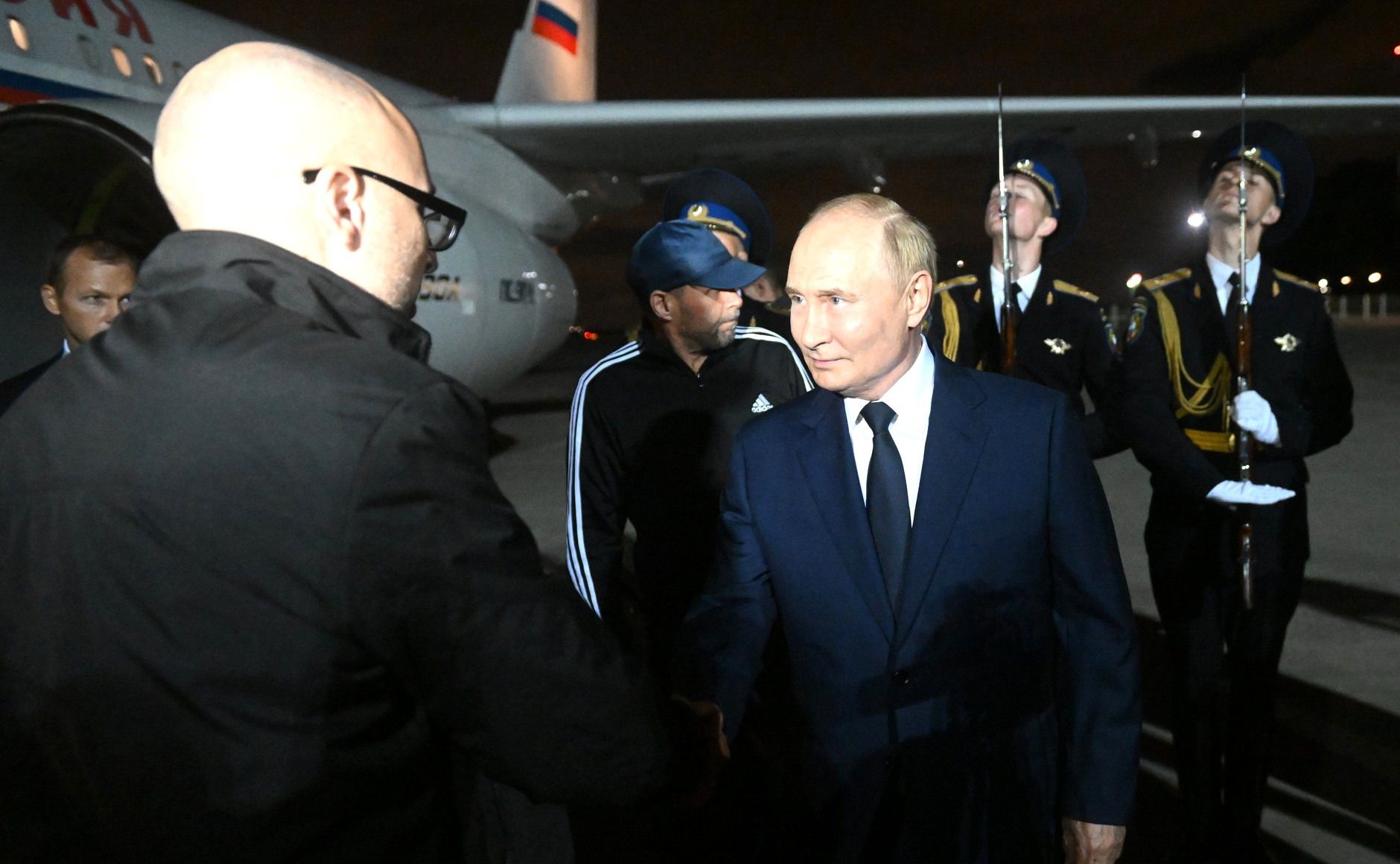
Vladimir Putin meets citizens of the Russian Federation returning as a result of the exchange at Vnukovo Airport, August 1, 2024. The man in the cap in the background is Vadim Krasikov. Photo: kremlin.ru
This exchange was the largest between Russia and the West since the Cold War: 16 people in exchange for eight adults and two children. In particular, Russia received security service agent Vadim Krasikov, convicted in Germany of the murder of Zelimkhan Khangoshvili in Berlin, and other “officials”. On the other side flew Paul Whelan, Alsu Kurmasheva, Vladimir Kara-Murza, Ilya Yashin, Andrei Pivovarov, Oleg Orlov, Lilia Chanysheva, Ksenia Fadeeva,Sasha Skochilenko and Rico Krieger, released from Belarus.
On the same day that the first print run of Evan Gershkovich’s book “This Cursed Beautiful Land” arrived in bookstores in New York and Washington, Donald Trump’s special envoy John Coale told The Atlantic that he had personally предложил the U.S. president to ease some sanctions against the Russian economy in exchange for the release of political prisoners. Trump agreed.
“Coale’s plan” will draw criticism from Kyiv, representatives of the Democratic Party in the U.S. Congress, and probably some European capitals, writes The Atlantic. On the other side of the political scale are the lives of political prisoners in Russia, about whom Nobel Peace Prize laureate Dmitry Muratov recently spoke in an interview with CNN. He reminded readers that John Coale’s mission has already freed more than 700 political prisoners from Belarus. Let’s see whether the politicians can make the neighboring country a little more beautiful than cursed.
If you enjoyed this article, consider making a donation — one-time or, even better, monthly. Your support helps us motivate our authors and become better with every article.
Our organization is recognized by the Internal Revenue Service (IRS) as a 501(c)(3) tax-exempt, charitable organization, which means that all contributions made to us are tax-deductible to the fullest extent permitted by U.S. law. Individuals may generally deduct charitable contributions of up to 60% of their Adjusted Gross Income (AGI) for cash donations made to qualifying 501(c)(3) organizations. For donations of appreciated assets (such as stocks or other long-term capital assets), the deduction is typically limited to 30% of AGI, based on the fair market value of the asset. C-corporations may deduct charitable contributions of up to 10% of their taxable income for donations made to eligible charitable organizations.
By submitting a donation, you confirm that you have read and accept the following documents: Privacy Policy and User Agreement, and also give consent to the processing of your personal data.
If you would like to unsubscribe from a monthly donation, please email us at: [email protected]