In all states that once chose socialism on the Soviet model, capitalism now reigns supreme. And this is because the Soviet model of socialism had not only constructive but also theoretical flaws that over time undermined it from within. Karl Marx had already warned Russian revolutionaries about these flaws.
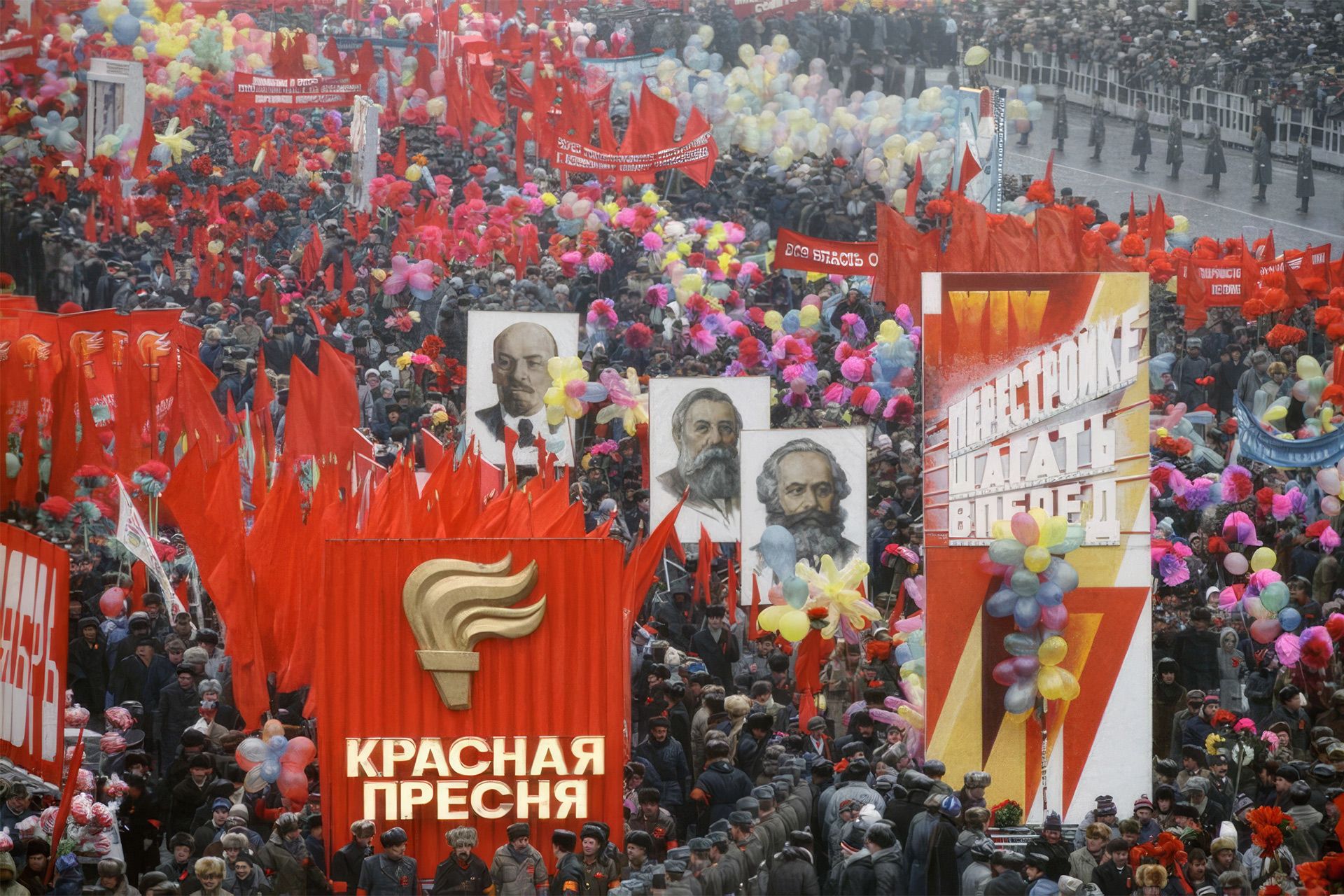
November demonstration, around 1988-1989. Photo: DR
The once-unnoticed “red day of the calendar” on November 7 is a reason to once again talk about some of the causes of the collapse of the Soviet model of socialism.
This model was defeated in every country in the world without exception that tried to build socialism on the Soviet model. Including, of course, those states where, say, as in China or Vietnam, a single infallible party still happily rules, bearing the name “communist”. But there too the red banners and ritual “communist” incantations are merely a cover for the vigorous construction of capitalism.
The issue, of course, is not words or party symbolism, but the socioeconomic base of these “communist” countries. And it is clear: in all these states we see today the triumph of capitalism — market relations multiplied by private ownership of the means of production.
For people who are alien to conspiracy theories, it is clear that the total collapse of the world system of that barracks-style state socialism, which existed in a wide variety of countries, happened not at all because “traitors” had infiltrated power in the USSR, China, or other countries of “real socialism”.
Obviously, the reason lies elsewhere. Namely, in the fact that the Soviet model of socialism had certain flaws, not only constructive but also theoretical, which over time undermined it from within.
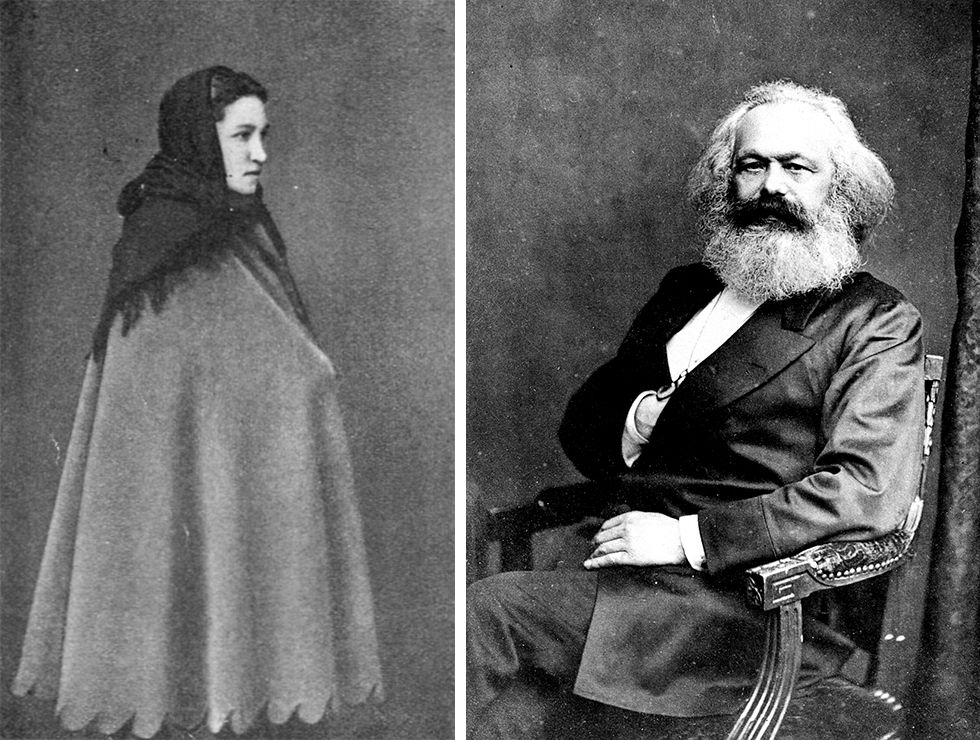
It seems that one of the conceptual theoretical errors of scientific communism, which led all subsequent revolutionary socialists “down the wrong path”, was the answer given by its founder, Karl Marx, to a letter from the Russian revolutionary, a member of “Narodnaya Volya” and one of the founders of Russian social democracy, Vera Zasulich.
On the left: Vera Zasulich; on the right: Karl Marx. Photo: Wikipedia
On February 15, 1881, Zasulich, who by then was making an ideological transition from populism to social-democratic and Marxist beliefs, asked the living classic to answer the question:
“Is it possible to build socialism in such a backward peasant country as Russia, relying on its rural commune?”
The fact is that many Russian revolutionaries of that time saw in the Russian commune the embryo of communism, to which Russia, in their opinion, could arrive by bypassing the horrors of early capitalism.
Marx hesitated, made several expanded multi-page draft sketches, but in the end, on March 8, 1881, sent her a short, one-page reply. Prefacing it with the ironic remark “regarding my so-called theory”, Marx wrote, in particular:
“The analysis presented in Capital, therefore, provides neither arguments for nor against the viability of the Russian commune. But special studiesTo study Russian history, Marx specifically learned Russian, which I carried out on the basis of materials drawn by me from primary sources, convinced me that thiscommune is the point of support for Russia’s social rebirth; however, for it to function as such, it would first be necessary to eliminate the noxious influences to which it is subjected from all sides, and then ensure for it normal conditions for free development“.
Thus, the answer of the European classic to the Russian revolutionary on this burning question was, on the whole, affirmative.
It is worth noting here that Marx devoted quite a lot of attention to the study of the rural commune. At the same time, he found no fundamental difference between the commune of the ancient Germans and the Russian or Indian commune of his own time, noting only different stages of its development among all peoples. Specifically, he distinguished a more archaic kin-based form of commune and a more modern neighbor-based.
The difference between these two types of commune, in his opinion, consisted mainly in the fact that the common ownership inherent in the first is already being replaced in the second — the neighbor-based one — by elements of private ownership.
It should be noted that this approach is generally shared by modern researchers of archaic societies.
However, the crucial point was that in this letter to Zasulich, Marx essentially departed from his own view of the progressive development of human society from simple forms to more complex ones. That is, from his famous “five-stage scheme”. Namely, from the idea that humanity on the road to communism passes sequentially through 1) the primitive stage of development, 2) the slave-owning system, 3) the feudal system, 4) the capitalist system, and 5) the communist system.
It must be admitted that this very notion of Marx’s “five-stage scheme” is to a significant extent the result of Soviet vulgarized “Marxism”.
In the same letter to Zasulich, Marx himself precisely emphasizes that his “so-called theory” applies first and foremost to Western Europe.
With regard to the East, and to a significant extent to Russia, Marx preferred to use the phrase “Asiatic mode of production” instead of the terms “slaveholding” and “feudalism”.
By “Asiatic mode of production” he meant a socioeconomic system that changed little in the East over many thousands of years of its history, the basis of which was precisely the rural commune, supplemented by craft production in the cities and despotic power at the center.
At the same time, Marx was categorically opposed to idealizing the peasant commune.
In the article “British Rule in India”, published in 1853 in the New-York Daily Tribune, he wrote: “however sad from the standpoint of purely human feelings the spectacle of destruction and disintegration” of this traditional rural commune, “we must nevertheless not forget thatthese idyllic rural communities, however harmless they may seem, were always the solid foundation of Eastern despotism, that they confined the human mind within the narrowest limits, making it a submissive instrument of superstition, placing upon it the slave chains of traditional rules“.
Marx’s closest associate Friedrich Engels, after the death of his friend, continued to maintain close relations with a number of Russian revolutionary émigrés, including Vera Zasulich.
In the preface to the German edition of the 1890 Manifesto of the Communist Party, Engels developed Marx’s thought expressed in his letter to Zasulich: “The question now is: can the Russian peasant commune — this, admittedly, already greatly shattered form of primitive common ownership of land — pass directly into the higher, communist form of common ownership? Or, on the contrary, must it first go through the same process of disintegration This refers to the transformation of communal property into private property, which is inherent in the historical development of the West?
The only possible answer to this question at present is the following. If the Russian revolution serves as a signal for a proletarian revolution in the West, so that both complement each other, then modern Russian communal ownership of land may become the starting point of communist development“.
So we see yet another, albeit with reservations, confirmation by the classic of Marxism of the idea held by many Russian revolutionaries who saw in the peasant commune the embryo of communist society.
Nevertheless, the dispute among Russian revolutionaries — whether socialism could be built in such a backward peasant country as Russia — did not end there. In fact, it continued right up to October 25, 1917, and even later.
The difference was only that in October 1917 this question shifted from being purely theoretical to being completely practical: should the Bolsheviks seize power or not? At that moment, even within the camp of the far-left socialists — the Bolsheviks — there was no consensus on this matter. At the meeting of October 10, 1917, members of the Central Committee of the RSDLP(b), Lev Kamenev and Grigory Zinoviev, voted against the decision on armed uprising.
More than that. On October 18 (31), 1917, Kamenev, in an interview with the newspaper Novaya Zhizn, effectively revealed the plans of the radical wing of the Bolsheviks to prepare the overthrow of the Provisional Government: “Not only I and comrade Zinoviev, but also a number of practical comrades believe that taking on the initiative of an armed uprising at the present moment, given the current balance of social forces, independently and several days before the Congress of Soviets, would be an impermissible, fatal step for the cause of revolution and the proletariat”.
Lenin, who at that moment was underground, was furious, called Kamenev and Zinoviev strikebreakers, and demanded that they be expelled from the party. At this moment, the “loyal Leninist” Stalin, who then headed the party organ of the RSDLP(b), the newspaper Pravda, published in it, on behalf of the editorial board, an article effectively in defense of Kamenev and Zinoviev, accusing Lenin of “harshness of tone” toward them and reporting that “in the main we remain (with them) of one mind”.
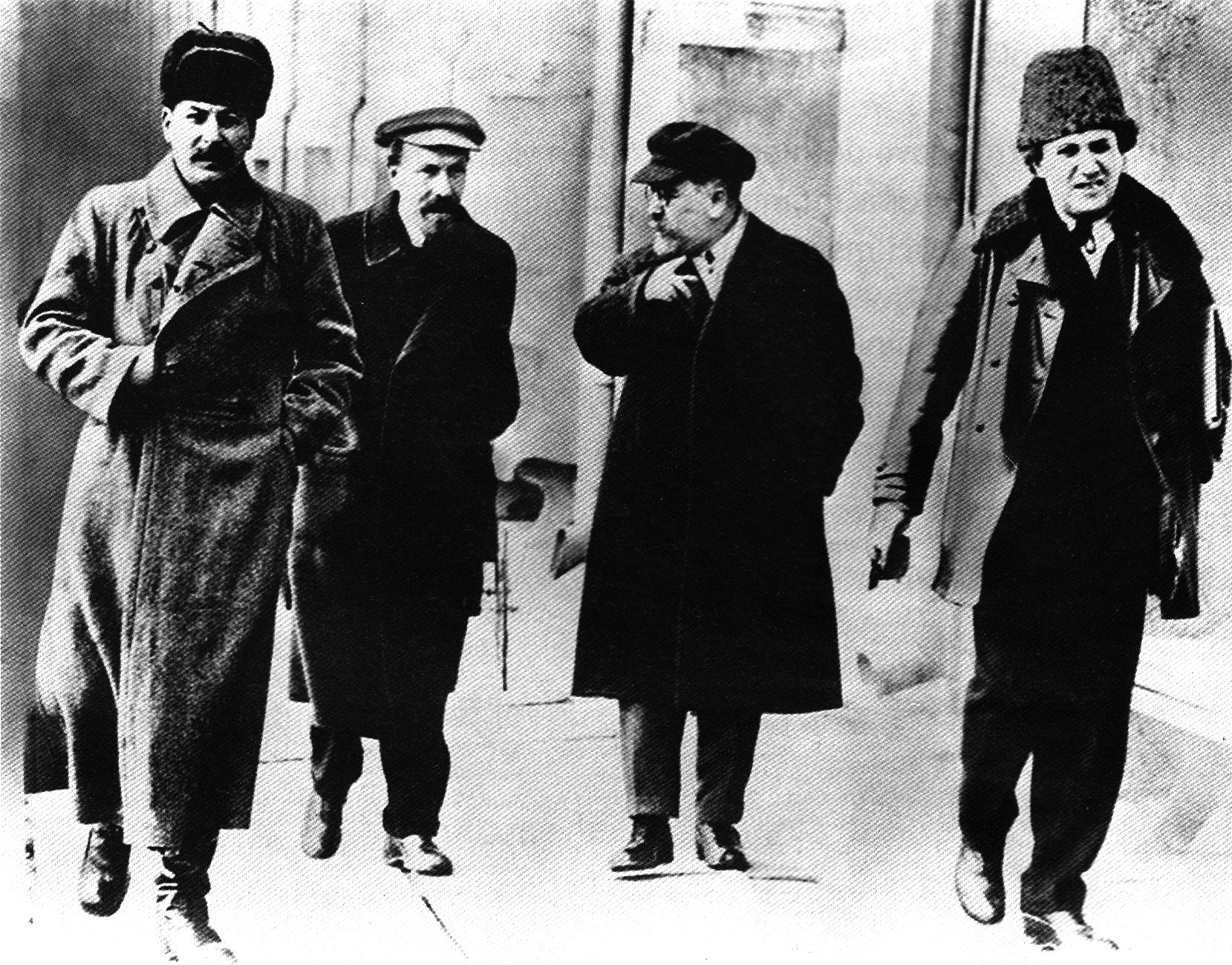
Stalin, Rykov, Kamenev and Zinoviev, 1925. Photo: Wikipedia
Trotsky later wrote indignantly about this, saying in essence that “Stalin single-handedly — against the Central Committee and against his colleague on the editorial board (Sokolnikov) - supported Kamenev and Zinoviev four days before the uprising“.
More than that, on the eve of the armed uprising, on the morning of October 24, when the leadership of the RSDLP(b) decided to begin it, forbidding members of the Central Committee to leave Smolny, which had become the headquarters of the Bolshevik revolution, Stalin suddenly disappeared from it.
Trotsky explained Stalin’s behavior on the eve of the October Revolution as follows: “The issue is not personal cowardice — there is no basis for accusing Stalin of that — but political duplicity. The cautious strategist preferred to stay on the sidelines at the decisive moment. He maneuvered and waited in order to determine his position depending on the outcome of the uprising“.
Whether Trotsky was right in explaining Stalin’s maneuvers on the eve of and during the October Revolution solely by his opportunism is hard to say now.
On the one hand, Trotsky, as the practical leader of the uprising of October 25 (November 7), 1917, was both a witness and a direct participant in those events.
On the other hand, it is also a fact that Stalin, at least up to 1924, was convinced that socialism could not be built in the USSR without the help of the developed countries of the West.
On this issue, as on many others, Stalin, who never had his own ideas on the key problems of socialist construction, always merely picked up other people’s ideas, including some of Trotsky’s own ideas. He was not original on this issue either.
Zinoviev and Kamenev (the latter returned on the morning of October 24, 1917, both to the Central Committee, which he had left, and to the revolutionary headquarters at Smolny) were not only forgiven, but later appointed to high positions in the Soviet government. Lenin, despite his hot temper, understood that their disagreements were purely theoretical. And in such matters, if they did not concern direct betrayal of fundamental views, he always showed tolerance.
All the more so because the idea that socialism could be built “in one, single, and very backward country” — especially in the agricultural sphere, which formed the basis of its economy — without the help of the developed Western states was shared by a significant part of the leaders of the RSDLP(b) of that time. Including Lenin himself. One of his last articles, “On Our Revolution”, published after the end of the Civil War in the spring of 1923, was also devoted to this question
If you enjoyed this article, consider making a donation — one-time or, even better, monthly. Your support helps us motivate our authors and become better with every article.
Our organization is recognized by the Internal Revenue Service (IRS) as a 501(c)(3) tax-exempt, charitable organization, which means that all contributions made to us are tax-deductible to the fullest extent permitted by U.S. law. Individuals may generally deduct charitable contributions of up to 60% of their Adjusted Gross Income (AGI) for cash donations made to qualifying 501(c)(3) organizations. For donations of appreciated assets (such as stocks or other long-term capital assets), the deduction is typically limited to 30% of AGI, based on the fair market value of the asset. C-corporations may deduct charitable contributions of up to 10% of their taxable income for donations made to eligible charitable organizations.
By submitting a donation, you confirm that you have read and accept the following documents: Privacy Policy and User Agreement, and also give consent to the processing of your personal data.
If you would like to unsubscribe from a monthly donation, please email us at: [email protected]