On a rainy spring day in 1976, FBI special agent Myron Fuller took the subway to Brooklyn to speak with a young businessman who was just starting out in real estate. His interlocutor was only 30 years old and was effectively living on his father’s money. Fuller found the young man in his cluttered and dirty office, which was located in a trailer on a construction site on the outskirts of Brooklyn. The owner of the trailer was Donald Trump.
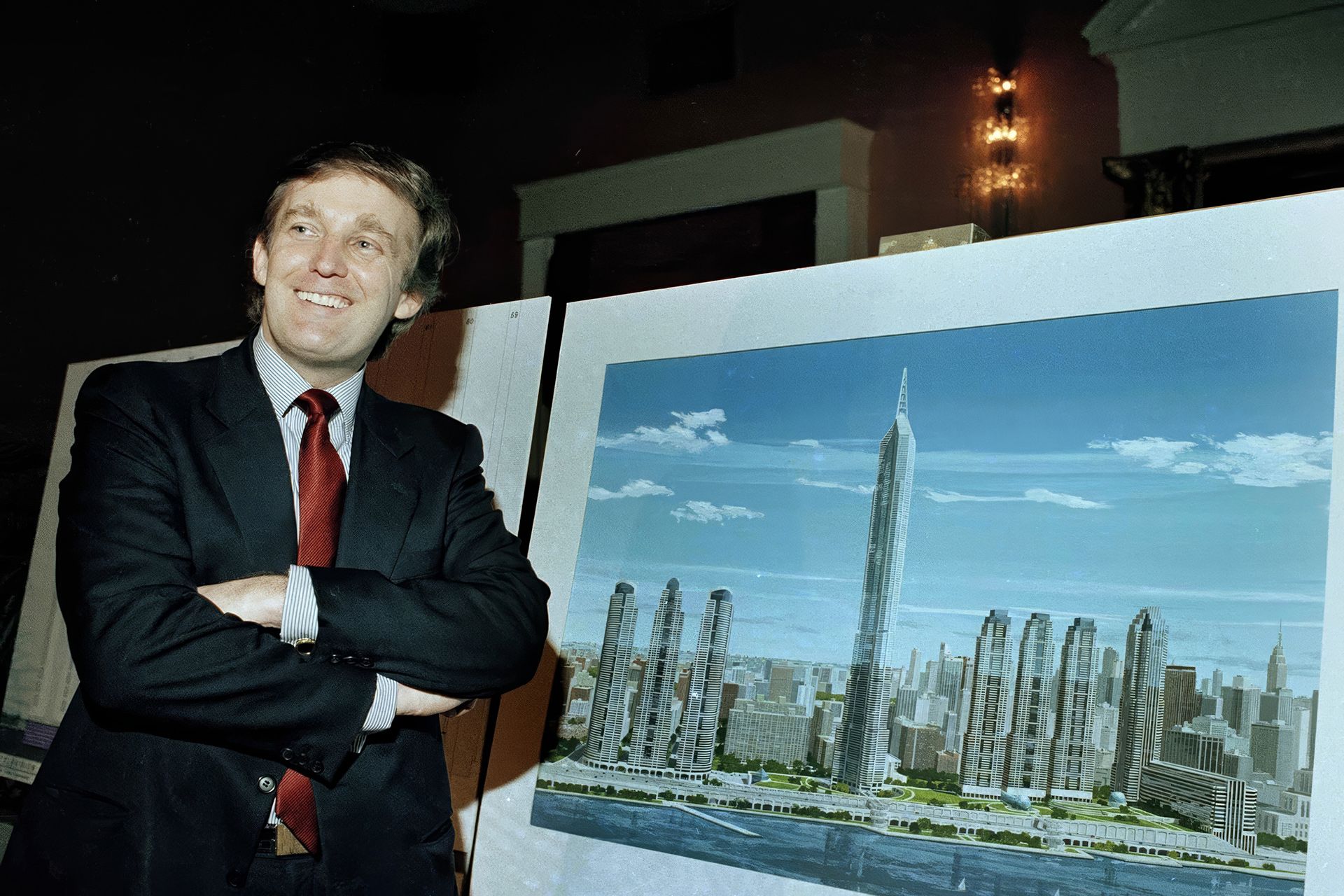
Donald Trump against the backdrop of a sketch of his ambitious Television City project on November 18, 1985, in New York. Photo: AP Photo / Marty Lederhandler
“Instead of cement paths there were boards covering the wet ground”, Fuller later recalled. He knocked and entered the trailer. The businessman never got up to greet the agent — Fuller does not even remember Trump shaking his hand.
The agent was carrying out an assignment from the FBI office in Miami. He had to verify information from a source who claimed that the southern branch of “Cosa Nostra” had asked Trump to act as a straw buyer for the Fontainebleau hotel. Once, this oceanfront hotel was a favorite meeting and party place for movie stars and millionaires, but even more it was known as a secret rendezvous spot for mafia bosses, whom Sam Giancana, nicknamed “Big Mo”, hosted at the Fontainebleau. He led the Chicago mob from 1957 to 1966, but Giancana’s influence knew no bounds. At the Fontainebleau, Mo met with CIA agents more than once to plan the assassination of Fidel Castro. Mo’s name also appears in the Kennedy assassination case.
In 1976, the Fontainebleau was on the brink of bankruptcy, and the mafia needed a straw buyer. Fuller asked Trump a simple question: did he want to buy the hotel? Trump replied that he had only “heard” that someone wanted him to act as the buyer. Myron Fuller closed his notebook, and Trump kindly called a driver to take the agent from Brooklyn to Manhattan.
Myron Fuller, who became famous after an FBI operation that formed the basis of the feature film “American Hustle”, forty years after this meeting told Newsweek that he regretted that a warning bell had not gone off for him then in Brooklyn. The investigation into Donald Trump’s role in the hotel purchase was suspended, but the name of the 30-year-old developer from the trailer was forever entered into the U.S. FBI file with the note “mob associate”. No U.S. president had a detail like that in his biography.
The mafia lawyer
The lawyer, senior companion, and mentor on Trump’s thorny path to success in New York’s darkest alleys was the famous Roy Cohn — former lawyer to Senator Joseph McCarthy, one of the city’s most influential specialists in settling delicate problems that arose between politicians and the mafia. The Trump family first hired Roy Cohn in 1973, when the U.S. Department of Justice accused their company of racial discrimination against tenants.
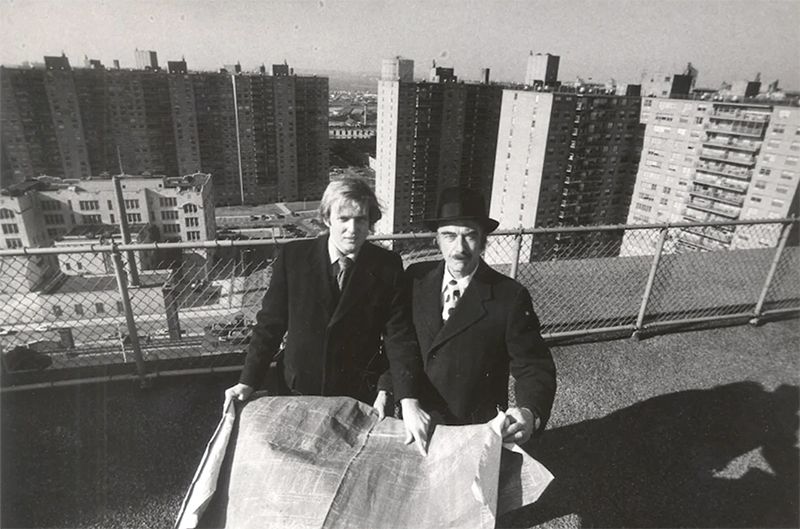
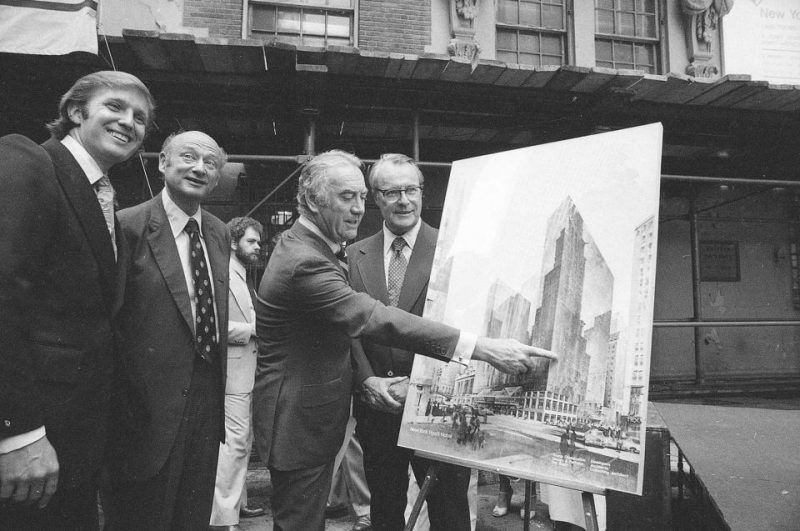
Donald Trump and his father Fred at the construction of Trump Village. Photo: Barton Silverman / The New York TimesDonald Trump (left), New York City Mayor Ed Koch, and New York State Governor Hugh Carey (center) at the presentation of the Grand Hyatt New York hotel project, June 28, 1978. Photo: New York Times
The case“United States v. Fred C. Trump, Donald Trump, and Trump Management” was heard in Brooklyn court for about two years; the Trump family was suspected of refusing to rent apartments to African Americans and Puerto Ricans. In the 3,700-unit Trump Village complex in Brooklyn, only seven Black families lived there in 1967. Lawyer Roy Cohn was a real magician — he secured a settlement by shouting and arguing with the judge.
The young 27-year-old manager listened to Cohn’s speech, holding his breath, and learned a great deal in court then: never admit guilt, hit back, and present a settlement as a victory.
Among Cohn’s clients were the biggest figures in the American mafia: Anthony “Fat Tony” Salerno, who became boss of the Genovese family after the death of “Don Vito”, Carmine Galante of the Joe Bonanno family, and also the Gambino family associate Carlo Gambino’s “Teflon Don” John Gotti. Journalist and Cosa Nostra researcher Sidney Zion claimed that Roy Cohn personally defended Gambino clan head Paul Castellano. Tony Salerno and Castellano were frequent and welcome guests at the lawyer’s mansion on East 68th Street.
Trailer for the film Apprentice (2024, directed by Ali Abbasi), which tells the story of Donald Trump’s acquaintance with Roy Cohn
It was exactly at the time when FBI agent Myron Fuller was questioning young Donny at the Brooklyn construction site that Roy Cohn hired a former Connecticut state prosecutor into his law office, a lawyer who had represented local mobster Andrew D’Amato, who was trying to buy the Fontainebleau hotel. Secret FBI information that D’Amato wanted to “put the asset in a nominee’s name” is what led the bureau to Trump’s trailer.
Roy Cohn died in 1986, by which time he had been disbarred. But Trump remembered him decades later: during difficult moments of his first presidency, he often complained that he did not have “his own Roy Cohn” nearby.
Fat Tony’s concrete
Roy Cohn’s clients controlled New York’s construction unions, without whose blessing no major project could be completed. In the 1980s, the mafia controlled the city’s concrete market: in Cosa Nostra’s hands were both the supply of the material and the unions that delivered and poured that concrete.
David Cay Johnston, a Pulitzer Prize winner who covered Trump’s affairs for nearly three decades, asked a question in a Politico article in 2016 that many later repeated: why was the 58-story Trump Tower built not on a steel frame but out of reinforced concrete? Yes, concrete speeds up construction and does not require expensive fireproofing, but it immediately makes the developer hostage to the unions: any concrete truck strike turns into a catastrophe.
According to Johnston and Village Voice journalist Wayne Barrett, Trump repeatedly bought concrete in one place — from S&A Concrete, which was owned through front men by Tony Salerno and Paul Castellano, to whom the buyer paid well above market rates. A later federal indictment against Salerno mentioned a nearly $8 million contract for the construction of the Trump Plaza residential complex in Manhattan as one of the criminal episodes in the history of “Fat Tony”, who was convicted in 1986. But while he was free, all his partners in the construction market could be sure: the unions would stay quiet, and the projects would not stop.
Wayne Barrett wrote that Trump was introduced to Salerno by Roy Cohn, and this happened just when other New York developers were begging the FBI to free them from mafia control over the construction concrete market.
The same era also includes the demolition of the Bonwit Teller department store, a 1929 Art Deco building on Fifth Avenue, on whose site Trump Tower eventually rose. Ronald Fino, the son of the Buffalo mafia boss, personally ran Local 210 of the construction workers’ union in Buffalo for about 15 years; it was tied to the mafia, and for eight years he held a post in the union’s national leadership. All that time Ronald Fino secretly and for pay worked for the FBI, receiving $7,200 a month. After “retiring”, he told Newsweek journalists that the department store demolition was assigned to a window-washing company, which hired 200 undocumented Polish workers known as the “Polish Brigade”. They worked 12 hours a day, seven days a week, without hard hats, goggles, or masks, and dismantled the twelve-story building by hand, with sledgehammers. They were paid about $4 an hour. During the demolition, all the Art Deco bas-reliefs that Trump had promised to donate to the Metropolitan Museum disappeared or were smashed, and asbestos was dumped near abandoned docks in Brooklyn. That is how Trump and his partners cleared space for themselves in the market.
Martin Scorsese’s film The Irishman (2019) tells the story of the mafia’s ties to the Teamsters union and Jimmy Hoffa, played by Al Pacino
The International Brotherhood of Teamsters union, thanks to which the great and terrible union boss Jimmy Hoffa, whose body has still not been found, became famous in large part, was founded in 1903 and over time became one of the largest unions in the United States. The Teamsters were linked to Cosa Nostra for decades, and Local 282 in NYC was their main nest and headquarters. It was run by John Cody, the “boss of construction sites”. When unions in New York declared a citywide strike, the only project where work did not stop for a single minute was Trump Tower.
John Cody’s son, Michael, told The Daily Beast that his father could often stop a construction project when the developer’s behavior displeased him, but Trump himself would immediately call, starting the conversation with the words: “Whatever you say, John”. Michael Cody summed up the nature of their relationship briefly: his father “walked all over him”. In 1984, Cody was convicted of racketeering and tax evasion. Trump would later say of him: “I barely even knew him. He was a bad guy”.
Atlantic City: betting on the mafia
As early as 1981, Trump decided to enter Atlantic City’s gambling business. This “industry” had historically been under strong mafia influence. According to an FBI memo, published by BuzzFeed, in April 1981 Trump himself came to the bureau, expressed “concerns” about the mafia’s dominance in gambling, and offered to “fully cooperate” — including allowing FBI agents to work undercover in his future casino.
Trump’s intermediary in contacts with the gambling business was Daniel Sullivan, who was well known to the Bureau because he combined a gangster career in Cosa Nostra with work as an FBI informant. Trump’s ties to Sullivan were the subject of a separate section in a report by the New Jersey Division of Gaming Enforcement, prepared in October 1981 for the Casino Control Commission. At the hearings, Trump denied under oath any mafia ties, and he did in fact receive the casino license.
Donald Trump in 1985. Photo: Neal Boenzi / New York Times
In 1983, Trump, through an intermediary, bought the abandoned nightclub Le Bistro for $1.1 million; it had belonged to Salvatore Testa, the son of Philadelphia mob boss Philip “Chicken Man” Testa. Salvatore was soon killed in a conflict with Philadelphia’s new boss, Nicky Scarfo. Trump then immediately met Scarfo’s accountant Kenny Shapiro, who helped Trump buy land for the casino.
Trump Plaza became the most desirable vacation spot for guests of all kinds of criminal backgrounds, and one of the casino’s regulars was Robert Libutti, a racehorse trader who lost millions of dollars at Blackjack. Libutti repeatedly discussed with Trump Plaza managers the possibility of inviting the well-known John Gotti, the top mobster in New York at the time, whom Robert affectionately called “my boss”, to the casino. There was a problem with that: Gotti’s name was on the blacklist of people already banned from casinos in the United States. In 1991, the New Jersey Casino Control Commission fined Trump Plaza $200,000 for removing Black people and female dealers from the tables for Libutti’s sake, and another $450,000 for luxury cars worth $1.6 million given to the honored guest on behalf of the casino. In August 1991, Robert Libutti was permanently banned from all casinos in the state. Trump was upset — losing good customers was not his way.
Trump later said he would not have recognized Libutti even if he were standing in front of him now. However, in 2016, Yahoo News ran a segment that clearly shows Robert Libutti sitting in the front row next to Donald Trump for three and a half hours at a fight, and it does not look at all like Trump does not know his neighbor. Libutti’s daughter later said that her father often flew on Trump’s helicopter and had been on his yacht many times. Still, Trump learned to forget what he did not need from the great Roy Cohn.
In the gaming business, Trump made so many new friends that his reputation quickly crossed the borders of the United States.
When the Kern/Trump consortium fought in 1987 for the right to build the first casino in Sydney, New South Wales police prepared a secret report calling the casino project extremely dangerous. Police recommended excluding the consortium from the competition and cited the reason as “Trump’s connection to the mafia”. Since then, Donald Trump has not liked Australia. But he dislikes paying taxes even more.
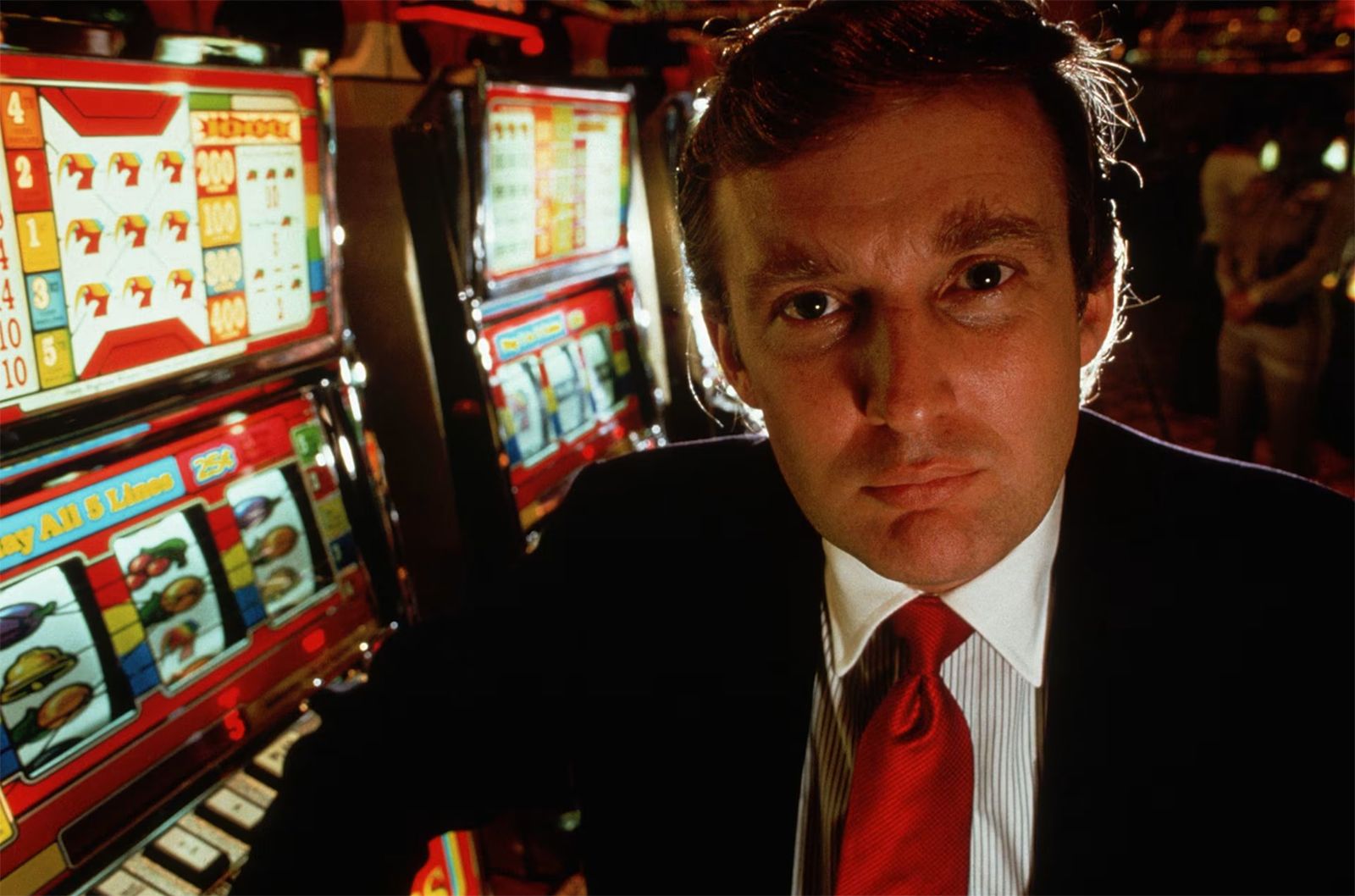
Donald Trump against the backdrop of slot machines during the opening of his casino resort Trump Taj Mahal in Atlantic City, New Jersey, in March-April 1990. Photo: Getty Images
According to the U.S. tax service, in the early 1990s the Trump Taj Mahal casino violated anti-money-laundering rules 106 times during its first six months of operation. In 1998, FinCEN, the Treasury Department’s financial crimes unit, fined it $477,700. Roy Cohn taught Trump — never admit your mistakes or your crimes. The casino paid the fine without admitting guilt. In 2015, a $10 million fine followed. This time Taj Mahal admitted that the violations were “intentional”, and money had been laundered for years. But by 2015 Trump was no longer running the company, and he had left the board back in 2009. Otherwise the casino would not have admitted anything.
The Russian trail
The history of Trump’s relationship with the so-called “Russian mafia” is described in detail on Most. The author of these lines personally met in the isolation cell of the Metropolitan Correctional Center with Vyacheslav Ivankov, who was awaiting trial there and is better known in Russia as the “thief-in-law Yaponchik”. After the interview ended, Ivankov called from the corridorthe MCC colleagues who had invited our film crew to the restaurantParadise at Fort Hamilton Parkway, Brooklyn. I knew that Ivankov lived nearby and had been arrested by an FBI tactical team led by agent Barry Levinson precisely in Brooklyn. But in American journalist Robert Friedman’s book “Red Mafia” another address was mentioned, where FBI agents were looking for the thief-in-law.
Yaponchik’s trail led straight to Trump Tower. FBI agents also repeatedly met him at the Taj Mahal casino, and after his arrest his notebook would contain the number of his private residence in Trump Tower and a fax number for the Trump Organization.
In 2011–2013, the FBI tapped apartment 63A in Trump Tower, which was located just one floor below Donald Trump’s private apartment. Apartment 63A was home to professional poker player Vadim Trincher, who, according to the FBI, ran an illegal gambling business right in the building on behalf of certain influential “Russian oligarchs”. According to Trincher’s indictment, in just the first two months of the illegal casinos’ operation, the bookmaker network transferred $20 million in cash to Ivankov’s longtime friend and “number one card sharp” Alimzhan Tokhtakhunov, better known in Moscow as “Taiwanchik”. In April 2013, FBI agents searched Trincher’s apartment, and in November of that same year Tokhtakhunov, who had already been wanted in the United States, was not sitting in a prison cell but in the Moscow VIP area of the Miss Universe pageant, organized by Trump’s company.
Vadim Trincher received five years in prison for organizing illegal games. His Trump Tower neighbor,art dealer Hillel Nahmad, was also arrested and in November 2013 pleaded guilty to organizing a multimillion-dollar gambling business in Trump Tower. Hillel Nahmad received a presidential pardon literally in the final hours of Donald Trump’s first term, in January 2021. The slogan “We don’t abandon our own” is popular not only in the Kremlin, but also in Manhattan business circles, where these words became the law of the street back in the days of Tony Salerno and Vito Genovese.
A secret informant or a “double agent”?
The most intriguing question in Trump’s biography is his relationship with the FBI itself. Former special agent Mark Rossini told The Newsweek that Trump was constantly seen at the bureau’s New York office and that he may have been a secret informant for James Kallstrom — a wiretap specialist who led many investigations against the mafia. Kallstrom himself, a close friend of Trump’s, denied it. Writer Craig Unger, author of the book “House of Trump, House of Putin”, also believes that Trump was not an FBI informant. He simply had a talent for making friends both in the bureau and on the other side of the front line, profiting from his connections.
Trump’s offer to “fully cooperate” with the FBI, which Donald Trump made in 1981 at the Bureau’s New York office, does not refute but rather confirms the version — a man who dealt with the mafia simultaneously maintained close relations with those who fought it.
U.S. FBI Director James Comey, who led the Bureau from 2013 to 2017 and began his career as a mafia prosecutor, wrote in his 2018 memoirs that talking with Trump and his entourage brought back flashes from the past: a silent circle of consent, total boss control, mystical loyalty, vows of allegiance, and an oath of silence. Publicly demanding “loyalty to the boss” at a White House dinner, Comey compared it to an initiation rite in Cosa Nostra.
Trump himself gave reason for such comparisons. In August 2018, when his former lawyer Michael Cohen began cooperating with investigators, Trump said that cooperation by former members of his team with investigators “should be forbidden”. In December he called Cohen a “rat” — that is how traitors are branded in Cosa Nostra. Former Nixon lawyer John Dean, whom Trump also referred to as a “rat”, replied that the president thinks, acts, and speaks like a mafia boss. Maybe he is the boss?
Donald Trump was never charged in mafia-related cases, and, as Newsweek acknowledged, there were no serious attempts. Trump’s lawyers point out that in 1980s New York practically any developer working with concrete in one way or another dealt with mafia-controlled firms. Trump himself consistently answered questions about such acquaintances the same way: I don’t remember that, I barely knew that one. That is exactly how Roy Cohn always built Cosa Nostra’s defense strategy.
***
P.S: In November 2026, nine members of the family of former U.S. President John Fitzgerald Kennedy filed a lawsuit against the construction of Donald Trump’s 76-meter triumphal arch in Washington, between the Lincoln Memorial and Arlington Cemetery, where John Kennedy and his brothers Robert and Edward are buried.
The Kennedy family statement says, in particular, that the arch “will cast a shadow over the graves of the former president’s relatives”. The case file on John Kennedy’s assassination contains many materials mentioning Sam Giancana, Tony Salerno, and the most influential mafia families of New York, which have already cast a sinister shadow over the history of the White House and its inhabitants. The shadow of Trump’s Triumph Arch on JFK’s grave may become the final and mystical point of this detective-political story.
If you enjoyed this article, consider making a donation — one-time or, even better, monthly. Your support helps us motivate our authors and become better with every article.
Our organization is recognized by the Internal Revenue Service (IRS) as a 501(c)(3) tax-exempt, charitable organization, which means that all contributions made to us are tax-deductible to the fullest extent permitted by U.S. law. Individuals may generally deduct charitable contributions of up to 60% of their Adjusted Gross Income (AGI) for cash donations made to qualifying 501(c)(3) organizations. For donations of appreciated assets (such as stocks or other long-term capital assets), the deduction is typically limited to 30% of AGI, based on the fair market value of the asset. C-corporations may deduct charitable contributions of up to 10% of their taxable income for donations made to eligible charitable organizations.
By submitting a donation, you confirm that you have read and accept the following documents: Privacy Policy and User Agreement, and also give consent to the processing of your personal data.
If you would like to unsubscribe from a monthly donation, please email us at: [email protected]