Upsala-Circus is a social circus project for children and teenagers in difficult life circumstances. It was founded in 2000 in St. Petersburg by director Larisa Afanasyeva together with her German colleague Astrid Schorn. After the start of the full-scale war in Ukraine, Larisa, together with part of the team, left Russia and moved to Germany. For four years now, Upsala-Circus has been working in Zeitz, a small town in Saxony-Anhalt. It is here that the far-right party “Alternative for Germany” (AfD), which is gaining popularity thanks to anti-migrant slogans, is currently leading in the regional elections.
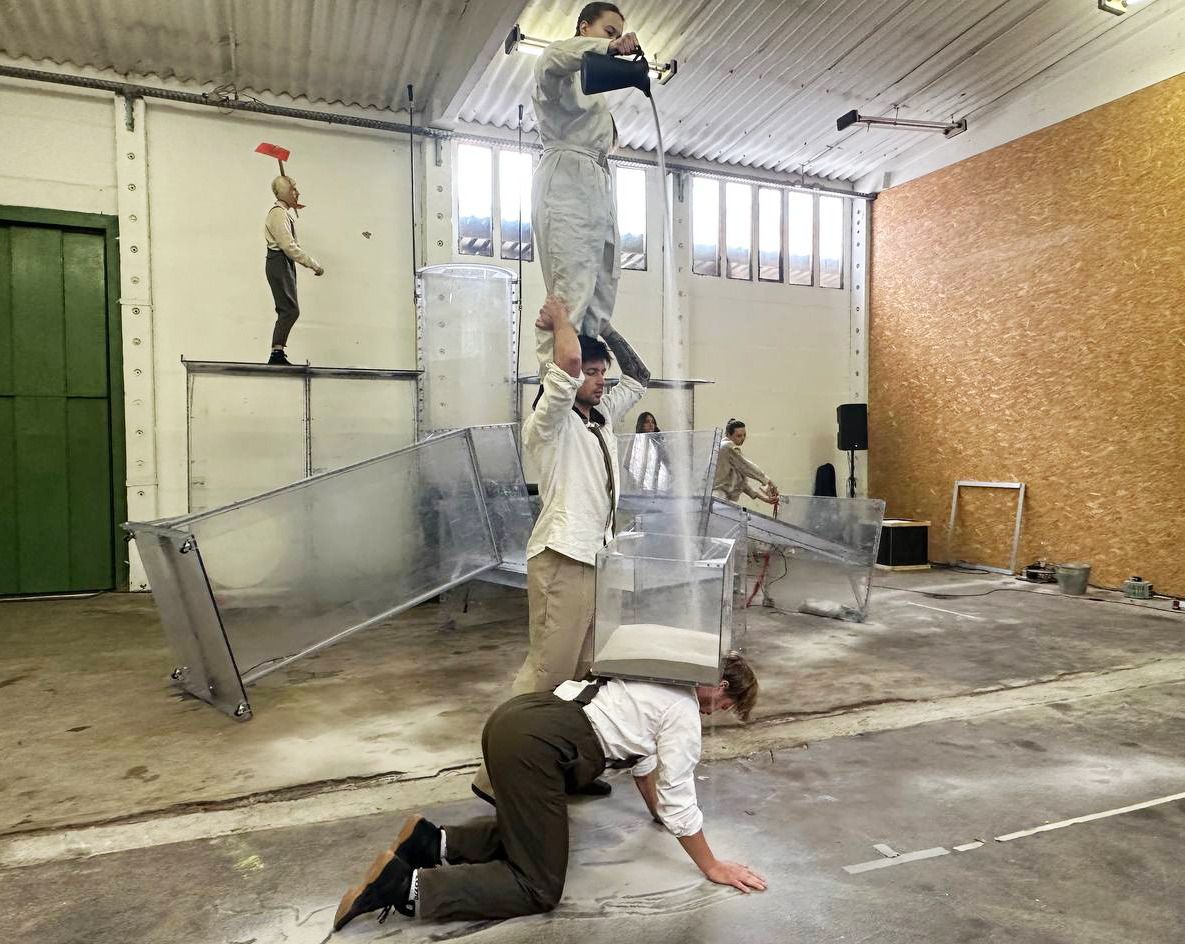
Upsala-Circus rehearsals take place in the building of a former garage, which was handed over to the troupe free of charge in 2022. Photo: Daria Chalikova
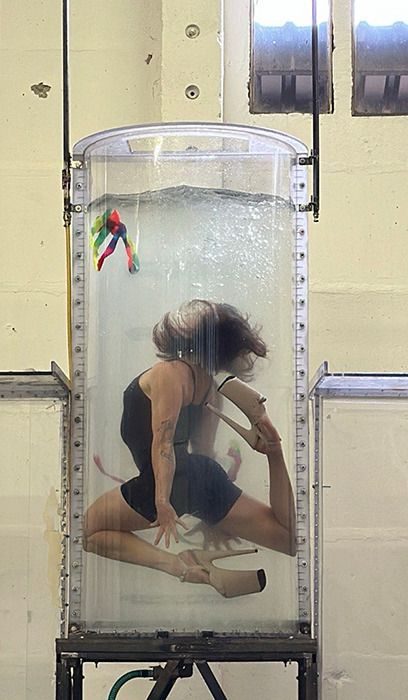
Upsala-Circus works with more than 120 children and teenagers, including both children from migrant families and local residents. And right now it is staging a performance about the history of the Bauhaus art school: on September 4 and 5 in Dessau, as part of the Bauhausfest “Salto/Takt/Form”, the circus will present the street performance “Heiterkeit” (“Cheerfulness”), created by an international team of artists from Germany, France, and Israel. At first glance, why would a social circus working with migrant children need a plot that would seem interesting only to art historians? But the experiments of the Bauhaus, founded in Weimar in 1919, influenced the way buildings, objects, typography, and visual culture look around the world today. In 1933, the Nazis closed the school, and its representatives were faced with a choice: emigrate or adapt to the new regime.
We spoke with the artistic director of Upsala-Circus about whether joint creativity can reduce fear and aggression in society and what happens to a cultural project in exile on territory where migrants are not welcome.
- A year ago you said in an interview that you need to get out of the Russian “bubble”. Do you feel that Upsala-Circus has now left it and become a German or European project in Germany, rather than a Russian one?
- I think we are indeed moving toward creating an international team. This is especially noticeable now in the composition of the trainers: we work with German specialists, and recently trainers from Morocco and Colombia joined the team. For us, it is very important not to close ourselves off within one culture, but to create an international space. I can confidently say that we already exist in this direction. Of course, there are things that hold us back, limit us, and do not allow us to develop quickly, but that is part of life, and we accept it.
At a rehearsal of the performance “Heiterkeit”. Photo from the Upsala-Circus archive
- And how does the aesthetics of the performance and of the circus in general change when people with different cultural experiences take part in it? What has changed, and what did you have to give up? Or what, on the contrary, have you gained?
- If you compare it roughly, for example, with Neukölln, the multicultural district of Berlin where new cafés and cultural spaces keep appearing and new communities keep forming, then it becomes clear what happens where there is no cultural exchange. It becomes closed off, the space gradually grows poorer, more monotonous and dull. But when new languages, music, colors, and cultural habits appear, that, on the contrary, becomes a huge gain. For me, it is like a carpet in which different bright, bold colors are woven together. And I am very grateful to the people who are ready to enter this shared home, are not afraid of one another, and keep it open.
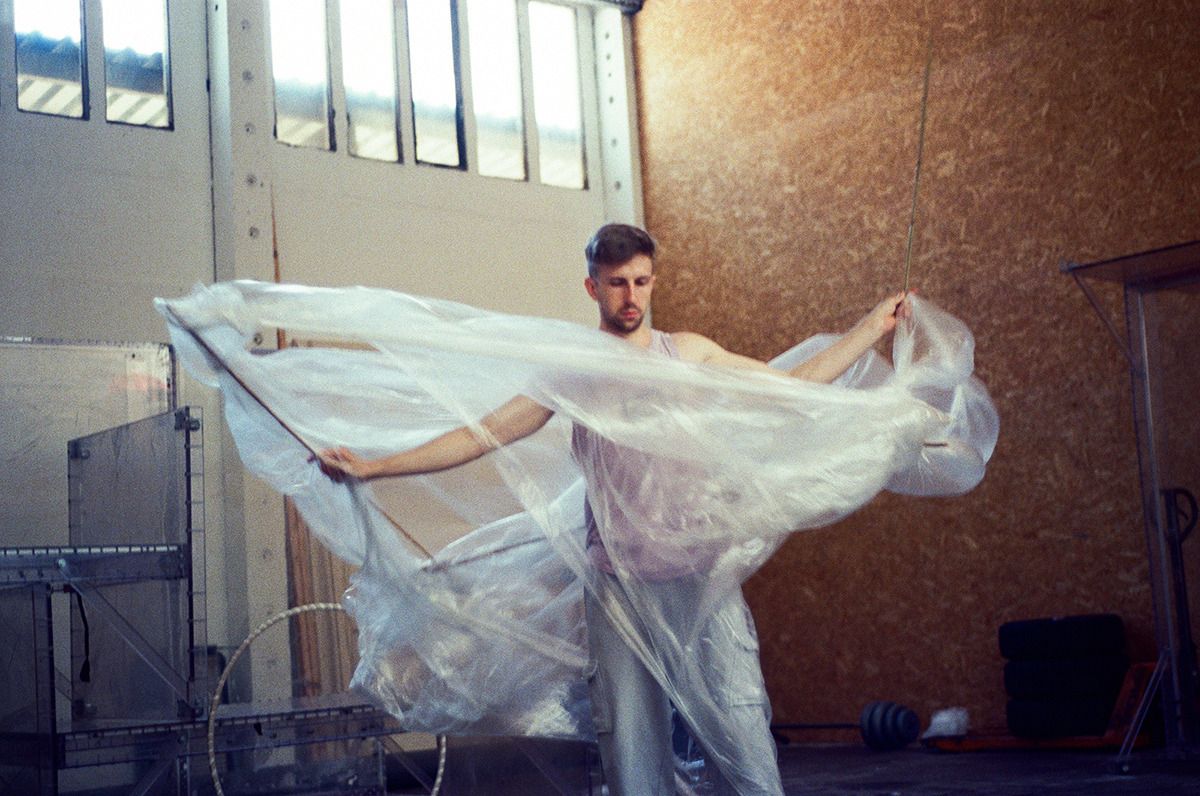
At a rehearsal of the performance “Heiterkeit”. Photo from the Upsala-Circus archive
- “Upsala” was never just a circus; you always had some social functions. Where does art end for you and activism begin? I’m interested to hear your opinion on multiculturalism, which modern German right-wing forces are working against. Have you had any problems because of this?
- We formulated the mission of Upsala-Circus as “Circus open to life”. Although that sounds quite broad, for us it means something very concrete: we do not distance ourselves from what is happening to us. And this performance, which we are now staging as part of the Bauhaus centenary, is precisely about that. Can you imagine the astonishing self-repetition of history? One hundred years of Bauhaus. It is a story connected to the development of nationalist ideas in Germany. From the very beginning, Bauhaus was subjected to enormous criticism from the state: a hundred years ago it was accused of cosmopolitanism and of rejecting traditional values. We know this list of arguments by which culture can be declared alien or dangerous.
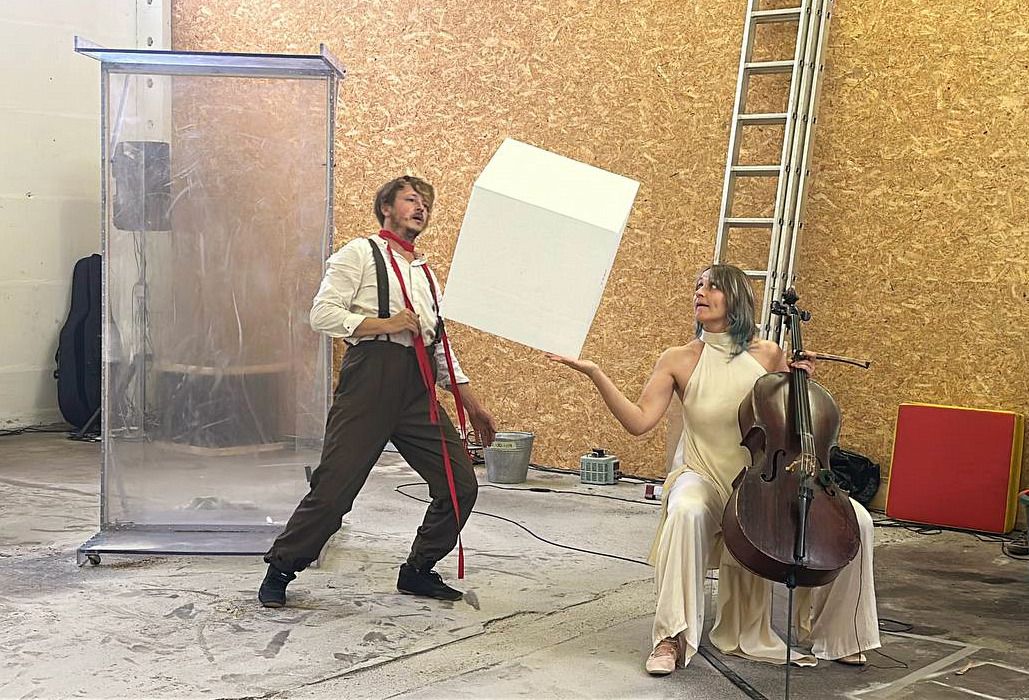
At a rehearsal of the performance “Heiterkeit”. Photo from the Upsala-Circus archive
And today I read an article saying that AfD is in fact using similar rhetoric in its criticism of Bauhaus. And for us it is especially important that we, people with Russian and migrant backgrounds, are now taking the stage in Dessau. But in the performance we speak not so much about the form of Bauhaus, because its aesthetics are only the first layer, but about the history of Bauhaus itself as a history of human choice.
It is the story of people who came there after the First World War, were in a very specific postwar frustration, but nevertheless found within themselves the strength and desire to live, create, and experiment. In this attempt to live freely, in this passion for life and freedom, they created absolutely astonishing forms that we still live with today, that still nourish and inspire us.
The title “Heiterkeit” is, of course, for us a unique gift of the German language, which we encountered in Merab Mamardashvili. We were talking precisely about what is important to us now, what inspires us, where we received the impulse in the culture and philosophy of Bauhaus. It is a story about people who, despite the impossibility of living in the old culture, despite the experience they went through and everything that happened to them, continued to live and create. For us, this is in a sense resistance to evil.
Therefore, this production is an opportunity to share emotions and thoughts: yes, friends, we are going through an absolutely astonishing tragic moment together, but we have one another. We understand what is happening, we see it, and we continue to live. We do not turn to the wall, we do not withdraw from life, we do not allow ourselves to be drained of strength. We continue to see this life as it is.
At a rehearsal of the performance “Heiterkeit”. Photo from the Upsala-Circus archive
And in Merab Mamardashvili, “Heiterkeit” is tragic cheerfulness. Perhaps that is why, if we talk about activism, I would not call it activism. It is rather a story about how we are inspired by life, how we see it, and how we process the events that happen to us.
But it is generally astonishing that now, at the centenary of Bauhaus, such a repetition of the circle is emerging, such a carousel of history. For us, it is a great responsibility to make such a statement precisely at this moment. This is a very important moment, a real peak, and we truly feel that responsibility.
- And what has changed in the city itself thanks to Upsala-Circus in Zeitz? And has anything changed at all? I’m interested in hearing about the social work. And again, you said you described your work as a utopia. After the move, does this utopia seem real, have you brought it to life, or has everything become even more utopian? How do you feel about it?
- Against the backdrop of what is happening, this utopia becomes even more pronounced and acquires additional meanings. The contrast between development, support, and the fear that exists in society becomes much more visible.
If we talk about Upsala-Circus as a phenomenon in our city, about 120 children and teenagers come to us every day. This year we decided to physically change the space in which we work. It was an ordinary GDR-era garage, and against the backdrop of the city’s general neglect it looked rather sad. We wanted to make it warmer, livelier, so that when a person walks by, they feel that something important is happening inside.
We hung up lights and made a large photo exhibition with portraits of our kids. It was important to us that people who know nothing about what is happening inside could simply walk past, see the photos, and understand: ah, there are such people here, you can get to know them. We were very afraid that the photos would be slashed or covered in graffiti. But the exhibition has been hanging for more than half a year now, and there is not a single piece of graffiti on it, not a single cut, nothing has been drawn on it. For me, this is a very interesting dialogue with the city. I don’t know why it is happening, but it is happening.
And of course, this is a meeting place and a safe space for us, for the children and teenagers who come here, for their parents, for the audience. Perhaps, without false modesty, I can say that it has become an important and meaningful place for me, for our team, for colleagues, for the children and their parents, as well as for people who care about the future of the city and want to see it developing rather than stagnating.
- Who do you work with today at Upsala-Circus? Do your participants include both children with migration experience and children from local German families? And can you already say that this shared space is really changing relations between them? Especially in the context of East Germany, where right-wing sentiments are strong: children themselves do not yet divide the world along political and national lines, but they do bring into the circus the ideas and fears that exist in their families. Can joint creativity gradually change these attitudes?
- You are absolutely right. And it seems to me that the cultural environment or joint creativity, however banal or strange that may sound, shows that living together takes away our fears. And now in our tent, in our garage, children and adults of different nationalities meet. And the more they communicate together, the more they participate together in this life, the less fear, aggression, and division they will have. And the principle of circus is very utilitarian in this sense. If I meet you, and we speak different languages, I say: “Hey, let’s make a pyramid together”. I extend my hand to you. And at that moment the hand tenses, because it is holding your hand. And if trust is built between us, you will believe me and stand on my shoulders. And then you will feel gratitude, because you are standing on my shoulders. So circus is a very physical thing. And in that sense, of course, we gladly use this tool, and it works.
At a rehearsal of the performance “Heiterkeit”. Photo from the Upsala-Circus archive
- In your first performance in Germany, “Suitcases”, you spoke about migration through fragility and the attempt to rebuild life from scratch. In “Heiterkeit”, it seems to me, a completely different tone appears. What question lies behind this performance? If in “Suitcases” it was “how do I rebuild my life?”, then what was the main question you asked yourself, the team, and the audience now? And have you found an answer?
- No, there is no answer. It is a question about our choice. What do I choose? How am I present here? When we started working, we found information in the archives about the lives of Bauhaus graduates. One graduate emigrated, made a difficult decision, and left for America. In fact, Gropius, and not only him, but several other people, went to America and made the decision either to keep developing or to lose themselves. The story unfolded differently for different people. Among the architects of Auschwitz were former Bauhaus members Fritz Ertl and Walter Dejaco. And Franz Ehrlich, a former Bauhaus student and communist, was a prisoner in Buchenwald. It was he who, on SS orders, designed the font for the inscription “Jedem das Seine” (“To each his own”) on the gates of Buchenwald. At the same time, there is a research-based version that he deliberately used Bauhaus-developed typography as a hidden gesture of resistance. Another graduate died in Buchenwald.
But this is a story about choice. A story about the fact that, you know, feeling what is happening to us now. In my opinion, we cannot go around the same circle again and say that politics does not interest us, that we are above politics. In my opinion, we have already been through that.
- You talk a lot about creating a safe space for others — for children, teenagers, people with migration experience. But how safe are you yourselves today? How do you feel as an artistic director and as an organization? Right now culture in Germany is facing funding cuts, and many projects are forced to fight for survival. How vulnerable is Upsala-Circus itself today?
- Of course, there are people who practice Buddhism, breathe, breathe, and calmly accept everything that happens. We have a different situation now. The organization has faced an incredible challenge in terms of survival. We really sleep anxiously because we do not know what will happen to us and what the future of Upsala-Circus will be. There is a great deal of uncertainty, a great deal of danger. But the team and I agreed that we must continue no matter what. Right now it is especially important not to shut down, not to fall, not to get lost, not to let this uncertainty stop us.
Larisa Afanasyeva (center) at an Upsala-Circus rehearsal in Zeitz. Photo: Iurii Galkin
Although we are seasoned birds. This has happened to us before, more than once. And we have always tried to steer our way out, find a solution, come up with some answer. So now we gather every day for emergency meetings, look for funding, and think about how we will survive дальше.
Right now we depend largely on donations, so we are actively asking our audience and friends to support us. Even small regular donations matter. For example, if 50–100 people can donate five euros a month, that would already be significant support for us, allowing us to breathe a little easier and keep working.
All these challenges will not go away. There is no escaping them. But we can keep working and look for ways to move forward.
- You have been working in Germany for several years now. Have you managed to feel part of the German or European circus community? And has your own view of circus changed over this time? People often say that those who move find it hard to integrate into the theater or art world because of language and professional connections. In circus, language does not seem to be such a hard barrier. Do you feel that Upsala has brought something to the German circus scene over this time?
- We do not have such a goal. We do not have the goal of influencing German art or German culture. We have the goal of seeing what is happening. Right now our task is to get acquainted. And to learn something. For example, in this performance we discovered the poetry of the German Dadaist Hans Arp. It is a little difficult to compare him with Kharms, but it is an astonishing, beautiful cultural phenomenon. And right now his poems are being performed for us by a German choir based in the city of Zeitz. And our Russian composer Dmitry Maksimovich is writing the libretto for this. So in fact this is an attempt to meet, an attempt to see, an attempt to hear the language, the musicality, to discover new poetry. And we really do not have the goal of changing German circus; we are not very ambitious people.
If you enjoyed this article, consider making a donation — one-time or, even better, monthly. Your support helps us motivate our authors and become better with every article.
Our organization is recognized by the Internal Revenue Service (IRS) as a 501(c)(3) tax-exempt, charitable organization, which means that all contributions made to us are tax-deductible to the fullest extent permitted by U.S. law. Individuals may generally deduct charitable contributions of up to 60% of their Adjusted Gross Income (AGI) for cash donations made to qualifying 501(c)(3) organizations. For donations of appreciated assets (such as stocks or other long-term capital assets), the deduction is typically limited to 30% of AGI, based on the fair market value of the asset. C-corporations may deduct charitable contributions of up to 10% of their taxable income for donations made to eligible charitable organizations.
By submitting a donation, you confirm that you have read and accept the following documents: Privacy Policy and User Agreement, and also give consent to the processing of your personal data.
If you would like to unsubscribe from a monthly donation, please email us at: [email protected]