On Sunday, Serbia will hold yet another snap election (no, that is not a mistake) for parliament — the National Assembly. For the first time in the past 15 years, the ruling party’s main opponents have become students and the dissatisfied people who joined them. Will they manage to defeat the well-coordinated party-state machine? And what can be expected — including by the many Russian emigrants — from this victory?
Opposition rally in Slavija Square in Belgrade, June 28, 2025. Frame from video: YouTube
Political life in Serbia is almost always restless; protests here are more the norm (though they are almost always very peaceful, if noisy), but the surprising thing is that in such an environment the Serbian Progressive Party (SNS) — Aleksandar Vučić’s party, which has ruled since 2012 as either prime minister or president — has always maintained a solid majority. This time, however, everything may change.
Features of National Politics
Serbia is a country with a parliamentary-presidential system of government. Put simply, in its system the prime minister and parliament (the National Assembly) deal primarily with domestic affairs, while the president handles foreign affairs. At the same time, the constitutional balance of power favors parliament and the prime minister: the president is assigned more representative functions. However, the real distribution of powers has always depended on who held these offices. With the Serbian Progressive Party coming to power in 2012, everything changed. Its leader Aleksandar Vučić became prime minister, and his ally Tomislav Nikolić became president. And during the first two terms, the division of roles was traditional: Vučić had greater influence, while Nikolić mostly represented the country abroad.
To be fair, at that time the country’s internal problems mattered much more than foreign policy: the country was recovering painfully from the 2008 crisis and even more so from the debt crisis that hit it after the one in Greece. Branches of Greek banks were collapsing in the country, “deceived apartment buyers” from unfinished buildings were protesting, and inflation was raging. It was precisely economic problems that led to the defeat of the previously ruling Democratic Party led by Boris Tadić: he lost the presidential election to Nikolić, and in the parliamentary elections, which were then held after the first round of the presidential vote, the Democratic Party moved into opposition.
Once prime minister, Vučić dealt with the crisis quite effectively: by 2014 the situation had begun to improve little by little, and soon Serbian GDP started growing at a pace of 3–4.5%, which is substantial for Europe. At the same time, Vučić managed to use the opportunities of snap elections, calling them every time the opposition’s protest activity declined — Serbs have long been joking about “regular snap” elections.
Vučić increasingly pushed President Nikolić out of decision-making (and media attention) — and in 2017 Nikolić announced that he would no longer run for president.
Is it any wonder that Vučić was elected president in the first round (more than 55% of the vote)? Young, charismatic, “lifted the country off its knees” — everything as it should be.
By then, the Democratic Party had lost all its influence, becoming, like the liberals of the 1990s in Russia, a symbol of the chaos that had befallen the country. The rest of the opposition was fragmented and spent more time quarrelling with one another than fighting SNS.
Now Vučić’s second and final presidential term expires in 2027. However, he did not wait and left the presidency in September, a month before the snap parliamentary elections he himself had announced (again!). At the same time, Vučić does not hide the fact that if his party wins, he intends to become prime minister — unlike the presidency, the prime minister’s office is not limited by the number of terms. However, this time things may not go as before.
Protests and Their Consequences
Protests in Serbia have probably never really subsided since they began under Slobodan Milošević — and led to the “Bulldozer Revolution” and his downfall. The thing is that they were usually local — either geographically, or by profession, or by political party. In 2014, farmers protested because the subsidies taken from them in 2012 as part of economic stabilization were returned only to large landowners. Then pensioners and public-sector workers protested over the same issue: their pensions and salaries had been cut by 10% in 2012, and when they were restored, 10% was cunningly calculated on the already reduced pensions and salaries.
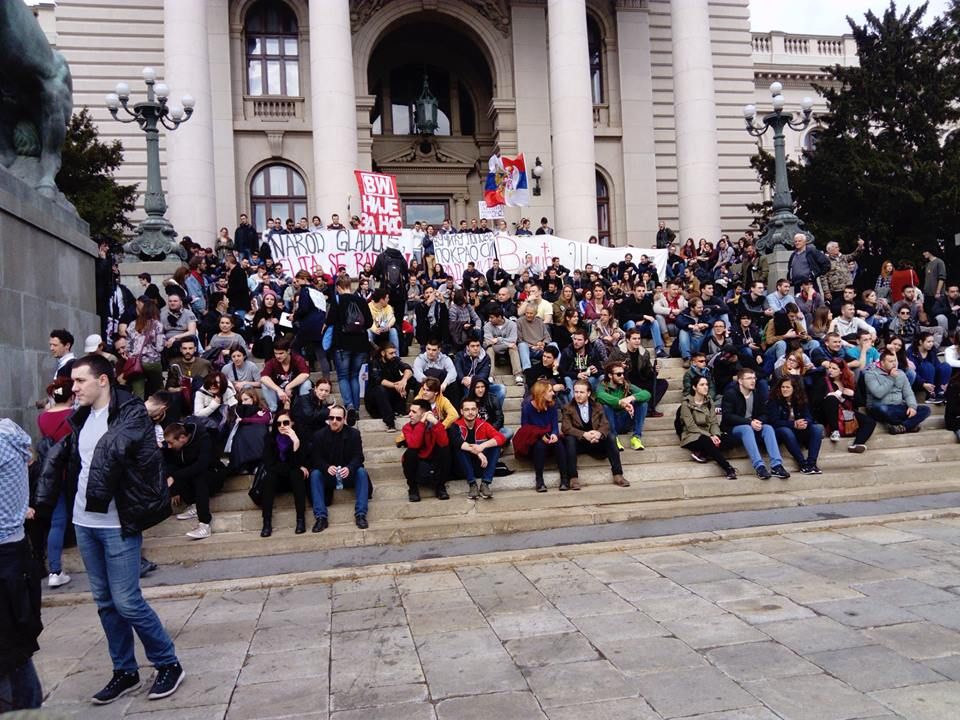
The students’ political protest began right after the 2017 presidential election, which Vučić won. Their movement was called “Protest Against Dictatorship”, and at times up to 80,000 people took to the streets of Belgrade. However, at that time no one, apart from the opposition, really supported the students. And the opposition itself was fragmented and focused more on criticizing the authorities and boycotting elections than on party-building.
Protesters on the steps of parliament, Belgrade, April 8, 2017. Photo: Wikipedia / DustBGD89-3 / CC BY-SA 4.0
And so it went: the protest movement would grow and then fade, and whenever there was a lull in the protest wave, “regular snap” elections were called, and SNS won them.
The Silent Army
At the same time, there was a quiet but massive placement of people from Vučić’s party or parties supporting it into all state posts, media leadership positions, and other important places. It has reached (and still reaches) the ridiculous: to get any budget-funded job, you need to join SNS — even if the job is that of a postman. And once in the party, you had to obey party discipline: attend party rallies, make the required speeches — and, of course, vote correctly. Given the increase in the number of officials, it must be acknowledged that today public-sector workers have become a serious force for Vučić — they now make up more than a quarter of all working citizens.
In addition to public-sector workers, pensioners support Vučić and his party: here everything is traditional for authoritarian regimes — before elections, pensioners are promised higher pensions, money is handed out, and so on. Another support group for the ruling party is rural residents. Here, not only (and not even so much) financial incentives work, but also the principle of “better not to make things worse” and the image of Vučić as a “regular guy” who drives around villages and small towns and does not mind sitting with villagers over a shot of rakija.
So, on Vučić’s side are public-sector workers (13% of the country’s entire adult population), pensioners (30%) and rural residents (38%). Of course, the overall total is not a simple sum of these figures: many pensioners live in villages, and among rural residents many also work in budget-funded jobs — the same postal workers, teachers, medical staff, public transport drivers, and state and municipal employees. But in general, more than half the population depends on the budget in one form or another, if not more. So is Vučić’s and SNS’s victory guaranteed? Not quite.
The Cursed Canopy
Even dependence on the budget did not prevent many Serbs from expressing dissatisfaction with Vučić. And as for his party appointees in local areas, people did not hold back at all. Especially since, year by year, the dominance of SNS loyalists became felt by practically everyone. Go into any public office — even the smallest boss is обязательно a member of SNS and someone’s appointee.
Accordingly, the quality of public services deteriorated, and the ability to influence them diminished. Corruption also grew — and this too was clearly felt even by the most politically inert people.
Rumor perhaps attributes more omnipotence to SNS than it actually has: almost every Serb told me that without connections nothing can be done — although I myself have repeatedly seen the opposite.
But such nationwide grumbling could have continued for a very long time — if not for the tragedy that happened in the country’s second-largest (and second-most important) city, Novi Sad.
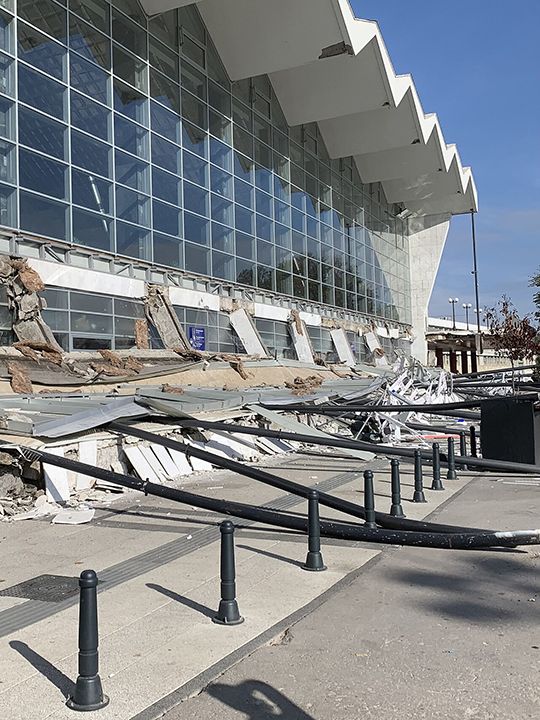
The railway station building in Novi Sad with the collapsed canopy. Photo: Wikipedia
November 1, 2024, was warm and sunny. People who came to the railway station in Novi Sad preferred, in such weather, not to sit inside the building of the station recently renovated by a Chinese contractor, but to sit on benches outside, under the building’s wide canopy. And at some point that canopy collapsed — прямо onto the people standing beneath it. 15 people died immediately, including a little girl; another person died later in hospital.
After the initial shock, people began asking: how could the canopy of a newly reconstructed building collapse at all — especially since that reconstruction, by the way, dragged on much longer than the original deadline? The Chinese company that carried out the reconstruction immediately stated that it had not been commissioned to repair the canopy. However, photos were soon found of people working on it. Who were these people? Who gave permission for its use? Who was actually overseeing the work? And why was the canopy decided not to be repaired, if that was the case? Who, in the end, is responsible for the tragedy that occurred?
There are still no answers to these questions. The reconstruction project documentation was published after numerous student protests, but the students insist that it is by no means complete. The investigation has still not disclosed either the cause of the disaster or those responsible — even the officials initially detained were released. And recently Vučić pardoned 26 people — and their names were not fully published. The opposition reasonably believes that those pardoned were precisely the ones responsible for the disaster.
The New Opposition
Large-scale protests began already on November 22, 2024. And it was students who started them — after students from the Faculty of Dramatic Arts at the University of Belgrade were attacked during an action commemorating the victims of the tragedy. However, the protest slogan “Your hands are bloody!” had already been heard earlier. And on December 22, the first nationwide protest took place, and although both the protests and the movement itself are still called student protests, in reality from that moment the students became only the support on which a new opposition began to crystallize.
A red handprint symbolizing bloodstained hands — one of the symbols of the protests that began after the tragedy at the Novi Sad railway station. The inscription in Serbian reads: “Your hands are bloody”. Nearby are the letters ZLF, indicating that the graffiti was placed by supporters of the Zeleno-levi front (Green-Left Front) party. Photo: Wikipedia
This opposition is quite diverse. It includes the students’ own parents and relatives — including people from villages, pensioners, and even public-sector workers. It includes farmers who, as part of student protests, have more than once marched in columns of tractors. It includes workers — both independent and employed — who drive students around, feed them, and so on. There are even war veterans and bikers protecting student actions. Finally, many teachers — both university and school teachers — have supported the students. Some of them lost their jobs because of it.
It should be said that this time the students’ tactics were different from previous protests. They did not limit themselves to actions in Belgrade, but repeatedly marched across the country. Videos showing entire villages lining the road, offering food and drinks to the marching students, rallies in a wide variety of cities, all the way to the most remote provinces where new participants joined the students, creative actions, volunteering — all this has led to the fact that today probably no fewer citizens support the students than support Vučić.
The new march of Serbian students on Belgrade began on October 22, 2026
At the same time, the old opposition did not support the students right away, largely because of the movement’s “omnivorousness”: the Democrats disliked the presence of nationalists in the movement, while nationalists disliked the presence of pro-EU forces. And the students themselves initially stated publicly that they did not intend to cooperate with anyone from the opposition. It got to the point that representatives of opposition parties could attend rallies only as private individuals, not as party representatives. But recently everything has changed.
Are the Students Winning?
Vučić, after keeping everyone in suspense with contradictory statements about the possibility of snap elections, finally announced parliamentary elections on October 25. At the same time, he temporarily left the presidency, entrusting these duties to his longtime ally, once appointed by him as prime minister and now Speaker of the National Assembly, Ana Brnabić. Vučić promised to hold presidential elections “perhaps sometime in December” — their date has not yet been announced.
Aleksandar Vučić. Photo: Wikipedia
The calculation is simple: if SNS wins, Vučić will take the prime minister’s chair and will be able to hold it for as long as he wants — until a “turnover election” happens. If his party loses, there remains the possibility of waiting until his lawful presidential term expires in 2027 — and then, perhaps, he may manage to push his successor into the presidency.
As of today, the situation is as follows. The final list of election participants includes 18 contenders. Number 1 is Vučić’s list, “United Serbia” — here we have both the almost mystical number one, which in authoritarian regimes always somehow goes to the ruling party, and clear associations with “United Russia”. The list includes SNS itself, the Serbian Radical Party of Vojislav Šešelj, previously acquitted by the Hague Tribunal, the party “Zavetnici”, which always supports Vučić — in total 10 parties, including the Pensioners’ Party, two peasant parties, and minority parties — the Vlach National Party and the Bosniak Old Strategic Party.
The presence of minority parties is no accident: by law, the 3% threshold does not apply to such parties, and therefore even one person from such a party can tip the balance. Something similar happened in recent local elections: in Niš, the majority of votes went to the opposition, but one person from the “Russian Party” got in thanks to the lowered threshold — and he decided the outcome in favor of the ruling SNS, leaving the local parliament in its hands.
In the current elections, as many as two Russian parties are participating, but there is no need to get carried away: in the “Russian Party”, founded by the owner of a marriage agency, there is not a single Russian (or even a Russian-speaking person), and in the party of Russian-Serbian unity, hastily created in September, there is supposedly one Russian among its 15 members (yes!). How is that possible? Very simply: by law, a person can simply declare their national identity. Incidentally, the ruling SNS makes wide use of this.
It is interesting that the traditional partner from previous elections — Ivica Dačić’s Socialist Party, Milošević’s former party — is running this time on a separate list. But there is no need to get carried away: this is also an election strategy — minority national parties and many other parties usually join the ruling coalition after the elections, giving it the chance to obtain a majority in parliament. Usually in exchange for some posts. That is exactly what happened in the previous parliamentary elections, when the united opposition coalition received 25% of the vote, but then many small parties that joined SNS formed a stable majority in parliament, pushing the opposition aside.
However, two can play at this game. Although the Student List includes most democratically minded opposition parties and movements, from the party of former head of state and Democratic Party leader Boris Tadić to environmental movements, part of the opposition is running on a separate list, “European Serbia”, led by the leaders of the previous protests, Marinika Tepić and Zdravko Ponoš. By the way, the Student List includes one of the parties of the Hungarian minority in Vojvodina.
“United Serbia”, as already mentioned, runs under number 1 and the name of the list is its election slogan; under number 2 is Vučić’s longtime partner Ivica Dačić with the slogan “Factor of Stability”. The “Student List” runs under number 3 and its slogan is “Students Win”. But how true is this slogan?
Balance of Forces
Polling data are contradictory: pro-government researchers (including bookmakers who take bets) give the advantage to Vučić’s list, while opposition pollsters favor the students. Bets on Polymarket also predict a Vučić victory with a probability of 61%. But that is not such a high probability, and the pool of bettors is quite small, as are the amounts wagered — under such conditions it is fairly easy to manipulate the results.
On Vučić’s side are substantial administrative resources and financial capabilities. For example, he handed out 50 euros to all adult residents of Serbia, and 200 euros to the unemployed and pensioners — as a result, at the Postal Savings Bank, where the money is issued, there are huge queues just to sign up to receive the money; at the post office, as I myself confirmed, there is not even enough money to pay pensions, but the effect is certainly significant.
On the students’ side are creativity, the constant creation of activities and news hooks, and the sincere desire of many Serbs to change something. And many of Serbia’s moral authorities, both those included on the list (for example, it is headed by the well-known Serbian cardiologist and professor Ilija Srdanović) and those who supported the students — for example, the famous tennis player Novak Djokovic.
Russia immediately and unambiguously supported “United Serbia”, the United States is keeping silent, while the EU’s position is interesting.
They do not openly favor anyone, but they are sending their observers to the elections, and this list has already caused irritation in ruling-party circles. However, representatives of the student list are even more outraged: according to them, the election commission registered as observers representatives of the MAGA movement, representatives of far-right European parties, and even observers from the fictional country “Chaciland” — “ćaci” is the nickname given to Vučić supporters who strongly opposed the students during the protests, because of the grammatical mistake in the slogan “Students (đaci) want to study”.
It should be said that the political views of the “Student List” are not radical — which is justified under the current mood of the electorate. For example, the interview of the list leader Srdanović by BBC Serbian edition perfectly characterizes their political slogans: mainly it is a fight against government corruption (“Either Serbia or the mafia”), and as for the most sensitive issues for the EU, such as joining sanctions against Russia or recognizing Kosovo, they are fully in line with the current authorities: no sanctions, Kosovo is Serbia, etc.
This may be why the EU is somewhat detached: on the one hand, its leaders are not very eager to deal with the authoritarian Vučić, who also skillfully balances between the EU, China, the United States, and Russia; on the other hand, he is at least well known and predictable, while what will come out of the “Student List” is unknown — the only thing known is that they cannot be made to do anything that Vučić refuses to do.
Concern has also taken hold among Russian emigrants, who after the start of the war formed an impressive community in Serbia. Many of them have already reached the stage of obtaining permanent residence, but citizenship has been practically frozen since the war began; only 30 people who had already surrendered their Russian passports and lived as stateless persons managed to obtain it. This, of course, does not count the “presidential list” of citizenship for services, which mainly included people close to the Kremlin.
Russian emigrants fear that if the opposition comes to power, it will completely close the road to obtaining Serbian citizenship, or even tighten the rules for obtaining temporary and permanent residence permits.
An example here is Montenegro, which even before introducing visas for Russians tightened the residence-permit rules so much that many were forced to sell their homes (they turned out to be cheaper than the threshold for obtaining a residence permit) and, after closing their businesses (to obtain a residence permit one must pay at least 5000 euros per year), moved to Serbia. The EU does not like Serbia’s liberal residence-permit regime, so the local Russian diaspora fears that if the opposition comes to power, it will tighten it.
For October 22, the “Student List” scheduled a final rally in Belgrade. According to statements by its representatives, provocations from the authorities and arrests were expected. However, the rally, which according to observers was attended by around 200,000 people, passed peacefully. True, there were recorded cases of attacks by masked thugs on people returning from the rally.
From Friday, the “silence period” begins, when campaigning is prohibited. Who will win remains unclear. However, it should be noted that even if Vučić retains power, the previous apathy of citizens is unlikely to return. Credit for that goes both to the students, who woke many people up and made them believe in the possibility of change, and to the economy, which is now not working in Vučić’s favor — rising inflation and the dominance of cronyism are irritating everyone already. So regardless of the election results, the country will evidently change. Which can quite reasonably be considered a victory.
If you enjoyed this article, consider making a donation — one-time or, even better, monthly. Your support helps us motivate our authors and become better with every article.
Our organization is recognized by the Internal Revenue Service (IRS) as a 501(c)(3) tax-exempt, charitable organization, which means that all contributions made to us are tax-deductible to the fullest extent permitted by U.S. law. Individuals may generally deduct charitable contributions of up to 60% of their Adjusted Gross Income (AGI) for cash donations made to qualifying 501(c)(3) organizations. For donations of appreciated assets (such as stocks or other long-term capital assets), the deduction is typically limited to 30% of AGI, based on the fair market value of the asset. C-corporations may deduct charitable contributions of up to 10% of their taxable income for donations made to eligible charitable organizations.
By submitting a donation, you confirm that you have read and accept the following documents: Privacy Policy and User Agreement, and also give consent to the processing of your personal data.
If you would like to unsubscribe from a monthly donation, please email us at: [email protected]