"It was simply a miracle, impossible without outside help". How a child with cerebral palsy from a family of Russian political emigrants got to the best doctors in the USA thanks to a stranger
Russian anti-war activists Maksim and Ekaterina Novichkova are raising their son David, who has had a severe form of cerebral palsy since birth. In 2023, they were forced to leave Montenegro, where they were persecuted by local far-right groups for public speeches against Putin, applied for political asylum in the USA, and settled in California. Last year, an incredible story happened to them here: thanks to the intervention of a stranger, David underwent a complex neurosurgical operation free of charge at a California clinic, which in the long term gives him a chance to move independently. The Novichkovs still do not know this person's name — and for the first time decided to tell how it all happened in order to thank the people involved in their son's treatment.
David Novichkov. Photo from the family archive
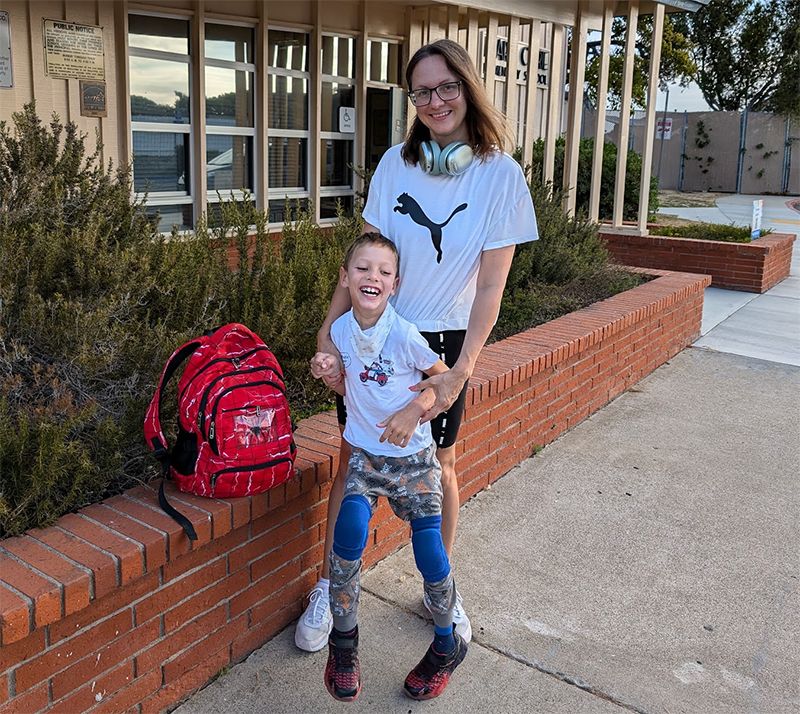
When David walks around our residential complex in San Diego, his mother — Katya — is beside him. She is the one who handles his daily rehabilitation: supports him while he walks, helps him keep his balance, protects him from falling, and tries not to do for him what he is capable of trying to do himself. We support him by the torso or arms, help shift his weight, protect him from falling, and try to intervene only as much as necessary. It is important to us not to go through this path instead of him, but to give him the opportunity to do as much as possible on his own. Sometimes a few dozen meters take a lot of time and require enormous effort from David, but he wants to keep going. For him, this is not just a walk. It is one form of daily rehabilitation and another attempt to get closer to what most people do without thinking — walking independently.
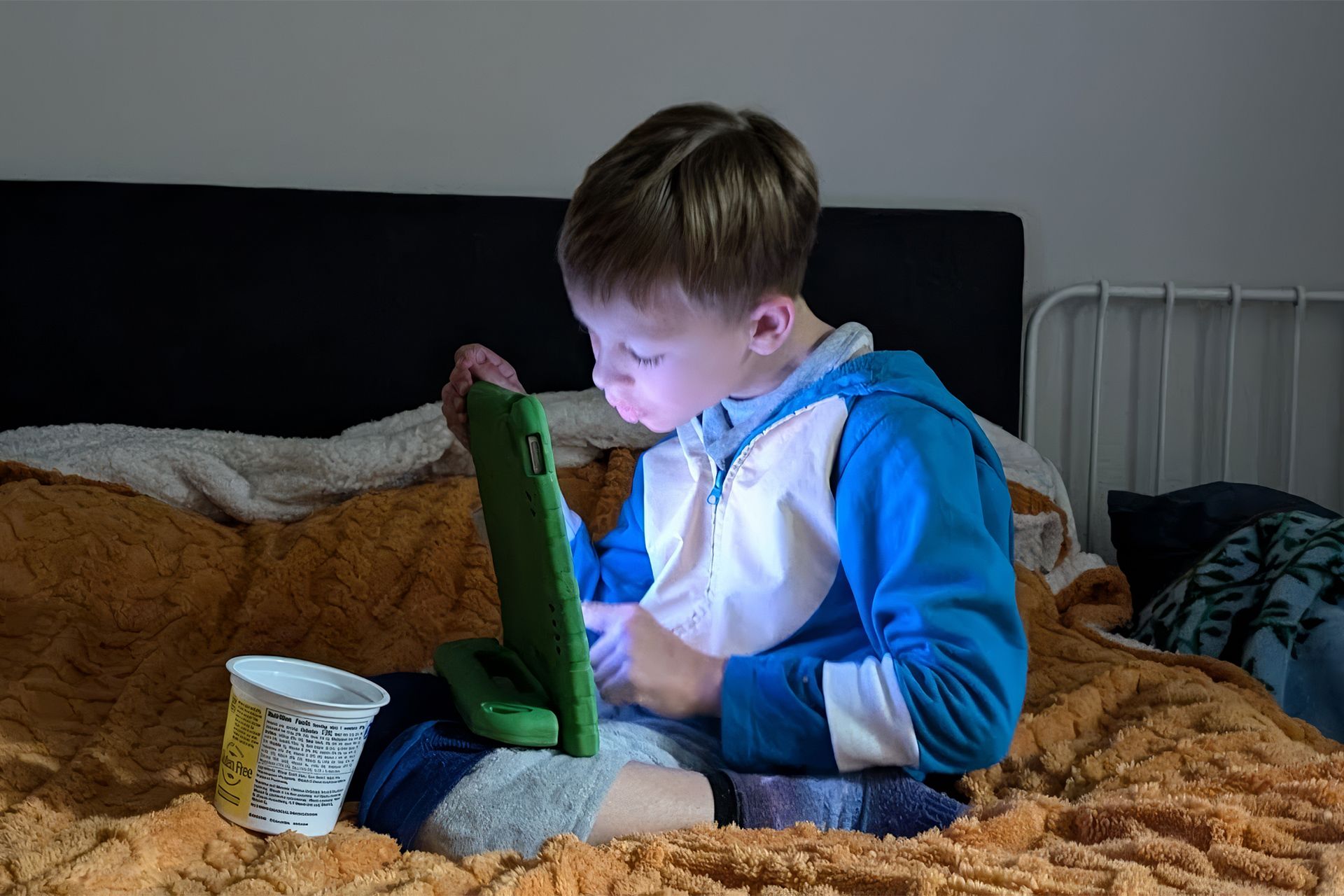
Our son is nine years old. He has cerebral palsy. He does not walk without support and does not speak, communicating with us through gestures, facial expressions, and sounds. He needs help with the most ordinary actions that make up a human day.
While we are nearby, we know how to lift him, seat him, understand what he wants, help him in the bathroom, support him while walking, and calm him at night. But as David gets older, the question that we dislike saying out loud appears more and more often along with hope: what will happen to him one day when we are no longer рядом?
Cerebral palsy for three
Nine years ago, during childbirth, doctors saw that David was not getting enough oxygen and decided to perform an emergency cesarean section. Then came intensive care, a ventilator, almost two weeks of fear and complete uncertainty. We did not know whether our son would survive and what the consequences of oxygen deprivation would be for his brain. And then the diagnosis of cerebral palsy entered our lives.
To understand what severe motor impairment means for a family, it is not enough to list diagnoses and treatment methods. It is much more accurate to go through an ordinary day. And our days do not begin in the morning. David sleeps restlessly, and at night one of us is always checking on him, covering him with a blanket, helping him change position. Sometimes Katya puts him next to her, because that can be easier for both him and her. So even sleep давно stopped being a time that belongs only to us.
David usually wakes up early. After sleep, he needs help with the bathroom, then — getting dressed, brushing his teeth, having breakfast, and getting ready for school. Each of these actions requires an adult's involvement and often physical effort. Then he needs to be put in the car, driven to school, and handed over to an assistant who helps him during the school day. After school we pick him up, help him change again, go to the bathroom, and eat, and then the home part of rehabilitation begins.
We try to walk with him regularly around the residential complex with support. We work out in the pool. Twice a week we go to CCS (California Children's Services) rehabilitation sessions. In the evening there are household routines again, a bath, exercises, games, and communication. When David falls asleep, our work does not end — night starts a new cycle.
David. Photo from the family archive
As he gets older, this burden becomes harder in the literal, physical sense. A nine-year-old child can no longer be lifted as easily as a three-year-old. He needs to be transferred, supported in the bath, protected while walking, and helped maintain his body position. At the same time, we consciously try not to do for him what he can at least try to manage himself. Sometimes it would be much faster to simply pick him up or finish the action for him, but independence only appears where a person is given time and the opportunity to act. So help can take more time precisely when we want to help less.
Because of this, the very concept of rest has changed. We try to take David to new places, go for walks, show him California, visit parks, swim. But a change of scenery does not cancel care; even a leisure trip is a lot of work for us. The pool is both entertainment and rehabilitation. A walk is both rest and walking practice. Any trip means the need to think in advance about the accessibility of the space, the need for diapers, the bathroom, the possibility of transferring David, and how much physical effort will be required on site.
Katya and I have not gone anywhere together for many years. Leaving David for several hours with someone he barely knows is practically impossible. He is used to being with us, does not speak, and uses his own communication system.
Whoever stays with him must understand his gestures and know many everyday nuances. At the same time, it is not easy for one parent to handle the full amount of physical care for long, so one person's rest often means extra strain for the other.
And yet it would be unfair to describe our nine years as a continuous chain of deprivation. Inside this very dense schedule lives an ordinary boy who loves to laugh, joke, be clever, and explore the world. David is constantly inventing ways to explain something to us with gestures, and our family communication sometimes resembles an endless game of charades. He knows how to negotiate during activities, knows how to show displeasure — and knows how to make us laugh at the moment when we have almost no strength left.
A science-fiction operation
Last September, we were discharged from UCSF Benioff Children's Hospital Oakland after one of the most difficult chapters in David's medical history. He underwent selective dorsal rhizotomy, or SDR. The goal of this neurosurgical operation is to reduce spasticity by selectively affecting the sensory nerve roots in the spinal cord area.
The very principle of SDR still feels almost fantastical to us. During the operation, the neurosurgeon gains access to very small nerve branches. Using electrical stimulation and intraoperative electrophysiological monitoring, the team checks how the child's muscles respond to stimulation of individual sensory root branches. Based on the response pattern, specialists identify the branches with the most pathological reaction, and the surgeon selectively cuts precisely those, trying to preserve the others, painstakingly sorting through tens of thousands of nerve fibers. This is not an operation where the doctor simply sees a “bad nerve”. It is the sequential work of the neurosurgeon and neurophysiological monitoring specialists, in which the decision is made based on the response of the child's neuromuscular system.
Oakland uses a modern minimally invasive single-level approach. UCSF describes it as a minimally invasive technique with a small incision in the lower back, through which the surgeon can examine the nerve branches and, using gentle electrical stimulation, determine which ones are most strongly associated with spasticity. In 2024, a group of UCSF specialists, including Dr. Peter Sun, published a scientific paper on the SDR technique performed through a minimal access at one spinal level. Before the operation, the exact location of the end of the spinal cord was determined using rapid MRI. This is an example of how carefully modern pediatric neurosurgery tries to reduce the extent of intervention where the operation itself requires utmost precision.
It is important to understand that SDR does not cure cerebral palsy and does not guarantee independent walking. UCSF specialists note that after such an operation a child may find it easier to sit, stand, walk with support, or use assistive devices, but the result depends on the initial condition and subsequent rehabilitation.After SDR, rehabilitation becomes no less important than the operation itself. UCSF considers intensive physical therapy a key part of treatment because after spasticity is reduced, the child has to learn to use the body's changed capabilities.
David with his mother Ekaterina. Photo from the family archive
Our goal was to reduce the spasticity in David's legs and give his body new possibilities. Possibilities that still need to be turned into skills through thousands of repetitions. We continue to hope that one day among these new possibilities there will also be his first independent step.
Dr. Peter Sun and his team
David's operation was performed by a UCSF team associated with the Peacock Cerebral Palsy & Movement Disorders Center. The center is named after Warwick Peacock, one of the pioneers of modern selective dorsal rhizotomy, and UCSF calls its program the largest spasticity treatment program in Northern California and one of the most experienced SDR teams on the West Coast. It brings together specialists in pediatric neurosurgery, neurology, orthopedics, rehabilitation medicine, and physical therapy.
One of the key people in this story for our family was Dr. Peter P. Sun. He is a pediatric neurosurgeon at UCSF, co-founder of the Peacock Cerebral Palsy & Movement Disorders Center, and one of the specialists whose professional work has for many years been connected with treating children with spasticity and SDR. It is important for us to write about this not only because the doctor's name should stand next to the name of a complex operation. This article is also, for us, an opportunity to publicly thank the person and the team who took responsibility for our child at the moment when we entrusted them with the most precious thing we have.
Photo from the family archive
In the hospital, you especially clearly understand how much medicine depends on the team. In addition to the surgeon, the operation involves anesthesiologists, neurophysiological monitoring specialists, nurses, rehabilitation doctors, physical therapists, and people who help the family navigate the organizational side of treatment. In the case of SDR, this teamwork is built into the very logic of the procedure. The neurosurgeon does not make the decision alone, but relies on monitoring data and on the overall plan, which begins long before the operating room and continues after it.
We cannot know what the functional result of the operation will be many years from now. No responsible doctor promises that. But we do know that David received a chance to reduce one of the most difficult problems for his body — spasticity. And we understand who helped make that chance real.
The person whose name we do not know
David's operation story is one of the most amazing things that have happened to our family over all these years.
At some point we learned that a person unknown to us from San Diego contacted Dr. Sun, told him about David, and asked whether he could be helped. From the information that reached us, this person had once been connected with the doctor's team or had worked with it. We cannot confidently speak about details we do not know ourselves. But the main thing we know for sure is this: someone we did not know decided to use their contact and their time for a completely чужого child.
After that, we were invited to Oakland. David was examined, specialists assessed his condition, and concluded that SDR might be indicated for him. The operation was approved and performed. We were helped with arrangements, accommodation, and subsequent rehabilitation, and our family did not have to pay for the operation itself. For a family that has lived for years between ordinary expenses, rehabilitation, transportation, equipment, and doctors, this was not just relief. It was simply a miracle, impossible without outside help.
The strangest thing about this story is that we still do not know who took the first step. We do not know this person's name or where he lives. We do not know whether he saw David after the operation and whether he knows how much his act means to us. Perhaps he did not want gratitude and deliberately stayed in the background. Perhaps the information was lost somewhere in the long chain of people who helped us. Sometimes we think that we could have stood next to him in the same store many times, driven in the next lane, or passed each other on a San Diego street — and not even suspected whose hand we would want to shake.
If this person ever reads the article, we want to tell him what we have not yet been able to say in person. We remember you, even though we do not know your name. Thanks to you, our son has one more chance. If you prefer to remain unknown, we respect that. To us, you will still remain the person who once did good for a completely unfamiliar family and asked for nothing in return. Among ourselves, we sometimes call you David's unknown guardian angel.
This story changed our attitude toward help as well. It is very easy to think that only wealthy philanthropists, famous doctors, or large organizations can change someone else's life. Our experience says otherwise.
Sometimes a person cannot perform a miracle themselves, but can make a call, introduce two people, pay for a few sessions, tell a story to someone who can help, or simply not walk by. For a family that has lived for years in a constant struggle for a child's possibilities, the consequences of such an act can be enormous.
Our main fear
Our family's story is complicated by one more circumstance. We live in forced emigration and do not have the large family network nearby that in many families becomes a safety net in case of illness, fatigue, or trouble.
Maksim has been involved in Russian opposition and human rights work for many years. In Russia he took part in major protest actions, and later continued this work abroad. Since 2018 he has been associated with the Free Russia Forum, participates in work related to identifying people involved in political repression, corruption, and Russian aggression, and also deals with sanctions issues within the framework of the “Putin List” project. Today he works as the technical director of MOST.Media. After assessing personal risks, our family left Russia, and in 2023 we had to leave Montenegro as well after threats and a physical attack on Maksim. The political history of our family deserves a separate text. The most important thing is that we were starting life from scratch again and found ourselves far from relatives who could theoretically take on part of the care for David.
In the previous article by Ekaterina for MOST.Media, the discussion was about another aspect of life for children with disabilities — how differently society can treat a person who is different from the majority, and how important true inclusion is. There, our experience in Russia, Montenegro, and American school was also described. In this article we want to show the other side of the problem. Even in a society where a child is included in school life and receives professional support, the family remains the main source of daily care. For us, this means that practically the entire system of David's everyday life rests on two people.
If something happens to one of us, the other will remain. But the thought that one day both of us may be gone is almost physically terrifying for us. This fear existed long before our emigration, but emigration made it sharper.
Today we rent housing. We do not have our own home, and for us this is one of the biggest unresolved tasks of the future. This is not about wanting to own real estate as a symbol of success. We want one day to leave David a stable and understandable space that can be adapted to his physical abilities and that will not disappear from his life together with changes in rental conditions or the parents' circumstances.
We imagine a home where accessibility of the bathroom, width of passages, handrails, transfer and movement methods, space for equipment, and future technical systems can be planned in advance. A home that David will know down to the smallest detail and in which the maximum number of actions can be made accessible to him himself. This will not solve the care problem, but it can reduce dependence on another person and give him what every adult needs — his own space and the right to manage his own life.
That is why we follow the development of robotics and artificial intelligence so closely. Today, conversations about humanoid robots often sound like a debate about the future of the labor market or yet another technological trend. We look at them differently.
If one day a reliable robot appears that can, at a person's request, hand over an object, prepare simple food, help open a door, call for help, control household systems, or safely support part of daily routines — for a person with severe motor limitations this could become a tool of independence.
At the same time, hope in technology does not cancel what needs to be done today. David needs classes, rehabilitation, medical supervision, equipment, trips, and constant practice. His body is growing now, so some possibilities can be preserved or lost precisely in childhood. We live in two time horizons at once. In the near term, we help him take the next step with support. In the distant term, we try to imagine what the space around him should become so that one day that support is needed as rarely as possible.
David with his mother. Photo from the family archive
When David walks beside us along the path of our residential complex, we are still holding him. Sometimes more firmly, sometimes almost imperceptibly. We feel how he shifts his weight and tries to keep his balance, and then takes the next step. Nine years ago, when he was born, we promised each other to be by his side always, no matter what happened. Now we understand that keeping that promise truly means not only holding him today. The most important thing we can do as parents is try to build him a life in which one day he will be able to feel safe and move forward even without our hands.
To support their son in the daily challenges of disability, Maksim and Ekaterina Novichkov created the project Super David. All funds raised through it go toward David's expensive rehabilitation after the operation. You can help the Novichkov family here.
If you enjoyed this article, consider making a donation — one-time or, even better, monthly. Your support helps us motivate our authors and become better with every article.
Our organization is recognized by the Internal Revenue Service (IRS) as a 501(c)(3) tax-exempt, charitable organization, which means that all contributions made to us are tax-deductible to the fullest extent permitted by U.S. law. Individuals may generally deduct charitable contributions of up to 60% of their Adjusted Gross Income (AGI) for cash donations made to qualifying 501(c)(3) organizations. For donations of appreciated assets (such as stocks or other long-term capital assets), the deduction is typically limited to 30% of AGI, based on the fair market value of the asset. C-corporations may deduct charitable contributions of up to 10% of their taxable income for donations made to eligible charitable organizations.
By submitting a donation, you confirm that you have read and accept the following documents: Privacy Policy and User Agreement, and also give consent to the processing of your personal data.
If you would like to unsubscribe from a monthly donation, please email us at: [email protected]