Borders between Russia and Europe are closing, and censorship is intensifying — how can bridges be built between those who left and those who stayed? Musicians, artists, activists, and journalists who left Russia after the invasion of Ukraine discussed this in Vilnius. We publish their conversation.
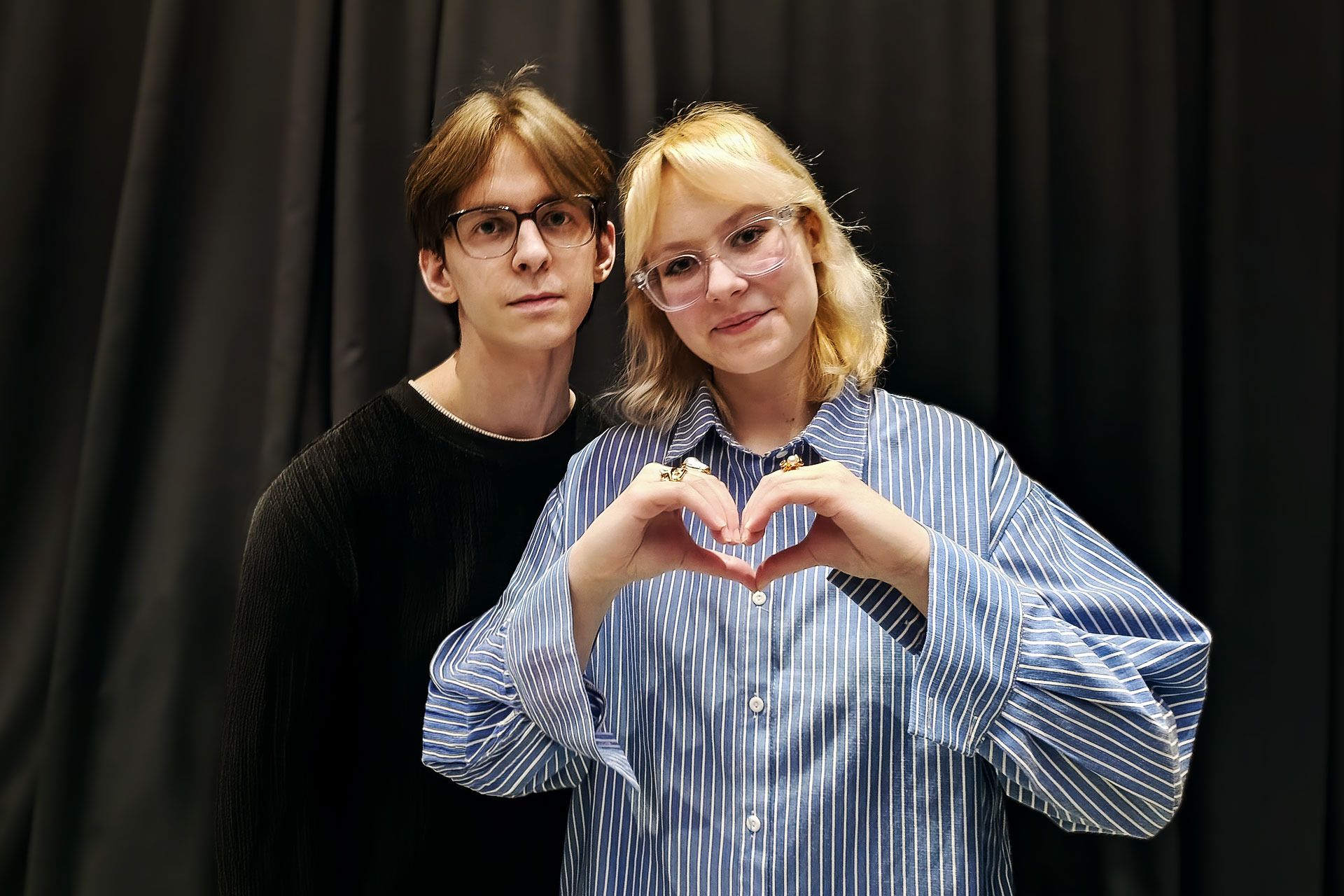
Diana Loginova (Naoko) and Alexander Orlov from the group “Stoptime”. Photo by Anna Gavrilova
Musician Diana Loginova (Naoko), member of the group “Stoptime”, who performed songs by anti-war musicians—including Monetochka, Noize MC, and Zemfira—on the streets of St. Petersburg. After several arrests, Naoko left Russia.
I feel that the connection with listeners in Russia is breaking down. We try to keep it somehow. But when I was in Russia, I sang for those who stayed there, while I was also staying. I understood them. Now I sing for those who have left. And I understand them too, maybe not completely.
Of course, I want to stay connected with the audience in Russia, even though it's now impossible to do what we used to do. It's very scary that everything we've done could just disappear. Because there’s no way to maintain this connection as strongly and closely as before.
When we gathered people around us in person, it was much more effective. When you look someone in the eye, it's completely different from what they see through Instagram or TikTok.“
Musician Alexander Orlov, guitarist of “Stoptime”. He also left Russia due to repression and continues to make music in Lithuania.
I think it’s important to mention — the people who listened to us in Russia stopped being in the same community and being together with us. It’s as if they split into small groups of five. And of course, this [the inability to perform in St. Petersburg, in Russia] broke the community’s connection. It used to be one big living organism that functioned during every performance of ours. Musician Ivan Alekseev (Noize MC). He writes and performs songs at the intersection of hip-hop, rock, and singer-songwriter genres, often addressing social and political topics. After the war began in 2022, he left Russia for Lithuania. He releases new songs, performs concerts, and keeps in touch with his Russian-speaking audience.
Yesterday or the day before, I suddenly realized that it’s already been four years since I ended up here. And I’d like to say: I’m exactly the person who, not so long ago, was part of your [“Stoptime” musicians’] online audience, who saw you only through social media. So I’d like to share this perspective from the outside.
Of course, I wasn’t physically standing there on Nevsky when you sang. But I connected so strongly, it was as if I was there. And I understand your frustration and feelings about just having left your homeland. I remember those feelings very well myself. But that doesn’t mean all these people are cut off from you.
And I think it’s not entirely fair to say people have split into little groups. Yes, you can’t all gather together now. But you just need to change the format of interaction and not let go of the connection, not devalue it yourselves. Yes, physical presence [with the audience in Russia] is impossible right now. But that makes the regularity and quality of our online connection even more important.
I won’t deny that the gap between those who left and those who stayed is widening. That’s inevitable, because we’re immersed in very different, dramatically divergent contexts. But I believe that we can still resist this growing divide.
How can you maintain cultural ties with your audience from a distance?
Ivan Alekseev (Noize MC)
“Now all artists in exile, and those who dare to keep the same beliefs and tone among those who remain in Russia, we’re all doing important work. We’re creating the language, the language of culture that we’ll all have to use to talk in the future. When the acute and terrible phase of what’s happening ends, another phase will begin—difficult, painful, unbearable in its own way—about how we’ll learn to communicate again. Because even geographically, we’re not going anywhere from each other. And I still believe there are some fundamental laws of evolution that will sooner or later lead us to a better world.
And I’d like us to be able to understand each other in that better world. It’s these bridges, which are sometimes so hard to build, that I think we should be working on. Especially those of us who continue to create in our native language.
Even literally, the Russian language in Russia is now changing rapidly. Censorship is increasing, and with it comes a huge number of new euphemisms, slang is changing. The language is being seriously abused there now. And we need to create our own language and make sure it stays relevant there too—among those who are ready to hear us.“
Renat Davletgildeev, journalist and TV host. He worked at the Dozhd TV channel and collaborated with Current Time and other independent media. Now he hosts shows on the YouTube channels “Khodorkovsky LIVE” and The Breakfast Show and speaks publicly on human rights and media freedom. Once in St. Petersburg we organized the [LGBT film festival] “Side by Side”. It was held in a big venue, we showed films, held various dialogues, discussions, and so on. Then, because of the law [banning “LGBT propaganda”], we had to move everything exclusively online. And the experience was, in principle, good. We held film screenings, discussions.
The audience wasn’t just from St. Petersburg — there were viewers from Moscow, Murmansk, even Afghanistan. Some online screenings drew thousands of viewers. And for me, it was exactly the same kind of connection with the audience as being together in a movie theater. Then, covid taught us all this format in general. Tons of events started happening online.
A little bridge to Vanya [Noize MC]. Vanya said that you [“Stoptime” musicians] were also a bridge for him — between him and Nevsky Prospekt. For me, you were that bridge too. I didn’t have the chance to see you, but I felt like part of you. Part of that crowd.
Viktoria Narakhsa, artist and director. Works at the intersection of theater, performance, and research-based art practices. She creates plays, laboratories, and art projects in different countries. After being arrested for participating in rallies supporting Alexei Navalny in 2021, Viktoria continued her work outside Russia. Her projects address political experience and repression, often involving the audience in open dialogue and experimental theater forms.
During covid, we tried to do online theater. You can imagine how strange that is: we have the format of film — quite self-sufficient, and the format of theater — also self-sufficient. It requires the presence of a live audience and live actors. But there were experiments. Some were successful, others less so. Overall, I think it’s worth trying. You probably just need to rethink it all over again. Because when covid ended, we could perform and do live shows again — as a normal theater should. But now there’s no such opportunity.
Performance by Viktoria Narakhsa. Photo by Anna Gavrilova
Ivan Alekseev (Noize MC) Propaganda is torn between two equally, perhaps, desirable motives: on the one hand — to say that we [outside Russia] are not needed by anyone, and on the other — not to mention us at all, the departed artists. Not even to say that we’re not needed. Yet, by both means, they broadcast that we’re supposedly forgotten and of no interest to anyone.
But then the guys [“Stoptime”] go out on the streets of St. Petersburg and sing — and crowds gather around them. Precisely because they sing our songs. And this is the offline proof that people are still following us, loving us, remembering us.
The songs that [“Stoptime”] performed and for which they ended up behind bars are not some nostalgic things from the late 2000s. These are songs I wrote already in exile. And these songs, written in exile, are a unifying factor for people who remain inside Russia. That’s the most obvious thing.
Plus, of course, I watch the reactions on social media to the things I post. Whether it’s just some news, new singles, music videos, or concert announcements. Probably the most telling platform where I’m present is my Telegram channel. And there’s a very young audience there. Almost everyone who comments is still in Russia. There are a huge number of them.
I don’t know what other proof is needed. People are still interested.
Even in the Soviet Union, where it was impossible to leave the country, people still listened to the BBC, Voice of America. And it was considered cool. People read banned books in huge quantities, those who were at all interested in art. Of course, in absolute terms, it was a very small group. But it existed, and it was active.
Now this group is even bigger. Now, creating an iron curtain of that quality is much harder than before. Information is much more fluid, and they won’t be able to stop this flow, no matter how hard they [the Russian authorities] try. And they are trying very hard. People managed, even in 1970, to transmit information by radio waves, read banned books, play forbidden music. Samizdat was developed. So we’ll still find some methods.
What new opportunities for growth does emigration open for artists and other creative people?
Viktoria Narakhsa, artist and director I’ve been doing projects not only in Russia for a long time — performances, plays, or labs in different countries. And I always do them in the language of the country I’m in. If it’s Spain, it’s Spanish, if Georgia, it’s Georgian, if Germany, then German, and so on.
My projects in Russia started to get banned quite early. I think when I was about 20-something, it became clear to me that there was nothing for me to do there. So I started traveling a lot. With projects, of course.
At some point, it became obvious to me that yes, there are national habits, cultural differences. But basically, people are people everywhere. And, for example, repression is equally bad wherever it happens. And that’s clear even in places where it doesn’t exist. Sasha Kazantseva, journalist, writer, sex educator, and queer activist. Author of the blog on sexuality “Washed My Hands”. After the war started, she left Russia and now lives in Lithuania.
I work with the queer community. When I lived in Russia, I worked a lot and closely with the queer community, made magazines, blogs, and much more.
And I have the same problem — for the past four years I’ve really felt like I’m losing touch [with people in Russia]. People there are already living in a completely different environment. But over the last year, I’ve found support in thinking of us as a cross-border, transnational community. Thinking about how all people on the planet are connected.
Living in Russia, I was really focused on the Russian-speaking, Russian community. But when I left, I realized, first, that I gradually developed a decolonial perspective. Second, I met many different people from different countries, with different problems—and I started to notice that all our problems are connected. For me, it’s now a huge support to think globally: how different people around the world are connected, what we can learn from each other, from people in countries we may have barely heard of in our lives.“
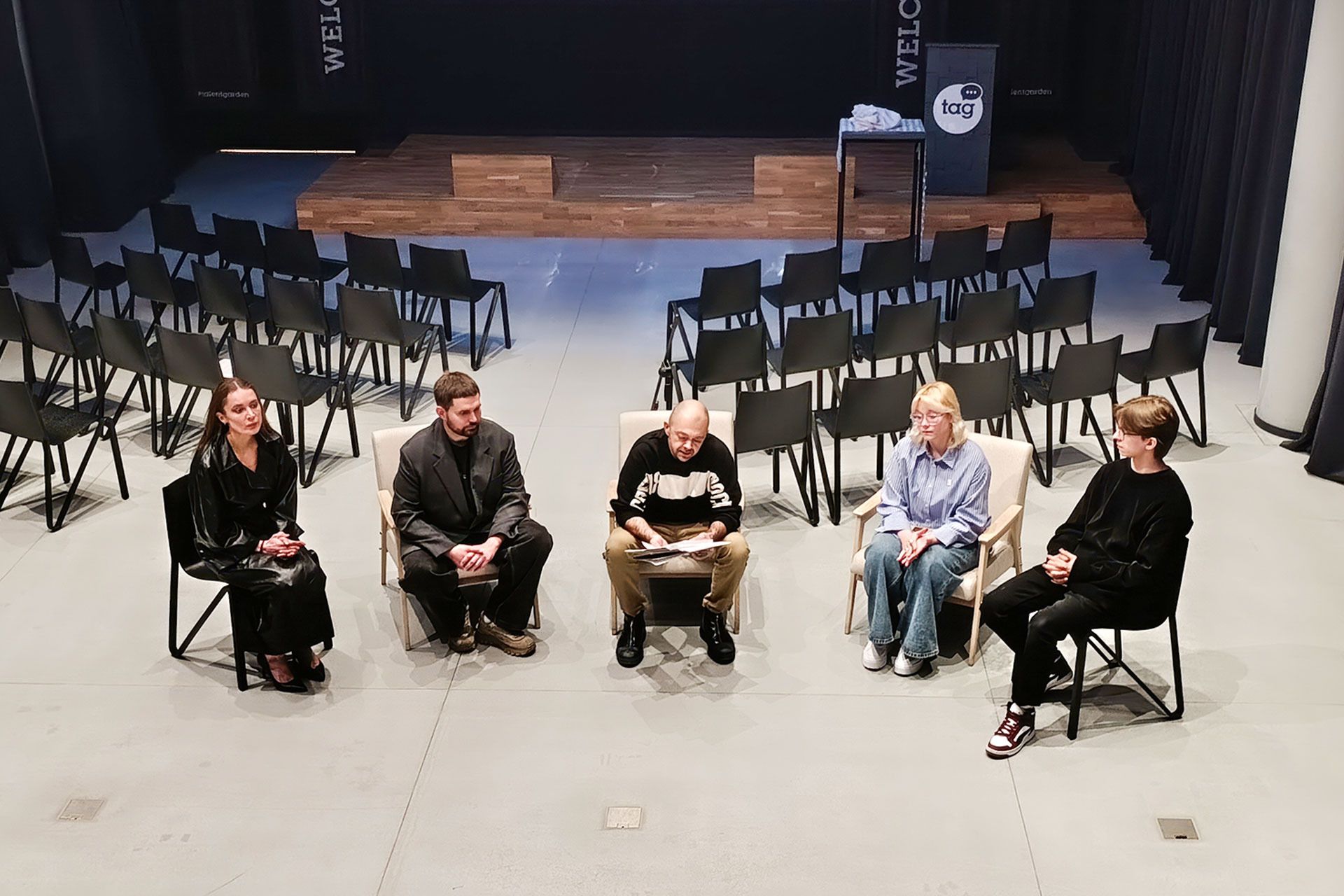
Participants in the discussion in Vilnius (left to right): Viktoria Narakhsa, Ivan Alekseev (Noize MC), discussion host, Diana Loginova (Naoko, lead singer of “Stoptime”), Alexander Orlov (“Stoptime”). Photo by Anna Gavrilova
Diana Loginova (Naoko, “Stoptime”)
As an independent band with our own material, we’ll be starting here, not in Russia. And I think it’s important to write about feelings and hopes that everyone experiences — regardless of nationality, gender or age. In other words, about what is familiar to every person. But to do it in my own language, which I value, and with, you could say, a touch of the culture I grew up in.
Alexander Orlov (“Stoptime”)
I think we need to build bridges with those people with whom we currently have problems. And look for connection with a view to the future, so that later there isn’t such a big chasm that it’s impossible to cross. For example, to find common ground with Ukrainians and start communicating with them now. Ivan Alekseev (Noize MC)
As for interacting with an international audience, I’ve been writing in English for quite a while. Naturally, it’s a small part of my work, but I’ve been doing it consistently for a long time. My band has also toured Europe and the US since about 2010.
Now I’m working on several international projects. One of them, for example, is Alexander Molochnikov’s production “Seagull”. It’s an interesting take on Chekhov’s “The Seagull”. The team played a season in London, and now shows are starting in New York. I wrote several tracks in English for this play, which are performed by the actors. And one of the songs that didn’t make it into the show I’ll be performing live there.
On the one hand, it’s a metamodernist look at Chekhov’s story. On the other, it’s a play about artists in Russia, about the challenges they’ve faced since the war began. Naturally, it’s also a play about the war itself. But it’s an English-language theater. Of course, some of the audience are emigrants. But in general, it’s aimed at and brings together English-speaking people who live and work in New York.
There’s another project I’m working on now. First, it will be a book of lyrics, and later a music album. These are translations of some of my songs, about 10-15, into Norwegian. I’m being helped by a Norwegian organization made up of members of the Russian-speaking diaspora. The translations are being done by a [Norwegian] translator and poet who knows Russian very well. She recently translated the album “February Lasts” by Vladi in full.
I literally just flew back from Norway’s Arctic. There’s a city called Kirkenes, very close to the town of Nickel. Basically, Murmansk is also nearby. Three borders come together at this point — Finnish, Russian, and Norwegian.
And in Kirkenes, there’s been a festival about neighborhood for 21 years. I took part in this festival in 2015, and this year I was invited again. I performed two songs with a Norwegian choir. And for the last number, we performed my song “Voyager-1” in Norwegian.
It was very interesting to watch the reaction of the Norwegians in the audience. Before that, I led the concert in English, introducing the next track before each song. I started with the song Voyager-1 in Russian. And at the end, after they’d already danced in the middle of “Lake” [Noize MC’s song “Cooperative ‘Swan Lake’”], Voyager-1 was performed in their native language. And it was touching to see that they were really moved by what they heard.
It was a real pleasure, and it was interesting. Besides everything else, it was just beautiful. I like how it sounds in Norwegian.
I think there are many languages in the world into which these songs could be translated. There are people who are interested. Yes, obviously, it’s not some kind of mainstream success in this country. Of course, to become a big sensation in a national language, you have to be a native. But still, there is interest. And in this respect, there’s room to grow, and I’ll keep working on it.
I planned my move even before the full-scale war began, because I was already completely banned from performing in Russia in 2021. I was going to record an English-language album. But, finding myself in the situation we’re all in, I realized that now is not the time for that at all. And right now, it’s very important to remain that Russian-speaking voice. It’s important to support all of us. Maybe not everyone needs it. But I see that a lot of people do.
If you enjoyed this article, consider making a donation — one-time or, even better, monthly. Your support helps us motivate our authors and become better with every article.
Our organization is recognized by the Internal Revenue Service (IRS) as a 501(c)(3) tax-exempt, charitable organization, which means that all contributions made to us are tax-deductible to the fullest extent permitted by U.S. law. Individuals may generally deduct charitable contributions of up to 60% of their Adjusted Gross Income (AGI) for cash donations made to qualifying 501(c)(3) organizations. For donations of appreciated assets (such as stocks or other long-term capital assets), the deduction is typically limited to 30% of AGI, based on the fair market value of the asset. C-corporations may deduct charitable contributions of up to 10% of their taxable income for donations made to eligible charitable organizations.
By submitting a donation, you confirm that you have read and accept the following documents: Privacy Policy and User Agreement, and also give consent to the processing of your personal data.
If you would like to unsubscribe from a monthly donation, please email us at: [email protected]