The American side is not going to make any concessions, at least according to the statements made. The EU pays for everything, receiving nothing in return. But this is not the only oddity of the deal, if we use Trump's terminology.
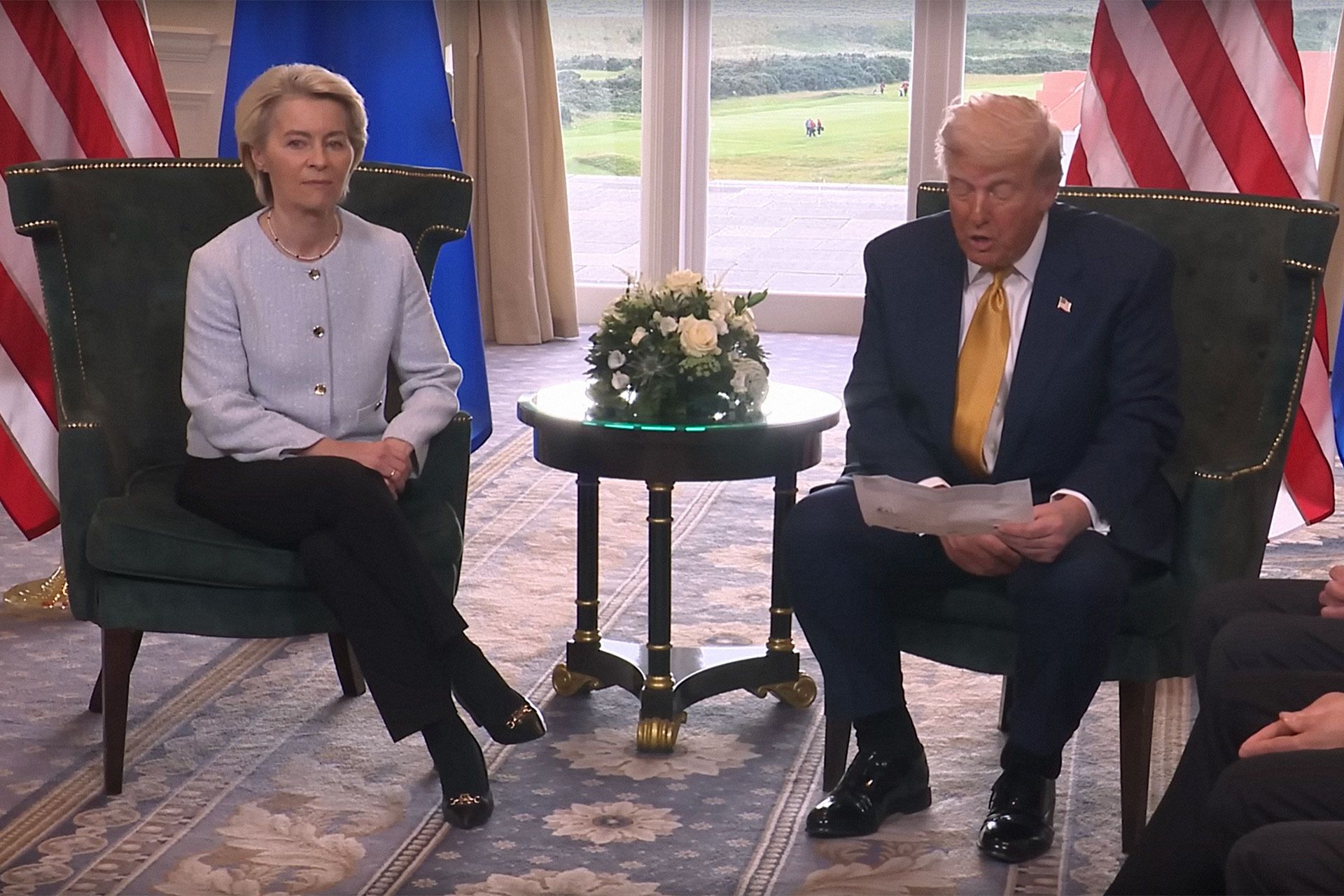
Meeting of US President Donald Trump and European Commission President Ursula von der Leyen. Turnberry, Scotland, July 27, 2025. Video frame: The White House
On Sunday, July 27, the world witnessed a strange scene. At the Scottish golf club Turnberry, owned by Donald Trump, a meeting took place between the American president and the president of the European Commission, Ursula von der Leyen. At this meeting, a trade agreement was signed between the EU and the USA.
Some key terms of the agreement became known: a 15% tariff is imposed on European goods when imported into the USA, while the European market remains open to American goods. Additionally, Donald Trump announced Europe's readiness to purchase $750 billion worth of energy resources from the US and invest $600 billion in the American economy in the coming years.
Donald Trump called the agreement very good, while Ursula von der Leyen looked somewhat embarrassed and thanked the American president for his invaluable contribution as a negotiator.
This event was preceded by Trump's threats to impose 30% tariffs on European goods due to the trade deficit, which greatly concerns the current administration in Washington and amounts, according to their calculations, to about $350 billion. However, on the other side of the Atlantic, a different balance was made and different figures were obtained: only a $57 billion deficit for the USA, if considering not only goods but also services. Thus, from the European perspective, Trump's claims were unfounded, and the introduction of practically prohibitive tariffs would mean declaring a trade war. The parties agreed to negotiate to reach an agreement by August 1, when the American administration planned to start applying the new customs tariffs.
The EU’s positions appeared strong enough to withstand Washington’s pressure. Only the EU and China have economies comparable in size to the American one, which determines interdependence and suggests a desire to avoid trade wars with inevitable damage to all. The EU population of 450 million exceeds that of the USA (340 million), indicating the high attractiveness of the European market. Brussels declared readiness to take retaliatory measures both for American goods and for digital giants, whose expansion into Europe is significant. Thus, it seemed that the EU had enough arguments to obtain acceptable and balanced conditions from the USA for continuing trade.
Nevertheless, the parameters announced when formalizing the agreement, as well as the unusual procedure of signing it at a golf club, were perceived in Europe as a heavy defeat for the EU. Consolation came in the form of thoughts that it couldn’t have been better, but Brussels’ initial positions suggested a different outcome. All political leaders and competent experts understood this. Critics of the European integration project felt inspired: indeed, recognizing the deficit of political and military influence of the EU, Brussels felt economically like one of the main centers of the modern world, which would not allow anyone to talk to it from a position of strength.
It turned out that the EU is a paper tiger not only in areas where its shortcomings are well known but also where its power should be evident. So what happened, why did such an unfavorable agreement with the USA arise? And what consequences might it have?
Usually, a bilateral agreement contains obligations for each participant. In the case of the EU-USA agreement, it is noteworthy that the American side is not going to make any concessions, at least according to the statements made. The EU pays for everything, receiving nothing in return. But this is not the only oddity of the deal, if we use Trump's terminology.
Room for interpretations
The clause about 15% customs duties is quite clear if one does not delve into details. Meanwhile, there are groups of European goods, in particular aviation equipment and technologies, which will not be subject to these tariffs due to their importance for American aircraft manufacturing. But negotiations apparently continue on many other points.
Thus, the full list of customs duties is not yet formed, and no one knows when it will take its final form. Moreover, the proclaimed openness of European markets also raises doubts, since the legally adopted EU norms cannot be canceled by Ursula von der Leyen, while they restrict, for example, supplies of American agricultural products to Europe. There is a suggestion that the tariff agreements are more declarative than they seem at first glance, and the pitfalls within them are deliberately overlooked.
But these omissions seem harmless compared to other provisions of the agreement. In particular, the European commitment to purchase $750 billion worth of American energy resources over three years is puzzling—not even because it is questionable given the volume of energy consumption in Europe. Much more important is the fact that purchases are made by energy companies of individual countries, and the European Commission simply has no authority to force them to enter contracts exclusively with Americans.
Even more surprising is the clause about investments of $600 billion in the American economy. The European Commission does not make any investments; this is a matter of private business. If it considers it necessary, it will create projects in the USA; if not, then it won’t.
Ursula von der Leyen might as well guarantee the construction of roads on Mars: in reality, she does not have the budget for such things, and entrepreneurs, if she wants to attract them, will themselves assess the prospects of such investments and make decisions.
Thus, all points of the trade agreement require clarification or are declarative, if not empty. Obviously, the EU chose to avoid a trade war and concluded an agreement that leaves room for interpretation. The cleverness of this move—much like the story of Nasreddin Hodja teaching a donkey literacy—implies, however, accompanying risks. Donald Trump will not be president forever, but he might remember the meeting in Scotland in a year, demand a report on promised investments, and, discovering the deception, become very angry and again announce those terrible tariffs that Europeans happily avoided today.
Critical dependence
It is difficult to judge the motivation of the American president. One might assume that he sought to publicly proclaim victory in the battle with the cunning Europe to convince his voter; that he believed in the effectiveness of tariffs as a tool to fill the budget and reduce the deficit; finally, that he hoped to relocate some European companies’ production to the USA to avoid paying customs tariffs. Time will tell where he was right and where he was wrong.
But it is much more interesting to understand what guided Ursula von der Leyen in agreeing to the dubious mise-en-scène at the golf club and expressing gratitude to Donald Trump for his benevolent approach. There is no doubt that her actions were coordinated with the leaders of the leading European countries and were not her own improvisation.
Essentially, the EU faced a choice: a trade war or an agreement on Trump's terms. A trade war itself would have meant a severe blow, primarily to Germany’s economy, which exports its high-tech products to the American market in large volumes. Obviously, German machinery and equipment manufacturers made considerable efforts to convince both their government and Brussels that a bad agreement is better than escalating tariffs. But if it weren’t for two other significant circumstances, Germany’s position might have met convincing counterarguments. There are two points of critical dependence of Europe on the USA currently that cannot be ignored.
First, it concerns the military potential of the USA. The war in Ukraine has lasted three and a half years and brings both direct threats of conflict escalation to the EU and an indisputable need for rearmament and creation of capable armies. All this takes time, but the transition period is hard to get through while constantly arguing with the USA. It is no coincidence that NATO Secretary-General Mark Rutte so diligently courted the touchy Trump at the summit to avoid any sharp statements from the American president at all costs.
For Europeans, it is crucial that, at least outwardly, everything remains as before: the USA is a reliable ally, military supplies to Ukraine continue, NATO mechanisms work.
A trade war could undermine the fragile understanding in military cooperation and support for Ukraine, which today seems to have developed between Europe and the USA.
Second, in the field of digital technologies and telecommunications, American dominance is so great that the EU cannot do without American companies. Theoretically, in response to tariffs, one could impose an additional tax on, say, Netflix in Europe, but it hardly makes sense to attack the entertainment industry while all government administration and information security systems run on American software. This would please no one, neither in Washington nor in Silicon Valley. Upon sober reflection, the European Commission decided not to worsen relations where the USA has a clear advantage.
Thus, the weakness of the EU’s position was determined not by its economic potential but by critical dependence in military and digital technologies. It would seem these circumstances should not affect debates on customs tariffs and trade balance deficits, having no direct relation to them. But, according to European diplomats, Trump builds his negotiating position precisely this way, using political levers to achieve agreement on other issues. None of his predecessors could seriously talk about the USA leaving NATO as a means of persuading Europeans—but today, the reality is that Trump easily utters such threats.
Political consequences
Obviously, a bad agreement weakens the EU, but to what extent? In recent days, Ursula von der Leyen personally received much criticism, but her position currently seems quite solid. Still, in most European capitals, the agreement was met rather with relief, considering that the worst-case scenario was avoided. The President of the European Commission still has the support of the main political forces in Europe, so a serious crisis in EU leadership is not expected soon.
A more serious problem seems to be the EU’s strategic perspective. It is not only that different countries’ expectations from negotiations with the USA did not coincide and defining a common position, as always, was difficult—after all, such disagreements within the EU are habitual and natural due to its structure. Worse is the trajectory of its development, consisting of strengthening European integration and gaining strategic autonomy, which seemed to have emerged in recent years, but is now questioned.
Supporters of preserving national sovereignties received confirmation of their fears: at a decisive moment, the EU again revealed its vulnerability and could not resist US pressure. So why create new pan-European projects if Brussels was weak before and remains so?
It is obvious that China, India, and other countries around the world closely followed the negotiations. Observers probably drew the following conclusion: the EU has not overcome the status of a junior partner to the USA, and if Donald Trump needs anything from Europe in the future, he will get it. These considerations will undoubtedly be taken into account by third countries in their relations with the EU, creating additional difficulties for Brussels.
At the same time, within Europe itself, besides criticism of the agreement, there is another point of view. Perhaps, under pressure from different sides, in the context of the war in Ukraine, the Russian threat, increased defense spending, and changes in American policy, the EU is not maneuvering so badly, trying to minimize damage. Considering the oddities of the agreement mentioned above, one might suppose that European concessions are not so great, and image losses just need to be endured. After all, trade wars, like any others, are better started well-prepared. Otherwise, it is wiser to avoid them.
If you enjoyed this article, consider making a donation — one-time or, even better, monthly. Your support helps us motivate our authors and become better with every article.
Our organization is recognized by the Internal Revenue Service (IRS) as a 501(c)(3) tax-exempt, charitable organization, which means that all contributions made to us are tax-deductible to the fullest extent permitted by U.S. law. Individuals may generally deduct charitable contributions of up to 60% of their Adjusted Gross Income (AGI) for cash donations made to qualifying 501(c)(3) organizations. For donations of appreciated assets (such as stocks or other long-term capital assets), the deduction is typically limited to 30% of AGI, based on the fair market value of the asset. C-corporations may deduct charitable contributions of up to 10% of their taxable income for donations made to eligible charitable organizations.
By submitting a donation, you confirm that you have read and accept the following documents: Privacy Policy and User Agreement, and also give consent to the processing of your personal data.
If you would like to unsubscribe from a monthly donation, please email us at: [email protected]