Across the country, bookstores are undergoing searches and prosecutor inspections. Publishers send them lists of “banned” books that must be removed from sale and destroyed. All foreign agent books must be sold by the end of summer: from September 1, any educational activity by authors with this status will be prohibited. How do small bookstores in the regions survive under these conditions? A report from Rostov-on-Don, where, despite all difficulties, there are three such stores.
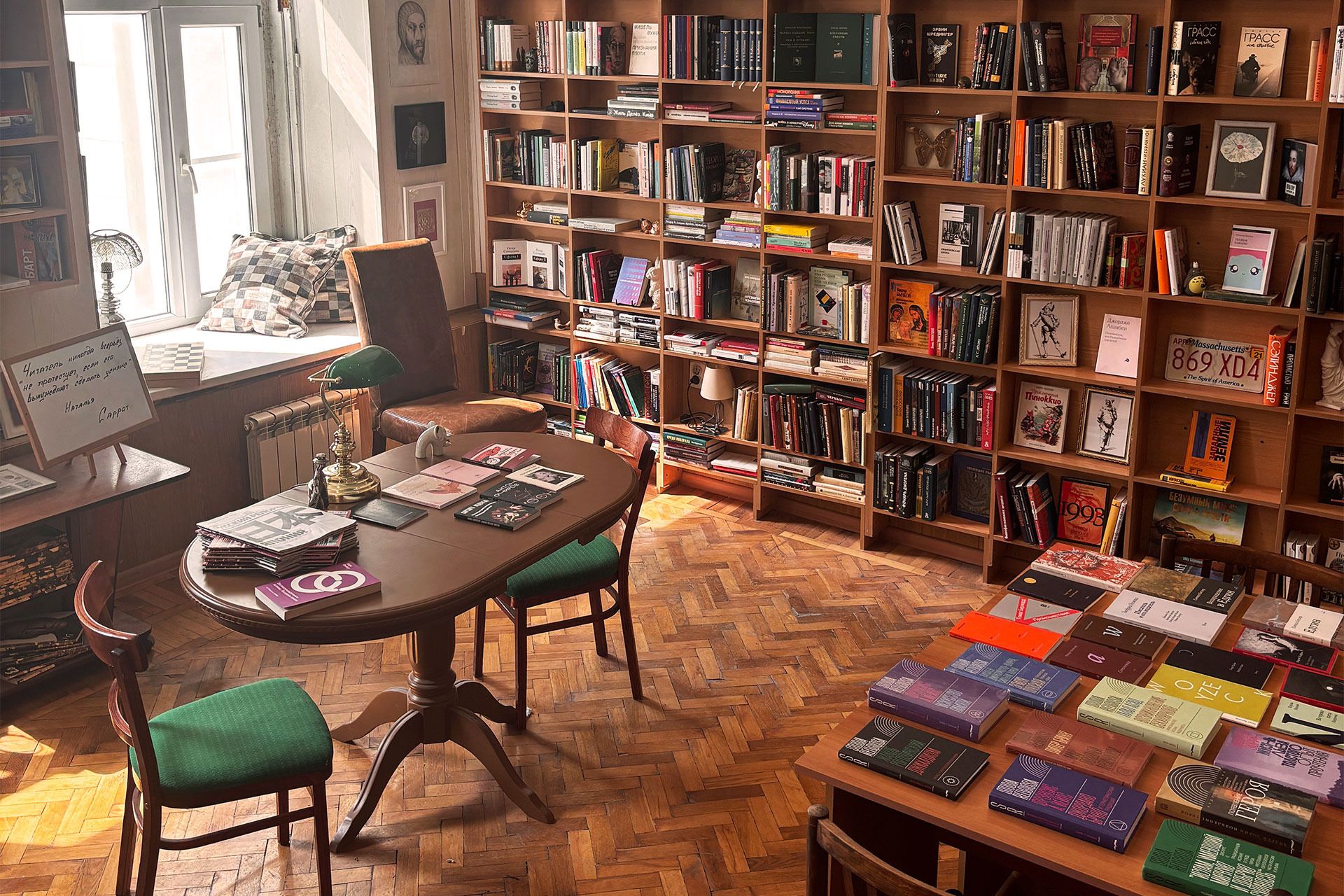
Bookstore “Palindrome”. Photo: social media
This material was prepared by the team of the project “Blue Capybaras”, where mentors work with aspiring journalists.
In the center of Rostov, on the third floor of an old building, is the “Palindrome” store. It’s not easy to find: the building only has a “Magnit” sign. But the bookstore’s social media explains where to enter. Tall stairs lead to the third floor, with posters of “Palindrome” on the walls featuring its slogan, also a palindrome — “Не видно как он дивен” (“It’s not visible how wonderful he is”) — a phrase readable both ways — and arrows pointing the way.
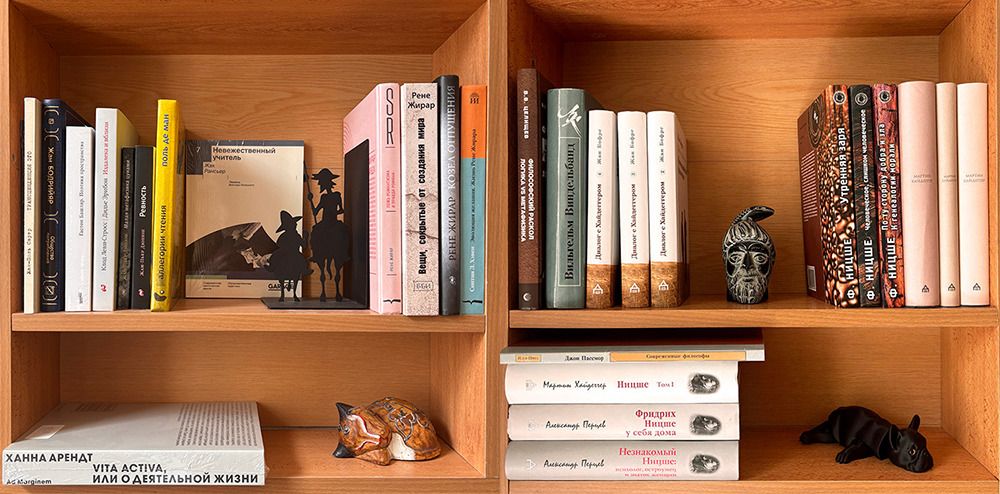
The small room is lit by warm lamp light. In the center is a table with books spread out on it. There’s also a lamp with stars cut out of its shade, brought from Istanbul. On shelves arranged around the perimeter are books on classical and contemporary philosophy, philology and art, anarchist literature, modernist prose, and contemporary poetry. Next to the French philosophers stands a figurine of a French bulldog; on other shelves are porcelain elephants and a bookend featuring Don Quixote and Sancho Panza.
During the day, the store is almost empty, but now, on a Sunday evening, eight people have gathered around the table in the middle of the room to discuss “The Lie of Romanticism and the Truth of the Novel” by French literary theorist and philosopher René Girard. Such meetings regularly take place in the store and are divided into three sections: “Pink” — joint reading of a short story, “Hedgehog’s Ear” — discussion of an academic text (exactly the Girard book), and “Transcription” — a conversation about a literary novel.
The store owners Ramzan and Alexandra, together with designer Anita, select books for discussions and also conduct the meetings as a trio. Every book in the store has been read by at least one of them. Today, more people came than usual. Anita goes to the back room to get extra chairs.
“What do you think, why do we even read Girard?” Ramzan asks Alexandra to start the discussion.
“I think, first and foremost, because he seriously reads literature himself: he looks for anthropological truth in it,” she answers.
Around the table, someone takes notes, others just listen. Ramzan speaks slowly, not so much lecturing as reasoning together with the others. Sometimes a listener adds a comment, and the discussion smoothly shifts direction. “So how did Girard define justice for himself?” someone asks. After a couple of hours, the discussion of the first chapter ends. Ramzan, Sasha, and Anita remind everyone the next meeting is in a week and that reading the book is not mandatory — “you can just come.”
Ramzan believes that independent bookstores exist precisely for meetings like these. Buying a book is not a problem thanks to marketplaces with a wide selection. Small stores, however, build and maintain communities and create a fashion for reading. But it’s not easy to do.
Books in the high-risk zone
An independent bookstore is a social project that is hard to make money from, especially in regions where there are fewer visitors than in Moscow and St. Petersburg. Recently, besides the usual problems, Russian booksellers have faced pressure from authorities.
Since November 2022, stores must sell foreign agent books in opaque packaging. After the so-called “international LGBT movement” was declared an extremist organization in November 2023, publishers began withdrawing certain books from publication, and bookstores removed them from sale.
In recent months, pressure on the book industry has intensified. On April 30, the prosecutor’s office inspected the St. Petersburg store “Podpisnye Izdaniya” and issued an administrative protocol under the article on “propaganda of non-traditional sexual relations and gender change” for selling the books “About Women” and “Against Interpretation and Other Essays” by Susan Sontag, and “The Body of Each” by Olivia Lang. Searches were also conducted at the Moscow “Phalanster” and Novosibirsk “Map of the World.” “Phalanster” and its director Boris Kupriyanov were fined 80,000 and 40,000 rubles respectively.
Independent publishers are also persecuted by Russian authorities. On May 15, employees and former employees of “Eksmo,” “Popcorn Books,” and “Individuum” were detained. There are three suspects in the case; some employees are witnesses. The case is based on “organizing the activities of an extremist organization.” The minimum penalty under this article is a fine of 300,000 rubles, the maximum is 12 years in custody. Since then, retailers have removed books from these publishers from sale.
The human rights organization “First Department”* believes that the repression against publishing staff is primarily related to LGBT** literature they published. However, “Novaya Gazeta” cultural observer Karl Ramal, who follows the book market, notes that censors’ focus is gradually shifting from queer authors to foreign agents, and retailers increasingly self-censor.
Photo: social media
Thus, the Russian Book Union issued recommendations for booksellers from the so-called “Expert Center.” The document states that foreign agent books are in a special risk zone and can be withdrawn from sale at any moment. There is no unified list of “banned” books; publishers compile their own. For example, at the end of May, Russian bookstores received a letter listing 37 books from the publishers “Ripol Classic” and “House of Stories” for destruction. Stores have three options for disposing of banned books: return them to the publisher, recycle them, or burn them.
Despite all this, independent bookstores still exist throughout Russia and adapt to new conditions while preserving their identity. In Rostov-on-Don, there are three such stores: “Palindrome” and “V Poryadke” have been operating for five years, and “Burevestnik” opened quite recently.
“Enjoying the interaction with books and people”
“Palindrome,” says Ramzan, “is a word palindrome. It reads the same forwards and backwards. But you have to notice this special symmetry. When we chose the name, we wanted to show that something interesting can be seen in the ordinary, and even a small bit of attention is somehow rewarded.”
“Palindrome” appeared at the height of the coronavirus pandemic. “We joked that if we open at such a time, then probably nothing will be scary afterward,” says Ramzan, co-owner of the store. He met Alexandra while working in the “Labirint” bookstore chain. Alexandra then ran the “Kinodelicacies” store, selling DVDs and film magazines. The store was in its last days, mainly serving friends and neighbors as discs became less popular. Stacks of DVDs—remnants of past luxury for connoisseurs—still stand behind the “Palindrome” cash register.
Alexandra graduated from the philology faculty; Ramzan studied poetry at the Literature Institute but didn’t finish—it was followed by postgraduate studies at the pedagogical faculty. He has always been passionate about philosophy. “Our first order was for 100 thousand rubles. Philosophical primary sources, poetry, good academic literature, etc. Basically, we ordered books that are hard to sell but honor the store,” Ramzan recounts. Some books from that order (mostly thick monographs) remain unsold to this day.
Shelves of the bookstore “Palindrome”. Photo: social media
According to the co-owner of “Palindrome,” recent bans on books have hardly affected his store—it was lucky that the books withdrawn from “Podpisnye Izdaniya” and “Phalanster” were not sold there. “They just paid attention to Susan Sontag’s books, not Foucault’s,” Ramzan says, “If Foucault gets banned, I don’t know what we’ll do.” Foreign agent authors’ books were removed from sale at “Palindrome” several months ago—they were inherited by Ramzan and Alexandra from the cult Rostov store “Intellectual’s Shop.” When it closed, its owners gifted part of their stock to “Palindrome.”
The main problem for independent bookstore owners is that it’s hard to maintain. Currently, Alexandra, Ramzan, and Anita freelance in copywriting and design to have free time to run the store. It doesn’t bring profit: rent is expensive downtown, and there are few customers. According to Ramzan, even when people come in, they often photograph books to later order them cheaper on marketplaces. “In essence, buying a book is a donation to the store,” he explains, “because you can buy it cheaper online.” Moreover, books have recently become more expensive; the average price of one edition is 1,000 rubles (including the book price, delivery, markup). Buyers are used to old prices: “People are willing to pay 300 rubles for coffee and think books should cost the same. But they have been more expensive for a long time,” Ramzan says.
For him, the bookstore is first and foremost a space of words and meanings that exists beyond space, time, and state borders. But reality seeps in anyway. “As they say, known events happened, and some of our regulars emigrated, which affected us too,” Ramzan recounts. “We ourselves became demotivated, yet automatically kept doing it.”
The owners of “Palindrome” hope that in the future the place will become self-sustaining. They want to protect the store so it won’t depend on their work elsewhere. “As long as we can afford the bookstore, we will run it,” Ramzan says, “otherwise we get bored. There’s little time, and it can’t be wasted on nonsense. What else to do? We have no big future goals. The communication with books and people itself brings us pleasure.”
“Palindrome” is friendly with other bookstores in Rostov. Sometimes they order books together from publishers to get a better price. According to Ramzan, the stores don’t compete but rather try together to introduce city residents to the independent bookstore phenomenon: “When you’re alone, you will always seem strange to people. Sometimes people still come in and ask, ‘Is this a library?’”
“There are few of us like this”
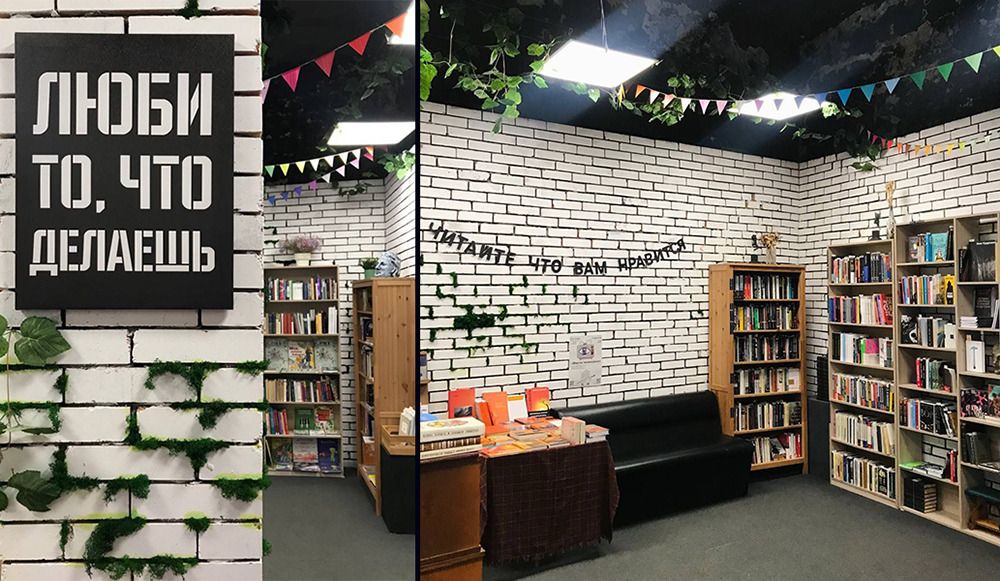
The bookstore “V Poryadke” is located in a basement. It’s a small room next to an art studio. The walls are white brick; around the perimeter are bookshelves. On one shelf is a papier-mâché head made by a Rostov artist. On a suitcase with old books is a sign “take for free.” Nearby, on a stool, is a box with foreign agent books wrapped in bubble wrap and a sign “100 each.” They need to be sold by September 1, when a law banning all educational activities for foreign agents comes into force.
It’s Sunday now, and the bookstore is empty. Although Anastasia, the store’s founder, notes that in recent months, after “Burevestnik” opened, visitor numbers have increased: “This circulation happens: the more bookstores, the more people in all of them.”
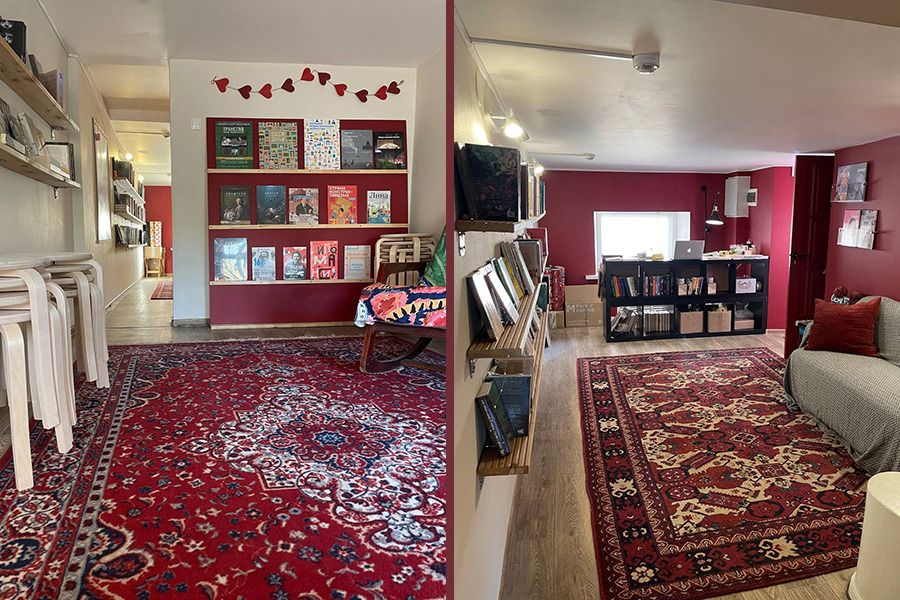
In the bookstore “Burevestnik”. Photo: social media
The woman doesn’t like the question about how she came up with the idea to open a bookstore: “I just wanted to bring books to Rostov that aren’t here. So the store appeared in autumn 2019. Back then, I didn’t even really know what an independent bookstore was.” The name “V Poryadke” (“All Right”) came from a meme where a dog drinks coffee in a burning house and says This is fine — Anastasia often shared it with friends.
Anastasia runs the store alone. It doesn’t bring profit, and she doesn’t have enough energy for everything, so the project grows slowly. “To develop, you need money, and to have money, you need to develop. It’s a cycle that’s hard to accelerate,” she says.
“V Poryadke” holds sketch club meetings (banners made at meetings are later hung on the store’s walls), a film club, and in March this year started a free course on foreign literature for everyone interested. It’s taught by a local star, professor of Southern Federal University Andrey Berdichevsky — according to Anastasia, people often have to stand at his lectures: “About 40 people come, and our store simply isn’t designed for that many.”
“V Poryadke” is visited by teenagers and those over seventy, workers and scientists. The owner often talks with customers and orders books at their request. For example, once she recommended a recently published novel by a female author to a regular male visitor of middle age: “He read it, came back and said, ‘I want more.’ It turned out he hadn’t perceived women’s prose before.” Now they periodically discuss new books written by women and exchange recommendations. “That’s how a person’s life changed,” Anastasia smiles.
But the book that started this story is no longer in the store: it ended up on the banned list, so Anastasia doesn’t want to name the author. She also removes other books when publishers send their blacklists or after raids by security forces in independent bookstores. “It’s a complete lottery,” Anastasia says, “you sit and don’t know what they’ll pick on. It seems you do everything: pack, label, remove from sale, and still they find something.”
Interior of the bookstore “V Poryadke.” Photo: social media
Several months ago, “V Poryadke” suffered a flood due to faulty sewage in the building. Books, furniture, and floors were badly damaged. Anastasia launched a fundraising campaign for repairs on social media, and many independent bookstores from different cities reposted it, even those whose owners she didn’t know. The money was quickly raised, and regular visitors, friends, and acquaintances helped dry the books and clean up.
“Independent bookstores are a community of people who survive, do something good, and are ready to help each other,” Anastasia notes. Above the sofa where we talk hangs a banner saying “Read what you like.” Anastasia brought it from a market in Krasnodar in support of the local store “Charlie,” which recently had a fire.
“I want to believe,” she says, “that our space supports people. I like the theory of small deeds: as long as you can do something that brings joy to others, you should do it. Every time you want to survive just a little longer. Out of principle. There are few of us like this.” * listed as foreign agents by the Russian Ministry of Justice
** The “International LGBT movement” was recognized as extremist in Russia by a Supreme Court decision
If you enjoyed this article, consider making a donation — one-time or, even better, monthly. Your support helps us motivate our authors and become better with every article.
Our organization is recognized by the Internal Revenue Service (IRS) as a 501(c)(3) tax-exempt, charitable organization, which means that all contributions made to us are tax-deductible to the fullest extent permitted by U.S. law. Individuals may generally deduct charitable contributions of up to 60% of their Adjusted Gross Income (AGI) for cash donations made to qualifying 501(c)(3) organizations. For donations of appreciated assets (such as stocks or other long-term capital assets), the deduction is typically limited to 30% of AGI, based on the fair market value of the asset. C-corporations may deduct charitable contributions of up to 10% of their taxable income for donations made to eligible charitable organizations.
By submitting a donation, you confirm that you have read and accept the following documents: Privacy Policy and User Agreement, and also give consent to the processing of your personal data.
If you would like to unsubscribe from a monthly donation, please email us at: [email protected]