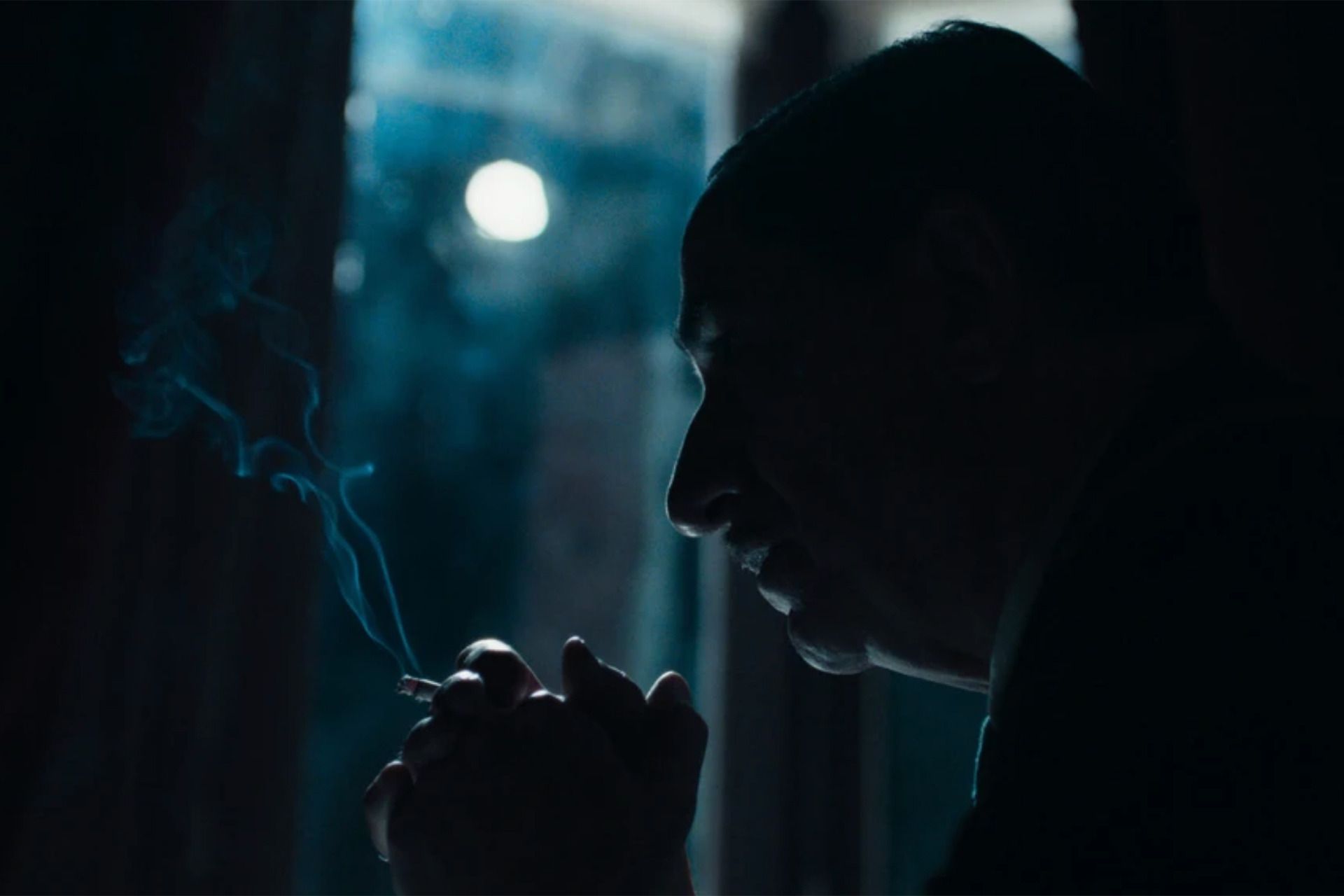
For many years after the Second World War, the French stubbornly pretended that their country had been a territory of Resistance during the occupation, and directors with a critical view of this myth were virtually ostracized. The French public has only now grown ready for a candid discussion of this topic: three films are arriving in national release at once — about De Gaulle, his supporters, opponents, and “apolitical” conformists. The latter, unfortunately, are usually in the majority.
A still from the film (fragment) “De Gaulle. The Iron Age” (dir. Antonin Baudry, 2026)
A surprising fact: in France, there have not been all that many biopics about such a powerful figure as Charles de Gaulle, a national hero. The first one, “I, General De Gaulle” by Denis Granier-Deferre, came out in 1990. Then came “The Great Charles” by Christian Faure (2006), “Farewell, De Gaulle, Farewell” by Laurent Herbier, the miniseries “The Great and the Hidden” by François Velle (2020), and in the same year — “De Gaulle” by Gabriel Le Bomin. And now, just days ago, screenings began for a new film — “De Gaulle. The Iron Age” by Antonin Baudry, known for “Wolf’s Call” and “Quai d’Orsay”.
This is the first part of a diptych. The second part, “De Gaulle. I Will Write Your Name”, is promised for release literally within a month. The film was shown out of competition at this year’s Cannes Film Festival and became one of the main draws for French attendees. Understandably so — a figure of such scale, the most ambitious French project of recent years, especially for a country not exactly famous for blockbusters. Interestingly, Bertrand Tavernier once planned to make a film about De Gaulle, but the producers insisted that the lead role be played by... Gérard Depardieu. Tavernier refused. The project stalled.
Baudry turns to the period from June 1940 to 1944, when the outcome of the Second World War was still far from clear and de Gaulle had not yet become a legendary figure. The film is based on the work of British historian Julian T. Jackson, “De Gaulle: A Certain Idea of France”, who helped with the screenplay. The filmmakers chose one, the brightest and most difficult period in the life of the future president of France — when the general entered history forever, not only of France but of the entire world, as a leader who, after humiliating setbacks, was destined for colossal success.
June 1940. France surrenders, and Marshal Pétain’s government becomes a puppet in the hands of the Nazis who defeated the country. An obscure general named De Gaulle (Simon Abkarian) tries to persuade Pétain and his entourage to begin the fight, not to surrender — otherwise great France will perish. Pétain indignantly rejects the accusations of cowardice, insisting that it is his strategy that will save France and the French. In despair, De Gaulle flees to London — without an army, without support, without much hope of success, armed only with one desire: to organize resistance, to force the country to take up arms. He tries to convince the world that the battle for France is not only not lost, but has not even begun.
On the radio, the general addresses the nation with a call to begin resistance. To his disappointment and horror, the nation responds very weakly — except for a small handful of patriots inspired by de Gaulle’s speech. His first supporters are a Polish plumber, Breton fishermen, and a priest. Those are the only ones left to rely on.
Over time, that “handful” grows, and more and more people join the Resistance. The film also includes the story of the young Parisian Fernand Bonnier (Florian Lesieur), a 20-year-old student who was among the first to side with de Gaulle, shot the Vichy minister General Darlan, and was executed for it two days after the assassination.
Charles de Gaulle’s relations with Winston Churchill (Simon Russell Beale) begin quite successfully — the British prime minister approves the French general’s decision to lead the resistance and gives him airtime on the BBC for his appeal. Something like a real male friendship emerges, but, alas, not for long. U.S. President Franklin Roosevelt played a role here, as he was categorically opposed to de Gaulle leading “Free France”. De Gaulle seemed to him too reckless and not wise enough, while also showing dictatorial tendencies. After wavering, Churchill agreed with Roosevelt’s arguments and ordered de Gaulle removed as a political force.
Naturally, the filmmakers do not for a second let the viewer doubt whose side they are on, portraying Churchill, in Simon Russell Beale’s brilliant performance, as a politician who inspires not the slightest sympathy, despite all his well-known contribution to victory in the Second World War. The relationship between de Gaulle and Churchill is the most interesting thing in the film, even if it is shown in a more one-sided way than it was in reality. Most of the film is devoted to verbal duels between the two politicians — one experienced, the other just beginning. But Baudry carefully departs from the traditional version, according to which the seasoned British politician acts as the wise mentor of the young French general. In the film, de Gaulle from the very beginning claims to be France itself, even though he formally represents no one. Churchill is both fascinated and irritated by this. The irritation later turns into rejection, which later, not without Roosevelt’s involvement, turns into conflict.
Baudry consciously avoids any psychologizing: we almost never see de Gaulle’s reflections, nor doubts about the correctness of the chosen path, nor the underlying reasons for one decision or another. Everything is on the surface here — the general is not inclined to involve the viewer in his inner experience. We see his family only once, for about a minute — apparently just to make sure that he has one.
As for the lead actor, that deserves special mention. Simon Abkarian is an Armenian born near Paris, from where his family moved to Lebanon (it’s amusing that at his Beirut school they called him “De Gaulle” because of his French background — see how an accidental nickname can sometimes come in handy). Abkarian is well known in French theatrical circles — he acted a lot at Theatre du Soleil, wrote plays, and staged productions himself in various theaters, winning the French theatre award “Molière” both as an actor and as a playwright and director. He has appeared in many films, though mostly in supporting roles. He bears little external resemblance to the protagonist — except perhaps for a long nose — but Baudry said in one interview that even when he was only beginning the screenplay, he could imagine only Abkarian in the role of de Gaulle.
What the actor has in common with the general is immense inner energy. True, the real de Gaulle, judging by surviving footage, was more inclined to publicly express emotions than the screen version, but Baudry considered it necessary to soften the hero’s outward emotionality, giving priority to the inner kind. And it worked — you can literally physically feel the force and energy coming from him. Against the backdrop of the fussing Churchill, de Gaulle appears much more masculine and weighty, which is exactly what the filmmakers aimed for.
A still from Antonin Baudry’s film “De Gaulle. The Iron Age” (2026)
Baudry assembled an impressive cast. The Vichy minister Darlan is played by Mathieu Kassovitz — a difficult role, a difficult character. In earlier films about De Gaulle, Darlan’s image usually flickered like a shadow — French cinema long did not want to bring him to the screen precisely because of his ambiguity. He was one of the founders of the Resistance, for which he deserves praise, but then he switched sides and joined the enemy camp — for which shame. This figure remained in the “gray zone” for a long time: the French sacredly guarded the myth of the involvement of the whole nation in the Resistance, and they did not want to admit that everything was far more complicated.
But more than 80 years after Germany’s capitulation, it has become necessary to admit that the Second World War was not a period of popular resistance in France against a handful of Vichy supporters and the Nazi army — collaborationism engulfed almost the entire country.
Perhaps that is why there were so few films about De Gaulle: no one was all that eager to admit how difficult it was to organize the Resistance. Only in recent times has the myth of a nationwide struggle against the Nazis and Pétain finally begun to slowly collapse.
For many years after the Second World War, the French stubbornly pretended that their country had been a territory of Resistance during the occupation. Countless films were made on this heroic theme, and the Vichy regime was mostly presented as a betrayal by the elites that had nothing to do with ordinary French people. As if the Vichy supporters were one thing and the people another. And films showing what happened in the German rear in France, how people voluntarily collaborated with the Germans, met with persistent public rejection.
Louis Malle, who made the film “Lacombe, Lucien” about an ordinary village boy who tried to join the Resistance but “accidentally” joined the Nazis, was forced to leave France for as long as ten years — public opinion turned so strongly against him for showing collaboration as an everyday phenomenon. Marcel Ophüls’ four-hour documentary “The Sorrow and the Pity” (1969), which debunks the official postwar myth of universal resistance, provoked literal fury among viewers. No one wanted to part with the convenient myth. So director Xavier Gianolli, with his film “Shadows and Rays”, stepped onto slippery ground, even though the myth of widespread French heroism had already begun to fade into oblivion.
At the center of the film is Jean Luchaire (Jean Dujardin), a journalist and “press king”. In the 1930s, Luchaire actively advocated strengthening friendship between France and Germany and became friends with Otto Abetz, a German diplomat who spoke French fluently (played by Otto Diel). Together they gathered crowds of young people before whom they gave fiery speeches about friendship, peace, and the possibility of resolving any conflict through negotiations. But the Second World War broke out, France quickly fell, and Abetz, by then already a SS Brigadeführer, arrived in Paris as Germany’s ambassador and simultaneously with a mission to “solve the Jewish question” in France once and for all. The two friends’ pacifism from the day before vanished overnight. Abetz secured more than substantial funding from the German authorities for a new newspaper, “Les nouveau temps”, which was headed, of course, by Luchaire. By the start of the war, his daughter, Corinne Luchaire, was almost the biggest film star in France.
After the liberation of France, Jean Luchaire was captured by the Allies, brought to trial, and executed in 1946. His daughter, the most popular French actress, was subjected to the harshest ostracism and a ban on her profession, lived out the rest of her days in poverty and disgrace, and died of tuberculosis at the age of 28 in 1950.
“Shadows and Rays” is a story about how a person builds a chain of decisions, one after another, gradually, not all at once, rethinking former views and ideals, thereby creating a new reality for himself. And so for him, a pacifist of yesterday, working for the occupier becomes the norm, and Luchaire is sincerely offended when part of the staff at his former prewar newspaper angrily refuse to work for “Les nouveau temps”, so generously financed by Nazi Germany.
And his daughter Corinne (Nastya Golubeva-Carax) has nothing to do with politics. She is simply passionate about her work, films a lot, gladly attends soirées with her father and his best friend Abetz. She likes everything, everyone needs her everywhere, she is a superstar.
Gianolli tries to draw a line between adaptation and participation in a crime, and he does so very delicately, mindful of the fate of directors who took on the theme of collaboration and paid for it with ostracism. But delicacy did not work — the French press, while acknowledging the film’s artistic merits, lashed out at the director for his approach to the theme of collaboration. He was accused both of excusing the characters and of rewriting history, and of being confused about his own attitude toward events in occupied France. How painful this topic is for the French if, in a film that condemns collaboration 100 percent, they find gaps to condemn...
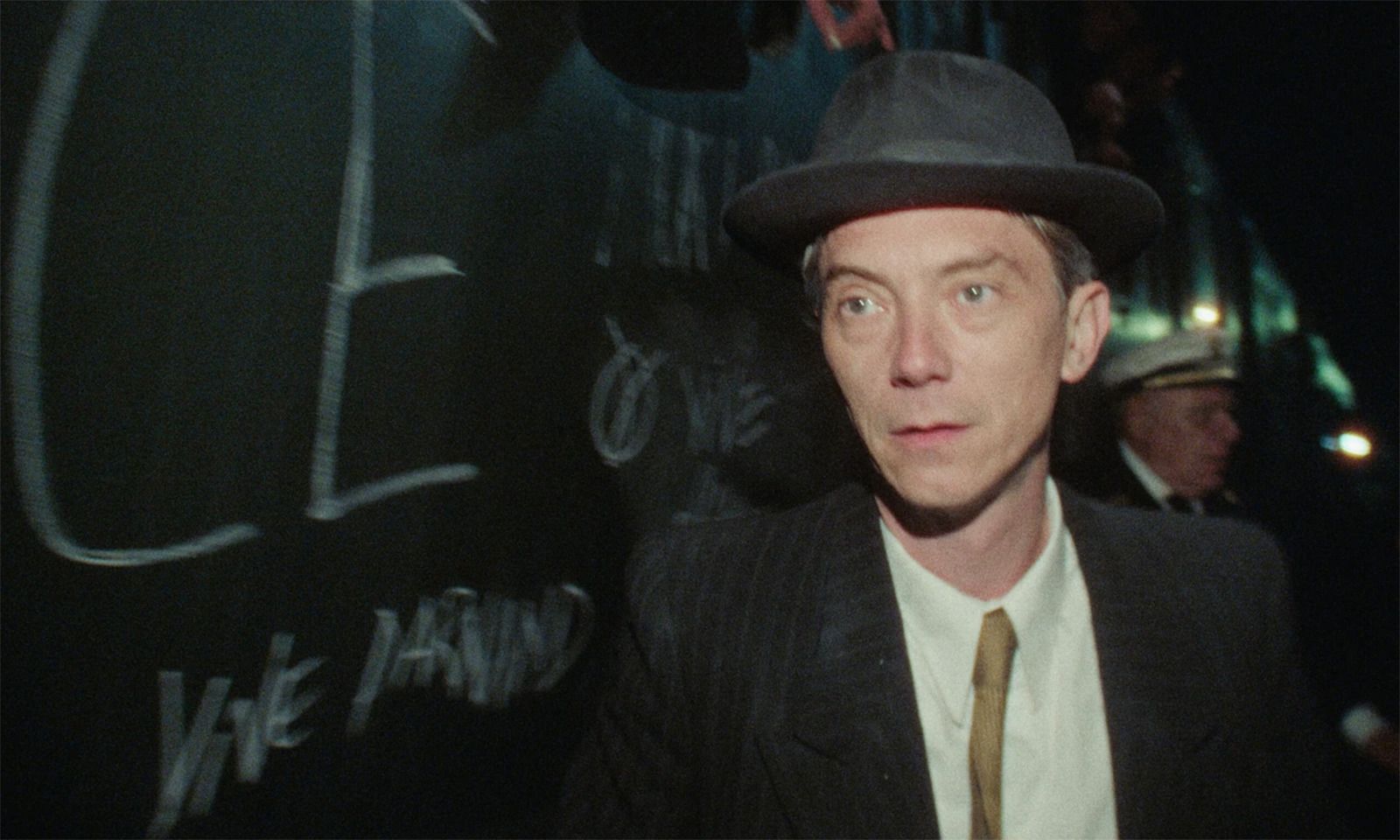
A still from the film “Our Salvation” (dir. Emmanuel Marre, 2026)
And in the last Cannes competition, Emmanuel Marre’s film “Our Salvation” was shown (about which “Most” has already briefly written after the festival, where Marre received the award for best screenplay). The film tells the story of a real person — the director’s great-grandfather, Henri Marre, who offers the Vichy government his work titled “Our Salvation” — in it he describes ways for France to emerge from crisis. Not being a Vichy supporter, Henri nevertheless gradually becomes entangled in a system of compromises and himself becomes part of the collaborationist system.
French critics unanimously praised “Our Salvation”, noting the freshness of its approach to the material. If earlier films about the period of France’s occupation mainly portrayed collaborators as military men and high-ranking officials, here the story is about an ordinary, “small” man with good intentions, by which, in the end, the road to hell is paved.
All the films listed clearly show how French historical memory is changing, how far it has moved from the myth of the “nation of resistance”. There is no information about the possible release of these films in Russia, and that is a pity — for Russian viewers they could be useful. Especially “Shadows and Rays” and “Our Salvation”.
If you enjoyed this article, consider making a donation — one-time or, even better, monthly. Your support helps us motivate our authors and become better with every article.
Our organization is recognized by the Internal Revenue Service (IRS) as a 501(c)(3) tax-exempt, charitable organization, which means that all contributions made to us are tax-deductible to the fullest extent permitted by U.S. law. Individuals may generally deduct charitable contributions of up to 60% of their Adjusted Gross Income (AGI) for cash donations made to qualifying 501(c)(3) organizations. For donations of appreciated assets (such as stocks or other long-term capital assets), the deduction is typically limited to 30% of AGI, based on the fair market value of the asset. C-corporations may deduct charitable contributions of up to 10% of their taxable income for donations made to eligible charitable organizations.
By submitting a donation, you confirm that you have read and accept the following documents: Privacy Policy and User Agreement, and also give consent to the processing of your personal data.
If you would like to unsubscribe from a monthly donation, please email us at: [email protected]