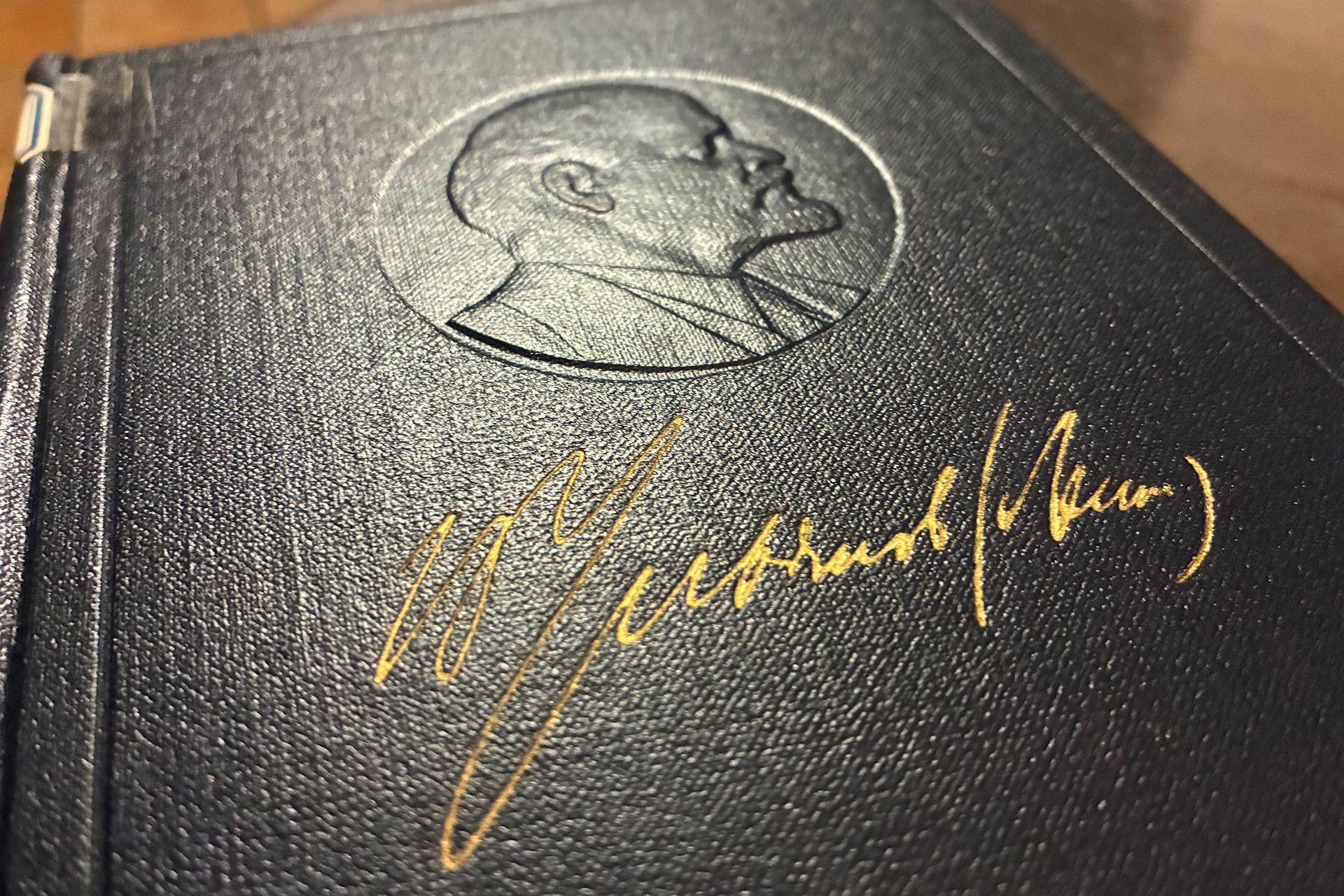
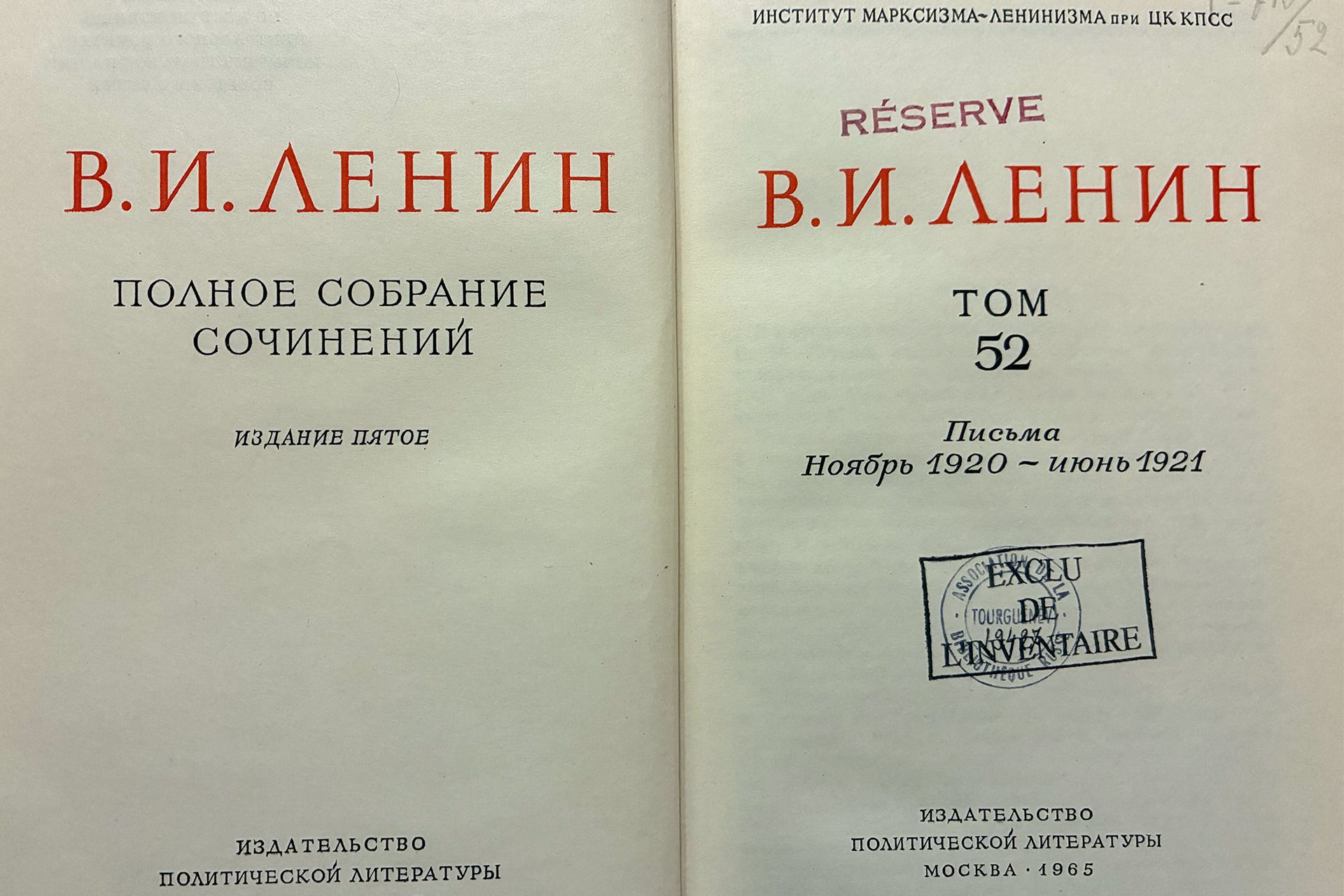
Last week, few people remembered Vladimir Ulyanov’s (Lenin’s) birthday. Among those who did mark the date was the Turgenev Library in Paris: on April 22, the complete 55-volume collected works of the leader of the Russian Revolution were ceremoniously carried out from its shelves. In the past 30 years, not a single reader of the Turgenev Library had requested Lenin’s works—so the staff of the oldest Russian émigré library decided to bid a cheerful farewell to the Soviet past, making room for new books. Parisian supporters of Lenin tried to intervene in the process.
Photo: Most.Media
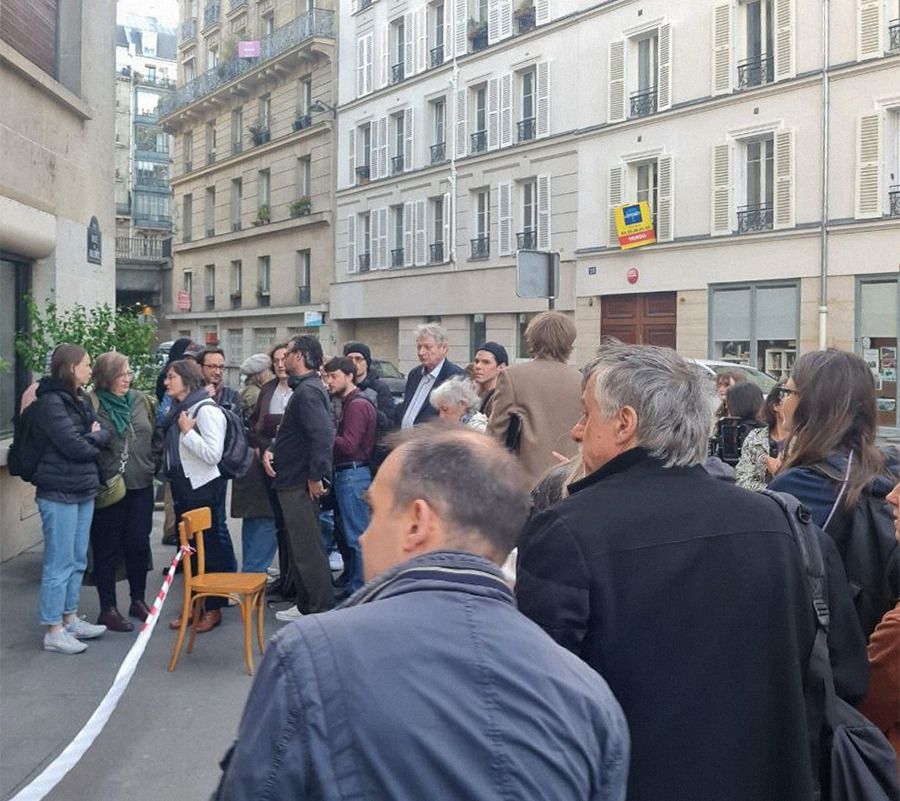
On the evening of April 22, the usually quiet Valence Street, home to the Russian Public Library named after Turgenev, is unusually lively. On the sidewalk by the entrance, surrounded by about a hundred onlookers, a guitarist plays softly. The occasional passerby glances curiously at the library president, Aglaya Asheshova, dressed in early 20th-century fashion:
“Dear guests! In organized groups, led by our attentive staff, you will go upstairs to the library and draw a lottery ticket. That’s the number of your Lenin volume,” she explains the rules. “With this number, you enter the hall and view the installation made from the complete works. At this stage, we’ll nourish your body and spirit, as you’ll need to wait for everyone to see the installation. While you wait, I suggest you recall the titles of Lenin’s works and quotes from them—you’ll be surprised how deeply they’ve entered our culture.”
“The guard is tired!” someone shouts cheerfully from the crowd.
“Lenin lived, Lenin lives, Lenin will live!” someone else joins in, though that quote isn’t from Lenin either.
– “Left-Wing Communism: An Infantile Disorder!” I can’t resist.
“Materialism and Empirio-criticism!” someone nearby chimes in.
“Why do you think Lenin is no longer relevant today?” comes a question from the crowd.
“Of course he’s still relevant—his works are available both online and offline in Paris, in public libraries. A 20-minute walk from here is the BULAC university library; you can register there with just a passport, no other requirements, and read Lenin from 10 am to 10 pm every day except Sunday,” answers the library president. “It’s just that in the last 30 years, no one here has requested a single volume from his collected works. And it takes up three linear meters. Our storage capacity is limited, so we’d like to make room for new books that readers will actually want.”
Photo: Most.Media
In the back rows of the crowd, a tall, long-haired man with deep shadows under his eyes raises his hand like a schoolboy, asking to speak. This is Denis Denisov, a doctoral student at the Paris School for Advanced Studies in the Social Sciences (EHESS). The day before, he had sparked a heated discussion on a French Slavic scholars’ mailing list, protesting the Turgenev Library’s plan to give away the unclaimed Lenin volumes to anyone interested. In his view, the 55-volume set, acquired by the library in Soviet times, should be preserved in its entirety—as a single collection and an object of historical memory.
“With this letter, I protest and call on all who supported my request to come on the 22nd. This is in no way intended to disrupt the planned program or embarrass the event. It’s a last attempt to use rational arguments against the planned destruction [...]. And at worst, perhaps we can at least recover most of the volumes as a buy-back option for participants,” Denisov wrote at 4 a.m. on the day of the “Lenin Removal.”
He arrived at the event with a hiking backpack, a rolling bag, and a French friend. Pierre Millet, also a doctoral student at EHESS, addresses the crowd, proposing a game comparing and contrasting Lenin’s and Turgenev’s works. Denisov translates his speech into Russian and asks Asheshova the same questions he had raised in the mailing list:
“What is the history of the complete Lenin collection at the Turgenev Library? Who ordered it, and which volumes were most interesting to readers?”
Aglaya explains that the current library staff have been unable to reconstruct the history of the 55-volume set’s acquisition—they can only assume that the Turgenev Library, founded and maintained by Russian political émigrés, was interested in studying Lenin’s legacy as a chief ideological opponent. In some volumes, you can even find pencil notes from readers. But these were clearly not made in the last three decades—since the early 1990s, these books haven’t been checked out even once.
“So Denis, why haven’t you come here to read Lenin all these years?” the library president asks.
“I was too busy working on my dissertation about events in my hometown of Sevastopol!” Denisov retorts (his dissertation, defended last winter, is titled “The French Intervention and Workers of Sevastopol. November 1918 – May 1919“). He promises to “present some arguments against the way the complete collected works are being removed” and to try to convince all the participants to give their Lenin volumes to him.
***
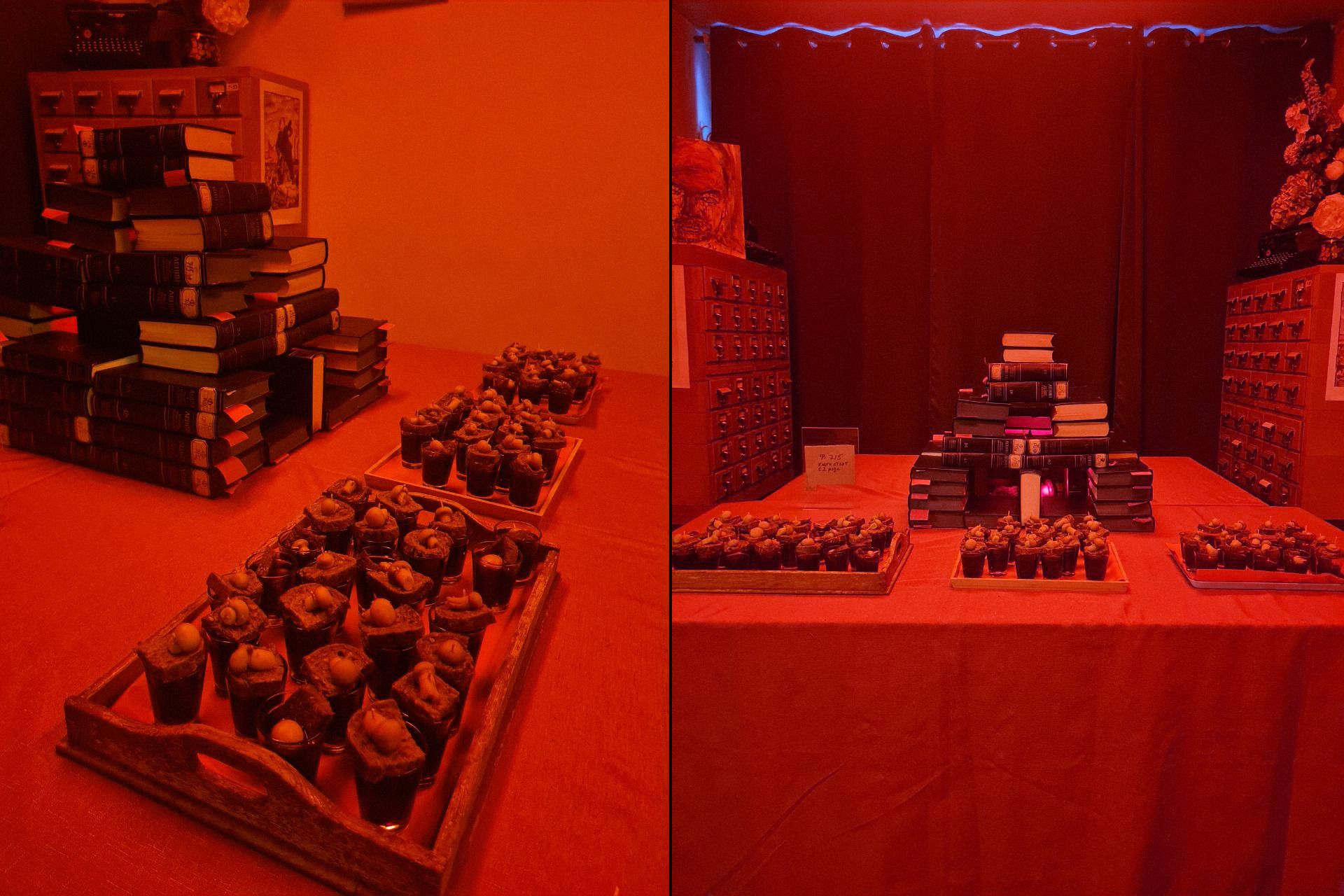
While musician Zhenya Kukoverov plays ambient variations—sometimes echoing Chopin’s funeral march—sociologist Alexander Bikbov, in a yellow-and-blue striped sweatshirt, directs the “queue to the mausoleum.” Indeed, in one of the library halls, the staff have built a model of Lenin’s mausoleum on Red Square (represented by red lighting in the library hall) out of the complete works. Inside the installation lies a fake mushroom, while in front are trays with red wine, topped with pieces of black bread and pickled mushrooms. The whole setup alludes to Sergey Kuryokhin’s famous TV hoax “Lenin Was a Mushroom.“
Photo: Most.Media
As the audience, having viewed the installation, returns to the sidewalk, Pierre Millet tries in vain to capture their attention. Climbing onto an improvised stage, he energetically delivers a lecture in academic French on the similarities and differences between Turgenev’s and Lenin’s texts—apparently, this was the promised game. The crowd quickly loses interest and drifts off into small groups. The little Frenchman struggles to hide his disappointment—but continues anyway.
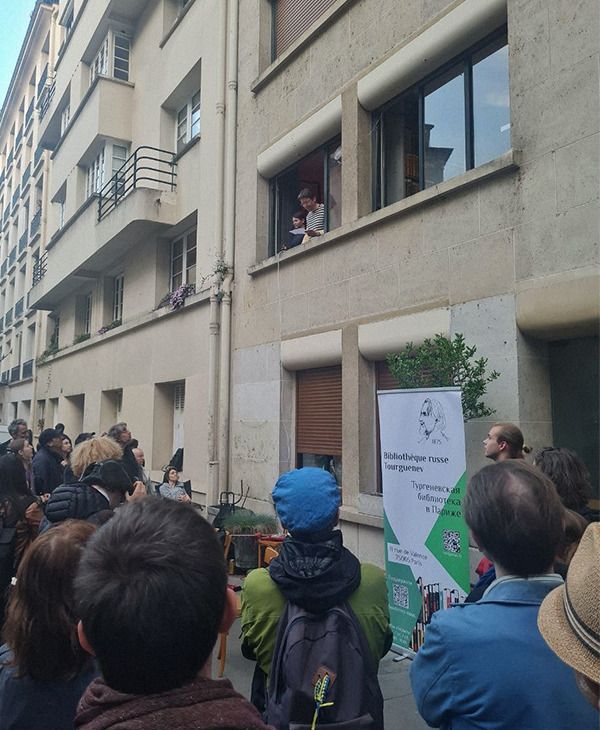
But then Alexander Bikbov leans out of the library window and, parodying Soviet announcers, reads out a decree to decommission Lenin’s collected works, peppered with references to the present day (“A longtime Paris resident, reader of the Turgenev Library, public figure, who before leaving for Russia… cleared his phone—sorry, left his personal archive at the Turgenev Library“).
Photo: Most.Media
The Russian Public Library in Paris was opened in 1875 by Russian revolutionary German Lopatin with financial support from the writer Ivan Turgenev, and after Turgenev’s death in 1883, it was named in his honor. Among the political émigrés who registered at the Turgenev Library was Lenin himself, who lived in Paris from 1908 to 1912. But his library card and other records, due to historical upheavals, ended up in Moscow. The premises from which Lenin is now being ceremoniously removed have only been occupied by the Turgenev Library since 1961. During World War II, German occupiers took the entire Turgenev Library collection from Paris to what is now Poland, from where it ended up in the Soviet Union after the war.
So Lenin and Turgenev really did have quite a few intersections.
***
The final stage of the event: giving Lenin away to good homes. Sociologist Bikbov and Aglaya Asheshova’s school-age daughter call out the volume numbers to be inventoried and decommissioned in random order. Participants in the lottery return to the library one by one, where Aglaya crosses their volumes out of a large handwritten register. Back outside, many begin to divine their fortunes from the Lenin volume they received. My neighbor happily quotes passages from the article “How We Traveled,” where Lenin describes returning to Russia from Switzerland via Germany in the famous sealed train car.
All of us, clearly, have also traveled—just in a very different direction from Lenin and his friends in April 1917. And it doesn’t look like anyone is planning to return for the sake of the Russian revolution, socialist or otherwise. But those who set out after February 24, 2022, will certainly have something to write about. Just not right now—the experience is too traumatic, and for many, it’s not over yet.
I drew volume 52 in the library lottery: letters and telegrams from November 1920 to June 1921. Doctoral student Denisov, despite his promises, doesn’t try to persuade everyone coming out with a blue volume in hand. The next day, on the Slavic scholars’ mailing list, he thanks the 13 people who gave him their volumes from the Turgenev Library—as well as the economists and philosophers who refused, intending to find and read a specific Lenin volume. “I wish them pleasant reading! May they freely express their thoughts in dialogue with Lenin’s texts,” Denisov writes.
I’ve already read my volume 52. In it, Lenin appears as a true genius of micromanagement and backstage intrigue—just as, perhaps, a hacked WhatsApp or email account of a top manager or senior official would look today. Ilyich involves himself in everything—from innovative sole-leather production and draining peat bogs to sending his two secretaries on vacation and planting flowers on Inessa Armand’s grave. There are long letters to party comrades debating ideology, and famous admonitions to allies who don’t want to interrupt their revolutionary work for a restorative trip abroad. But mostly, it’s the typical content of work chats, adjusted for the realities of a hundred years ago.
So I suppose my dialogue with Lenin’s texts can be considered to have taken place. But without the event of carrying out these dusty volumes from the Turgenev Library, I probably would never have become interested in their contents.
If you enjoyed this article, consider making a donation — one-time or, even better, monthly. Your support helps us motivate our authors and become better with every article.
Our organization is recognized by the Internal Revenue Service (IRS) as a 501(c)(3) tax-exempt, charitable organization, which means that all contributions made to us are tax-deductible to the fullest extent permitted by U.S. law. Individuals may generally deduct charitable contributions of up to 60% of their Adjusted Gross Income (AGI) for cash donations made to qualifying 501(c)(3) organizations. For donations of appreciated assets (such as stocks or other long-term capital assets), the deduction is typically limited to 30% of AGI, based on the fair market value of the asset. C-corporations may deduct charitable contributions of up to 10% of their taxable income for donations made to eligible charitable organizations.
By submitting a donation, you confirm that you have read and accept the following documents: Privacy Policy and User Agreement, and also give consent to the processing of your personal data.
If you would like to unsubscribe from a monthly donation, please email us at: [email protected]