Berlin journalist Marta Hillers did not seek fame or popularity. She certainly was not trying, as one might say today, to “hype” her suffering. She simply needed to speak out, to share with others what she herself experienced and what hundreds of thousands of other German women of that time endured. To feel, if not compassion, then at least understanding. Alas. During her lifetime, she received neither from her country.
I became interested in the fate of Marta Hillers and her book “A Woman in Berlin” while exploring a broader topic — the mass violence by Soviet soldiers against German, and not only German, women and children at the end of World War II. This book is the account of a German journalist about what happened to her and many other German women from late April to June 1945. About life in a bombed and devastated city where women of the defeated country became prey to the victors. During this entire time, she kept a diary.
In 1954, Marta published it in the USA under a pseudonym in English. The book sold poorly and did not achieve much success. In 1959, it was also published in Germany under a pseudonym.
In the GDR, the anonymous author was accused of a) “defaming the honor of German women” and b) engaging in anti-communist propaganda. These were carefully crafted accusations, considering that no one in Germany would dare deny the facts presented in these memoirs, so they chose to accuse her of immorality and anti-communism instead.
In the 1950s, Marta married and moved to Switzerland. She categorically refused all offers to republish her memoirs until the end of her life. They only saw the light again two years after her death—in 2003—and immediately became a bestseller. In 2008, a feature film based on her diaries was made in Germany, featuring, among others, Russian actors such as Yevgeny Sidikhin.
In 2019, Marta Hillers' book was published in Russia by the little-known independent Belgorod publisher “Totenburg”,
and already in November 2021, three months before Putin's Russia's full-scale aggression against Ukraine, it was banned as “extremist” material.
By the time I began reading Hillers' memoirs, I had already read the memoirs of Soviet WWII veteran Leonid Rabichev, “War Will Excuse Everything.” And that is much more terrifying. It is a long account of his life, including pages devoted to the same topic reflected in Marta's diaries. The same story, but from the other, Soviet, perspective.
We will return to the memoirs of this Soviet officer later, but for now, I will only say that even after reading them, Hillers' book is not for the faint of heart. It is a document of the era, powerful and heavy. It is interesting also because Marta was one among many. It is like the diary of the Leningrad girl Tanya Savicheva — the notes of one person serving as a vivid illustration of the enormous human tragedy called the Siege of Leningrad.
Both diaries are mirrors reflecting the terrible reality of that war. Only Tanya Savicheva’s diary, which was presented as evidence of Nazi crimes during the Nuremberg Trials, was essentially canonized and counted among the Soviet martyrs. Marta Hillers, on the contrary, was accused of every mortal sin. She was branded a harlot, an anti-communist, and that “nothing happened.” Neither the facts she described, nor her feelings, nor even her existence. Modern Russian critics especially insist on the last point. Moreover, from their point of view, the book is too well written and edited (“cinematic“). Imagine that! The author, being a journalist, literary processed her notes before publishing them. This is no coincidence, no coincidence…
Besides this, the authors of almost all Russian reviews on this book accuse Marta Hillers of being a “Nazi.” From this, the reader, naturally, is supposed to conclude that she deserves no sympathy. “It's not a sin to rape a 'Nazi.'”
Moreover, from the viewpoint of pro-government Russian historians, there were no rapes by Soviet soldiers in Germany at that time.
Well, after the publication of Rabichev's memoirs (and there were other Soviet witnesses: Lev Kopelev, Mikhail Koryakov, Natalia Gesse, Zakhar Agranenko, not to mention foreign researchers on this topic), the question of “did it happen or not” is closed for any reasonable person. One can urge not to speak about it, as Rabichev’s friend, poet, prose writer, and journalist Olga Ilnitskaya, begged: “I do not want to hear this; I want you, Leonid Nikolaevich, to destroy this text!” But denial is impossible.
Being already very old and ill, the veteran found the strength not to give in to persuasion and not to destroy this part of his memories. For Rabichev, as one can understand, this was a confession of a grave sin he could not end his life path without facing… Though not as terrible as Major A., who lined up his subordinates in the headquarters courtyard (!): pants down, forward!... And then shot two repeatedly raped and mutilated girls — two sisters who came to the Soviet soldiers asking for help because they had lost their parents and brother during deportation from East Prussia.
No, Rabichev’s personal sin was smaller. He did not beat, maim, or kill, but... he also participated. He did not resist when comrades teased him “for being weak”: “What, you’re not a man?!” Like other Soviet soldiers in East Prussia, he had many choices then. German women had none.
He could not leave without telling all this.
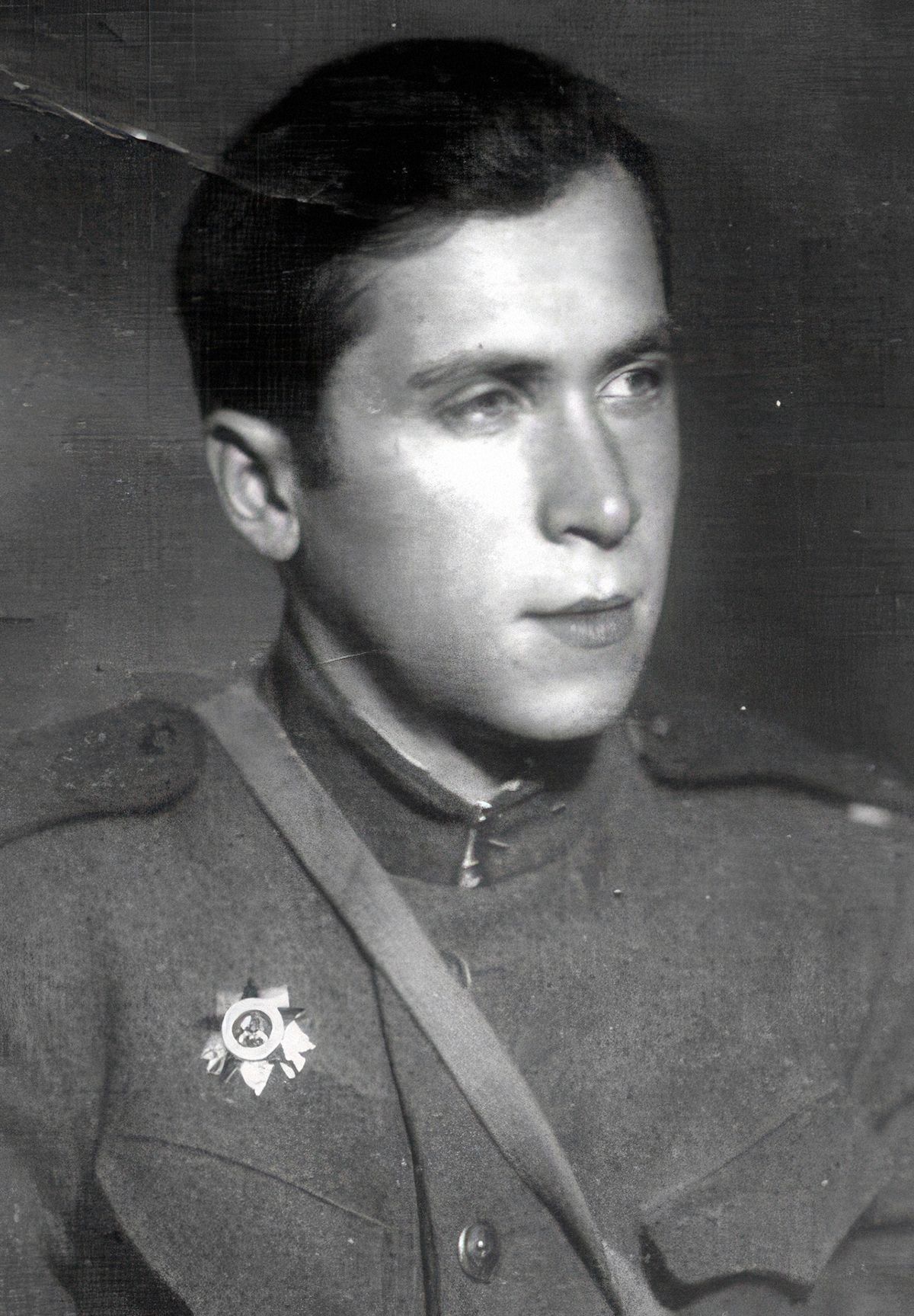
Leonid Rabichev in 1945. Source: wikipedia
From Leonid Rabichev's book “War Will Excuse Everything”:
“…our troops in East Prussia caught up with the civilian population evacuating from Goldap, Insterburg, and other cities abandoned by the German army. On carts and cars, on foot — old people, women, children, large patriarchal families slowly, on all the roads and highways of the country, moved westward.
Our tankers, infantrymen, artillerymen, signalmen caught up to clear the way, threw their carts with furniture, suitcases, trunks, horses into ditches by the roadside, pushed aside the old and children, and forgetting duty and honor and the retreating German units that offered no resistance, thousands attacked women and girls.
Women, mothers, and their daughters lie on the right and left along the highway, and before each stands a cackling armada of men with their pants down.
Those bleeding and losing consciousness are dragged aside, children rushing to help them are shot. Cackling, growling, laughter, screams, and moans. And their commanders, their majors and colonels stand on the highway, some laughing, some conducting, no, rather regulating. This is so that all their soldiers without exception participate.
No, this hellish deadly gang rape is not collective guilt or revenge on the cursed occupiers.
Permissiveness, impunity, anonymity, and the cruel logic of a maddened crowd.
Shaken, I sat in the cabin of the truck, my driver Demidov stood in line, and I imagined Flaubert’s Carthage, and I understood that war will not excuse everything. The colonel who just conducted the operation could not stand it and joined the queue himself, and the major shot the hysterical children and old people.”
Rabichev’s memoirs are eyewitness testimony, told by a witness and participant. It happened! Only those whose value system is skewed towards violence and coercion can deny it. Those for whom patriotism is above truth and replaces it.
What Marta Hillers recorded in her diary, after reading Rabichev’s memoirs, might seem less terrifying to some. But the horror experienced by this woman in Berlin 80 years ago still suffocates.
Before telling about this book, I want to point out something else. Modern Russian “debunkers” accuse Marta Hillers of allegedly being a Nazi because she wrote for some German newspapers of that time. No quotes supporting these accusations are provided.
At 16, that is in 1927, Marta tried to find her place in the turbulent political life of Germany. Numerous parties of the Weimar Republic—from Nazis to communists—all shouted their own truths. In the early 1930s, Hillers became an activist of the Communist Party of Germany. In 1932-33, as a 21-year-old woman, she traveled to the USSR and was recommended by the Central Committee of the KPD for transfer to the CPSU as a candidate. The recommendation was given by one of the most radical German communists of that time, Spartacus League member Max Barthel.
One modern Russian “exposer” wrote a review of this book in Putin’s favorite newspaper “Komsomolskaya Pravda” with the telling headline: “Millions of raped German women have reached Russia.” And this despite the fact that Marta’s memoirs say nothing about “millions of raped German women” (as noted here).
Among other things, he writes:
“In the 1920s, the real Marta was a fiery communist, visited the USSR, learned Russian. Max Barthel, one of the prominent leaders of the Spartacus movement and an early member of the Communist Party of Germany, gave her a recommendation to the Imperial Union of German Writers. But later Barthel became one of the most famous defectors from the 'reds' to the 'browns.' In the 1930s, such people in Germany were called 'beefsteaks' — 'brown outside, red inside.' Marta defected with him.”
To someone not well-versed in the events of that time, this “revelation” might make a strong impression. Meanwhile, the Communist Party of Germany in the 1920s and early 1930s actively adopted nationalist and anti-Semitic slogans of the Nazis. This was not ignored even by the leader of the German communists, Stalin’s protégé Ernst Thälmann.
To accuse some German communists of switching to the NSDAP at some point after all these repeated shifts in the KPD's “party line” from internationalism to Nazism and back can only be done by an ignoramus or someone deliberately falsifying facts. Not to mention that the left wing of the National Socialist German Workers' Party, represented by the Strasser brothers and Röhm, was then hard to distinguish from communists due to their social and anti-capitalist rhetoric.
As for Marta Hillers, there is no evidence that she became a member of the Nazi party. Yes, after the Nazis came to power, she continued working as a journalist, but apparently did not produce any propaganda materials.
Hitler’s regime provided writers certain niches where they could “hide out” without heavily compromising themselves by working for the Reich.
In particular, Marta wrote for the student magazine “Help Me!”. From April 1945, she became an employee of another youth magazine, Ins neue Leben (“In the New Life”). Her diaries from the first weeks after the defeat of the Hitler regime show no concern about having to justify her work for it. On the contrary, at one point she mocks a lady horrified that she must undergo such a procedure.
Moreover, everyone who worked in Third Reich propaganda was justifiably considered accomplices in Nazi crimes. At least they were banned from professions such as teaching and journalism. Hillers not only continued working in the media but also became the editor-in-chief of the youth magazine Ins neue Leben from 1948 to 1950.
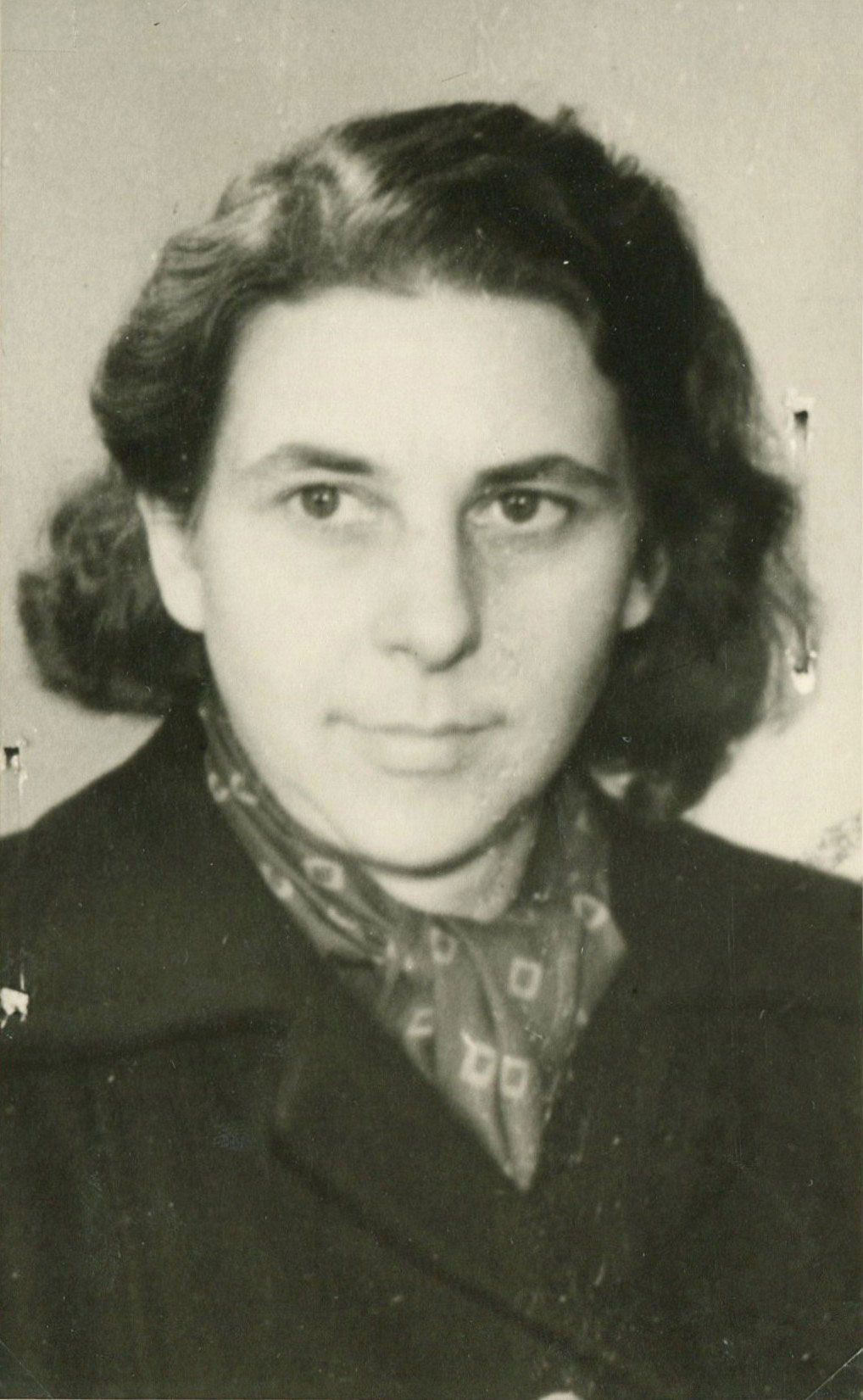
Marta Hillers in 1946. Photo: wikipedia
Another suspicion expressed by Russian critics about Marta’s memoirs is that supposedly no one has seen the handwritten version of her diaries. This is false: both the handwritten and typed versions of her diaries are today kept at the Munich Institute of Contemporary History and are accessible to researchers. The authenticity of the manuscript, as well as the fact that the first typed version was edited personally by her and not by some third parties, has been proven by serious experts.
Now about the content of this book.
Marta Hillers’ diary is the story of a woman caught in the whirlpool of history, who did not lose the ability for self-reflection and generalization, trying to understand what happened to her and around her. These are the notes of one among many. It is no coincidence that the title of her book can literally be translated as “One Woman in Berlin” (“Eine Frau in Berlin”). Alone in both senses. Both that no loved ones were near her at that moment, and that she was one of many millions of other German women at that time who, like her, could only count on themselves and the mercy of the victors.
Hillers unfolds before the reader a whole gallery of portraits: neighbors, men, women, Soviet soldiers. The latter, by the way, are very different, and she never ceases to be surprised by this. Among them are scoundrels-rapists, good-natured and cheerful men, impeccably polite, well-mannered, and educated officers—in short, all kinds.
The diary entries begin on April 20, 1945. The war enters Berlin, the rumbles of explosions grow louder. Life in the huge city slowly dies. Problems with gas, electricity, water. The closer the war gets, the more sporadic these amenities become, then disappear altogether. Citizens hide in basements. Phones and radios fall silent, even substitutes for newspapers—information leaflets printed by the government in the last days on one side of damp paper—cease to be distributed. The lack of any information about what is happening is as frightening as the absence of light and water.
Only rumors remain. A familiar baker says:
“If they come, they will take all the food from the houses. They will leave us nothing. They have decreed that Germans must starve for eight weeks. In Silesia, everyone is already fleeing to the forests and digging up roots. Children are dying. Old people eat grass like animals.”
Despite hunger, cold, and lack of light, Marta does not lose her irony:
“Here it is, the voice of the people. No one knows anything. The newspaper 'Völkische Beobachter' is no longer on the stairs. No Mrs. Weier comes to read me the stories of rapes at breakfast: 'A 70-year-old old woman was raped. A nun was raped 24 times.' (Who counted this?) And all this in large print headlines. Should this inspire, for example, the men of Berlin to defend women and us to defend ourselves? Ridiculous. The only result of such information is that thousands of helpless women and children on the fast highways rushed west, where they could starve or die under air strikes. When reading this, Mrs. Weier’s eyes always became wide and shiny. There appeared either horror or unconscious joy that she herself did not face this… But there have been no newspapers since the day before yesterday. The radio has been dead for four days.”
The end of the war finds Hillers in a small attic apartment with leaking walls. The owner of the apartment is a former colleague of Marta’s. She does not know where he is now. Not long ago, he was drafted into the army; the last news from him was from Vienna, where he was at a distribution point.
Life in the besieged city sharpens instincts. The main feeling Marta experiences now is hunger. Food is less and worse. Potatoes taste like cardboard, leftovers of cheese and a crust of bread make up breakfast. Potatoes and overcooked pearl barley jelly can fill the stomach, but the feeling of hunger multiplied by the fear that even this might soon be gone does not pass.
On April 27, in the basement where the house residents hide during the city assault and where Hillers now almost constantly lives, the first Russian soldier appears. A boy of rural appearance. Marta refreshes her Russian, asks what he wants. The boy is silent. She offers him a bowl of pearl barley soup. He shakes his head. What does he want? The boy smirks: “Schnapps.” No, no vodka here, the residents wave. He leaves.
Marta follows him outside. Everywhere are Russian soldiers. A few are trying out stolen bicycles. They don’t know how to ride them, help each other, constantly crash into things, which makes them very amused. There are many horses everywhere. Two soldiers ask Marta to show them where the nearest water pump is—their horses want to drink. Marta leads them. A quite friendly conversation ensues. The guys try to find out if the girl is married, and if not, would she like to marry one of them. After a negative answer, the simple matchmaking ends.
Scene from the film “Nameless – One Woman in Berlin” (2008)
Other young Russian soldiers, meeting Marta’s gaze, look down. But then an unpleasant, slightly drunk type approaches. He offers to go with him to the yard. For wristwatches. He has two pairs. With the help of new Russian friends—horse handlers—she barely manages to shake him off. As soon as Marta returns to her apartment, a baker as white as flour comes for her. Russian soldiers harass his wife. Marta is the only one who speaks Russian in the house; everyone turns to her as an interpreter. She goes down to the basement and sees three soldiers surrounding a well-built baker’s wife. They especially like full-figured women. Patriarchal peasant notions of female beauty.
Marta rushes outside. Seeing the first Russian officer she meets, she begs him for help. He goes with her to the basement, persuades the soldiers for a long time to leave the baker’s wife alone. After the soldiers leave the basement, he departs. The residents lock the basement from inside. Marta knocks and shouts, but they do not open. She remains alone on the dark stairs; two soldiers whom she managed to get out of the basement now turn their attention to Marta. They attack her, tear her clothes. While one rapes her, the other stands guard—watching to ensure no one sees. Then they switch places…
Fighting still continues in Berlin, but the attitude toward women here, in Germany’s capital, is somewhat different than in East Prussia or Silesia. Four months of hell, when Soviet troops had just entered German territory, are behind. Information about mass rapes and murders of women, old people, and children reaches the world community.
In early April 1945, Stalin issued a decree punishing such crimes up to execution. For this reason, Soviet soldiers now go hunting at night, trying not to be seen by their superiors. Before starting to harass, they ask the girl’s age—punishment for violence against minors is especially severe. After some time, notices appear on house doors in Russian and German, stating a ban on breaking into citizens’ apartments.
However, the wave of such crimes cannot be stopped by one Stalin decree or even by exemplary executions of the guilty.
That same night, four Russian soldiers break into the widow’s apartment where Marta now lives after a shell exploded near her attic. Another rape. This time the rapist is alone. He carries his victim in his arms to another room. In the morning, he introduces himself: Petka. A huge, broad man like a wardrobe, a Siberian. He promises to come back in the evening. Meanwhile, the widow, a fifty-year-old lady, was also raped that night. It was too dark to see the attacker’s face—a boy, quite inexperienced.
In the evening, the huge Petka returns and assures Marta that he thought only of her all this time. Hour by hour, she thinks, Romeo was the last thing I needed!
Three days later, two more Russian soldiers with automatic rifles burst into the widow’s apartment. Another rape. Marta can’t take it anymore. She makes a decision. She needs someone senior among this gang of soldiers who will protect her from the others.
It didn’t take long to find. In the yard of their house is a whole camp of Russians. Anatoly, a Ukrainian. A senior lieutenant, a sturdy country man who before the war managed a dairy farm at a collective farm. Friendly, treats Marta well. For some time, he really becomes a wall protecting her from other Russian soldiers.
Anatoly brings his comrades. The widow’s apartment now is something like an officers’ club. What different faces, Marta marvels to herself.
Here is Vanya. He is only 16. Already a sergeant, very serious, helps the widow with all his might, washes the dishes. Left alone with Marta, he confesses: “We are evil people. And I’m bad because there is evil all around.” He himself is a good guy. When a Soviet soldier tried to break into this apartment again, Vanya aimed his automatic at him and drove him out.
And here are Grisha and Sasha from Kharkiv. Friendly guys. Grisha was an accountant in his previous life. The widow’s lodger Mr. Pauli, whom everyone takes for her husband, is also an accountant. In joy, they drink with Grisha to the international accountants. Mr. Pauli is delighted. “What life juice, what strength in these Russians!” he shouts, hugging Grisha.
A new face appears in the widow’s apartment, whose doors do not lock because the locks were broken by soldiers’ rifle butts. This is Andrey, who in peaceful times was a school teacher. Andrey is an orthodox Marxist. Well-read, well versed in politics and economics. He blames not Hitler personally for the war but capitalism, which gave birth to Hitler and mountains of weapons. Andrey believes that the German and Russian economies complement each other, and Germany built on socialist principles could become a natural partner of Russia.
Marta relaxes her soul with this guy, as he is the only one not interested in her body. She seems to him only a smart interlocutor. When Andrey is with them, whether talking about politics, economics, or simply something human, or quietly writing some reports at the table, she feels calmer. The widow also grew fond of him and throws herself around his neck like a relative when he appears.
Meanwhile, Anatoly is transferred to headquarters. Marta sees him less and less, and then he is sent to another city altogether.
Even before Anatoly completely disappeared from her life, a new officer, a major, appears in the widow’s apartment. He was brought to them by a blond lieutenant wounded in the leg, who had forcibly taken her the previous night. Now he introduces her to the major. And where is Anatoly? He will not come anymore. Marta feels she is being passed on like an object.
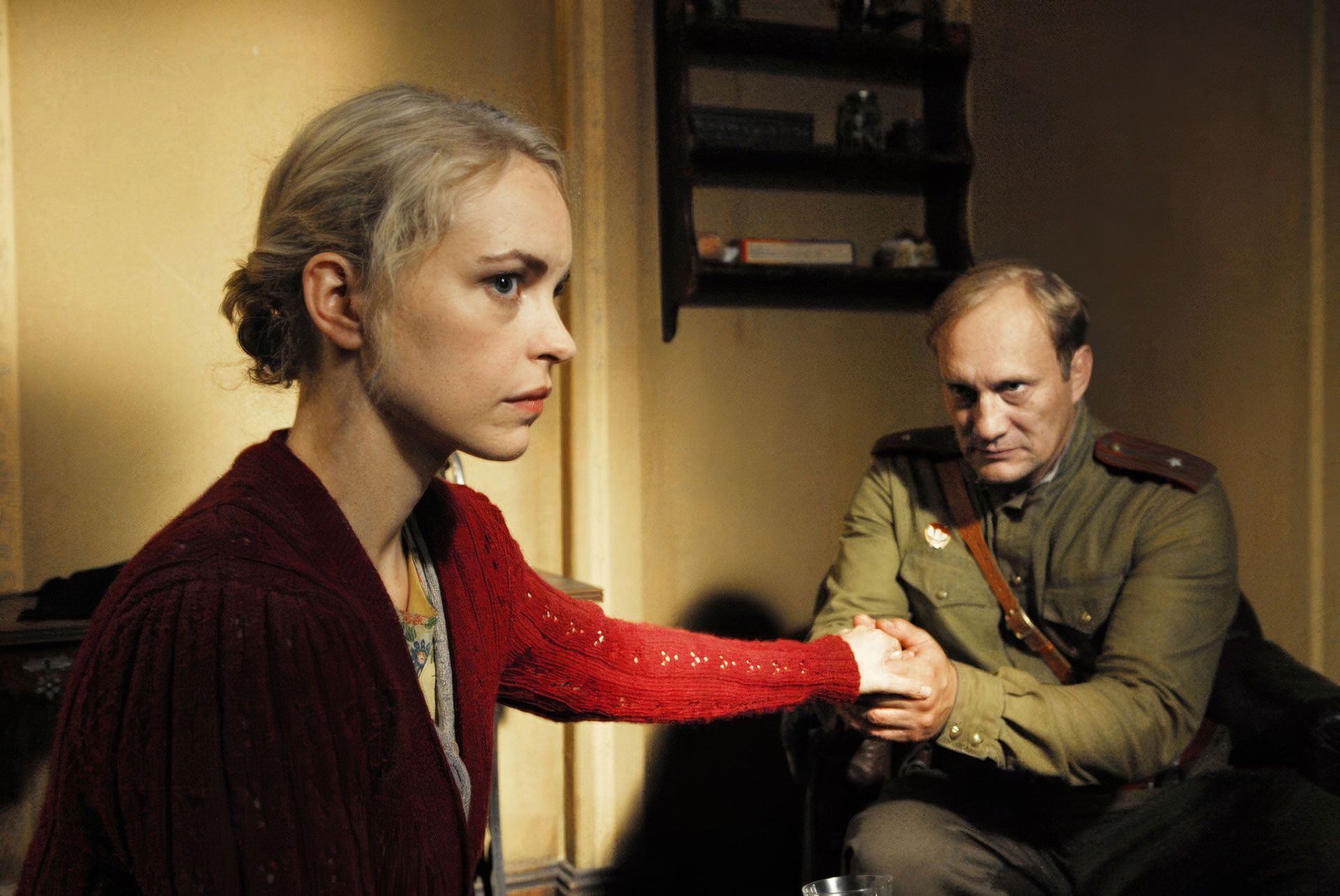
Nina Hoss and Yevgeny Sidikhin in the film “Nameless – One Woman in Berlin” (2008)
However, the major is all politeness and consideration. A walking textbook of good manners. He asks if he is too intrusive and shows by his whole demeanor that he is ready to leave if she finds him a burden. No, not a burden. Marta has no choice. She builds her plans on him. To survive now, she needs someone who can protect her from further violence.
She even likes the major. Polite, intelligent, kind, tactful. Despite his wounded knee, he dances well. Moreover, he has an excellent ear. Marta is amazed how he plays various pieces on the harmonica, including classical music. At the same time, Marta is sure: if she demands the major to leave, he will do so immediately. But now she cannot be alone.
She listens to her feelings. No, this is not love. What love in a situation where you have no choice, when you are under the pressure of necessity? She just needs now someone who will protect her from the next violence. Preferably someone as sweet and intelligent as the major. And yes, the major, like his comrades, does not come to visit empty-handed: bread, herring, vodka—they constantly bring these in large quantities, what is needed for physical survival.
“Is this prostitution?” Marta asks herself. Probably yes. She had never done this before. But today her body does not belong to her, and it feels as if someone has taken her soul out of it. She is forced to sell herself to survive.
Does she have another way out? Perhaps, but it is much worse. Red-haired Elvira, an employee at a liqueur factory, was raped by no fewer than 20 soldiers. Then they let her go, having taken off her boots first. She walked barefoot with her boss to Marta’s house over gravel and shards of broken glass across the whole city.
“We owe all this to our leader,” Marta writes.
And here are two more Russian soldiers. One elderly, the other a seventeen-year-old boy, a former partisan who joined the Soviet troops on the western front. They came to Frau Lehmann, who, as they learned, has two small children. They brought chocolate for them. The seventeen-year-old looks at Marta and asks her to translate that German officers in his village stabbed children, smashed their heads against walls.
Before translating, Marta asks:
- Is it true? Are you a witness?
He replies strictly:
- Yes. I saw it twice myself.
Frau Lehmann: “I don’t believe it! Our soldiers? My husband? Never!”
“Silence. We all stare straight ahead. A German baby, unsuspecting, bites a foreign index finger, babbles and squeaks.”
“I have a lump in my throat,” Marta writes.
Hillers did not seek fame or popularity. This is indicated by the fact that in her narrative she changed not only her own name but also the names of the people she wrote about, even the street names and district of Berlin where the house she lived in was located. She even changed her appearance, turning herself from a brunette into a blonde. She certainly was not trying, as one would say today, to “hype” her suffering.
Marta simply needed to speak out, to share with others what she herself experienced and what hundreds of thousands of other German women of that time endured. To feel, if not compassion, then at least understanding. Alas. During her lifetime, she received neither from her country. She lived the following half-century with her pain in a quiet private life, closing herself off from this world in Switzerland, perhaps trying to erase these memories from her mind. Whether she succeeded—now no one will ever know.
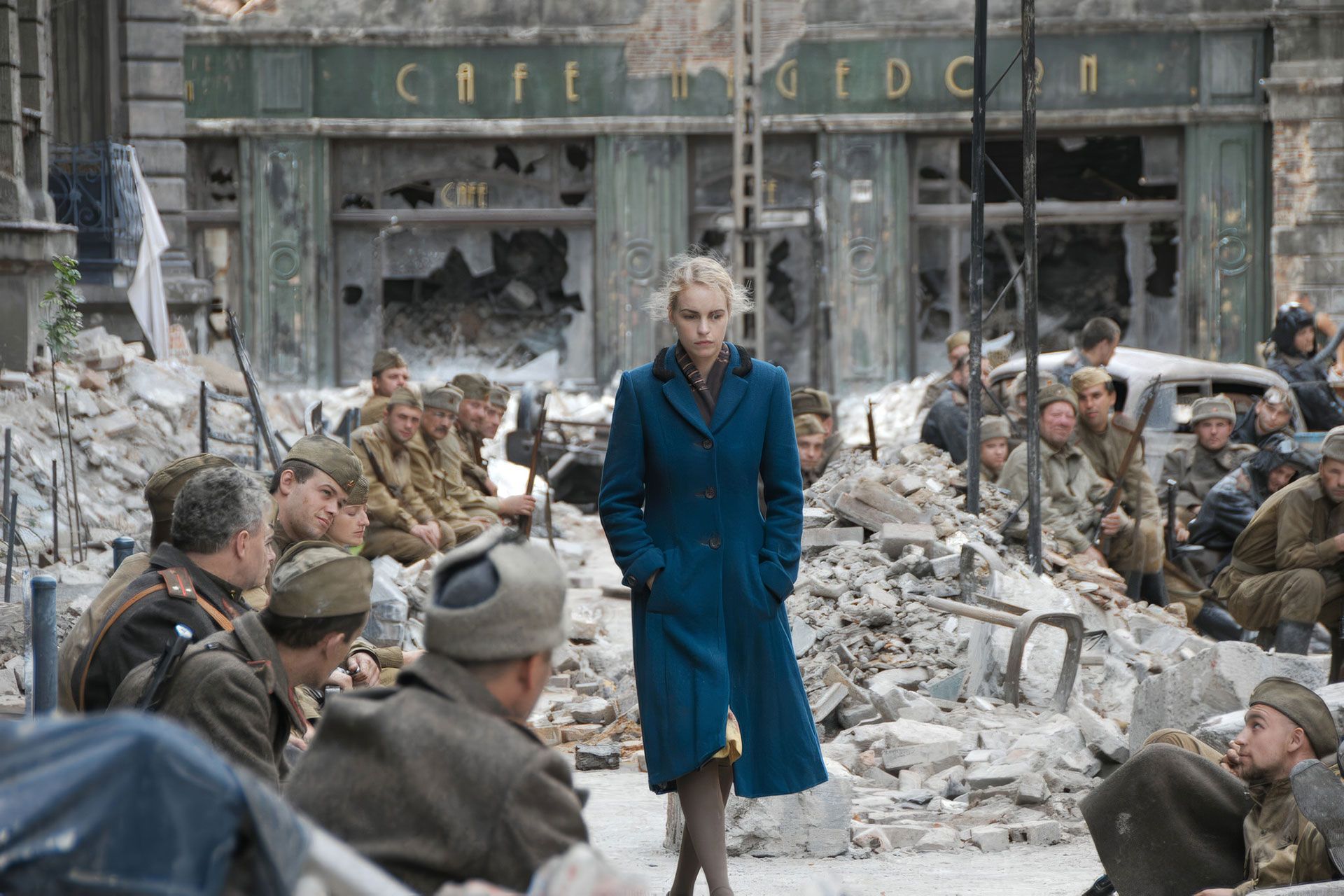
Main photo — a scene from the film “Nameless – One Woman in Berlin” (2008)
If you enjoyed this article, consider making a donation — one-time or, even better, monthly. Your support helps us motivate our authors and become better with every article.
Our organization is recognized by the Internal Revenue Service (IRS) as a 501(c)(3) tax-exempt, charitable organization, which means that all contributions made to us are tax-deductible to the fullest extent permitted by U.S. law. Individuals may generally deduct charitable contributions of up to 60% of their Adjusted Gross Income (AGI) for cash donations made to qualifying 501(c)(3) organizations. For donations of appreciated assets (such as stocks or other long-term capital assets), the deduction is typically limited to 30% of AGI, based on the fair market value of the asset. C-corporations may deduct charitable contributions of up to 10% of their taxable income for donations made to eligible charitable organizations.
By submitting a donation, you confirm that you have read and accept the following documents: Privacy Policy and User Agreement, and also give consent to the processing of your personal data.
If you would like to unsubscribe from a monthly donation, please email us at: [email protected]