At the end of January, the Washington-based Center for Strategic and International Studies (CSIS) published updated data on casualties in the Russia-Ukraine war. According to analysts’ estimates, the total number of killed, wounded, and missing amounts to 1.8 million people. Of these, 1.2 million are Russian losses, and 600,000 are Ukrainian losses.
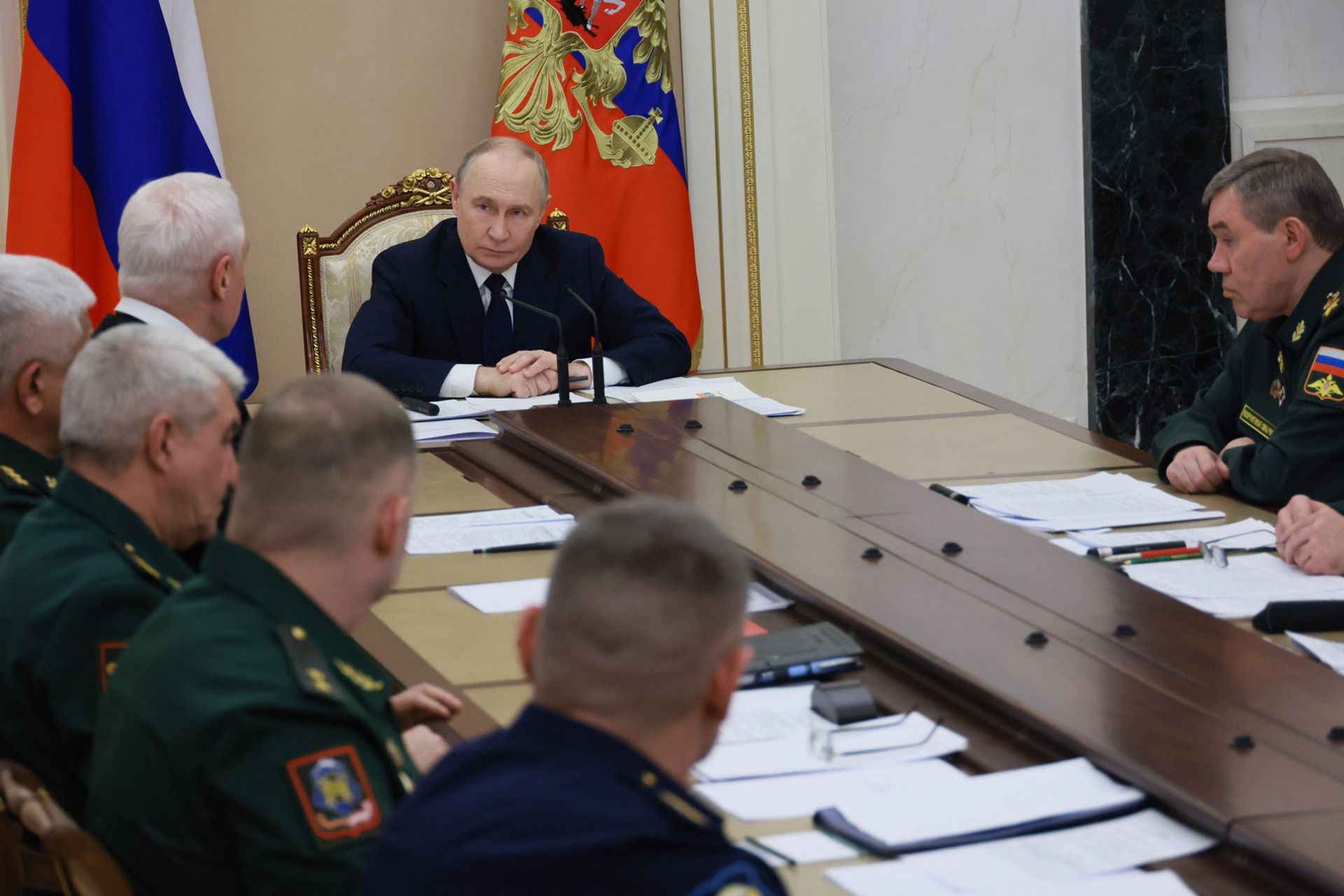
Meeting on the situation in the special military operation zone, December 29, 2025. Photo: kremlin.ru
According to CSIS experts, Russia has lost 315,000 soldiers killed, while Ukraine has lost 140,000. This latter figure does not include tens of thousands of dead and deceased Ukrainian civilians. The CSIS methodology has not been made public.
A few days after this data was published, Ukrainian President Volodymyr Zelensky effectively disputed the Ukrainian loss figures. In an interview with French television, he stated that “officially, on the battlefield, the number of (Ukrainian) soldiers killed, whether regular or mobilized, is 55,000 dead.” He added that there is also “a large number of people whom Ukraine considers missing.” No methodology was presented in this case either.
Meanwhile, a few days after the CSIS study results were released, similar estimates were presented by participants in a joint BBC and Mediazona project, which regularly publishes information on Russian military losses since the start of the war based on open sources.
Regarding the methodology, the BBC and Mediazona project writes: “In Russia, the names of the dead and photos from funerals are published daily. Most often, the names are given by regional leaders, district administrators, local media and educational institutions where the deceased once studied, as well as relatives. … We consider confirmation of death to be a publication in an official Russian source or media, posts by relatives, or posts in other sources if accompanied by photos of the burial.“
As of February 6, 2026, according to BBC and Mediazona estimates, Russian forces have lost in Ukraine, only killed, 173,477 people. At the same time, researchers admit that data based solely on open sources are far from the real numbers.
“According to military analysts’ estimates,“ write the project participants, “our count based on cemeteries, memorials, and obituaries covers 45–65% of the actual number of deaths. This is because a significant number of the bodies of soldiers killed in recent months may still remain on the battlefield: their evacuation poses a risk for the living, primarily due to drone strikes.”
Based on this, the BBC and Mediazona researchers acknowledge that the real losses of Russian forces, including those mobilized in the annexed Ukrainian territories (‘L/DNR’), “may be in the range of 288,000–409,000 people.” These figures are close to the estimates by “Most,” which we also calculate based on Russian data.
Six months after the start of the full-scale Russian invasion of Ukraine, Mikhail Khodorkovsky published on his Twitter a letter from the Russian Ministry of Finance to the head of the government apparatus, D.Yu. Grigorenko, based on a letter from the Russian Ministry of Defense.
The Ministry of Finance document discussed payments to the families of Russian soldiers killed in Ukraine. It also listed the exact number of Russian soldiers and officers killed in the “special military operation” as of August 24, 2022. At that time, the number was 48,759 people. This list did not include foreign and Russian mercenaries (various PMCs), nor those mobilized in the so-called “republics” of Donbas. The Russian authorities neither confirmed nor denied the data from this document.
Accordingly, starting from the figure of 48,759 Russian soldiers killed in the first six months of the war, one can calculate the average daily loss for the Russian army. Based on this data, it is just over 270 people per day. Notably, the bloodiest battles of that year for Bakhmut, Avdiivka, and Kharkiv region were still ahead, so the average daily loss figure for the first year of the war may have been even higher.
Since the full-scale Russian invasion of Ukraine, it has been almost four years or 1,442 days. If we multiply these days by the average daily number of Russian soldiers killed, that is, by 270, we get 389,340 dead.
However, it should be noted that in December 2025 and January 2026, according to Ukrainian data (in particular, as reported by the commander of the Ukrainian Armed Forces’ Unmanned Systems Forces Robert “Magyar” Brovdi), Russian losses sharply increased and exceeded monthly mobilization.
For example, in January, Russia mobilized about 22,000 recruits, losing 30,618 personnel on the front in the same month. “Magyar” claims that the figures are “verified.” If this is indeed the case, then the total number of irrecoverable losses of the Russian army in Ukraine has already exceeded 400,000 people.
Given that the number of wounded and missing since World War II has been about 2–3 times higher than the number of killed, that is, it may range from 800,000 to 1.2 million people, total Russian losses (killed, wounded, missing) may currently range from 1.2 million to 1.6 million people.
Besides these calculations, we can verify Russian losses in another way. Namely, with data, which in a somewhat figurative manner, was provided to the public by the Russian Armed Forces’ Commander-in-Chief Vladimir Putin himself. At a meeting with mothers and wives of fallen “SMO heroes” on November 25, 2022, he said:
“But you know what comes to mind, I have already mentioned this before. In our country, about 30,000 people die in road accidents (per year), and about the same from alcohol. And, unfortunately, life sometimes turns out this way, life is complex and diverse... Some people live or don’t live – it’s unclear, and how they die – from vodka or something else – it’s unclear, and then they’re gone. Whether they lived or not – that also seems to pass unnoticed: whether the person lived or not. But your son lived, you understand? He achieved his goal.“
If we take Putin’s own data, dividing the figure of 60,000 by the 270 days of war at that time, we get an estimate of average daily Russian army lossesof 222 people. One can certainly argue about its accuracy, but it can be stated for sure that no commander-in-chief will ever overstate his army’s losses. Especially when the war is in full swing. Accordingly, these daily losses are most likely understated by Putin. But even so, the result is quite impressive.
Multiplying 222 (average daily losses) by the same 1,442 days, we get 320,124 Russian soldiers killed according to Putin’s own version. Add to this the number of wounded: 960,372 (320,124 × 3) and we get 1.28 million total Russian military losses.
It turns out that the CSIS data (1.2 million Russian losses) are quite relevant. But is it possible that Ukraine’s manpower losses are half those of Russia?
The Ukrainian Armed Forces command, given the difference in mobilization capabilities between Ukraine and Russia, conducts the war much more rationally, withdrawing troops to new positions in case of risk of serious losses. To date, Russia’s advantage remains only in the size of its army and long-range missiles. However, these missiles are mainly used against infrastructure targets deep inside Ukrainian territory, not at the front, where they are practically useless given current warfare methods (“dead zone” 10–20 km wide, dispersed troops).
Russia’s advantage in frontline aviation (except strategic) has already been almost two years almost completely nullified by Ukrainian air defenses. Most Russian fighter approaches to Ukrainian territory closer than 50–100 kilometers are their last. In this case, I rely on my own monitoring, which I conduct every day. A military aircraft is not small or cheap, so every downed plane is immediately recorded in statistics and verified, including by admissions from the other side, for example, z-bloggers.
The latest attempts by Russian aviation to strike Ukrainian positions from a relatively close distance (several dozen kilometers from the line of contact) were in February–March 2024 and ended in disaster. Over two weeks, from February 17 to March 1, the Ukrainians shot down 12 Russian combat aircraft. That’s almost one plane per day. Moreover, 9 out of 12 were Su-34s—some of Russia’s most modern fighters
After that, Russia began launching airstrikes mainly from Murmansk (Olenya airbase) and the Astrakhan region (Kapustin Yar range) using aircraft capable of carrying medium-range missiles, i.e., over 500 km, and mainly, as noted, against infrastructure targets, because these missiles are expensive and there are not enough of them in Russia. Aircraft are armed with them as they come off the production line.
The use of the remnants of Russia’s Black Sea Fleet today is also problematic. The latest Ukrainian unmanned underwater drone strike on Russia’s newest “Varshavyanka”-class submarine in the port of Novorossiysk, where the fleet retreated from Crimea, speaks for itself.
From this, we can conclude that the ratio of Russian and Ukrainian losses, calculated by CSIS as about 2 to 1 (1.2 million to 600 thousand) is a fairly conservative estimate.
Thus, with a high degree of probability, we can state that the total Russian military losses in the war against Ukraine amount to between 1.2 million and 1.6 million killed, wounded, and missing. Of these, only the killed number between315,000 and 409,000 people.
And in conclusion, let me remind you that the USSR lost 15,000 killed in ten years of war in Afghanistan. Putin, in four years of his war of aggression in Ukraine, has lost at least twenty (20!) times more than the Soviet Union lost in Afghanistan. At the same time, in addition to the 10% of Ukrainian territory that Russian troops seized in 2014–2015, since the start of the full-scale invasion in 2022, they have occupied only an additional 10% of Ukraine’s land.
If you enjoyed this article, consider making a donation — one-time or, even better, monthly. Your support helps us motivate our authors and become better with every article.
Our organization is recognized by the Internal Revenue Service (IRS) as a 501(c)(3) tax-exempt, charitable organization, which means that all contributions made to us are tax-deductible to the fullest extent permitted by U.S. law. Individuals may generally deduct charitable contributions of up to 60% of their Adjusted Gross Income (AGI) for cash donations made to qualifying 501(c)(3) organizations. For donations of appreciated assets (such as stocks or other long-term capital assets), the deduction is typically limited to 30% of AGI, based on the fair market value of the asset. C-corporations may deduct charitable contributions of up to 10% of their taxable income for donations made to eligible charitable organizations.
By submitting a donation, you confirm that you have read and accept the following documents: Privacy Policy and User Agreement, and also give consent to the processing of your personal data.
If you would like to unsubscribe from a monthly donation, please email us at: [email protected]