Centuries changed, but the old pattern remained. It was not so much dangerous criminals who ended up with the executioners, but rather random people and disgraced members of the elite.
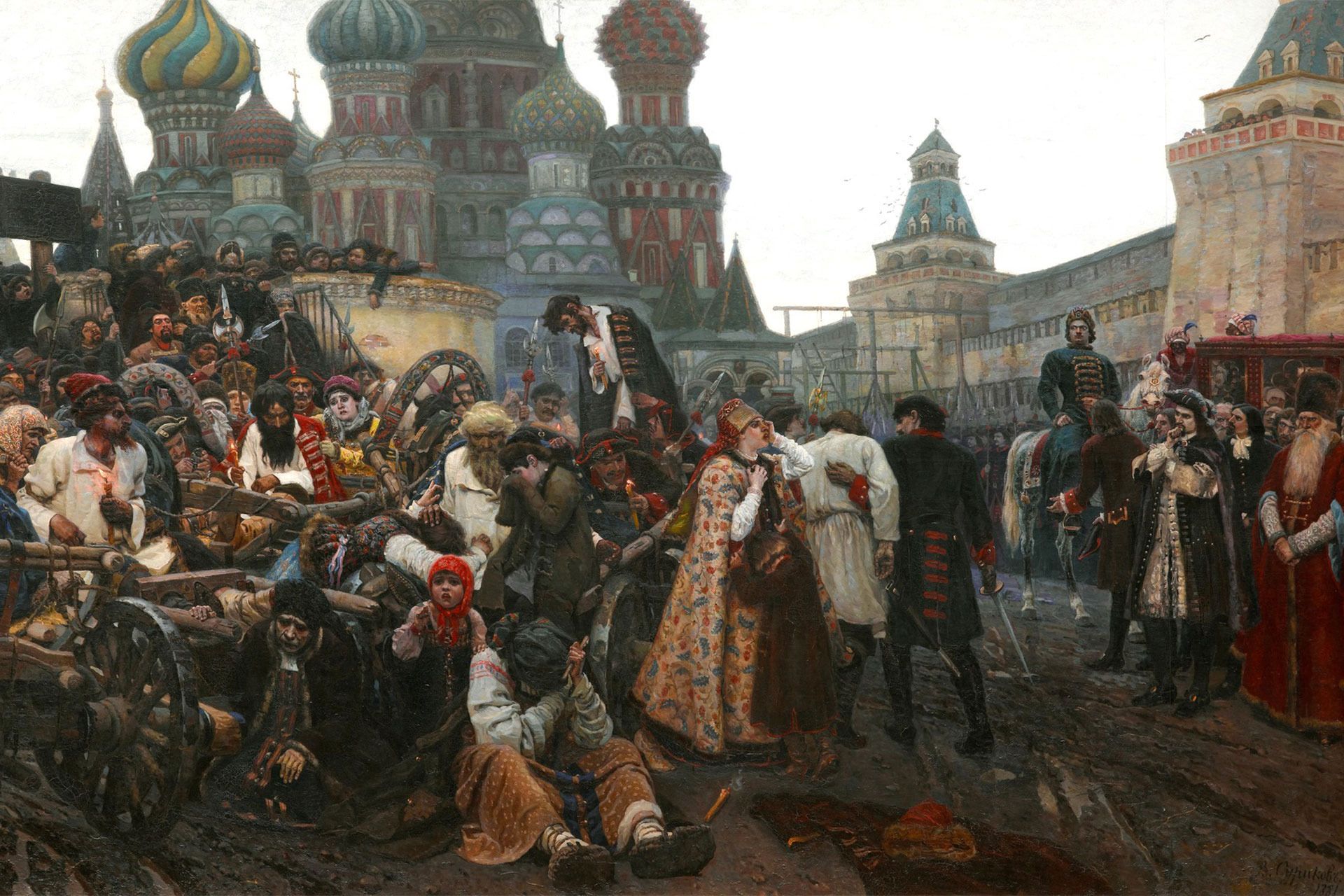
Vasily Surikov “Streltsy” (fragment), 1881. Image: Wikipedia
In the last week of the calendar summer, the Russian government made a strange move. The media got hold of Resolution No. 1266 signed by Mikhail Mishustin addressed to the head of state. The authors of the document proposed that denounce the Council of Europe Convention on the Prevention of Torture and Inhuman or Degrading Treatment or Punishment.
Even if the recipient signs the proposal, legally it would not mean the legalization of torture in the country. Russia is still a party to a similar UN convention, and Article 21 of the federal Constitution explicitly states: “No one shall be subjected to torture, violence, or other cruel or degrading treatment or punishment.” There are three articles in the Russian Criminal Code that in one way or another prohibit torture: No. 117 (“Torture”), No. 286 (“Abuse of Official Power”), and No. 302 (“Coercion to Testify”).
However, it is hard to shake the feeling that Resolution No. 1266 is a clear signal to law enforcement. As if to say, those at the top see how dangerous and difficult your service is, and the final result is more important than liberal nonsense from some papers. You could also put it this way: the document signed by Mishustin is the first act in 86 years of Russian history that encourages torture (since the telegram from the Central Committee of the All-Union Communist Party (Bolsheviks) dated January 10, 1939, “On measures of physical impact on the arrested”). Meanwhile, the entire history of this shameful phenomenon shows that encouraging torture is an irreversible process with unpredictable consequences. Often, initiatives here backfired on their own initiators.
The patient (possibly) will be saved
Even considering only Europe, torture was considered normal there for a long period: from early feudalism up to the Enlightenment era. The Russian lands in this regard were neither better nor worse than other states of the Old World.
Initially, it was believed that pain could only be inflicted on those from the lower strata of society. But over time this notion faded—as slavery declined, serfdom developed, centralized states formed, and the church gained power. Comparatively humane analogs of torture like ordeals or trial by combat disappeared, and all suspects began to be tortured regardless of social status. This especially applied to those accused of the most terrible crimes by the standards of their time—treason and heresy.
Similar standards for investigative processes developed in various kingdoms and principalities. They did not follow modern principles of presumption of innocence and protection of defendants' rights. The person appearing before the judge-investigator had to prove their innocence at any cost. For medieval people, the best evidence of a person's righteousness was their ability to endure pain and not change their testimony. After all, the nascent state of criminology at the time left investigators with few alternatives to cruelty—there was no talk of fingerprints, DNA tests, or street camera footage yet.
Such investigative processes took root in the young Russian state with its capital in Moscow. In 1497, Prince Ivan III the Great officially legalized torture in his Sudebnik. The document explicitly mentioned physical impact on suspects in Articles 14 and 34. The first permitted torture of natural persons, meaning those pointed out by an already exposed wrongdoer. The second allowed officials to order executions at their discretion.
And to whom they give a thief [the criminal], they order him to torture the thief, and he tortures the thief straightforwardly, and if the thief says anything, he must report it to the grand prince or judge who gave him the thief…
- from the Sudebnik of 1497
Moreover, confessions obtained under torture could serve as grounds for death sentences—for robbery, murder, church theft, and other offenses. This often happened in practice.
The informer is worse than the rebel
At the turn of the 15th-16th centuries in the Russian state, a simple system of torture was established. Moscow specialists did not use elaborate devices like “Spanish boots” or the “Iron Maiden.” The main tool was the wooden rack—a simple “П”-shaped construction. The victim was tied by the hands behind their back and hung from its crossbar. This is where the Russian euphemism “master of shoulder matters” for executioners comes from.
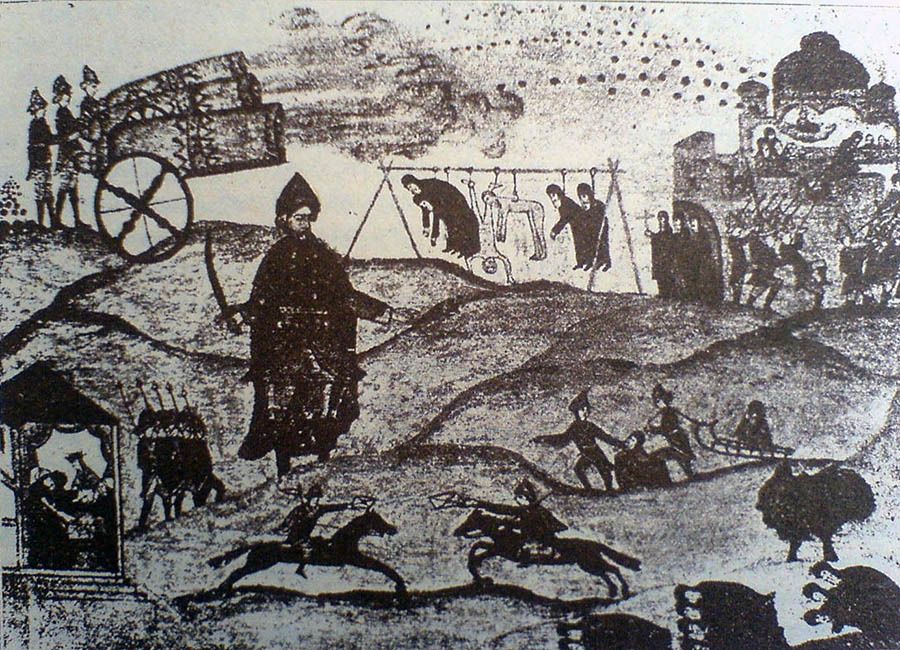
Executions of Solovetsky monks. From an old Old Believer icon. Three centuries. Volume two: Collection / Compiled by A. M. Martyshkin, A. G. Sviridov — Moscow: GIS, 1991. Image: Wikipedia
Torture on the rack did not always require special zeal from the executioners. Often victims only endured the “whiskey” on the device, which could last over an hour—many fainted from pain. If suspects were stubborn, executioners added weights to their feet (“shaking”), whipped them with whips and rods, dripped water on their shaved heads, or subjected them to other abuses. Much depended on the era: notoriously sadistic rulers encouraged innovations in torture. For example, under Ivan IV the Terrible, people were whipped with burning birch branches, and under Peter I, backs were torn with a “cat's paw” device the monarch saw during his travels in Western Europe.
Executioners were especially ruthless toward those considered state criminals. Often the “crimes” of political prisoners in those distant times (as in modern Russia) were fabricated. For instance, in 1627 a certain Vasily Los from the town of Livny in the Oryol region endured a hundred lashes, ten “shakings,” and three rounds of whipping with burning birch branches. But at the last stage of torture, the half-dead man confessed to a terrible crime: he once publicly sang a song about Tsar Boris Godunov. At the time of the early Romanovs, the monarch who ruled a generation before was a taboo figure; Boris had tried to suppress his future successors out of fear of losing power.
And if anyone, having learned or heard of a gathering or conspiracy or any other evil intent against the Tsar's majesty among certain people, […] does not inform [the authorities], he shall be executed without mercy
- from the Sobornoye Ulozheniye of 1649
Vasily's case cannot be considered an executor's excess. In the “rebellious” 17th century, actual conspirators were systematically equated not only with church schismatics but also with careless jokers, singers, and blasphemers against the monarch. Executioners saw no difference between people like Los and, say, veterans of Stepan Razin's uprising.
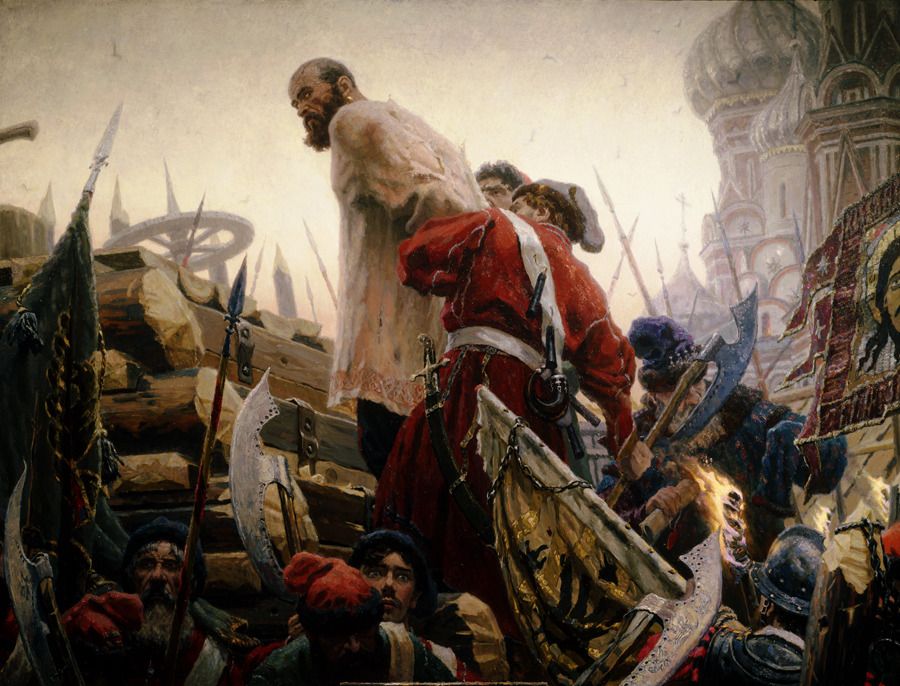
Sergey Kirillov. “Stepan Razin”. 1985-1988. Image: Wikipedia / Sergei Kirillov / CC BY-SA 3.0
Moreover, laws of the Russian state explicitly obliged subjects to report any slander against the monarch—proven failure to report was punishable by death. In 1649, this norm was included in the Sobornoye Ulozheniye, the code of laws of Tsar Alexei Mikhailovich, under which the country lived for over 180 years.
The tsar-reformer, also the executioner
As mentioned above, Peter's reforms did not add any humanity to Russian investigations. On the contrary, torture under the tsar-reformer became more frequent, harsher, and far more systematic. It is no coincidence that one of Peter I's first innovations in 1686 was the establishment of the Preobrazhensky Prikaz (later the Secret Chancellery)—the de facto state security service, where real and alleged political criminals were tortured in dungeons. Contemporary historian Evgeny Anisimov mentions documentary evidence that the monarch personally participated in the work of the “Preobrazhentsy.”
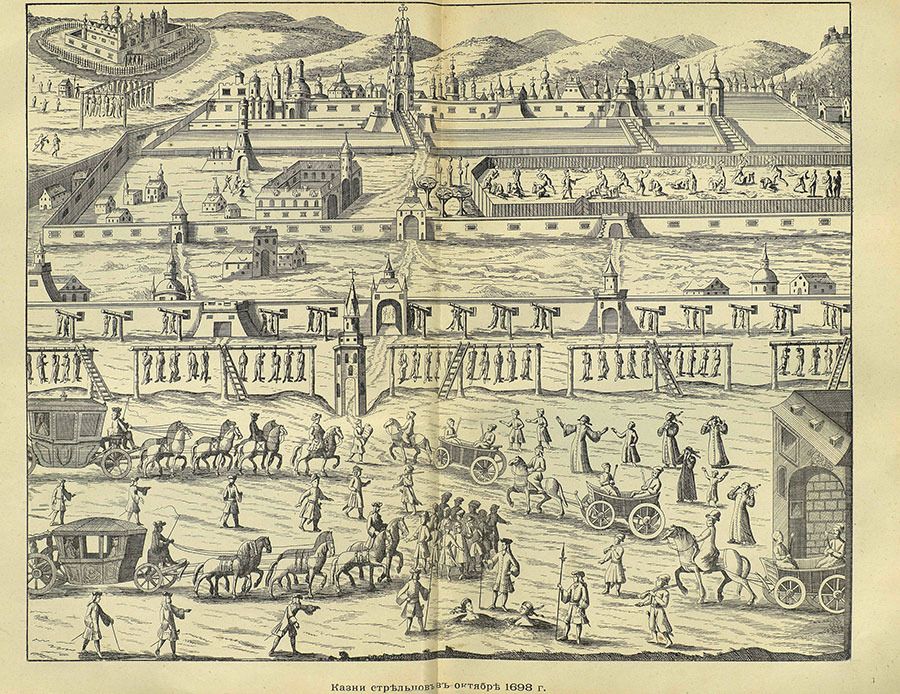
Drawing illustrating the execution of the Streltsy (from Johann Korb's Diary). Image: Wikipedia
By that time, the old rules that somewhat limited torture had died out in Russia. The previous leniency toward those who confirmed all accusations against themselves from just the sight of the rack, whips, and other sinister instruments was gone. Now cowards were put through the three prescribed torture sessions just like stubborn deniers of guilt. Moreover, no social status protected from torture anymore. Priests and aristocrats were sent to the rack.
A telling case is that of the general scribe and judge of the Zaporozhian Host Vasily Kochubey and Poltava colonel Ivan Iskra. In 1707, two Zaporozhians reported their hetman, the notorious Ivan Mazepa: “He wants to betray the Great Sovereign, defect to the Poles, and do great harm to the Moscow state.” However, Mazepa was still in Peter's good graces then, and Kochubey and Iskra had no convincing evidence. The unfortunate informers were tortured, and executioners forced them to confess to slander. In 1708, both Ukrainians were executed.
Later events showed that Kochubey and Iskra were not entirely mistaken. Although Mazepa “defected” not to the Poles but to the Swedes, Peter I effectively admitted his mistake. Both executed men were solemnly reburied, and their families showered with favors. Nevertheless, hanging on the rack and whipping subjects of the empire did not stop. As is known, in 1718 even the tsar's own son, Tsarevich Alexei, died under torture. And the count of various jokers, singers, and grumblers from the common folk ran into the hundreds.
Hanging by the rib during Peter I's era. Brikner A.G. History of Peter the Great: In 5 parts — St. Petersburg: A.S. Suvorin Printing House, 1882-1883. Image: Wikipedia
Nothing changed under Peter’s successors. In 1742, the Secret Chancellery even issued the “Procedure for Torturing the Accused”, a detailed and comprehensive instruction for executioners.
Only three tortures are allowed, but if the tortured changes their speech on the second or third torture, they must be tortured three more times. And if they change their speech in three tortures, torture continues until they say the same thing in all three. For no matter how many times one is tortured, if there is any difference in testimony, they must endure three more tortures to confirm.
- one of the provisions of the “Procedure”
By that time, the executioners’ guild had learned to settle many things by custom. This specific environment was much like a caste: not the most honorable craft was usually inherited. Executioners were understandably not well liked by neighbors. For example, executioners traditionally married the daughters of colleagues or sex workers. But this did not prevent them from profiting from bribes: some paid for milder torture for themselves, others for the most brutal executions of their enemies.
Grandmother began it — grandchildren finished it
The reigns of Empresses Anna Ioannovna (1730-1740) and Elizabeth Petrovna (1741-1761) became the golden age of Russian torture. No one was literally safe from the rack, whips, and burning birch branches. Especially notable was the extremely despotic Anna, who spared not even her own associates.
A telling example is the fall of Artemy Volynsky, one of the empress’s cabinet ministers. In the 1730s, he personally led “interrogations with severity” of inconvenient aristocrats. Notably, the executor was usually the military prosecutor Vasily Suvorov. Descendants remember him as the father of the famous commander, but contemporaries knew him primarily as an exceptionally cruel executioner. The Volynsky-Suvorov tandem repeatedly broke the strongest and healthiest men into crippled wrecks.
However, in April 1740, political rival Ernst Biron, Anna’s main favorite, reported Volynsky. The German time-server presented Volynsky’s “General Project on the Improvement of Russia” as an attempt on autocratic power. All of Volynsky’s attempts to justify himself failed: he was cruelly tortured and publicly executed. It is possible that Suvorov, his former comrade, took part in the tortures of Artemy Petrovich.
In a way, Volynsky’s suffering was not in vain. Twenty-two years later, after another palace coup in St. Petersburg, Catherine II came to power. The last woman on the Russian throne was also the first head of state to categorically condemn torture. After reviewing the case of the executed minister, the new empress found it absurd.
From this case [Volynsky’s], it is clear how little reliance can be placed on statements under torture, since before torture all these unfortunate people asserted Volynsky’s innocence, but under torture said whatever the villains wanted. It is strange that mankind came to believe more in the words of a person in agony than in cold blood. Anyone tortured in agony no longer knows what they say.
In the 1760s-1770s, Catherine’s Senate issued a series of secret decrees that unofficially limited torture. A full ban was not yet envisaged: the authorities only restricted who could be tortured, the grounds for executions, and their specific methods (for example, the rack was banned). In practice, judges and investigators, especially in remote provinces, still exploited the imperfection and secrecy of anti-torture decrees for a couple of decades. Until the early 19th century, officials continued to secretly torture suspects or obtain confessions through threats of beatings.
However, in the summer of 1801, contemporaries were shocked by events in Kazan. Local authorities arrested a petty bourgeois without evidence, accusing him of arson after a devastating fire. The man denied guilt and died under torture, which caused a nationwide outcry. Under Anna Ioannovna or Elizabeth Petrovna, such an incident would hardly have surprised anyone, but Russia was slowly changing for the better at that time. Young Emperor Alexander I used public discontent to ban the long-discredited practice. On September 15, 1801, the monarch openly and without exceptions forbade torture in the empire (though corporal punishment remained).
It should be noted that the revolutionary decree apparently took full effect only after Alexander’s death. Only in 1832, under his successor brother Nicholas I, was the archaic Sobornoye Ulozheniye finally replaced by the modern Code of Laws of the Russian Empire. Bureaucrats and police received clear new rules—without torturing suspects. And in the 1860s, serfdom abolition, censorship easing, and judicial reform finally uprooted torture.
In 1873, the historical journal “Russkaya Starina” published a series of articles about torture in the 18th century as a clearly unknown and unequivocally unacceptable practice for contemporaries. However, in the next century, the country would regress.
Work for special people
The first renaissance of torture struck Russia during the Civil War years. All warring sides were ruthless toward captured enemies—real and imagined. Torture was practiced by the Bolshevik Cheka, white army counterintelligence, and various separatists along with popular insurgents.
Countless war crimes of the 1917-1922 war are a topic for a separate series of articles. I will only emphasize that the executioners in uniforms of all colors were not always driven by ideological fanaticism or even thirst for revenge. Often they were motivated by simple greed. For example, researcher of the White movement in southern Russia Nikolai Karpov noted that in the main prison of Denikin’s “capital” Novorossiysk, “counterintelligence agents were entitled to 80% of the sums found upon exposing a 'commissar.' Therefore, it is no surprise that anyone with money could become a 'commissar.'”
After the Bolsheviks’ victory and the war’s end, it seemed the country returned to rejecting torture. Articles 109 and 110 of the RSFSR Criminal Code of 1926 explicitly prohibited “abuse” and “excess” of power, especially if accompanied by “violence, use of weapons, or painful and humiliating acts against the victim’s dignity.” Similar provisions existed in the codes of other Soviet republics. At first, Chekists and police generally observed these rules—not only toward criminals but also political prisoners. Defendants in the USSR’s first political trials, such as the fabricated 1930 “Promparty case,” later recalled that investigators forced them to give false testimony without beatings or abuse.
In the 1930s, the situation changed. Trial experiments gave way to truly massive repressions. The Soviet society itself had developed a toxic moral climate. It became normal for citizens to dehumanize those whom the state considered enemies. Chekists grew accustomed to constant procedural simplifications of fabricated cases. Regional NKVD chiefs openly stated that the main goal was to obtain a sincere confession by any means from the suspect. The personnel of the “organs”—mostly poorly educated peasants and urban lower classes, hardened by World War I and the Civil War—were quite suited for such tasks.
Importantly, the torture renaissance was fully supported in the Kremlin, including personally by Joseph Stalin. At first, the dictator limited himself to hints in private conversations. In May 1937, he significantly told NKVD chief Nikolai Yezhov that arrested Red Army commanders would not confess voluntarily: “Well, you see for yourself, but Tukhachevsky must be made to talk.” The Chekists did not disappoint: through beatings, they obtained penitential testimony from the disgraced marshal.
But such cases became more numerous, not only in Moscow but throughout the USSR. To meet the set KPI, Chekists increasingly tortured their victims in violation of the law. On January 10, 1939, the Central Committee of the All-Union Communist Party (Bolsheviks) conditionally legalized these practices retroactively through a special cipher telegram signed by Stalin:
The use of physical impact in NKVD practice was allowed from 1937 with permission from the Central Committee of the All-Union Communist Party (Bolsheviks) […] against obvious enemies of the people who, using humane interrogation methods, brazenly refuse to disclose conspirators and withhold testimony for months […]. Experience shows that this policy yielded results, greatly speeding up the exposure of enemies of the people.
De facto, this unofficial rule remained in effect until Stalin’s death. In 1952, Stalin reminded his last state security chief Semyon Ignatyev that Chekist work was not “lordly” but “rough peasant,” demanded to “take off the white gloves,” and cited the founder of the Cheka Felix Dzerzhinsky, who “had special people for dirty work.”
From the “conveyor” to the “tapik”
Torture in Stalin’s USSR was extremely varied. Not all involved physical contact. The basic method for Chekists was the “conveyor”—the same detainee interrogated for days without breaks by several officers, denied food and sleep. The “conveyor” could be supplemented by the “carousel”: several investigators shouting simultaneously and chaotically around a person seated on a chair. Another form of bloodless torture was forcing the interrogated to stand in one place for a long time, sometimes on one leg.
Of course, in the NKVD-NKGB-MGB, following Stalin’s instructions, they often “took off the white gloves.” Beatings of suspects often saved time. They were beaten with fists, sticks, belt buckles, and homemade clubs made, for example, from car tires. Leningrad party worker Alexander Tammi, who survived repression, wrote years later that each of “his” investigators had their own methods. One simply punched the face, another whipped with a fishing line, and a third hit with a stool and strangled with a belt.
Social status and former merits meant nothing. The NKVD system had a network of “special objects” for working with former Soviet elite members. These were torture factories where investigations deliberately “worked” with the most interesting suspects: nomenklatura, diplomats, Red Army commanders, former Chekists, prominent scientists, and cultural figures. The most notorious was Sukhanovskaya Dacha, a former Catherine monastery near Vidnoye, Moscow region. There victims were beaten, gassed, thrown into cold water, or tortured by heat in an overheated punishment cell.
After March 5, 1953, of course, much changed. The state no longer needed to constantly fabricate political cases. The renewed KGB became interested in real, not fictitious, spies and dissenters. But the habit of violence was deeply rooted in the culture of Soviet security forces. As Russian human rights activist Viktor Davydov noted, it was in the 1960s-1970s that the familiar post-Soviet-era torture practices in the “organs” originated. For example, the “elephant”: putting a gas mask with a closed valve on the suspect’s face. Or electric shocks—the police had no stun guns, so executioners first used a twisted car battery. Later, security forces began using TA-57 field telephones. Incidentally, the current war has given the “tapik” torture new scale—according to UN observers’ reports, it is used by bothwarring sides.
But returning to the Soviet Union, as Davydov also noted, in Khrushchev and Brezhnev times, detainees were usually beaten in pretrial detention cells. In detention centers and temporary detention isolators, staff acted more subtly. They either used formally legal coercion methods (placing detainees in punishment cells) or pressured interesting convicts through loyal prisoners. In the mid-1970s, the Ministry of Internal Affairs of the Georgian SSR secretly began using so-called “press cells”: cells where criminals cooperating with the administration beat, tortured, or raped inconvenient “kums” (comrades).
Dissident prisoners often ended up in press cells too. But the Kremlin officially denied torture in the Soviet Union at that time (although it officially ratified the relevant convention just before the collapse, in 1987) and greatly feared international publicity. When in the mid-1980s dissident Sergey Khodorovich managed to report his ordeals from Butyrka prison to the outside, his conditions improved and he was later even allowed to leave the country.
A one-way road to nowhere
Torture did not disappear from Russian reality even after the USSR’s collapse. However, for a time this shameful practice lost its political tint. In the 1990s and 2000s, negligent investigators usually used violence to close high-profile “hanging cases.”
A classic example is the case of Alexey Mikheev. In September 1998, a traffic inspector from Nizhny Novgorod was detained on suspicion of murdering a random acquaintance. Later it turned out the missing girl had just gone out partying and returned home after some time. However, the investigators, caught in a frenzy, beat Mikheev with electric shocks demanding a confession to a phantom crime. After several days of abuse, the desperate man jumped out a window. Alexey miraculously survived but remained disabled for life. Eight years later, the European Court of Human Rights awarded the Russian authorities to pay the Nizhny Novgorod resident €250,000.
Mikheev’s case was one of many similar ones in Russia at that time. Increasingly, it was revealed that victims of police torture were not truly dangerous criminals but petty thieves and hooligans or law-abiding citizens arrested by chance. For a while, it seemed the state might eventually outgrow this practice—especially after the high-profile crackdown in 2013 on the notoriously infamous “Dalniy” police department in Kazan. However, in those same years, Russia ideologically turned in a completely different direction, and the fight against torture gradually faded away.
It is also important that society did not develop a broad demand against abuses by people in uniform. In the still relatively mild 2017, a survey by the “Public Verdict” foundation showed that up to 73% of Russians do not condemn violence by law enforcement per se. Coincidentally, that same year saw the start of the “Network” case—the first major political trial in Putin’s Russia accompanied systematically by torture from FSB officers. At that time, the prosecution claimed that a group of anarchists from St. Petersburg and Penza planned a series of terrorist attacks for the 2018 presidential elections and World Cup. Seven key defendants received sentences of 6 to 18 years in prison.
The public outcry over the “Network” case and exposed torture in Volga region colonies was enough only for the authorities to promise to consider strengthening anti-torture legislation. In the end, corresponding amendments to Articles 286 (“Abuse of Power”) and 302 (“Coercion to Testify”) were even adopted in Russia, already after the start of the “special operation.” But human rights defenders initially concluded that even on paper these two articles contain loopholes that, even under the best conditions, would allow law enforcement to continue torturing citizens.
The problem with the Russian definition of torture is too narrow an interpretation of “state representative.” International law assumes that torture can be committed by any person endowed by the state with power or the right to use violence. The Russian Criminal Code refers to a state representative in an overly literal sense—Article 286, under which torturers are prosecuted, is designed only for officials, military, and law enforcement who commit violence exclusively with their own hands.
Most importantly, the modest legal toolkit available is so far ready to be used only against very foolishly caught law enforcement officers. There is no talk of holding accountable by law those who used violence against “real enemies”—anti-war activists, picketers, opposition supporters.
In fact, the recent cabinet resolution already looks like a legally certified wink to law enforcement: “Work, brothers, we understand everything.” However, history teaches that legalizing torture (like any repression) is always a one-way street with no turns. And the events of the past 3.5 years show that nothing fundamental has changed in the universe. Systems like today’s Russian one always need “outsiders,” and when those run out, they easily designate yesterday’s “own” as outsiders.
When you sit in a spacious office with expensive furniture, it is easy to imagine that dumbbells in the rectum or a severed ear are something distant, dangerous only for extremists and terrorists. But on one terrible day, just a couple of calls and a silent nod from the Chief are enough for people in balaclavas with Z insignias to start working on you too.
If you enjoyed this article, consider making a donation — one-time or, even better, monthly. Your support helps us motivate our authors and become better with every article.
Our organization is recognized by the Internal Revenue Service (IRS) as a 501(c)(3) tax-exempt, charitable organization, which means that all contributions made to us are tax-deductible to the fullest extent permitted by U.S. law. Individuals may generally deduct charitable contributions of up to 60% of their Adjusted Gross Income (AGI) for cash donations made to qualifying 501(c)(3) organizations. For donations of appreciated assets (such as stocks or other long-term capital assets), the deduction is typically limited to 30% of AGI, based on the fair market value of the asset. C-corporations may deduct charitable contributions of up to 10% of their taxable income for donations made to eligible charitable organizations.
By submitting a donation, you confirm that you have read and accept the following documents: Privacy Policy and User Agreement, and also give consent to the processing of your personal data.
If you would like to unsubscribe from a monthly donation, please email us at: [email protected]