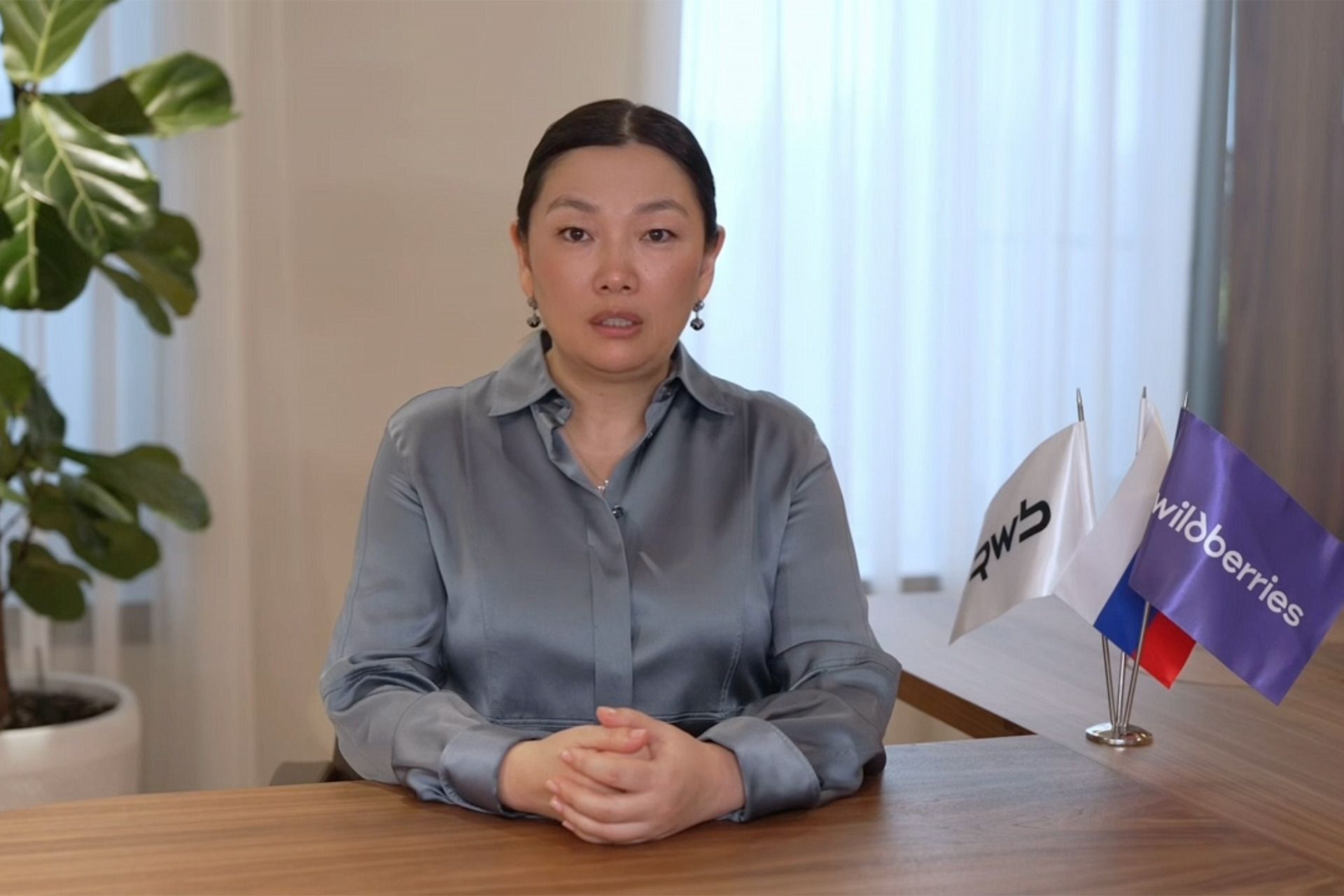
Desperate pleas from Wildberries owners and sellers to the government are provoking a sluggish and chaotic response. And it seems the issue is not just a banal lack of money.
Source: Tatyana Kim via Telegram
Wildberries marketplace founder Tatyana Kim at the end of July said that she had appealed to the government for help in compensating losses to affected sellers and promised that concrete measures would not be long in coming. A week later, the Central Bank announced measures: it recommended that creditors postpone claims against small and medium-sized businesses “affected by terrorist attacks”: grant credit holidays, and not charge penalties or fines on overdue payments. Given that most Wildberries sellers, and the marketplace itself, simply have no way to repay their loans (the sellers took out loans secured by goods that burned), a reasonable question arises: fine, the banks will go along with the Central Bank’s request, but what next?
No money, but hang in there
Let’s say they even give out more loans for new purchases — then drones will come again and burn everything down. Forgive the loans? There is no separate statistics on lending to online trade, but in the Central Bank’s latest data, trade and auto repair accounted for just under 8.5 trillion rubles — this is fourth place after manufacturing (read: the defense-industrial complex), financial activities, and R&D (read: again the defense-industrial complex plus import substitution), and in terms of the volume of loans issued (i.e., their number), trade and auto service are on par with the defense-industrial complex. Even if we imagine that out of 8.5 trillion rubles, only 1 trillion will go to the affected sellers (and let’s not forget that drones keep burning warehouses), it turns out that the banks will suffer huge losses with no hint of compensation. Bankers may tremble before the government, but they are not suicidal.
The affected sellers themselves are asking to have their marketplace commissions reduced — at least for six months, until sales recover. But then the question arises: whose expense will the celebration be organized at? If we talk about Wildberries, the company itself is now in an unenviable position: analysts are already seriously discussing the possibility of its bankruptcy. Other marketplaces are also now spending money on additional warehouse protection and redistribution of goods.
If we are being fair, the state should be responsible for the losses: it started the war, and drone attacks are a consequence of that decision.
But the state is in no hurry to help: for now the situation is “under control”. And the measures under consideration do not look like direct support, but rather like a reasonable concession — you can’t take anything from someone who has nothing. Thus, the Ministry of Economic Development and the Ministry of Finance under Deputy Prime Minister Alexander Novak are studying packages of proposals for deferrals and installment plans for mandatory tax payments for sellers who lost their goods, while the Ministry of Industry and Trade is considering initiatives from business groups and the financial bloc to support the trade sector in emergency situations.
The Kremlin did not find money to support the affected sellers. Which is understandable — there isn’t enough for the war.
After the Thursday election
Beyond the lack of money, the Kremlin may have other considerations. It is generally believed that throughout the war the authorities tried to normalize the situation inside the country so that people would enthusiastically attend honey fairs and patriotic song concerts, paying no attention to the fighting itself. But in 2026 the situation changed.
First, the system of recruiting soldiers for money has begun to fail: the pace of contract recruitment is falling, as shown both by the expansion of payments to recruiters and by economic pressure — from reducing university places to urging students to sign a one-year contract to serve as drone operators. Meanwhile, Ukrainian drones are already killing more soldiers than are coming in as replacements.
Second, the demobilization of society itself is beginning to work against the Kremlin. Ukraine’s transfer of the war onto Russian territory — including attacks on oil refineries and marketplaces — is provoking justified outrage among the population. In other words: you promised us a peaceful life — so what is this? On the other hand, the Kremlin vitally needs Russian citizens to go to the front again, if not entirely voluntarily, then at least with a desire for revenge. Of course, the Ukrainian drone is absolutely indifferent to what the Russian soldier shouts before dying: “For the Motherland!” or “For the money!” But in the first case, more soldiers can be recruited, which means there is hope of overloading the Ukrainian drone control centers.
Under these conditions, burned-out sellers become the ideal environment for changing the social contract. You have suffered from Ukrainian drones, so go and take revenge or at least somehow help us take revenge — that could be the message of propaganda to them.
At the same time, the background message will be that at the front you can earn money to rebuild your business. And even if you die, your family will not be left without money and with your debts. Sounds fantastic? But listen to the election speeches of virtually all parties: they are exactly about this — it is time for us to rise as one to defend the motherland (and the money).
If so, then why should the authorities help the victims? Much more likely, in my view, is the following: the government “discusses measures” and makes reassuring statements before the State Duma elections. After the elections, whether it is Putin himself or a “collective Putin” in the form of top officials and propagandists, they announce: we held back for a long time, hoping for the Kiev regime’s reasonableness, but now we are forced to strike with full force. Arise, vast country, arise to the mortal fight. Everything for the front, everything for victory, and whoever is against it is an enemy and a traitor. Under these conditions, the outrage of deceived sellers may turn into criminal cases with substantial prison terms.
However, they will be given some symbolic handouts: like the same tax holidays with the cancellation of fines and penalties. But no more: the state will offer its citizens the chance to get their money back and their former well-fed life with weapons in hand — or at a machine tool in a military factory. And this is not only about Wildberries sellers. The concept has changed, and after the elections Russian citizens will have to accept that now proving loyalty to the state will require not only words, but deeds as well.
P.S. This will not affect propagandists, officials, or deputies, nor their relatives — and that, by the way, may turn out to be a much stronger stimulus for social upheaval than it is now.
If you enjoyed this article, consider making a donation — one-time or, even better, monthly. Your support helps us motivate our authors and become better with every article.
Our organization is recognized by the Internal Revenue Service (IRS) as a 501(c)(3) tax-exempt, charitable organization, which means that all contributions made to us are tax-deductible to the fullest extent permitted by U.S. law. Individuals may generally deduct charitable contributions of up to 60% of their Adjusted Gross Income (AGI) for cash donations made to qualifying 501(c)(3) organizations. For donations of appreciated assets (such as stocks or other long-term capital assets), the deduction is typically limited to 30% of AGI, based on the fair market value of the asset. C-corporations may deduct charitable contributions of up to 10% of their taxable income for donations made to eligible charitable organizations.
By submitting a donation, you confirm that you have read and accept the following documents: Privacy Policy and User Agreement, and also give consent to the processing of your personal data.
If you would like to unsubscribe from a monthly donation, please email us at: [email protected]