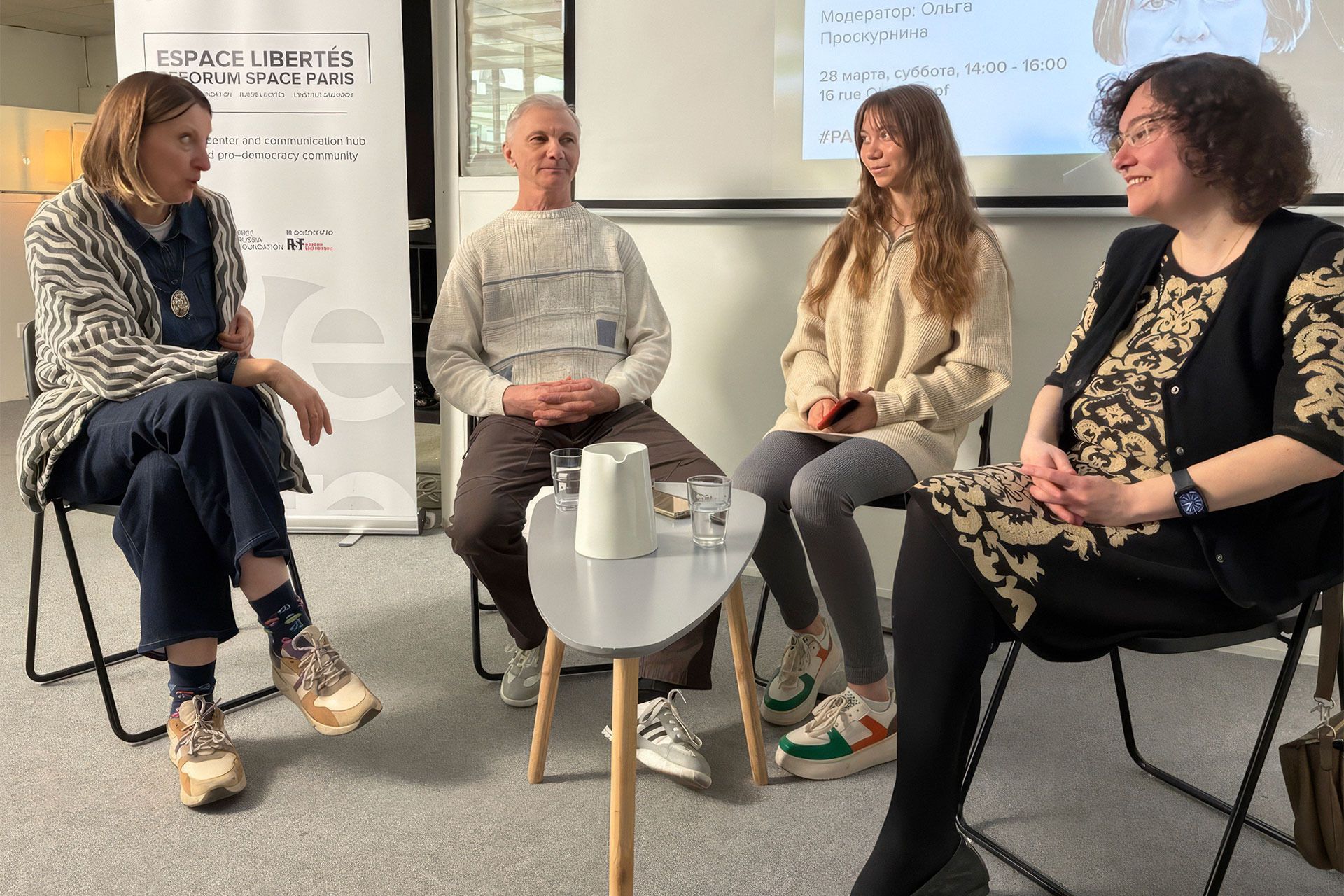
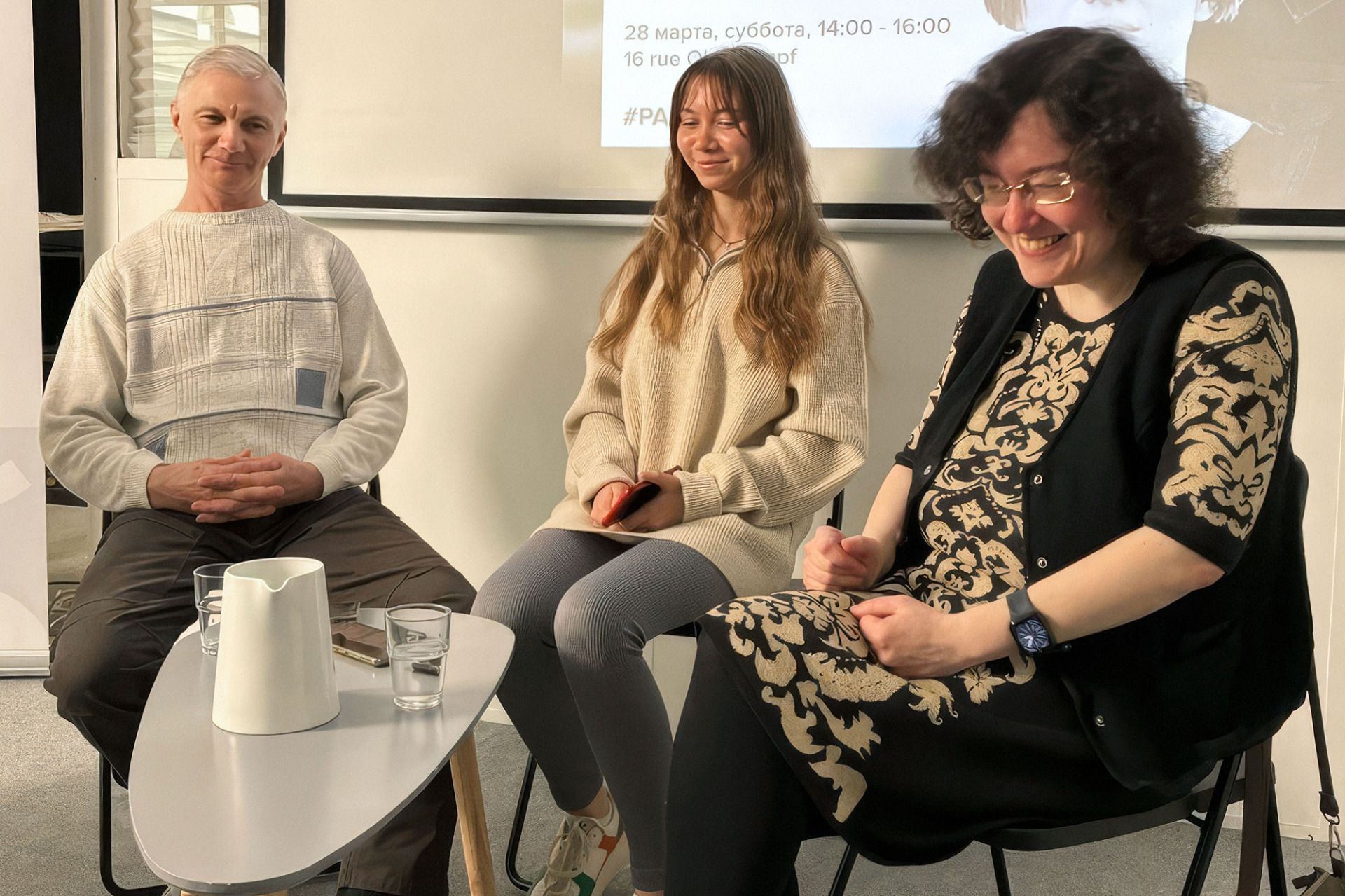
Last Saturday, the Paris resource center Espace Libertés Reforum Space hosted a presentation of Ksenia Kirillova’s poetry collection, illustrated by Masha Moskalyova, “A Hillock on Canvas.” This is the first release of the Most.Media publishing program, the first publication experience for the 16-year-old artist, and the first in-person meeting of all participants in the creative process. At the public talk, together with Masha’s father, Alexey Moskalyov, we discussed creativity in political emigration — as well as the circumstances that led all participants in this discussion into emigration: the war in Ukraine and the repression in Russia against its opponents. We are publishing an abridged transcript of our conversation for easier reading.
Public talk at Espace Libertés, Paris, March 28, 2026. Left to right: Most founder and editor-in-chief Olga Proskurnina, Alexey and Masha Moskalyov, Ksenia Kirillova. Photo: Most.Media
Ksenia Kirillova:
I never planned to emigrate. My husband and I were planning to move to the US on his temporary work contract back in 2013, before Crimea, and it just so happened that the moment of departure and the start of the war coincided. When I found myself in the US, it was important for me to understand what had happened to Russian society: how people could accept Crimea at first, and then the war. Crimea could still be explained somehow—propaganda, national pride—but when people started killing and there was no reaction, it was a shock to me.
I started doing social analysis—what is now called propaganda analysis: how it affects people and how people adapt. Already in 2014, it became clear that people believe what they want to believe to preserve their inner comfort. I didn’t expect myself to be one of the first to describe this, because now it’s talked about a lot, but I started writing about it back in 2014.
The first to notice this analysis were not even experts, but American Cold War intelligence veterans. American veterans, former intelligence officers, when they retire, become experts, join the expert community, and give interviews openly. I have never had any connections with intelligence agencies—if I did, it wouldn’t be public. The younger veterans still integrate into the expert environment, while the older ones are no longer involved. My first acquaintances were precisely these people—wonderful grandpas; one of them, Michael Davidson, also writes spy novels and knows Russian. Unfortunately, in American culture, these people are abandoned, but for me, they were a treasure trove of information.
Michael and I wrote the first novel together; he translated my chapters into English. Then I published my first historical spy novel about the Cold War, called “In the Web of Madness,” which, in addition to the spy plot, depicts Soviet punitive psychiatry. It was translated into Ukrainian and presented in Ukraine—which was important, because after the annexation of Crimea, Russia began using punitive psychiatry against Crimean Tatars. That’s when I realized that the spy novel, for me, is not just an entertainment genre.
I really wanted people to start reading about the war, because at that time, people simply ignored it. How do you draw attention to war? Well, a spy plot is interesting. And these spy adventures are mostly not about professional spies. It’s a story about ordinary people—agents, their victims, people caught in extreme situations. Such a plot better shows the drama, the complexity of moral choices. I’m interested in showing not spies, but ordinary people in extreme situations.
Olga Proskurnina: How did you decide to work on a spy trilogy about the war in Ukraine right in 2022?
Ksenia Kirillova: The war in Ukraine was, of course, a huge pain for me, but not a surprise—I mean the full-scale one. Since I was working on this topic, I had no doubt, from the end of December, that there would be an invasion. Even the analytical centers [in the US] were already working in high gear all of January. The Americans knew a big war would start and were ready for it before others. The Americans’ mistake was that they thought: is this blackmail and pressure or preparation? But it was both. First, to break them with blackmail, and then to invade anyway, but with a more respectable pretext.
So at first, books were out of the question. I needed to understand what was happening with people, how they perceived it. And for me, the important question was: why do people, even abroad, keep working for Russia, even though they’re smart and understand everything? Why wasn’t 2022 a shock for them? Why weren’t they scared by the horror they were participating in?
I wanted to show, through fiction, what I was already writing as an analyst: mechanisms of self-justification, mechanisms of how a person tries not to notice the war. My main character, Sergey Bessonov, is quite a smart person, he understands everything. I was interested in how one can convince oneself, how one can quiet one’s conscience. Most people do this unconsciously, but he consciously suppresses this awareness.
And then I immediately thought of Sergey Efron—Marina Tsvetaeva’s husband, who worked for the NKVD in emigration. It seems he sincerely believed in the communist idea, as his letters suggest, but he also had a powerful nostalgia. And we’ll never know for sure what it was: sincere belief or a form of self-deception, when he believed in the idea to justify his inner motive, his nostalgia.
What struck me in Efron’s story was that he destroyed his entire family. I wanted to show people, on the one hand, these mechanisms of self-justification, and on the other—the collapse. Where such choices lead. Because I understood one thing that, unfortunately, the wave of emigration in 2022 didn’t yet understand: at first, a person acts at the peak of conscience, shock, guilt, horror, and then anyone, even a dissident, adapts. That’s how people are. And when people get used to it, but their life still doesn’t settle, after a few years a person becomes very fragile.
I think the first book in this trilogy—“Efron's Mistake”—is more relevant now than it was in 2022 [Most.Media is preparing to republish “Efron's Mistake” in Russian; it was published in French by Marie Barbier Editions on March 27]. Because back then, everything felt very clear, and now it seems like nothing has changed, but psychologically, there’s no strength left. And someone might think: my God, what have I done, why did I destroy my life, since I couldn’t save anyone anyway, and my life is ruined, and no one in the West, it turns out, was waiting for me. And to remind people that there are choices that should never be made under any circumstances, no matter how hard emigration is—that’s very important.
Olga Proskurnina: Let’s talk about emigration and moral choice with people who know it firsthand—Alexey and Masha Moskalyov. You waited more than a year for a humanitarian visa to Germany in Armenia. How did you get there and survive that waiting period?
Alexey Moskalyov: The first big doubts were whether we could even leave Russia. As soon as I was released from the colony, on the way home I immediately got calls from people who were helping us: “Alexey, don’t go home, go straight to the airport, to Moscow.”
For me, this was strange: how could I not see my apartment, my home for two years? I decided to visit anyway. Masha and I took the risk and went home, spent the night, and the next day went shopping. When we returned, our neighbor told us that while we were out, the police had come: they knocked on the door, looked at the balcony for a long time, walked around the house—they were looking for us. We realized that staying any longer would be very dangerous. There were suggestions that they might open another case against me, and we had to leave Russia within a few days. At that time, neither Masha nor I had passports for foreign travel, so we had to leave for a third country that accepted Russian internal passports—Armenia.
We stayed there for a year and four months, waited about a year for the German visa. As far as I know, the German Foreign Ministry approved our case, but when it was transferred to the Ministry of the Interior, the humanitarian visa program was suspended, so we were left in limbo. At the end of December, Masha and I discussed it and decided not to wait for German visas and to apply to France. Credit to the French authorities—they processed everything very quickly, literally within a month and a half we got our documents, and on March 11 we arrived in Paris.
We were worried that Armenia might not let us leave—they could have put out a search from Russia, so we could have been detained.
Olga Proskurnina: And when you left Russia for Armenia, were there any problems at departure?
Alexey Moskalyov: No, we left without any problems.
Olga Proskurnina: And how did you live in Armenia, what did you live on? I understand you didn’t have jobs there?
Alexey Moskalyov: Mostly we were supported by the Nevzlin Foundation. Leonid Borisovich [Nevzlin] paid for our apartment and helped us financially. Activists and volunteers also helped, sending us some money. So we didn’t have any problems in that regard.
Olga Proskurnina: Masha, how did you study during that time? Are you studying somehow?
Masha Moskalyova: When we arrived in Armenia, I was still studying, continued ninth grade remotely, but when the OGE exams came up, I contacted my supervisor, and she said I had to come to Moscow to take the exam in person. Since that was absolutely impossible, I had to leave school. Then I studied on my own to keep up with the school program, worked with tutors, then improved my program and studied fine on my own, without a tutor. Now I plan to go to a French school.
Olga Proskurnina: So, how did you all meet and start your creative project together, how did that happen? Ksenia Kirillova in Serbia, the Moskalyovs in Armenia...
Photo: Most.Media
Ksenia Kirillova: I listened to one of Alexey’s interviews, and he said that Masha writes stories. Of course, I knew Masha’s story from the moment it became widely known. But I never imagined I’d ever not only see Masha, but even talk to her in person!
I started thinking about how I could be helpful. My own life in emigration isn’t very secure in terms of protection—you never know what will happen tomorrow. But I found Masha’s stories on a small website, read them, and there was Masha’s contact. We called and at first just talked about creativity. Then, since I was actively writing for Most.Media, I decided to suggest to both Masha and Olya: why not do an interview? Since Olga herself was also following Masha Moskalyova’s case.
Olga Proskurnina: I had been subscribed to the Telegram group “Freedom for Alexey Moskalyov” since its very creation.
Ksenia Kirillova: As we all probably were. Of course, Masha didn’t know us, but we all knew her in absentia all these years. Of course, Olya agreed, Masha agreed, and by then we were already informally acquainted, so we did the interview.
After that, we kept in touch, and Masha started sending me her drawings, and I sent some poems. And then one day—without planning or discussing publishing—Masha sent me an illustration for my poem “For Easter,” just in response. Over the fall, Masha drew eleven illustrations. We sent the collection to all publishers. And they all said more or less the same thing: the poems are beautiful, and Masha draws beautifully, but poetry doesn’t sell.
And now I have questions for Masha. Everyone knows your anti-war drawing made at age 12, and it’s great that your artistic career didn’t end there. How do you see your future in France?
Masha Moskalyova: Honestly, I don’t know yet. I think it will become clearer a bit later. But, of course, I’m not going to give up drawing, I’ll keep going. Maybe I’ll go to art school, but right now I can’t say for sure.
Alexey Moskalyov: You know, for me it was a revelation from the very beginning—when Masha started drawing and writing her first stories. It was right after we arrived in Armenia, maybe for psychological reasons. She says: “Dad, do you want to read my stories?” I said: “Sure.” I read them—and I was amazed at how my child could come up with this. Then I saw her drawings, mostly portraits of politicians. It really impressed me.
Olga Proskurnina: Did you also do commissioned portraits in Armenia, am I right?
Masha Moskalyova: I did a commission once. It was for a friend. His friend asked me to draw a portrait of his deceased girlfriend. They’re all oppositionists. I haven’t had other commissions yet, because I haven’t posted about it online.
Olga Proskurnina: Friends, you got that, right? You can place orders. If anything, write to Most.Media, we’ll pass it on.
Question from the audience: I was a bit interested in the history of the first white emigration. You were talking about Efron, but Efron wasn’t the only one. Their task was to break up the White movement. I’ll draw a little parallel with today. I’m not saying all of us here are the White movement, but the special services of those times, I think, are the teachers of today’s Russian special services. Do you think there’s a chance that there are also forces here trying to break up Russian society?
Ksenia Kirillova: Agents have always been recruited and still are. That’s why I show this problem in modern times—I write about a contemporary agent of Russian special services, not about Efron. And that’s already the answer to your question.
But when I wrote this novel, I didn’t fully understand the scale of agent work. There won’t be a crackdown on our diaspora now—it’s a different angle. I didn’t fully understand how hard it is for our people to survive in emigration, especially if they end up in unsafe countries. Because it’s a vicious circle. If you leave for a third country and live there, that country is recognized as safe, you can’t get a humanitarian visa. But in that country, you’re actually not safe. You can’t go back to Russia. You depend on a Russian passport. You live in a country where dependence on a Russian passport matters, and you’re not entitled to protection elsewhere. But people like Sergey Bessonov are still a minority.
But I’m more concerned about something else. I think the next book in this war series, which I want to write, will be about how good people are broken. We haven’t shown this yet. Because if someone starts working for Russia now, maybe they do it under duress—because of blackmail, because of pressure. I know what colossal pressure is put on these people in unsafe countries. And some break.
And, of course, again, it’s important to show that there are choices you can never make, under any circumstances. Yes, you can be cunning, try to get by if you’re in a country whose authorities won’t protect you, but you can’t betray your friends, you can’t work for this evil. Because you can’t live with that. A person shouldn’t carry that inside and live with it.
And, in fact, you can show that there’s always a way out, no matter what happens. There’s always a choice. But I also want to show how they break people, because this isn’t talked about now. There’s a stereotype in safe countries that all agents work for money. No. Now there’s a wave where they started breaking people. Breaking them through their relationships with loved ones. And this problem also needs to be shown. Because we can’t influence the scoundrels who work for Russia. Only imprison them, yes.
But this process, when ordinary people are broken—I feel sorry for these people. And you can influence this process, going back to what we already discussed: providing people with protection so they don’t depend on Russia. And this is a question of the security of the European Union. It would be good if people here understood: the more a person depends on Russia, the more vulnerable they are to these processes.
Olga Proskurnina: How exactly are people blackmailed?
Ksenia Kirillova: Any way possible. They terrorize loved ones. They create legal problems that prevent people from getting documents in other countries. Because a number of countries never grant asylum from Russia. And you depend on any piece of paper that Russia gives or doesn’t give.
Olga Proskurnina: Yes, in the times of Efron and Tsvetaeva, there were Nansen passports, which saved people and helped them stay mobile. Now, unfortunately, that doesn’t exist.
Question from the audience: I follow what’s happening in Russia and Kazakhstan a lot, the processes are very similar. I tried to imagine the operative who flagged Masha’s drawing, did the paperwork, went to the prosecutor’s office. Very interesting: did you see this person? What kind of person is he?
Alexey Moskalyov: First of all, they never introduce themselves, so you can’t tell if he’s a major, a sergeant. And they never show documents. Second, whether a person serves a criminal regime or not—that’s still a matter of conscience.
The first time Masha and I were taken to the FSB, an FSB officer interrogated me for about three and a half hours. Masha was in the next office, and as he explained, she was being questioned separately. After all the questions—and the first questions were: what do you think of the president, what do you think of the “special military operation”—at the end, he offered: would you like your daughter to head some youth patriotic movement, where she would call young people to patriotism, to support Putin, and so on. They also said they would help promote Masha’s career: everything would be fine, she’d finish school, they’d help her get into university without exams, there’d be no problems. That’s why I say: it’s a matter of conscience. If I had agreed at that moment, all the consequences—my imprisonment, jail, criminal case—could have been avoided.
Olga Proskurnina: Interestingly, Naoko was offered the same thing, and so was her mother.
Ksenia Kirillova: I just can’t process this. How can a grown man interrogate a twelve-year-old girl? What kind of person do you have to be? Alexey, what’s your impression: do they really believe in what they say, or do they just need to check a box? What’s going on in these people’s heads? Maybe Masha can say too. What is this phenomenon?
Alexey Moskalyov: In my opinion, the pressure was initially on the child, to somehow influence the father.
Ksenia Kirillova: But what do they feel? Do they believe what they say? Do they think there’s a threat in Masha’s drawing? Or do they just need to check a box? Do they even care? What’s in their heads?
Alexey Moskalyov: It’s hard to figure out their inner psychology. I think, in my opinion, the financial side plays a role here. This whole structure is tied to finances. They understand that if the criminal regime goes, so do their careers and financial support. Everything is tied to finances. That’s why they’ll fight to the end.
Olga Proskurnina: Russian security services went through a traumatic experience after the collapse of the USSR, when for ten years they were in a very tough financial situation. They really don’t want to go back.
Ksenia Kirillova: I think they understand that this time it will be worse. Because the USSR collapsed at its most “vegetarian” peak, when society didn’t demand it as much. And now they could be jailed at this peak.
Olga Proskurnina: Masha, what were your impressions of talking to FSB officers?
Masha Moskalyova: Not the best. But I’d say there wasn’t really an interrogation. They understood I was a child, what could they get from me? They mostly asked who I wanted to be, if I wanted to be a police officer or a teacher. The questions were odd, but there was no pressure.
Olga Proskurnina: Were you scared?
Masha Moskalyova: No.
Olga Proskurnina: Did you find it funny?
Masha Moskalyova: Not funny, of course. But I was more worried about my dad than myself. I didn’t know where he was. I assumed they’d let me go, everything would be more or less okay, but I didn’t feel much fear. I didn’t know what the consequences would be, just childishly.
Olga Proskurnina: Given how many criminal cases are now being opened against teenagers in Russia—something that didn’t even happen in Stalin’s times—that’s not such an illusory threat. Do you keep in touch with anyone in Russia? Are you able to communicate with people from your past? How do people in your town view what happened to you?
Alexey Moskalyov: I’ll say right away, we have no contact with relatives. When all this started, all the relatives we turned to refused to help, no one helped. So after my release, we have no contact with them.
Olga Proskurnina: Do you have any friends left?
Alexey Moskalyov: You know, no. There are no supportive people. I just want to expand on this a bit. If not for Putin, we probably wouldn’t know how much crap is around us. Neighbors, relatives, acquaintances—it all surfaced. The stuff that doesn’t sink, you could say.
A small example. When Masha came home from school, she was afraid the police would take her out of class—she said, “I’m afraid to go to school.” I told Masha: the next day I’ll come myself to meet you. I waited in the foyer for her class to end. The school principal saw me waiting with other parents and called the police. Four officers came, two went to Masha’s class, two came to me, a man and a woman. They started questioning me: do you know what your daughter is doing? That was the first time I saw her drawing. I’d never seen it before. They showed me the sketchbook. When I looked at it, I didn’t understand why the police would be interested in it. They said: “Well, you understand, we’re conducting military operations, a war with Ukraine.” I said: wait, you’re conducting it—we have nothing against Ukraine or the Ukrainian people, don’t tie us to this. And the parents waiting nearby heard all this. Do you think any of them supported us—like, how can you punish a child for a drawing? No. All of them [started saying]: “Right, he should be deprived of parental rights, the child should be taken away, and he should be put in jail.” What did you expect? And remember, in Stalin’s times, four million denunciations were filed.
Question from the audience: They say it was the teacher who reported Masha, but I heard from my sources that the teacher just shared it with someone without thinking. What really happened? Who exactly reported her?
Masha Moskalyova: It was a classmate whose father works in the police. After class, when the art teacher had already left, this classmate came up to me and saw I’d drawn something different from everyone else. After that, she probably reported it to the principal—or her father did, and he told the principal. She was called in for a conversation about me with the principal afterward.
Woman from the audience: So it wasn’t the teacher, it was a student? Did the teacher hand you over to the FSB?
Ksenia Kirillova: The teacher later handed me directly to the FSB and called the police.
Masha Moskalyova: That was my homeroom teacher, a completely different teacher.
Question from the audience: How did your classmates react? What was their attitude toward you after that? You kept studying there, right?
Masha Moskalyova: For a little while, I stayed in the same class. The students treated me the same as before. I didn’t talk to any of them, we had no common interests. After it happened—still indifferent. No questions, nothing else.
Olga Proskurnina: And you didn’t have any friends left in Yefremov either?
Masha Moskalyova:
No.
Question from the audience: Can I ask a very personal question? How was your relationship with your mother? Was there really a threat that you could be left without parental care and end up in a state institution?
Masha Moskalyova: Yes. When I was in that rehabilitation center in Yefremov, my mother was persuaded for a long time to take me back. She got calls ten times a day. They called and persuaded her to take me back—the administration, officials, everyone talked to her. She made excuses that she had work, debts. They paid off her debts, sponsored her. Because of the financial help, she agreed and took me back; they provided everything for her.
Question from the audience: During the time you spent together, did you get to know each other better, maybe develop a closer relationship?
Masha Moskalyova: No. I already knew what kind of person she was. I didn’t learn anything new.
Olga Proskurnina: For me, the most striking thing here is that despite all the acid poured into Russian society, there are still strong parents who unconditionally protect their children. I think we’ve all seen Yuri Dud’s interview with Diana Loginova (Naoko) and her mother—and appreciated the efforts Irina Loginova made to protect her daughter, and the bond between them. In the story of Masha and Alexey Moskalyov, I see the same thing. Their circumstances are different, but the story is about the same thing.
Ksenia Kirillova: That’s what I was talking about: you can be blackmailed, but there’s always a way out. Look at what Naoko’s mother did. She’s a mother, she should save her child. If she had made her a second Shaman, who would blame her? She was saving her child. But she tricked those security officers. She saved her child, and at the same time didn’t become an accomplice. And she lived in Russia. There’s always a choice, even if you’re in a terrible situation. You don’t have to choose between your child and your conscience. Three arrests in a row—and the mother still had a choice. And she made that choice.
Olga Proskurnina: I think only this will save us all. The unconditional desire to protect and support no matter what, and not to break, no matter how hard the pressure.
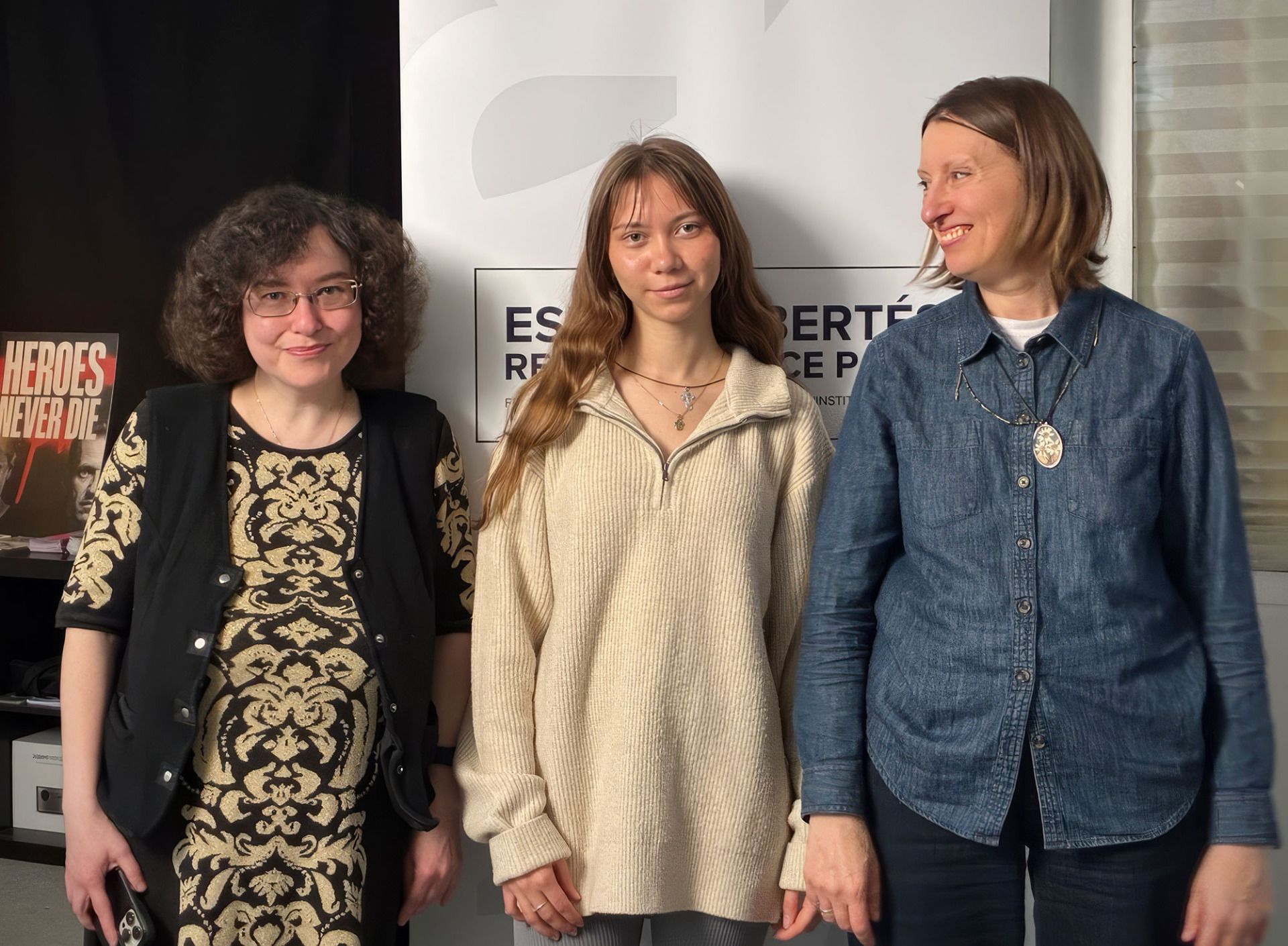
Ksenia Kirillova, Masha Moskalyova, and Olga Proskurnina. Photo: Most.Media
Ksenia Kirillova’s poetry collection with illustrations by Masha Moskalyova in Russian and French can be purchased on Most in electronic and print form. Visit our Bookstore! And this weekend we’ll tell you about our public talk for the Francophone audience in Marina Tsvetaeva’s last Paris apartment, and about Ksenia Kirillova’s spy novel “Efron’s Mistake,” which will soon be released on Most.
If you enjoyed this article, consider making a donation — one-time or, even better, monthly. Your support helps us motivate our authors and become better with every article.
Our organization is recognized by the Internal Revenue Service (IRS) as a 501(c)(3) tax-exempt, charitable organization, which means that all contributions made to us are tax-deductible to the fullest extent permitted by U.S. law. Individuals may generally deduct charitable contributions of up to 60% of their Adjusted Gross Income (AGI) for cash donations made to qualifying 501(c)(3) organizations. For donations of appreciated assets (such as stocks or other long-term capital assets), the deduction is typically limited to 30% of AGI, based on the fair market value of the asset. C-corporations may deduct charitable contributions of up to 10% of their taxable income for donations made to eligible charitable organizations.
By submitting a donation, you confirm that you have read and accept the following documents: Privacy Policy and User Agreement, and also give consent to the processing of your personal data.
If you would like to unsubscribe from a monthly donation, please email us at: [email protected]