Russian activists are not always safe even after emigrating. Persecution can continue beyond Russia’s borders—including at the hands of informal groups acting in line with Russian propaganda. This is what sex educator and LGBTQ+ activist Sasha Kazantseva faced in Lithuania: last summer, she began receiving threats, and people associated with a homophobic group targeting queer teens and activists came to her home. Since then, Kazantseva has been seeking a response from Lithuanian authorities so that such cases do not go unpunished. In an interview with “Most,” Sasha Kazantseva explains how this pressure works, why it’s not an isolated case, and what is happening to queer people from Russia—both inside the country and abroad.
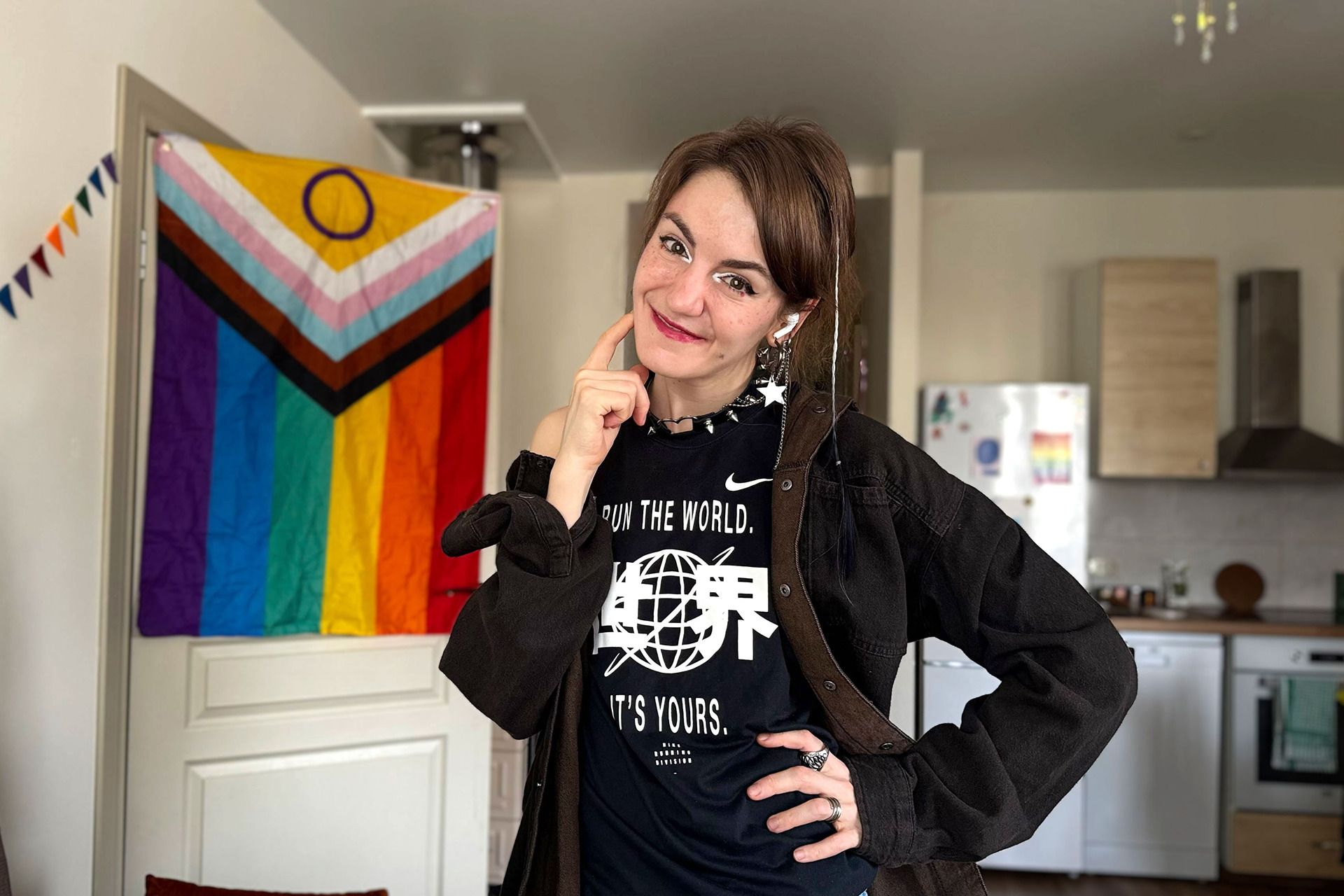
Sasha Kazantseva. Photo: Anna Gavrilova
- Tell us, what is happening with your persecution case now? You’ve spoken to many media outlets and given several interviews on this topic. Has the publicity helped at all?
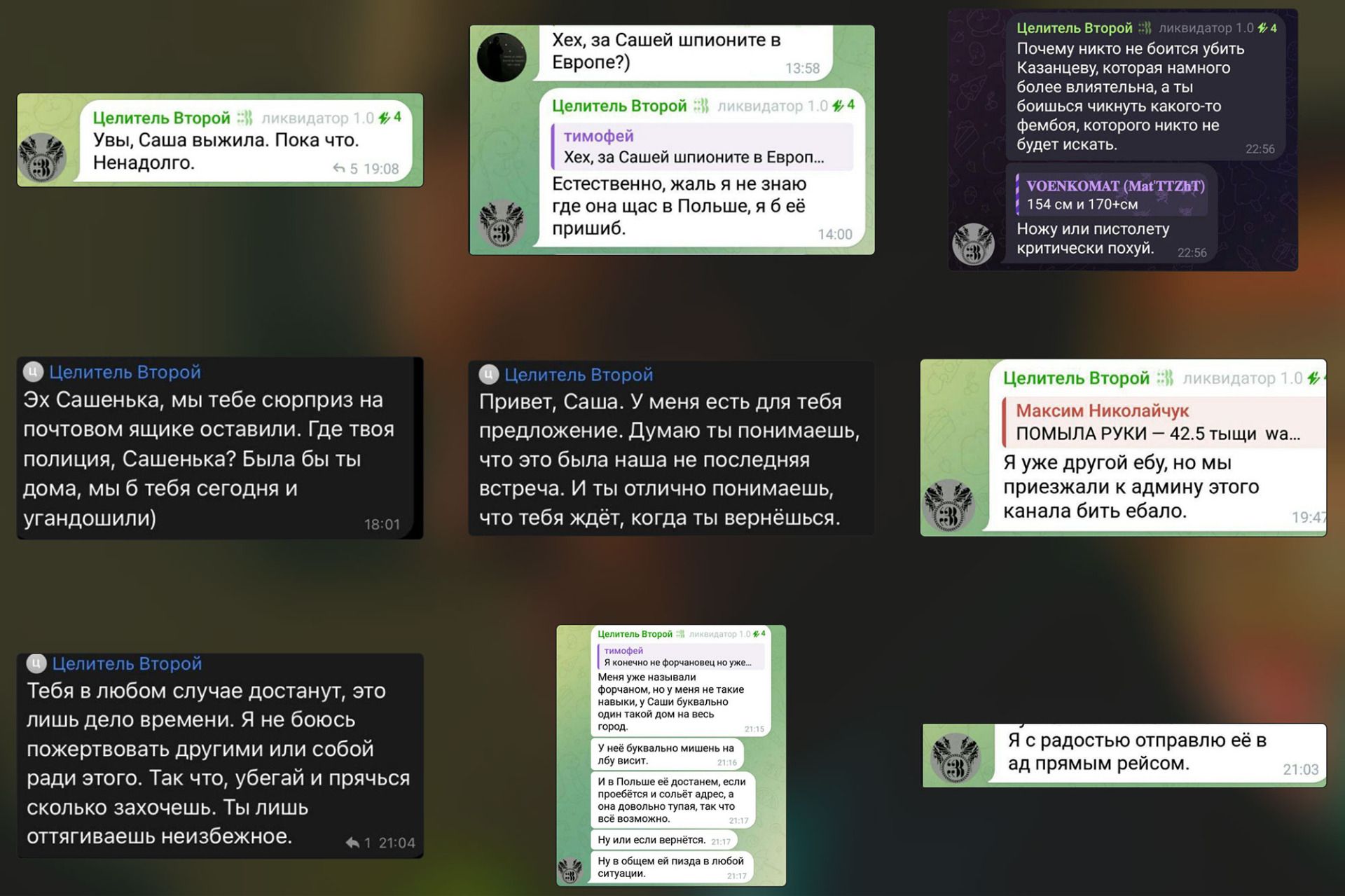
- I think it has. I received three refusals from the police to open a case—even though there were dozens of threats and my home address was published. The stalkers came to my house with the intention to kill me, as they themselves stated. But for eight months, the police didn’t open a case, just sent refusal after refusal. The best thing now is that, thanks to the publicity, the prosecutor’s office ordered the police to start an investigation. And that’s already a success. I spoke with Lithuanian human rights advocates, and they said that such threat cases in Lithuania are usually investigated very poorly, so even just getting an order is a big achievement and the result of a lot of work. It’s hard for me to judge, since this is my first experience with such a media campaign in Lithuania, but I was told it was done very well. Plus, public figures themselves started reaching out to me, offering help. I managed to get in touch with the UN—they wrote to me themselves.
- Why do you think cases about threats are investigated so poorly here? Is it lack of experience, lack of cases involving persecution of LGBT people?
- I don’t know all the nuances of the Lithuanian legal system yet and can only share some points that human rights advocates have told me.
The first thing I know and have heard many times: cases about threats are investigated very poorly, it’s very hard to achieve anything. For example, I had a large article about my case published on “15min.lt”. The journalist who contacted me to do the story had also faced threats—she was threatened as a journalist, her underage children were threatened, and the police did nothing. Although her colleagues supported her. And it was only with difficulty—apparently also thanks to media publicity—that they managed to get at least a recognition that threats to minors are not normal and something needs to be done. That’s the first story.
The second is that in my case, there’s also the qualification of a hate crime, meaning I’m being persecuted as an LGBTQ person, as an LGBTQ activist. And, as I understand, there’s no established practice in Lithuania for investigating such crimes—this is something that still needs to be developed.
And that’s sad, because many local LGBTQ people face threats, stalking, various attacks and stress, but again, the police have no experience with such cases. Plus, any system tends to act according to familiar protocols, in energy-saving mode.
From what I’ve heard, there aren’t a lot of police resources in Lithuania, and they try to conserve them. But I don’t know all the details. And on top of that, my story is… unpopular: I’m a migrant and an LGBT person. And that’s not something people, including possibly police officers, will necessarily sympathize with—I’ve been told as much.
- In your stories, you wrote that you’d be able to help people facing similar problems in Lithuania. Has anyone reached out to you yet, complained about something similar?
- I’ll approach your question from a slightly different angle. For the past eight months, I’ve been living in this story, and at times—literally without days off, because it takes up several hours a day, sometimes even a whole workday.
At first, it was all new to me: I’d never been in a situation where I had to deal with legal issues in another country, a country I don’t know well, searching for contacts I don’t have.
My work is independent activist research, content creation, writing, videos. And I thought: okay, since I’m diving into this lore, I can—jokingly—“make some content” out of it. But seriously, the more I get into this topic, the more I see that it’s a systemic problem.
I’ve had to learn more about how pro-Russian groups operate within the EU, because I need to reference this when talking to media and human rights advocates.
And I think that over these eight months, I’ve already gained some unique experience in a human rights campaign in Lithuania—including in this narrow LGBTQ case. And if something comes of it, it could become a precedent that other lawyers and advocates can use. And since I’m the kind of person who likes to share knowledge when I get it, and I’m inevitably accumulating it on this topic—yes, I’ll try to do something.
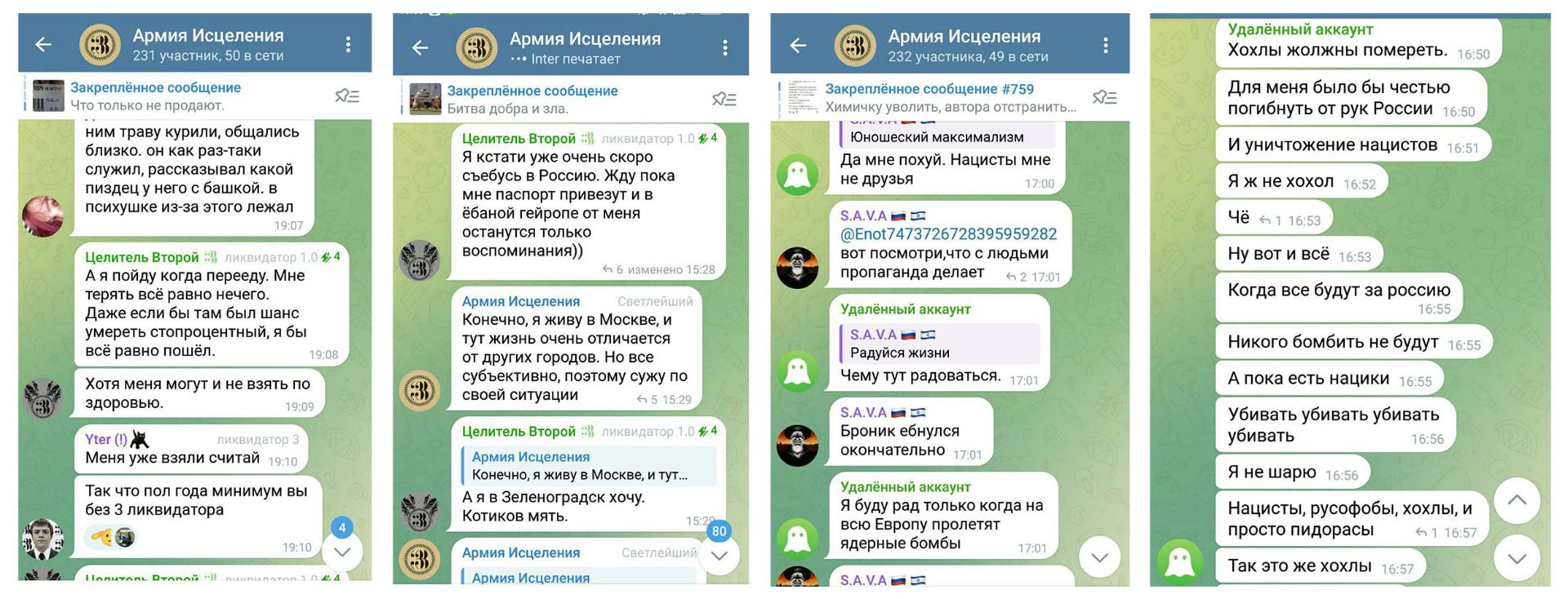
- Has anyone already shared their stories with you about attacks from the homophobic Telegram community “Healer’s Empire”?
- I know that many people in Russia have suffered from this group, and most of its members are there. They actively go after school kids, teenagers: they bully, out, and force them to delete social media. I don’t know about physical assaults, but I know there are human rights advocates who, thanks to this story, started digging into this group and may uncover something.
The problem is that this group isn’t the only one. And the number of such groups in Russia is growing. It’s reminiscent of the early 2000s, when the state seemed to supplement its security sector with such “activists,” not hindering them and sometimes encouraging them. Human rights advocates believe that such groups are, to some extent, “on the radar” of the FSB. They may not have a specific FSB handler, but at the very least, the FSB is aware of their activities. And apparently, this group too—they themselves claim that Russian security services support them.
And since the number of such groups in Russia is growing, it’s reasonable to assume that there will be more of them in Europe as well. We’re already seeing a trend where Russia recruits not very smart, but highly charged youth within the EU for its shady business. And Russia will keep pushing into the EU, into the Baltic countries—there’s no reason to expect otherwise. Accordingly, there will be more of these people, and it’s important to be ready to deal with this.
At first, my case seemed private. But now I see it’s a much broader story. If these people don’t come, others will.
- What have you found out about this group of stalkers so far?
- The leaders’ names are known. One of them is Maksim Suleymanov, the son of a wealthy businessman from Moscow, whom a TV Rain journalist called. He said something like, “I live in an elite village with the Russian government elite, you can’t do anything to me.” His father works with government contracts. After the report on TV Rain, Maksim wrote that he was going to the “special operation.” Maybe because his dad talked to him. But after that, he kept writing to me—I don’t know if it was from the trenches or not.
- So he himself lives in Russia, not Lithuania?
- Yes, Maksim Suleymanov is in Moscow. And in Lithuania lives Bronislav Minderis—the second leader of the group, who said he organized the visit to me. After the TV Rain report, which said Maksim was supposedly going to the “special operation,” Maksim wrote that he was handing over the reins to Bronislav and now he’s in charge.
Who are these people? Judging by our interactions, as is often the case, not very smart young men. Maksim is about 25, Bronislav about 20. They have strength, lots of aggression, want to channel their energy somewhere, but not much brains.
This, in general, isn’t a new story: the Russian state uses such charged young people to solve its little problems without burdening official security agencies.
- Can your case be seen as a possible “trial run” for a wider practice of pressuring activists outside Russia?
- I looked at it from this angle too: these stalkers, in their communication with me, constantly pushed the narrative that I’m a “propagandist,” “terrorist,” “extremist,” appealing to the fact that I’m a criminal in Russia. At the same time, the fact that I’m not in Russia and that Russian laws don’t apply within the EU—they seem to have no understanding of that at all.
A journalist from the Lithuanian outlet 15min.lt spoke (link without paywall) with Bronislav Minderis, who is in Kaunas. And she said he just doesn’t get that you can’t persecute me under Russian law inside the EU, especially on political charges.
If the “test run” of this case had been “successful”—and they wrote to me, “if you were at home, we’d kill you”—could it have been a kind of trial balloon? Right now, we don’t see mass persecution of activists inside the EU, but could it start at some point? Given the situation, that risk can’t be ruled out.
That’s one version. The second is that this group started following me on their own initiative, mostly online. On their channel, someone claimed to be a handler from the security services. He said they act within the laws of the Russian Federation, so they are “clean” under Russian law.
It could be that they started this movement themselves, began to actively harass me. And then—if they really do have handlers—those could pick it up and use it as a practice. Because if it works once, if they see that the police don’t react much, it can work a second time.
And in this sense, I think it’s very important to speak out loudly about such situations. Because yes, I’m alive, but if this time the police do nothing, such groups and those behind them get the signal: you can go after others too. And then move further—half a step at a time, then more. Then they might start entering apartments, and maybe even stabbing someone.
I want these groups and Russian security forces not to feel that, for example, in Lithuania, it’s very easy to do this.
- Do you know if the police met with Bronislav Minderis, maybe questioned him about your case?
- No, nothing happened—that’s the problem.
Journalists basically did the police’s job: they found the names, addresses, everything about Bronislav, even where he lives. But in these eight months, the police have done nothing.
They could have at least summoned him for questioning, at least indicated that this is not okay—just paid some attention. Even if they didn’t open a case, they could have come to his house and said: people are complaining about you. At least at the district police level.
- After the publicity, did they stop threatening you, leave you alone?
- No, they didn’t leave me alone. To me, that’s another sign of their fanaticism—they keep going. They attack my social media, send bots to all my accounts. After the TV Rain story, Maksim Suleymanov wrote to me: “You think you’re so cool, but you won’t stop us.”
Bronislav constantly comments, writes dozens of stupid messages. At first I banned him, then I stopped. He wrote himself that he has hundreds of bought accounts. Plus, lawyers advised me not to ban him—it’s evidence, let him write.
And for me, it shows how unpunished they feel, how much they don’t see any limits. Bronislav has been saying for all these eight months that the police won’t do anything to him, that he’s fully protected by Lithuanian law. Okay, maybe Russian activists aren’t the most important residents for Lithuania. But at some point, he could start attacking Lithuanian citizens. For example, he wrote that he saw women, one of whom was wearing a rainbow shirt, and wanted to attack them, but there were people around. So if someone writes that he dreams of going to the “special operation,” that he killed gays, that he wants blood—it would be good if at least a district police officer visited him. We have hundreds of screenshots of what Bronislav wrote. And it’s absurd that the police do nothing. Even though he writes things like “I want rockets to fly at Europe,” “I leaked the contacts of Lithuanian military bases.”
- Do you feel support here, in exile? From friends, colleagues, anyone else?
- I guess I’m lucky overall that I feel supported. I have an audience, so I feel like I’m not alone: I can say something, and people will respond.
But I’ve thought a lot about the support system, because it turned out it’s not so easy to get help. Including from Russian organizations in relocation.
So if people start chasing you and threatening you, it doesn’t mean you’ll immediately get all possible help—even if you’re relatively media-exposed. It doesn’t work that way, it was still hard. But I try to focus not on those who turned me down, but on those who supported me. And yes, there’s a lot of support.
Journalists responded, I’m very grateful to the reporters from TV Rain, Glasnaya, 15min.lt, human rights advocates. Many people were helpful, wrote letters to politicians.
So there is support. But for now, it’s probably more one-off. I don’t feel like the system in Lithuania itself thinks this shouldn’t be happening. I think some things should be done, because everyone is interested in making sure this doesn’t happen.
I understand that on one level, this is my private case, but on another—it could become a regular story in a few years, when people will be threatened at home, and this will become a way of intimidation.
- The situation looks terrible and absurd: the authorities in Russia have passed repressive laws against LGBT people, some have been forced to leave, others have been intimidated into silence. But even those who left are still being persecuted. What do you think they are trying to achieve?
- I think it’s not just an LGBT issue, because my case is quite political. I’m also being persecuted as a political activist, I feel that strongly. Pro-government bloggers write about me, strange people come to comment. And I don’t think it’s just because I work with the LGBTQ theme. There are much more popular Russian LGBT bloggers who left, who aren’t involved in political activism, and they don’t face this. I think the Russian authorities are interested in neutralizing people who stick their necks out politically. The endless internet blockings are also about preventing influence from outside the border.
- Do well-known LGBT people react to your story? Have any tried to support you?
- Like who?
- For example, say, Mikhail Zygar, Karen Shainyan.
- No, they haven’t. Mikhail Zygar followed me on Instagram at some point. That’s all. Who else is a publicly known LGBT person?
- Out? Anton Krasovsky. Okay, just kidding. Zemfira.
- Well, no, she’s not out. We don’t really have public LGBT people who are both media figures, out, and politically active.
- Can we even talk about solidarity among LGBT people from Russia?
- I generally feel very strong solidarity with the queer community. I’ve even caught myself thinking that I never had a special sense of connection with my “homeland”—and I find it hard to understand how that works. Even though I never planned to leave, I planned to live and work in Russia, but specifically within the LGBTQ community. And this community is, in a way, my “homeland.” I feel at home with LGBTQ people from all sorts of countries.
Of course, I’m speaking in generalities, since there isn’t one single LGBTQ community, there are different subcommunities. But I think many LGBTQ people have at least some experience of this meta-community feeling—even if it’s just occasional. For me, it’s fairly constant.
I notice that many LGBTQ people who are in more or less the same media space, regardless of country, can talk about the same things, share similar values, and understand each other.
As for people from Russia—it’s hard for me to judge. I talk to people from different countries, and Russians are not the majority. They’re there, but not more than others.
I try to keep up with how the community inside Russia is feeling now, but I can’t know fully—only in fragments. So I’m not the most competent source about the situation inside Russia. But I really want to find ways to be useful for queer people inside Russia.
- Do you think public figures who themselves may belong to a persecuted queer community have a moral responsibility to speak out? And how important is such support—can it really help those facing pressure? For example, Zemfira has never said “I’m with you.” And that, probably, would be valuable for many to hear.
- If you’d asked me this before February 2022—about coming out or supporting LGBTQ people, even using Zemfira as an example—I’d have said it’s important to consider the circumstances: how a person was socialized, what environment they live in, what risks they face.
I might have a different position, but I understand that I can’t imagine what another person, another woman, is going through. And, as they say, thanks for making some contribution so that I can be out and see the value in that. Sometimes closeted public figures are even useful in reverse—you look at them and think: I don’t want that, I want to be out.
But since 2022, for me and for many, everything has become more acute. We’re not talking about coming out, but about words of support. And it’s not so much a question for Zemfira, but for public people in general.
The crimes of the Russian government against LGBTQ people and the war in Ukraine are directly connected. Since 2014, Russia has been losing Western allies and needed new ones. In response, it began actively promoting “traditional values” as state ideology.
How does it work? Through fear—that “the gays will come and change your children’s gender.” Children are a powerful trigger for moral panic. This is the basis for the ideology that Russia exports to potential allies.
So there’s the “perverted West,” and there’s “us with our traditional values.” Interestingly, when this propaganda reaches, for example, African countries, it uses decolonization rhetoric: the West colonized you and is still doing so, but we protect you from these “horrible Western values,” including LGBTQ.
- So it’s an export product?
- Kind of like how Russia sells oil. It’s a resource on another level, but it also sells well and helps gain allies.
The very idea that a person doesn’t have the right to be different, that someone can know what’s “right” to be—is a very fascist idea. And it’s from this that all levels of Russian aggression grow. This idea is scaled up and projected onto different spheres of reality. And from this perspective, I think it’s very important to talk about what and why the Russian authorities are doing to LGBTQ people.
Since 2022, Russia has passed three anti-LGBTQ laws. One of them has effectively deprived 1% of the country’s population of access to basic medical care. It’s a truly genocidal anti-trans law. Even the Ministry of Health resisted, but they were simply silenced. Another law, seemingly completely disproportionate to the “problem,” is the recognition of LGBTQ as an “extremist movement.”
- Why do you think Russian public figures—stars of journalism, stage, film, politics—pay so little attention to this topic? Even those who are already outside Russia.
- I’ve heard from many journalists and YouTubers that it’s an unpopular topic, it’s scary to take it on: there will be drama, people will unfollow. And I get it, even with my small blogs. When I take on hate-generating topics, I think to myself: “Well, here we go.” It takes energy, and when you’re already under pressure, you might not have enough for one more thing.
But on the other hand, we’re already working in a conflict zone where we’ll be hated anyway. The question is what we’re willing to stand up for. Do we think this topic is important? I think there’s a lack of understanding—and I want to work on this—that it’s relevant to everyone.
Not just because “first they came for someone else.” But because everyone, in some sense, has a queer experience: none of us is the “perfectly correct person” that the state and society approve of from all sides. Everyone has the experience: I’m not quite like others, and I’m embarrassed about it. And there’s the fear that you could be punished for that.
This builds up tension. We think we have to put on a brave face, because as we are, we won’t be accepted—not because we’re doing something bad, but because “that’s not how it’s done.”
And if we’re talking about a freer society, it’s important to talk about the possibility of being yourself. I want to find the words to explain how much the state of society depends on how it treats LGBTQ people.
On one hand, how a society treats vulnerable groups is a litmus test; on the other, it’s a way to understand how we are as people and how we live in society. What the whole country is experiencing now after 2022, LGBTQ people have already been living through for at least ten years: since 2013, we’ve lived under the propaganda law, but hardly anyone besides us cared. There’s this perspective that the Russian authorities first test repressive scenarios on vulnerable groups, and then just expand them to all citizens. In fact, the Russian authorities have legally made everyone queer, put everyone in the same status that LGBTQ+ people had for years. You carefully filter your words, maybe pretend or just hide your true self to avoid repression. But you know you’re still not protected from it. That’s why it’s important to notice when vulnerable groups next to you are being hurt or, even more so, repressed—even if you don’t belong to them yourself. Otherwise, these practices quickly become normalized and start being applied to everyone.
If you enjoyed this article, consider making a donation — one-time or, even better, monthly. Your support helps us motivate our authors and become better with every article.
Our organization is recognized by the Internal Revenue Service (IRS) as a 501(c)(3) tax-exempt, charitable organization, which means that all contributions made to us are tax-deductible to the fullest extent permitted by U.S. law. Individuals may generally deduct charitable contributions of up to 60% of their Adjusted Gross Income (AGI) for cash donations made to qualifying 501(c)(3) organizations. For donations of appreciated assets (such as stocks or other long-term capital assets), the deduction is typically limited to 30% of AGI, based on the fair market value of the asset. C-corporations may deduct charitable contributions of up to 10% of their taxable income for donations made to eligible charitable organizations.
By submitting a donation, you confirm that you have read and accept the following documents: Privacy Policy and User Agreement, and also give consent to the processing of your personal data.
If you would like to unsubscribe from a monthly donation, please email us at: [email protected]