Today, one can observe increasing activity of Russian special operations in Europe and expect it to intensify, since Ukrainian resistance relies primarily on European aid. The Kremlin is looking for ways to undermine this alliance no less than for military victories.
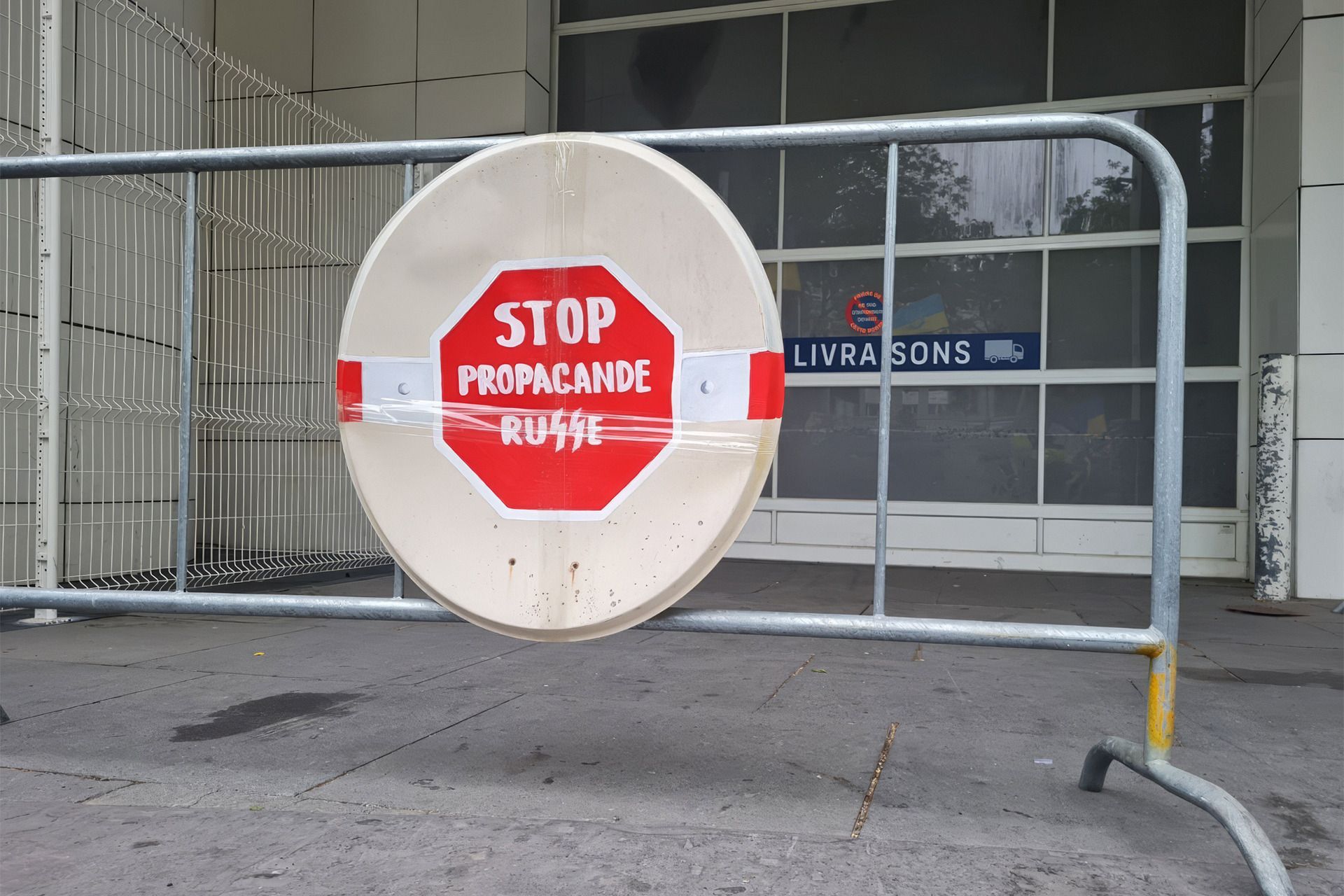
Paris, June 3, 2026, protest against the activities of Russian propagandist Ksenia Fedorova on the French TV channel CNews. Photo: Most.Media
Russia’s invasion of Ukraine in February 2022 was preceded by a long and noisy propaganda campaign in which Moscow accused the West of many sins. In particular, the following crimes were listed: NATO expansion; the organization of the Maidan in 2014; the disruption of the Minsk agreements; and, in general, constant deception. President Putin himself and those officials of his regime tasked with public appearances have constantly tried, and continue to try, to present the matter as if Russia had no choice, as if it allegedly had “not attacked anyone“, and merely took care of its own security.
There is no reason to get drawn into polemics with propaganda exclamations, especially since they are refuted by well-known facts.
From time immemorial, the aggressor has tried to pose as the victim. Post-Soviet Russia continues the Soviet tradition in this sense, in which external expansion was always presented as a response to some threat.
At the same time, it is important to note one striking feature. Over its history, the Soviet Union carried out many direct attacks on neighboring countries, using various justifications, which in the event of success led either to annexation of territories or to the establishment of a puppet regime. But in parallel with these actions, the Soviet Union, viewing the global West as its main and mortal enemy, tried, without declaring war, to weaken it by every means, using the tactics of asymmetric operations. This refers to attempts at various kinds of sabotage and assassination on the territory of Europe in particular, as well as interference in the political life of European countries.
This could happen through the banal bribery of influential figures — or, in a more sophisticated version, through material support for parties and newspapers broadcasting Moscow’s version of international events, through campaigns and movements favorable to Moscow that sow division within the unity of Western countries.
Finally, in general, one can speak of systematic efforts to undermine and discredit the democratic and legal foundations of life. Left aside are other tricks of the Soviet security services, in particular the struggle against Western influence in third countries, where the Soviet Union actively supported one side in civil conflicts that had pledged allegiance to the socialist choice.
All these actions today fall under the definition of hybrid warfare, and the VChK-GPU-NKVD-MGB-KGB line has accumulated extensive experience in organizing such special operations. It is hardly possible to speak of their success — after all, the Soviet Union suffered a historical defeat despite all this dubious resourcefulness. But the method itself was not criticized during the formal transition from the KGB to the FSB and other security services responsible for external security matters and differing from one another in departmental affiliation and division of labor.
President Putin, who knows firsthand the methods of hybrid warfare, has always, in all his undertakings, relied on the network of his security services headed by the FSB. It is no surprise that in the new series of diverse acts of sabotage in Europe one can discern the same hand, familiar since Soviet times, albeit adapted to modern technology.
Today, one can observe increasing activity of Russian special operations in Europe and expect it to intensify, since Ukrainian resistance relies primarily on European aid. The Kremlin is looking for ways to undermine this alliance no less than for military victories.
The presidential campaign in France
The presidential elections in France will take place in the spring of 2027, and the election campaign began this autumn. The circle of main candidates is generally known. Among those who have already announced presidential ambitions, there are those who will, quite obviously, continue France’s current foreign policy, in particular with regard to the war in Ukraine, and there are other candidates whose position appears more ambiguous.
Three contenders from the first list — Édouard Philippe, Gabriel Attal, and Raphaël Glucksmann — were hit by strange cyberattacks in early August. Fake videos appeared on social networks, disguised as reports from well-known news outlets, featuring recognizable journalists, in which these people were compromised. For example, there were rumors about one candidate’s health problems or an offer of money for a positive review of another candidate. These materials, obviously generated with the help of artificial intelligence, were not of good quality, and the forgery was easy to spot. French investigators made a special statement about the involvement in this story of a group of hackers linked to Russian security services.
This is one of the scenarios of modern hybrid warfare, in which Russia actively interferes in all European elections (so far without much success, if we do not count isolated local victories) and, it seems, is seriously preparing to take revenge in France after failures in Romania and Hungary.
Another French story is connected with the name of Ksenia Fedorova, who got her minute of fame during a press conference in Versailles in 2017 after the first meeting between President Putin and the newly elected President Macron. At the time, as a correspondent for Russia Today, she complained to Macron about the refusal to accredit the Russian news agencies Russia Today and Sputnik in his campaign headquarters. The French president’s response was very sharp. He accused Russian media of behaving not as news organizations but as “agents of influence” and distributors of “false propaganda”. President Putin listened to this rebuke impassively and made no comment.
Russia Today and Sputnik broadcasting was stopped in the EU after the war began, but Ksenia Fedorova did not leave France; on the contrary, she obtained a residence permit and became a frequent guest on the CNews news channel as an expert. In essence, she regularly broadcast all the main theses of Russian propaganda regarding the war in Ukraine live on a French news channel.
Paris, June 3, 2026, protest against the activities of Russian propagandist Ksenia Fedorova on the French TV channel CNews. Photo: Most.Media
But at the end of July 2026, the French Ministry of the Interior announced the cancellation of Fedorova’s residence permit and her immediate deportation from the country. A scandal erupted. On CNews, which takes a conservative position on many political issues, the Interior Ministry’s decision was criticized as an attack on freedom of speech. Some French politicians previously noted for sympathies toward Moscow also came out in defense of Ksenia Fedorova, who in turn said she would go to court.
Nevertheless, in the context of hybrid wars, this story looks very telling. The issue is not Ksenia Fedorova’s private opinion, but the fact that she is trying to pass off the false theses of Russian propaganda as the judgment of an independent expert. There is a substitution of concepts: to familiarize oneself with Moscow’s position, one can invite its official representative, for example from the embassy (which French news channels have done repeatedly), but from an impartial commentator one should expect not a repetition of Kremlin narratives, but their analysis.
Sabotage in Germany
Two ministers of the German government — foreign and interior affairs, Johann Wadephul and Alexander Dobrindt — made a joint statement on September 1, in which they accused Russian security services of attempting to organize a terrorist attack at Leipzig Airport on August 4. This is a very strange story that could have ended tragically. In the immediate vicinity of Ukrainian transport aircraft, a drone carrying explosives was found, which was neutralized. Later, two more drones were found near the airport. According to the two ministers, the investigation established the identities of the two organizers of the sabotage, as well as their connection to Russian security services.
This is only one episode, albeit a fairly high-profile one. Not a day goes by without reports that in one European country or another there has been an explosion at a facility, or a cyberattack on one of the vital control systems, or some foreign object has suddenly ended up on the tracks, or someone has cut communication cables, or something else of that sort. For front-line states in Eastern Europe, news of unidentified drones arriving from somewhere has become part of everyday life.
At the same time, of course, there is no evidence that Russian security services are necessarily behind every incident. One cannot claim, for example, that the destructive fires that occurred in Europe in the summer were the result of deliberate arson. But the frequency and variety of incidents, as well as their openly sabotage-oriented nature, cannot help but suggest that, at least in some cases, these events had organizers.
It must be admitted that if this version is correct, the task facing Russian security services does not look insurmountable.
Current oil prices allow Moscow to continue financing the war despite certain budgetary difficulties. There is no problem in allocating the necessary funds for preparing sabotage if there is political will.
Technically, it is not that difficult to find, among the millions of people from the former Soviet Union living in Europe, a certain number willing to earn money by carrying out an assignment from a handler in Moscow. This requires neither valuable agents nor their personal presence, and any operative is expendable, though capable of causing serious damage. Even if each individual episode does not yet seem significant, together they reveal the vulnerability of many European production, logistics, and communications systems.
And an unpleasant question arises: what would happen if the drone at Leipzig Airport actually attacked a Ukrainian aircraft, presumably loaded with ammunition? Would that still be hybrid war, or already real war?
What Europe should do
The German government announced countermeasures in the wake of the Leipzig Airport incident: the closure of the Russian consulate in Bonn and the Russian House in Berlin, as well as tighter visa policy. It cannot be ruled out that these actions will create some inconvenience for Russian security services, and their ranks of agents in Germany will thin somewhat. But it is hard to believe that they have suffered a crushing blow and that the sabotage will stop. The simplicity of their organization is too obvious.
At the same time, for Berlin, as for other European capitals in such a case, it is difficult to find any additional intimidating measures. In essence, Europe stands at a crossroads: to move toward open escalation or remain within the framework of hybrid war.
In the first case, this does not necessarily mean strikes on Russian territory by NATO forces or by several NATO countries — that would mean war with Russia — but rather raising the level of confrontation, for example through a complete blockade of Russian ports on the Baltic Sea or through the transfer of new types of weapons to Ukraine. Nevertheless, today we are seeing a more cautious search for retaliatory steps, and we can say little about it with certainty, since European security services will not talk about their actions.
At the same time, Europe is actively rearming, and politicians and military officials, above all from the Baltic states, Poland, and Germany, openly speak of the need to be ready to repel Russian aggression. Over the past months, the tone of public statements has become much more alarmist, and this is no accident: the degree of determination of European governments to confront Moscow, within the framework of hybrid or any other war, directly depends on the state of public opinion. Citizens must feel that the danger is real. If there had been a powerful explosion at Leipzig Airport, causing numerous casualties as a result of sabotage organized by Russian security services, Germany would have had every reason to classify it as an act of direct aggression and take more severe measures than those that were announced. A necessary condition for this is public support, even if incomplete.
The effect of hybrid wars may turn out not quite as the Kremlin expects, counting on destabilizing Europe and undermining its unity. It cannot be ruled out that European citizens, on the contrary, will consider the Russian threat to be real and will agree to increased military budgets and the strengthening of existing military alliances.
If you enjoyed this article, consider making a donation — one-time or, even better, monthly. Your support helps us motivate our authors and become better with every article.
Our organization is recognized by the Internal Revenue Service (IRS) as a 501(c)(3) tax-exempt, charitable organization, which means that all contributions made to us are tax-deductible to the fullest extent permitted by U.S. law. Individuals may generally deduct charitable contributions of up to 60% of their Adjusted Gross Income (AGI) for cash donations made to qualifying 501(c)(3) organizations. For donations of appreciated assets (such as stocks or other long-term capital assets), the deduction is typically limited to 30% of AGI, based on the fair market value of the asset. C-corporations may deduct charitable contributions of up to 10% of their taxable income for donations made to eligible charitable organizations.
By submitting a donation, you confirm that you have read and accept the following documents: Privacy Policy and User Agreement, and also give consent to the processing of your personal data.
If you would like to unsubscribe from a monthly donation, please email us at: [email protected]