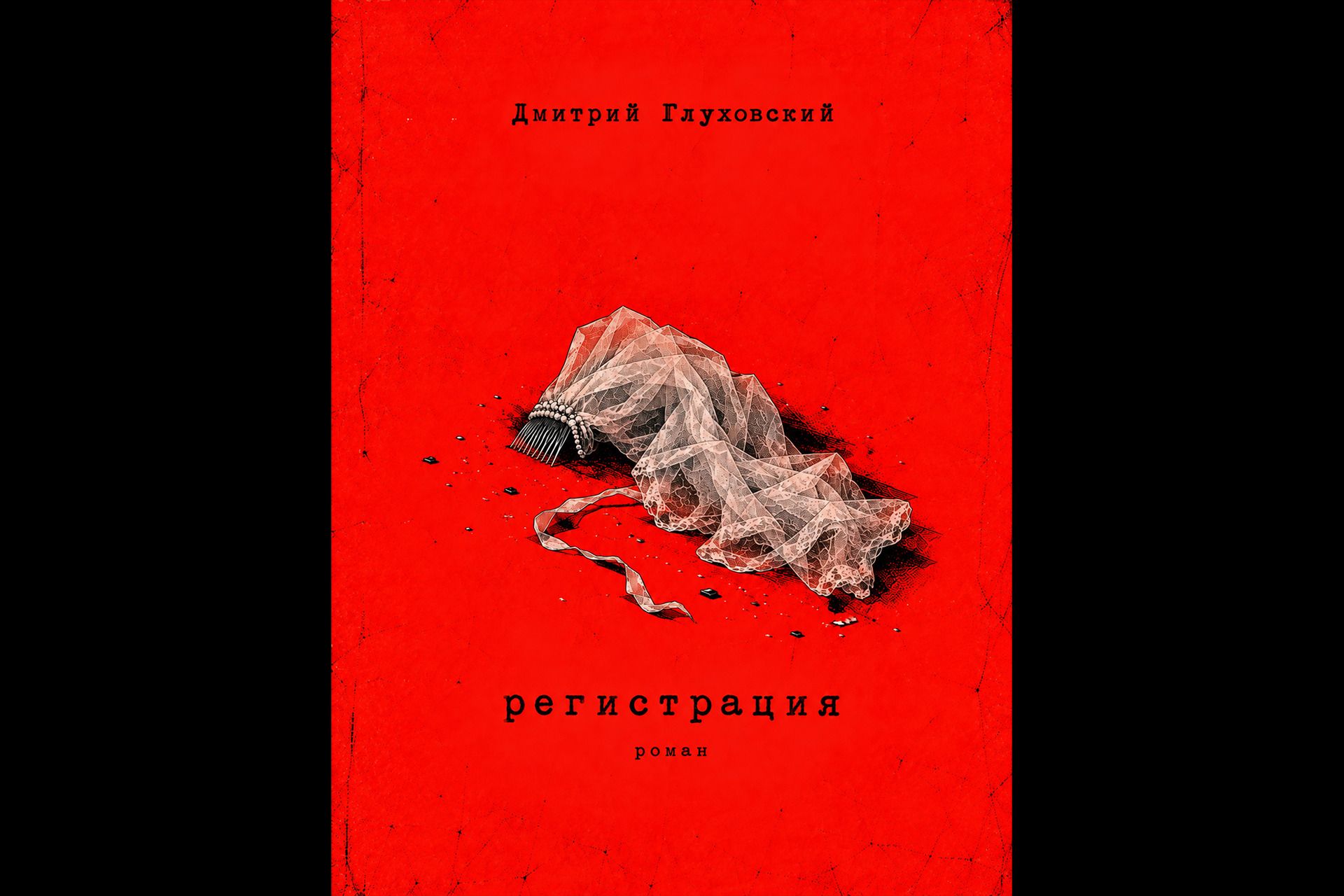
Glukhovsky posted his new novel online for free — as he explained, for those who cannot afford to buy the book. Given that in Russia the books of the writer-“foreign agent” are banned, such readers there now make up the majority.
“Registration” is the first novel about the current war, about how far behind the front line the brutalization (animals, forgive us!) of ordinary people takes place. The war strikes not only legitimate targets — the occupiers — it also strikes those who continue to live their прежней life in the same place, go to their old job and have no intention whatsoever of even touching a weapon.
“Registration” is a novel about a war in which there is no war as such. It rumbles somewhere far away, beyond the pages, but even a thousand kilometers from the front line it changes everything — family relations, ideas of good and evil, the sense of normality. Glukhovsky writes not about battles, but about people who adapt to war, profit from it, try not to notice it, or use it as a universal excuse. There is no safe distance: war enters a Moscow apartment, a beauty salon in Vologda, a hospital ward, a mother’s love — and every minute puts a person before a choice.
The main heroine of the novel, Ulyana Tsaryova, lives in Vologda and works as an administrator in a semi-basement spa salon. She is thirty, her life irritates her, she does not like her job, money barely suffices, but she wants to see the future like in an advertisement — her own apartment, a family, a child, a vacation by the sea. She endlessly scrolls reels, believes horoscopes, and waits for a miracle that would transport her into another, real life.
That miracle is promised to her by the state — Ulyana’s fiancé, Sasha, went to Ukraine as a contract soldier, where his mother sent him. “A man must earn money, support the family”. By “support the family”, the mother means that with her son’s combat payments she will finally be able to buy the coveted cottage — big, beautiful. True, Ulyana is pregnant by Sasha, and that may complicate the path to the dream. But Ulyana knows: as soon as Sasha returns, they will register their marriage, and then most of the contract money will go to them, and the mother-in-law will have to make do. The only problem is that for six months now there has been no word from Sasha — either he is in captivity or he is dead.
But Sasha is alive; he is in a Moscow hospital, only without legs and with a severe traumatic brain injury. That means Ulyana needs to get to Moscow as soon as possible and get married quickly, otherwise she will never see any money. Ulyana goes to him, stays with a distant relative, Marina, and her husband, Maksim, and proves to the hospital administration that by law the soldier from the “special military operation” must be married on the day the application is submitted. Sasha’s mother, Tatyana, also rushes to Moscow — she needs to get ahead of the potential hated daughter-in-law, otherwise the cottage will remain only a dream. The struggle for the state-promised payment becomes the central knot of the plot, and Sasha himself — the tragic center of the novel.
The Moscow line — the family of distant relatives with whom Ulyana is staying, educated people who understand the injustice of the war — initially runs parallel to the line of the main heroine. The girl believes television, repeats poster slogans about defending the fatherland, about Ukrainians bombing Donbas, about the sacred mission of the Russian army. Maksim’s attempts, as a particularly fervent opponent of the war and the Putin regime, to bring Ulyana to some kind of analysis run into her deaf irritation and do not shake her faith in television one iota.
It is interesting that Glukhovsky does not give the reader the chance to sincerely sympathize with these people, although, it would seem, they say the right things, their position is backed by knowledge, and Maksim, the owner of a bookstore, even dares to stand up to rabid patriots demanding that the books of foreign agents and “terrorists” be thrown out. The author carefully, unobtrusively deprives them of moral privilege.
Yes, they are opponents of the regime, but their goal is to sit out the bad times and preserve their привычная life without paying any price for their position.
Maksim’s demarche — his refusal to throw out the wrong books — is more of an outburst of irritation, a fit, a small protest by a small intellectual man, and this protest quickly fades when it becomes clear that it is about to bring real trouble. Glukhovsky does not condemn them and even seems to feel something like sympathy and compassion, but quite delicately leads the reader to a thought not obvious to many: in this war there are no innocents. There are simply different degrees of guilt — some went to kill for money, others, through their concessions to evil, keep Russian society afloat in agreement with the first.
There are also third ones — such as 27-year-old Kirill, the son of Marina and Maksim, who in ’22 fled to Georgia via Upper Lars to avoid mobilization, but soon returned because “my crowd is here” and you only live once, and besides, he was offered a good position in a large bank. Pumpkin latte spills over the rim. As a result of Ulyana’s efforts, angered at this family of traitors, Kirill will choke on the drink, which symbolizes today’s widespread philosophy of “life goes on”.
Before our eyes, Ulyana turns from a victim of propaganda and her own credulity into a predator insisting on her right to dispose not only of the “death payments” but also of the fates of the people who tried to stand in her way. Her resentment toward the family that sheltered her is not just annoyance; it is a class hatred that has risen from somewhere deep inside and devoured all the human and humane things that remained in her. She manages to ruin these people’s lives — casually, without any plan — simply because in today’s Russian society, saturated with discontent, this is welcomed and encouraged.
The distant war ricocheted off the dormant basest instincts. War maims souls in ways no body ever could.
Registration is not only that very stamp in the passport for which the heroine fights furiously, arranging a marriage with a dying man. Registration is assigning each person their role and their price. The state recognizes a person through paper, an entry in a database, a status, a certificate. Otherwise, you are nobody. But war also “registers” everyone, assigns them a role and a price — quickly, almost instantly all the characters move into a new quality. Sasha turns into a hero, a disabled man, the deceased, and the “death payment” with which his loved ones will be able to fulfill their desires; Ulyana instantly moves from the category of bride to the category of widow, Tatyana from simply the mother of a young man to the mother of a hero. Each has their own function, their own entry in the corresponding register.
Formally, the dream came true — Ulyana becomes the owner of the business, gains independence, and prepares to give birth to a son. But money does not bring the freedom she expected. It only closes the circle of her desires and leads to the same humiliation the girl experienced at the very beginning, when she was not yet the well-provided widow of a hero of the “special military operation”.
Glukhovsky shows not just Russian society during wartime — he shows a mechanism of moral degradation, and not only of the “deep” people, but also of those who until recently took to the streets and today are ready to reconcile themselves to one degree or another.
Violence spreads not only through orders and propaganda. It penetrates private life through compromise, fear, poverty, ignorance, dreams of wealth, for the sake of which one can send one’s own son to war or secure the registration of a marriage with a half-corpse. The large state machine is reproduced in small human decisions.
Glukhovsky works magnificently with language. His authorial speech adapts to the consciousness of the characters; he tells each person’s story in their own language, as if eavesdropping on their thoughts and transmitting them to the reader, only without quotation marks. Language is a very strong part of the novel; Glukhovsky is excellent at showing the clash of ideas through their everyday existence — at a family dinner, in a conversation about payments, in a queue, in correspondence, in short dialogues with officials. Admittedly, the density of the language can at times be tiring, but even in that weariness there is its own truth — as you work your way through the thickness of the speech, you sink deeper into the character’s consciousness.
“Registration” captures the moment when war stops being perceived as an emergency and becomes part of everyday life. This is a harsh, unsettling novel not about how people support or do not support war, but about how war gradually yet steadily settles inside a person and, hundreds of kilometers from the front, controls people like Karabas-Barabas controls his puppets. But, as it turns out, puppets are also capable of controlling Karabas-Barabas — they just do not realize it themselves.
If you enjoyed this article, consider making a donation — one-time or, even better, monthly. Your support helps us motivate our authors and become better with every article.
Our organization is recognized by the Internal Revenue Service (IRS) as a 501(c)(3) tax-exempt, charitable organization, which means that all contributions made to us are tax-deductible to the fullest extent permitted by U.S. law. Individuals may generally deduct charitable contributions of up to 60% of their Adjusted Gross Income (AGI) for cash donations made to qualifying 501(c)(3) organizations. For donations of appreciated assets (such as stocks or other long-term capital assets), the deduction is typically limited to 30% of AGI, based on the fair market value of the asset. C-corporations may deduct charitable contributions of up to 10% of their taxable income for donations made to eligible charitable organizations.
By submitting a donation, you confirm that you have read and accept the following documents: Privacy Policy and User Agreement, and also give consent to the processing of your personal data.
If you would like to unsubscribe from a monthly donation, please email us at: [email protected]