U.S. President Donald Trump signed the law on “hellish sanctions” against Russia on Friday, September 18. The law also took effect on that date. But are these sanctions really so terrible? Or is this just another declaration of intent without an effective enforcement mechanism?
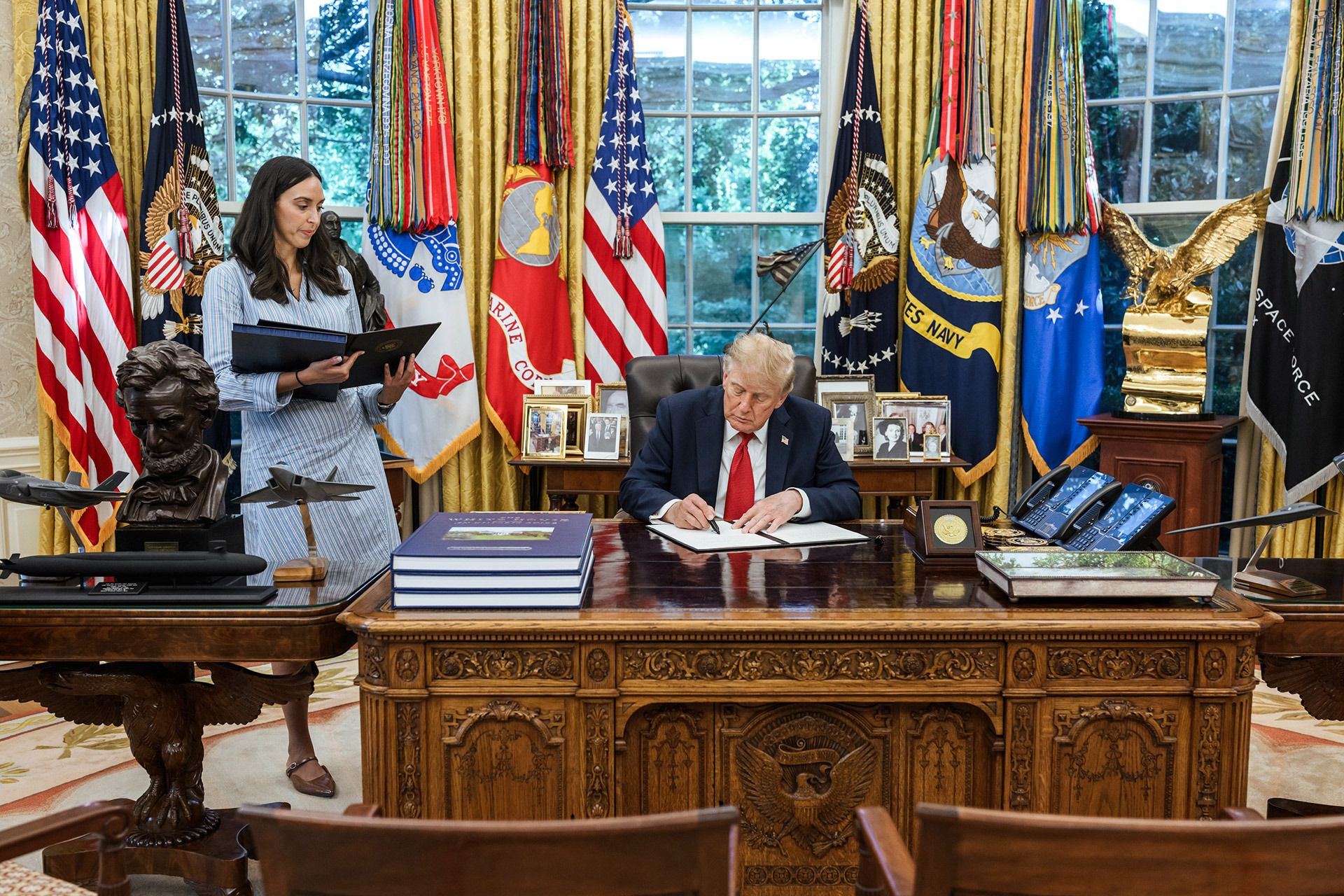
U.S. President Donald Trump signs Senator Lindsey Graham’s sanctions bill against Russia and Iran, September 18, 2026. Photo: White House website
The U.S. law on “hellish sanctions” against Russia (officially titled the “Lindsey O. Graham Act on Sanctions Against Russia and Iran”, with Iran added at Trump’s insistence) was approved by the Senate on August 7, and on September 16 it was passed by the House of Representatives, which had returned from summer recess.
Why is a separate law needed?
Right now, sanctions (and not only in the U.S.) are introduced through one-off packages. For example, in the U.S., OFAC (the Office of Foreign Assets Control within the U.S. Treasury Department) proposes new targets for sanctions, guided by a range of different factors — political will, resources, negotiation tactics — where the effectiveness of sanctions relative to the main goal, ending the war, may not matter all that much. Sanctions are proposed in packages and usually as a retaliatory and demonstrative measure: ahead of allies’ summits, in response to Russian escalation, etc. At the same time, Trump, whom critics in the U.S. have nicknamed TACO (“Trump Always Chickens Out”), still shows confidence that Putin can be tempted by a “good deal”. Apparently, that is precisely why, before every negotiation with the Russian side, he has so far been slowing down the introduction of new sanctions.
Now all actions are spelled out in the law: within 30 days of its signing — that is, by October 18 — the U.S. administration must approve and put into effect most of the key packages of restrictions and tariffs. During this time, the White House must compile specific sanctions lists, which will include Putin and other significant figures in the Russian leadership, major banks (including Sberbank, VTB, and Gazprombank), the “shadow” fleet transporting sanctioned Russian oil, as well as foreign companies and states that continue to buy Russian oil while ignoring the established restrictions, including the price “cap” ($60/barrel under U.S. sanctions).
Within the same 30 days, the U.S. president must impose tariffs on Russian goods — including oil, gas, petroleum products, petrochemicals, and coal. Rates can reach up to 500% of their market price. Every 180 days (for banks, the first cycle is 210 days), the U.S. president must review the sanctions list: identify everyone who meets the criteria — new “shadow” fleet vessels, banks conducting transactions with Russia, suppliers to the Russian military-industrial complex — and impose sanctions on new violators (as well as remove those who have mended their ways from the list).
Most of these measures must formally be imposed by the president, but the law explicitly requires him to do so within the specified deadlines. At the same time, the White House retains significant freedom in applying certain measures — in particular, in determining the size of some tariffs and using the exceptions provided for by the law
The most important thing is that, unlike a presidential decree or an OFAC decision, the law is very difficult to repeal: to do so, both chambers of parliament would have to approve its repeal again.
In this respect, it is similar to the notorious Jackson-Vanik amendment: adopted as an amendment to the Trade Act in 1974 in response to the Soviet Union’s ban on Jewish emigration, it was repealed only in 2012, when there was no longer either the USSR or exit visas, and its authors had already died. With the collapse of the USSR, the amendment’s application was suspended, but revising the law was too much trouble. In the end, the U.S. repealed it only when it passed the Magnitsky Act.
That is, the “hellish sanctions” are here for the long haul. Although their content may change.
Flexible tariffs
The key point here is that all tariffs provided for by the law have the prefix “up to”.
Thus, the U.S. president may impose tariffs of up to 100% on goods from the five largest countries buying Russian oil and gas (including China and India) for new purchases. It is obvious that for China, whose leader Trump is meeting in the coming days, the conditions will be softer than for India. Fortunately, unlike China, the latter has no land border with Russia, while the country has become the largest producer of petroleum products from Russian oil — which, incidentally, it supplies to the EU and thereby helps the Russian regime bypass European sanctions.
By the way, some EU countries may also fall under the “hellish sanctions”.
Thus, Hungary is already asking not to be punished for buying Russian oil, promising to give it up in 2027, together with the rest of the European Union members. And Serbia continues to fight for permission to buy oil for the country’s only refinery, owned by NIS, which Gazprom Neft still has not managed to sell outright to Hungary’s MOL.
The U.S. president can also impose tariffs on Russian goods of up to 500%. At the same time, Russian enriched uranium, which the U.S. still buys from Russia, is regulated separately by the law: the document contains a special section on uranium imports from Russia and sanctions against Rosatom. In principle, trade turnover between the U.S. and Russia is so small that even an increase of almost a quarter in the first half of the year amounts to less than $4 billion. So tariffs on Russian goods are unlikely to have much impact on American consumers. In the end, apart from fuel for nuclear power plants, the main items of Russian exports to the U.S. are mineral fertilizers and metals. For these, unlike nuclear reactors, which are built for specific fuel parameters, alternatives to Russian supplies do exist.
Who will get which tariffs and how much we will learn in less than a month. For now, we can say for sure which Russian sectors they will hit the hardest.
Shadow banks, shadow fleet
First of all, ordinary citizens may feel the impact of sanctions through banking operations. The law provides for sanctions against Sberbank, VTB, Gazprombank, and other Russian financial organizations with state participation. It separately provides restrictions against foreign financial organizations that carry out significant transactions with them.
The practice of previous sanctions shows that initially most foreign correspondent banks freeze all transactions just in case. The “freeze” can last for months, and it may never end: for example, after December 2023, Joe Biden’s decree on secondary sanctions against banks conducting transactions in the interests of the Russian military-industrial complex, China’s largest banks simply shut down any work with Russian transactions. But over time, settlements were restored — transactions began to be routed through small regional banks, through chains of intermediaries in Hong Kong, the UAE, and Central Asia. VTB even has its own Shanghai branch, through which the bank processes payments, including for sanctioned goods. Finally, an entire network of payment agents emerged — for example, Sber processes small payments through private individuals in Tajikistan, etc. In supplies of Russian goods, barter (India) and crypto are often used.
It should be expected that this time too the first reaction will be the cessation of any Russian transactions through foreign banks. However, there is also a difference: any newly established channel can be shut down after six months, with an update to the sanctions list. This is unlikely to stop the same purchases of drone components from China or missiles from North Korea, but for the business of importers and citizens who still manage to move money out of Russia, this may become a problem. Especially for large fortunes: it is no coincidence that this year the capital outflow abroad has doubled. In addition, the law prohibits working with any banks with state participation, not just those included in the Treasury’s SDN list. That means the loophole for transferring funds through small regional banks will also be closed.
For the Russian budget and oil companies, the new measures against the “shadow” fleet are also important. Right now, to add a vessel to the sanctions list, it is necessary to prove that it is actually transporting not just Russian oil, but oil sold above the “cap”. Direct proof means finding the relevant documents, but to do that you have to seize the vessel and find those documents on it. However, seizing a vessel that is not on the sanctions list is fraught with legal problems. Therefore, indirect evidence is usually used: ship-to-ship oil transfers at sea, transponder shutdowns, fake insurance. And these pieces of evidence must hold up, while tanker owners constantly re-register vessels to new shell companies, changing both the name and the call signs in the AIS automatic navigation system. As a result, a vessel may be under EU or UK sanctions but absent from the U.S. list, and vice versa.
Now, if a vessel is included in at least one sanctions list of Western countries (the EU, the UK, Canada, Australia, New Zealand, Japan), this automatically means it is included in the U.S. sanctions list. Now OFAC no longer has to gather evidence, which takes several months, but the shipowner has to prove that he is not a camel.
Of course, Russian transactions will not disappear, and shadow tankers will not stop sailing, but everything will be slower, riskier, and, most importantly, more expensive, because no one has отменed the price of risk.
India, too, is likely to reduce its purchases of Russian oil and, above all, will now demand a discount. And if Russian oil is currently trading even at a premium to the benchmark (Brent), then after October 18 discounts may return — and possibly substantial ones. Already on Monday, Finance Minister Anton Siluanov said that next year’s budget is being drafted with a planned price of $50/barrel — effectively half the current level. This may be prudence in anticipation of the “hellish sanctions”.
All that remains is to hope that Trump will direct all his efforts not toward trying to placate Vladimir Putin, but toward speaking from a position of strength. And if not — there will be other presidents. After all, these sanctions, as already noted, are with Russia for the long haul.
If you enjoyed this article, consider making a donation — one-time or, even better, monthly. Your support helps us motivate our authors and become better with every article.
Our organization is recognized by the Internal Revenue Service (IRS) as a 501(c)(3) tax-exempt, charitable organization, which means that all contributions made to us are tax-deductible to the fullest extent permitted by U.S. law. Individuals may generally deduct charitable contributions of up to 60% of their Adjusted Gross Income (AGI) for cash donations made to qualifying 501(c)(3) organizations. For donations of appreciated assets (such as stocks or other long-term capital assets), the deduction is typically limited to 30% of AGI, based on the fair market value of the asset. C-corporations may deduct charitable contributions of up to 10% of their taxable income for donations made to eligible charitable organizations.
By submitting a donation, you confirm that you have read and accept the following documents: Privacy Policy and User Agreement, and also give consent to the processing of your personal data.
If you would like to unsubscribe from a monthly donation, please email us at: [email protected]