In the first days after news of the massacre in El Fasher, many residents of Israel and foreigners in solidarity with them asked a naive question: where is the world looking? Where are the UN resolutions, the condemnatory articles by leading journalists, and the flash mobs featuring Hollywood stars, as happened during Israel’s Iron Swords war against Hamas terrorists? But these outcries are as naive as they are pointless.
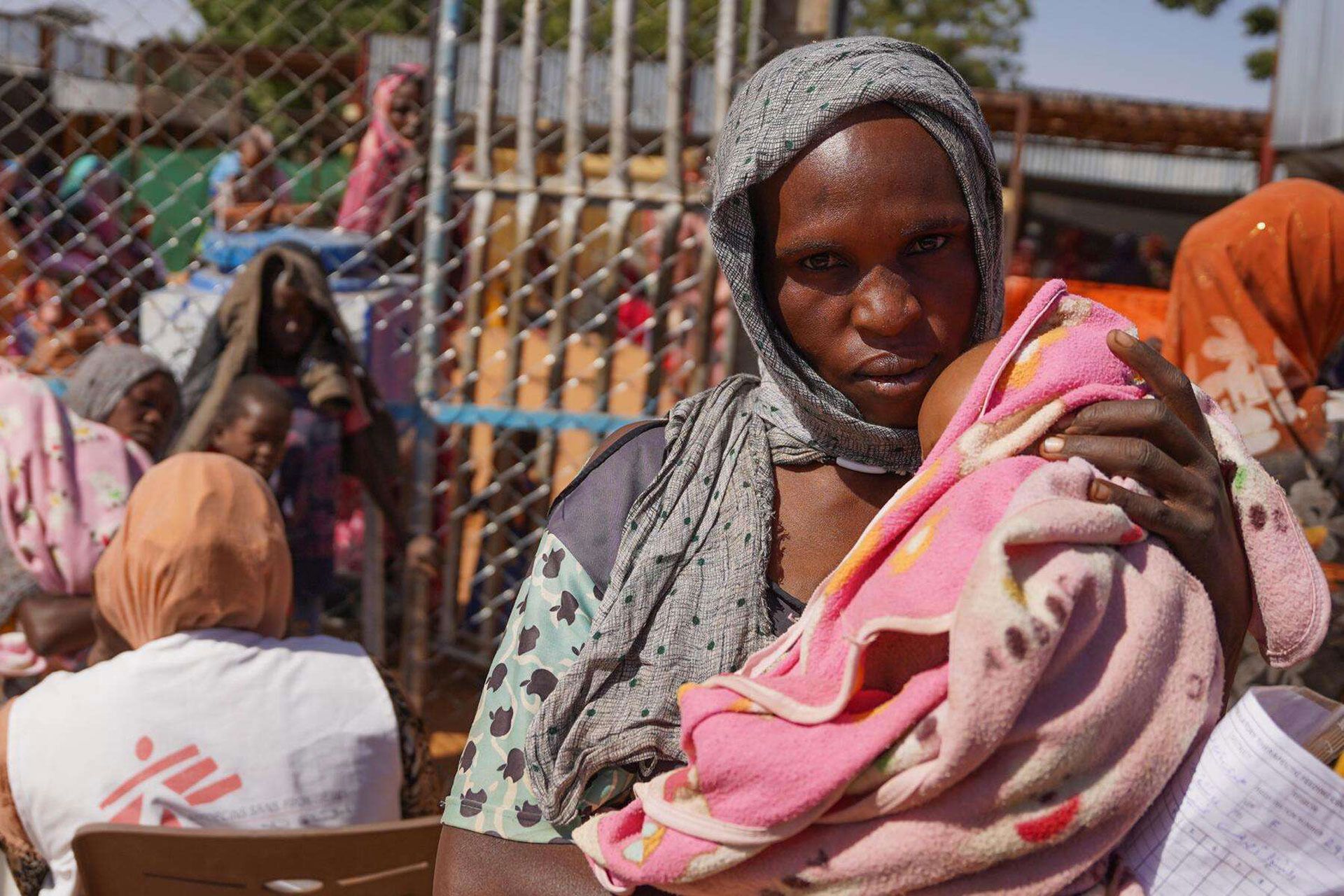
Photo: doctorswithoutborders.org
At the end of October, researchers from Yale University published news that, under other circumstances, could have shocked the whole world. Scientists, analyzing satellite images of the planet, “discovered” mass killings in the city of El Fasher in western Sudan. The cameras revealed huge dark red stains, numerous motionless bodies, and no signs of life on the streets.
There could be no mistake. This monstrous discovery coincided in time with reports from Sudan’s peculiar political life: for the past two and a half years, the country has been embroiled in civil war. In October 2025, rebels from the “Rapid Support Forces” captured El Fasher from the forces of the nominally legitimate government after a fierce, months-long siege. The images studied at Yale only confirmed what the defeated side had already claimed: over 2,000 civilians were killed in El Fasher.
It’s harder to understand who exactly serves in the RSF and their opponents. What do they fight for? Who helps them from abroad? What’s in it for them? And why is the rest of the world so indifferent to Sudan’s catastrophe?
The Yoke of Independence
Sudan is a clear illustration of the idea that a country’s greatness isn’t measured by statistics. The country is vast (even after South Sudan’s secession in 2011, it remains the 15th largest in the world), rich in minerals (gold, oil, copper, chrome), and has a strategic location (a broad outlet to the Red Sea, connecting the Indian Ocean to the Mediterranean). But by all human development indicators, it is among the most troubled even by Africa’s modest standards.
In almost all key global rankings—GDP per capita, HDI, corruption perception, press freedom, etc.—the East African nation is consistently among the bottom ten or twenty. In 70 years of independence, Sudanese have endured over 30 coup attempts, rewritten their constitution six times, lived twice under unchanging dictators, lost 20% of their original territory, and are now experiencing their third protracted civil war. What ruined Sudan?
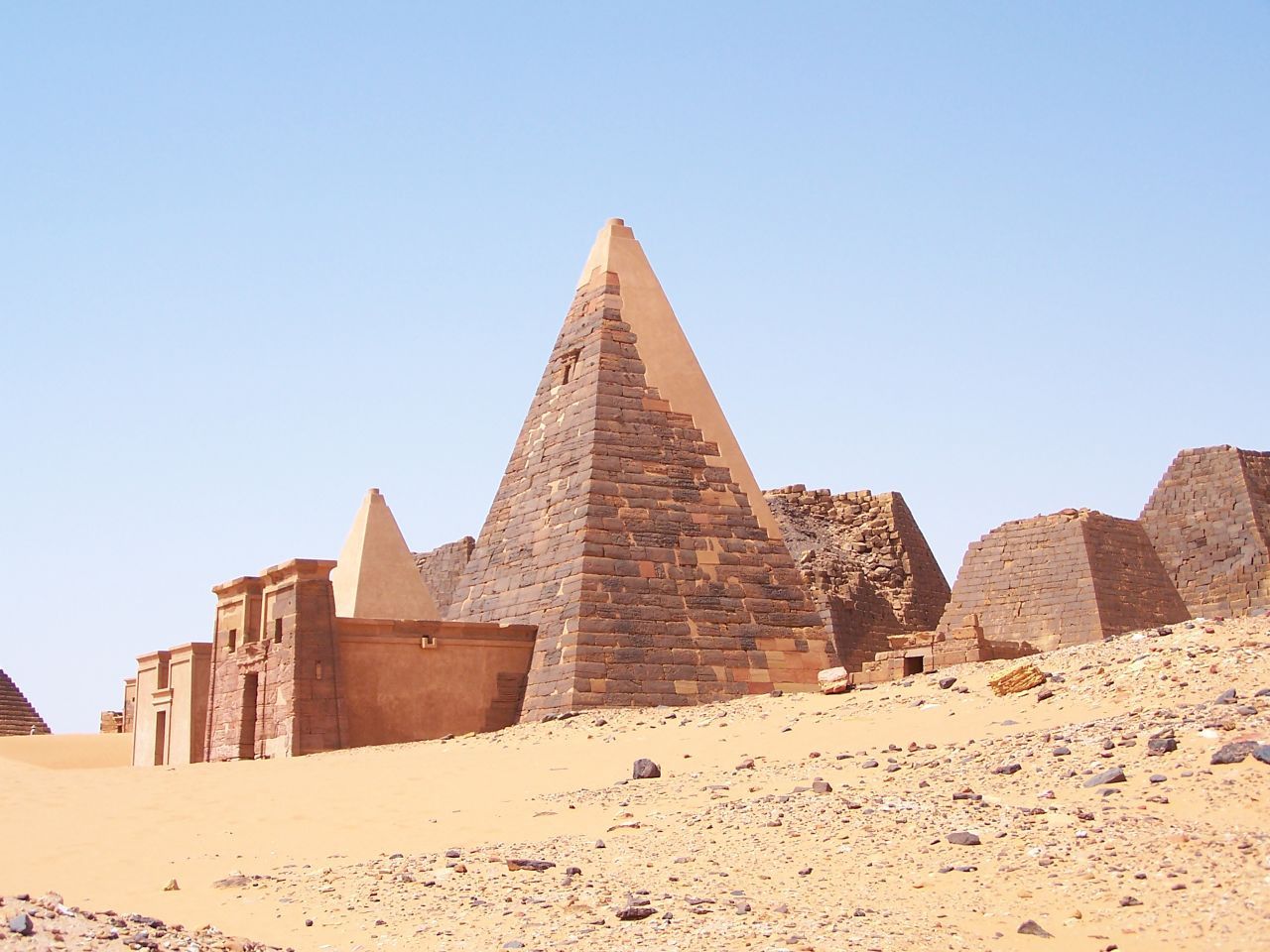
The Meroë Pyramids, built at the beginning of the 1st millennium BCE, are one of many traces of Sudan’s rich past. Photo: Wikipedia / Fabrizio Demartis
The country’s vast borders, like those of most of its continental neighbors, were not formed by the natural development of local peoples, but by European colonization. From 1899 to 1956, the British ruled here, formally declaring Sudanese lands a joint condominium with Egypt. The British knew that the population of this conquered giant territory was not homogenous. In north-central Sudan, Arabic-speaking Muslims predominated, while in the peripheral regions, dark-skinned native ethnic groups, usually animists (Dinka, Nuer, Beja, and many others), were the majority.
From 1924, the British, in the spirit of divide et impera, deliberately isolated Arabic-speaking Sudanese from the indigenous animists. The latter were encouraged to adopt Christianity and learn English, while the Muslims were largely left alone. By the 1950s, two dissimilar “proto-nations” had emerged in one country, each a complex amalgam of tribes and clans. Northerners were united by Islam and Arab culture, while the periphery’s residents shared a more African appearance, English language, and Christianity mixed with traditional cults.
During decolonization, British officials wondered whether such different Sudanese could coexist in a sovereign Sudan. The Arabized northerners were more numerous (about 60–70% vs. 30–40%), wealthier, and better educated than the periphery. The colonizers reasonably feared that the former might simply enslave the latter in the new state. In the late 1940s, the British seriously considered handing the southern regions to culturally close Uganda, but later decided that autonomy within a united Sudan would suffice for the problematic territories.
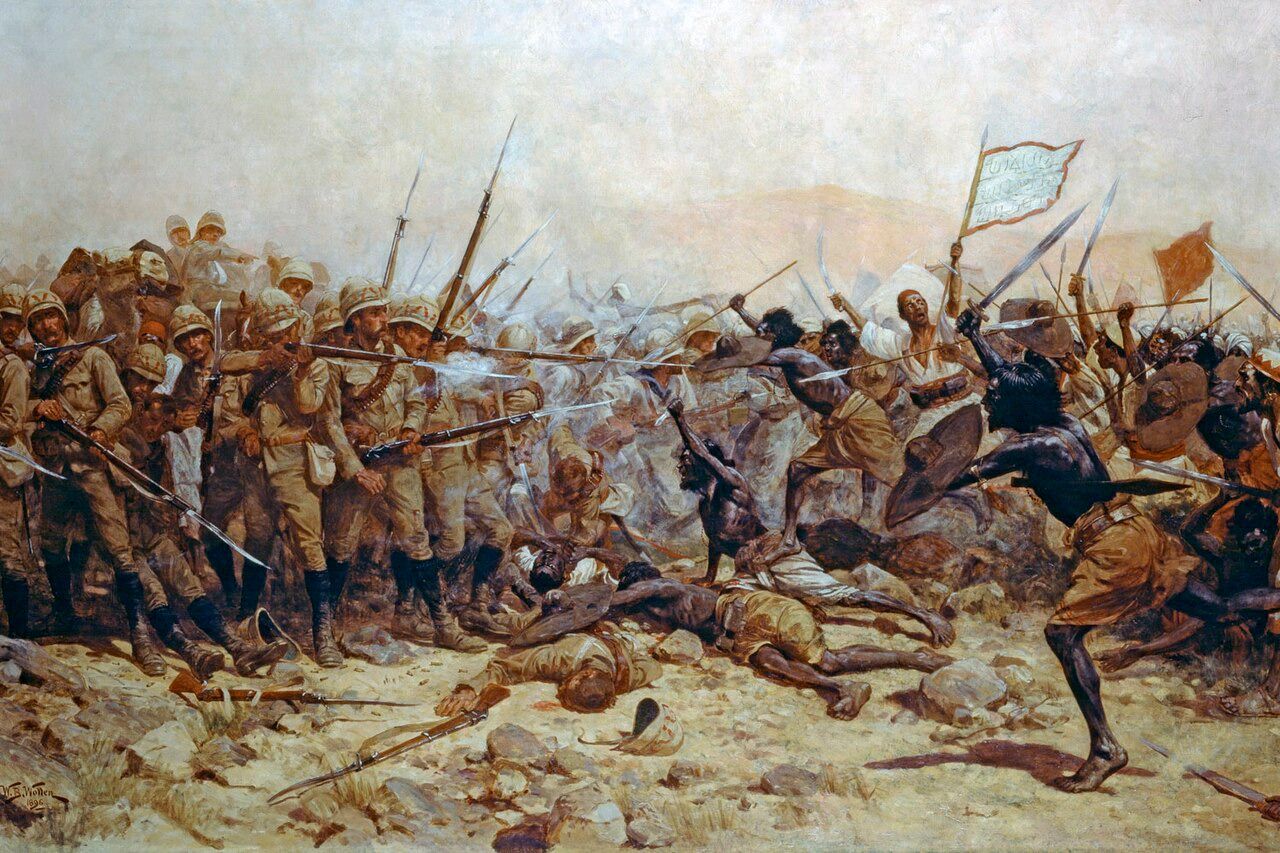
The Battle of Abu Klea in 1896—one of many episodes of Sudanese Muslim resistance to the British colonizers, known as the Mahdist Rebellion. Image: Wikipedia / William Barnes Wollen (1936)
On January 1, 1956, the former condominium finally declared itself an independent republic. Northern clans began dividing power through endless coups and government crises. Meanwhile, the Arabized elites reminded the indigenous peoples that they were now second-class citizens, with no special rights for the South, and that the empty promises from fleeing British should be forgotten. The southerners expected as much: the first uprisings among Christians and animists broke out even before the colonizers left, and in the 1960s, clashes turned into a full-blown civil war.
The southern rebellion didn’t interfere much with the constant coups in the northern capital, Khartoum. Finally, on May 25, 1969, the Sudanese got a strong autocrat—General Jaafar Nimeiry seized power. The new leader understood that the war was at a stalemate and could not be ended by force alone. Negotiations began, and in 1972, in Addis Ababa, Ethiopia, the sides reached a compromise peace. The southerners agreed to stay within Sudan in exchange for autonomy, respect for minority religious rights, and official status for the English language. Of course, this happy ending was entirely false.
Poured Out Alcohol, Broken Promises
The first war between North and South ended in catastrophic losses for Sudan. About half a million people died on both sides, roughly 3–5% of the country’s population at the time. It seemed the northern elites would be forced to recognize their mistakes and give up on forcibly assimilating the periphery’s people.
But intercommunal tensions after the Addis Ababa Accords of 1972 did not disappear. Old prejudices were fueled by climate change. Many regions of Sudan, as part of the semi-desert Sahel macroregion, suffered devastating droughts. Amid Africa’s explosive population growth, the disaster intensified competition for land and water—and, as a result, hostility between the Arabized and indigenous populations.
Nimeiry (left) with the leaders of neighboring Egypt and Libya, Gamal Abdel Nasser (center, in civilian clothes) and Muammar Gaddafi, 1969. Photo: Wikipedia
President Nimeiry’s strange ideological twist played a role. He started his rule in the typical spirit of Arab republics of the time: as a convinced progressive, secular leader, and Soviet ally in the Cold War. But in the early 1970s, Nimeiry quarreled with local communists and, after a series of coups and countercoups, physically exterminated the Sudanese Communist Party. Then the dictator turned to traditional Muslim values—apparently as the only way to consolidate the not-so-united Arabized clans. The real power and wealth in independent Sudan, belonged to the Ja’alin tribal alliance, from the relatively prosperous Nile Valley, which didn’t sit well with people from other regions. Political Islam, in theory, leveled the playing field for all Arabized tribes.
Islamization of the country hit non-Muslim minorities hard, who had only recently been promised the right to live by their own customs. In 1983, Nimeiry abolished southern autonomy and declared the entire state an Islamic republic under Sharia law. The dictator led by example, personally pouring $11 million worth of confiscated alcohol into the Nile. The southerners, to put it mildly, did not appreciate this and rose up in rebellion, sparking the second civil war. Even in the North, not everyone accepted the president’s new eccentricities. On April 6, 1985, Nimeiry’s regime (he was abroad at the time) was overthrown by a group of officers who intended to restore secular rule and reconcile with non-Muslim compatriots.
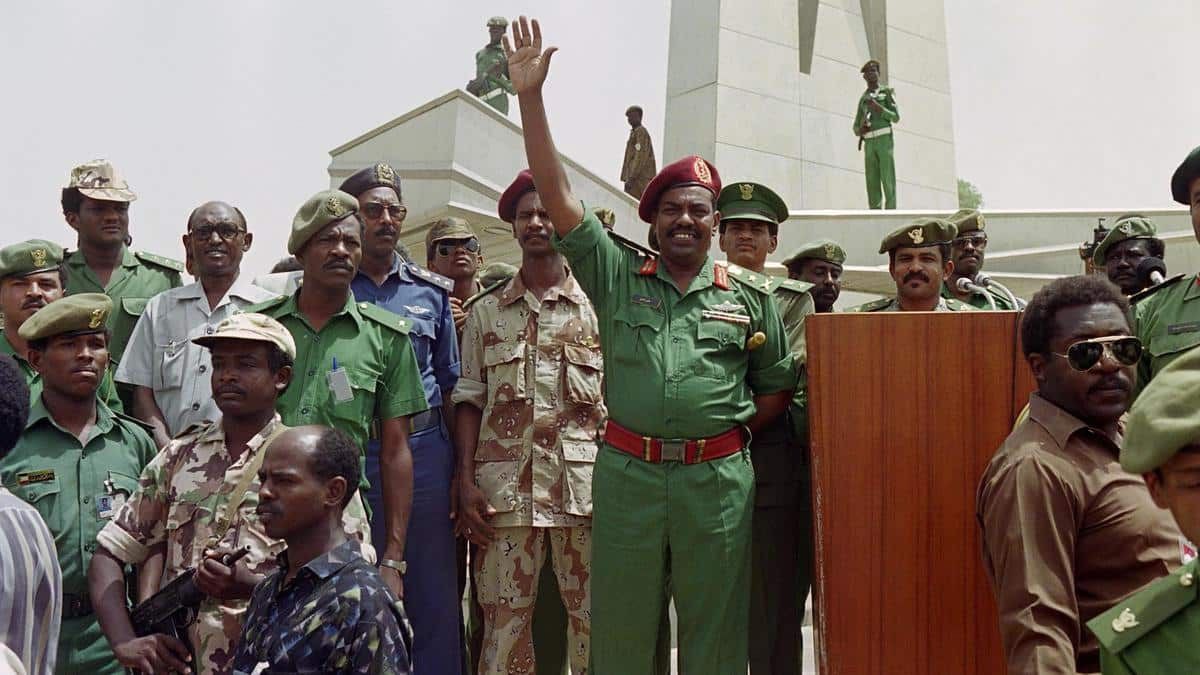
Al-Bashir (center) in the first hours after seizing power, June 30, 1989. Photo: Wikipedia / alrakoba.net
Unfortunately, the conspirators’ good intentions led nowhere. The war in the South continued, and on June 30, 1989, power in Khartoum was seized by a new, even more odious dictator from the Islamist generals—Omar al-Bashir. The military leader immediately declared that “democracy that cannot feed the people does not deserve to exist”, banned everything Nimeiry hadn’t already outlawed, and resumed the campaign against rebellious regions with renewed vigor.
In the 1990s, due to al-Bashir’s ties with figures like Osama bin Laden and Saddam Hussein, Sudan was firmly placed on international blacklists. The new millennium found this potentially rich country, with its mineral resources and strategic location, as a poor pariah with Sharia courts, riven by internal war.
Devils on Horseback
The return and cleansing of the southern provinces became the main task of al-Bashir’s presidency. The new dictator spared no means, so the second Sudanese war, after feeble attempts at reconciliation, quickly descended into a particularly brutal bloodbath, making the 1964–1972 conflict look almost chivalrous by comparison.
Al-Bashir literally assembled a combo of the dirtiest ways to wage war. Government forces used captured Christians and animists as slaves, and conscripted their children into the army. Northerners welcomed fugitives from other African countries—such as Uganda’s “Lord’s Resistance Army” or Rwanda’s “Interahamwe” (the same group that committed the Tutsi genocide in 1994). The separatists—the southern Sudan People’s Liberation Army and its allies—responded in kind, though on a smaller scale.
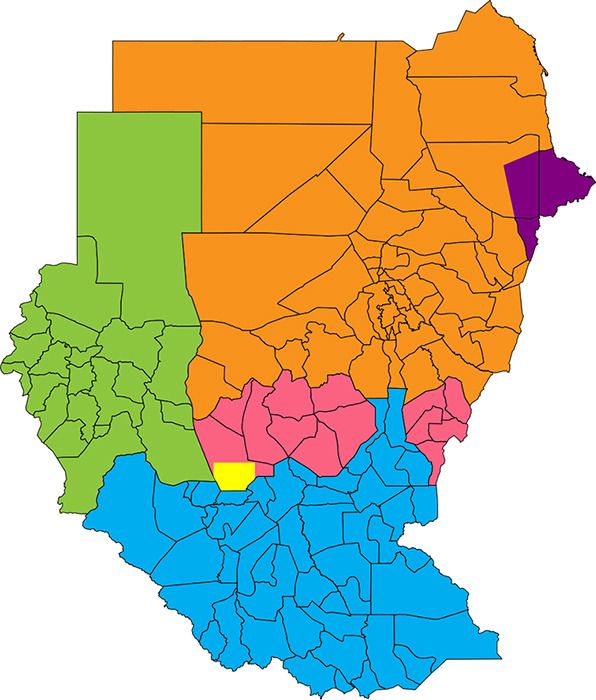
Sudan within its 1956–2011 borders, with problem regions highlighted. Blue shows the Christian-animist South, green shows the Darfur provinces. Map: Wikipedia / Lokal_Profil
By the late 1990s, it was clear that al-Bashir had spilled rivers of blood for nothing. Southerners firmly controlled their regions, and inter-tribal strife had begun in the Sudanese North. In 1999, the president, out of desperation, tried to repeat Nimeiry’s promise of autonomy, but SPLA leader John Garang responded with “you must be joking”—the South remembered the fate of the Addis Ababa Accords from thirty years earlier. Meanwhile, the country’s situation increasingly resembled a humanitarian catastrophe: the number of dead and refugees ran into the millions.
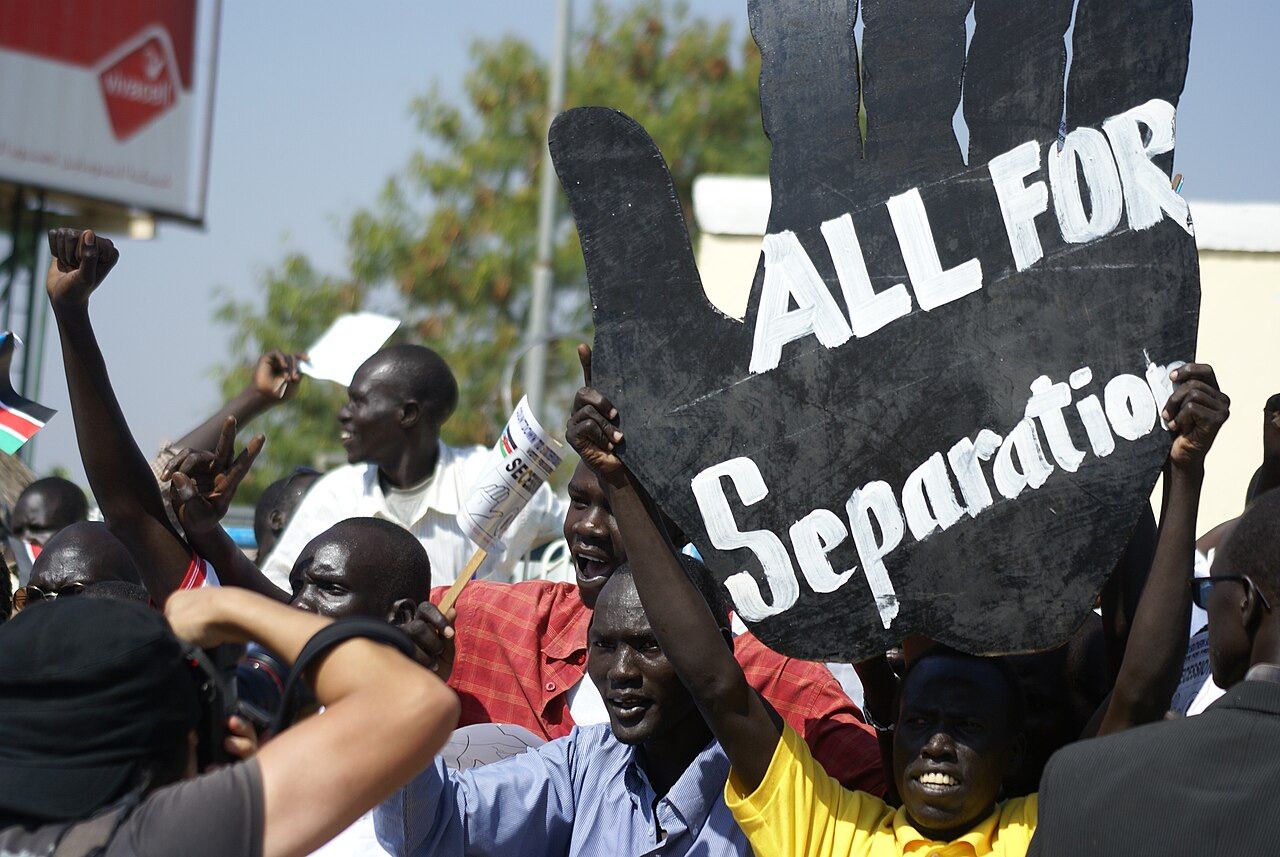
By the mid-2000s, Western sanctions hampered al-Bashir’s ability to continue the war. The international community clearly sympathized with the rebels, and even the Sunni Arab world distanced itself from their discredited co-religionists. Yes, regimes like Iran’s or Belarus’s were willing to sell weapons to Khartoum, but there was nothing left to pay them with. On January 9, 2005, in Nairobi, Kenya, the Sudanese dictatorship admitted defeat: the South became de facto independent in exchange for oil transit payments. From January 9–15, 2011, locals confirmed this choice in a referendum—South Sudan became the world’s youngest internationally recognized state.
South Sudanese campaign for separation from the North, January 2011. Photo: Wikipedia / Al Jazeera English
Al-Bashir could only console himself with the fact that in the 2000s he managed to suppress a new separatist hotspot in Sudan—the western region of Darfur. Unlike the seceded South, this territory is almost entirely Muslim. But when droughts in the Sahel worsened land disputes, it became clear that for local Arabized populations, their Muslim co-religionists from the indigenous Fur, Zaghawa, and Masalit peoples were no closer than the “infidel” southerners. The natives responded to discrimination with armed resistance, and soon volunteers from the rest of Sudan joined their enemies.
In the mid-2000s, pro-government forces in Darfur killed about 300,000 people. Arab militias systematically burned, tortured, raped, and killed members of indigenous ethnic groups. The militia known as the hard-to-translate “Janjaweed”—either “ghost riders” or “devils on horseback”—was particularly notorious. Its core consisted of those with no place in a country ruined by dictatorship and endless wars: members of low-ranking Arab tribes, the landless, pardoned criminals, and demobilized soldiers.
No one tried to stop the “devils.” But at that time, international human rights organizations were at least somewhat monitoring the situation in Sudan, so the Darfur massacre went public. It was easy to establish that “Janjaweed” was backed by official Khartoum. On March 4, 2009, President al-Bashir made history as the first sitting head of state indicted in absentia by the International Criminal Court. However, this had no practical consequences for the already semi-isolated dictator.
Refugee camp in Darfur, 2005. Photo: Wikipedia / Mark Knobil
Al-Bashir didn’t even bother to distance himself from the Darfur butchers—just as, a decade later, Vladimir Putin would publicly encourage Russian army units that killed civilians in Kyiv’s suburbs. In 2013, the Sudanese dictator gave “Janjaweed” the status of Rapid Support Forces—an elite light infantry, autonomous from the regular army. The long-entrenched dictator clearly saw the RSF as his personal guard, able to protect him from Sudan’s inevitable military coups.
Omar had no intention of retiring. In April 2015, he was elected president for the fourth time; these elections remain the last in Sudanese history. The incumbent, as in all previous elections, received over 90% of the vote. But by winter 2019, this popular love had evaporated. Khartoum and other cities were swept by spontaneous protests from citizens driven to despair by hopeless poverty and rampant corruption.
The army top brass and RSF commanders decided that 75-year-old dollar billionaire al-Bashir had served his time. On April 11, 2019, the seemingly eternal president was overthrown by coup-plotting officers. The victors didn’t hand over the former leader to international justice, locking him in a Sudanese prison instead, officially for corruption and the 1989 coup.
Rebellion Against the Rebels
Not only did the RSF not defend the ousted president, but neither did another notorious paramilitary group—the Russian Wagner PMC. Yes, at the time of the coup, some members of the group were in Sudan. The mercenaries trained African soldiers, and Prigozhin’s political technologists prepared the failed 2020 re-election campaign for al-Bashir. In return, Sudanese authorities gave Wagner’s owner access to gold mining.
In the summer of 2017, a subsidiary of one of Prigozhin’s firms, “M-Invest,” was established in Sudan. It was called Meroe Gold, headed by long-time Prigozhin associate Mikhail Potepkin, a St. Petersburg native who previously managed shadow internet projects at the “troll factory.” Now his expertise had expanded—Meroe Gold was engaged in the gold mining business: for example, it owned a processing plant near mines in the northeast of the country
- Ilya Barabanov, Denis Korotkov, “Our Business is Death”
As can be seen, in the 2010s, al-Bashir’s regime partially emerged from international isolation thanks to Sudan’s raw material resources. In addition to ties with Putin’s Russia, Khartoum also restored contacts with the Arab world and built bridges with China. However, diplomatic successes did not save Sudan’s second dictator from an inglorious fall. The new masters of the country were members of the Sovereign (Transitional) Council—a temporary government of military and civilian leaders who could, with some stretch, be called liberal reformers.
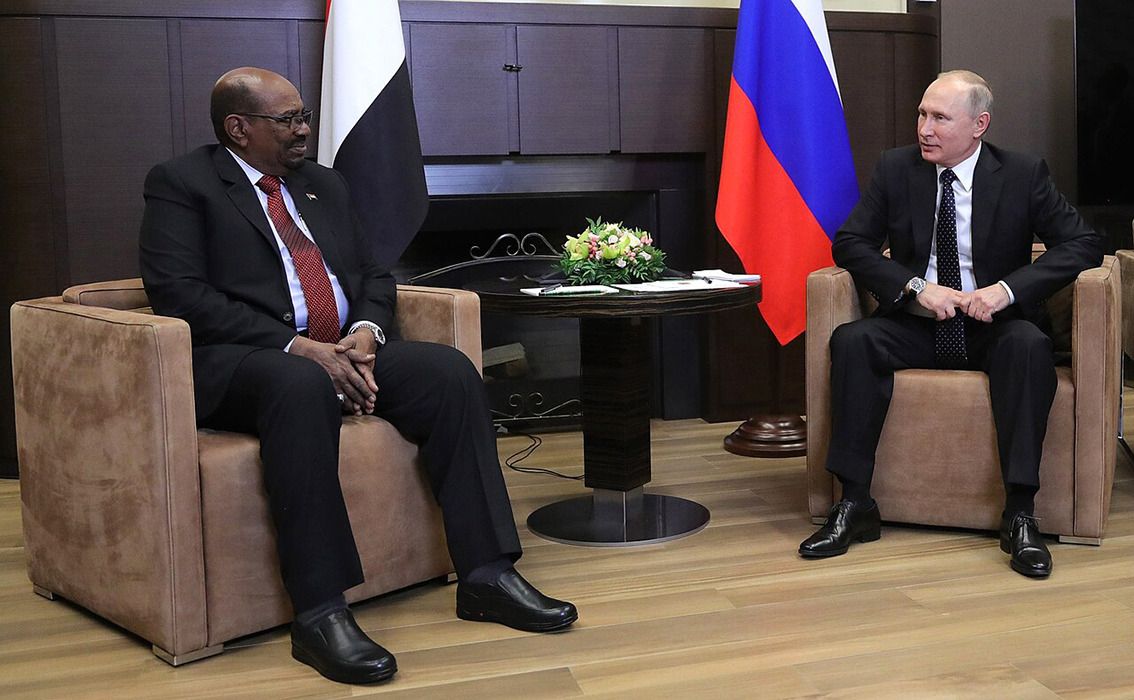
Al-Bashir meeting with Vladimir Putin in Sochi, 2017. Photo: Wikipedia / Kremlin.ru
Council head General Abdel Fattah al-Burhan initially announced a 39-month plan for Sudan’s transition to democracy. The first enemies on this difficult path to the rule of law were, predictably, the so-called liberals. On October 25, 2021, al-Burhan carried out another coup against the civilian politicians who were in his way and turned the Sovereign Council into a military junta. Notably, at the UN, his actions were supported by Russia and China.
It’s hard to say whether this is a coup or not. A coup has a specific definition, and sometimes it’s just a change of power. We need to see. It’s up to the Sudanese to decide whether it’s a coup or not
- Dmitry Polyansky, Russia’s Deputy Permanent Representative to the UN
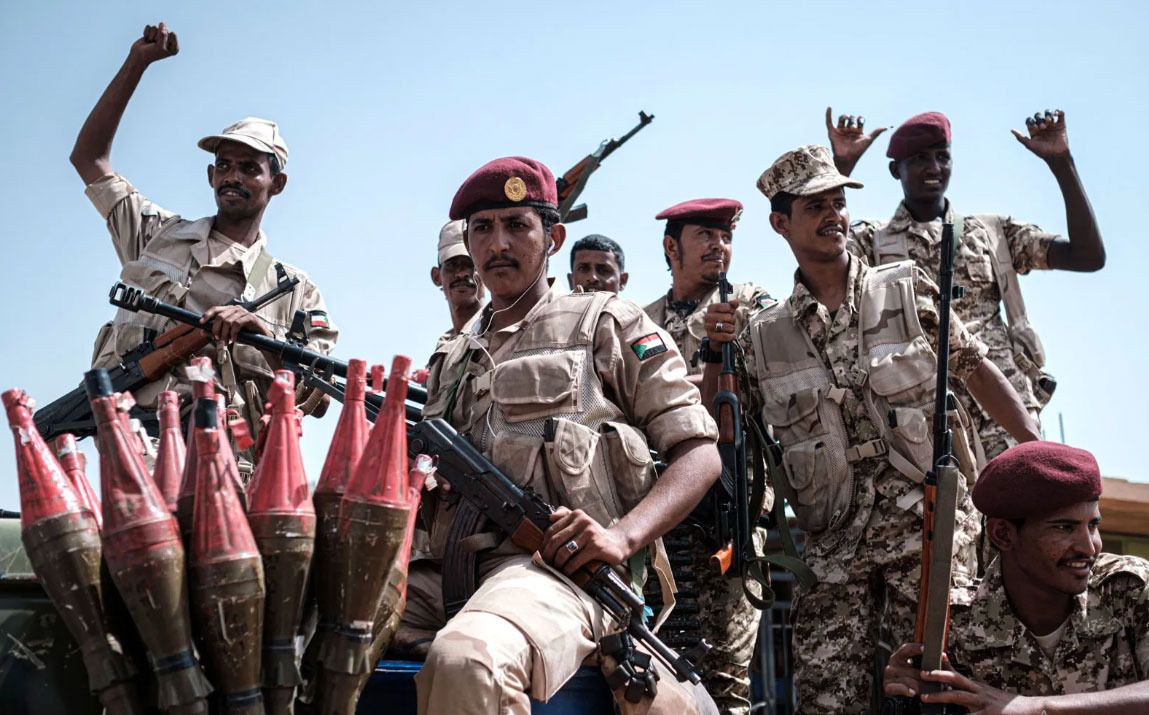
A third dictatorship under an irremovable president loomed on the horizon, but the ambitious general found a worthy opponent in RSF commander Muhammad Hamdan Dagalo, better known as Hemedti. This man, from a poor peripheral tribe and once a camel herder, made his name in Darfur in the 2000s. Hemedti personally took part in the massacres in the west, then turned “Janjaweed” from a gang of marauders into something like a real army and acquired his own gold mines. In the 2010s, the adventurer strengthened his position by making friends in the Gulf monarchies: the UAE and Saudis rented the RSF from al-Bashir for operations against the Houthis in Yemen.
Fighters of Sudan’s Rapid Support Forces, summer 2019. Photo: Yasuyoshi Chiba/AFP/Getty Images
After the 2021 coup, open hostility broke out between al-Burhan and Hemedti. Publicly, the RSF chief accused his rival of sympathizing with the old regime and opposing real secular-democratic reforms. In reality, everyone knew Hemedti was unhappy with al-Burhan’s plan to integrate the former Janjaweed into the army chain of command. Russian readers need no explanation: three years ago we witnessed a similar conflict between Russia’s Defense Ministry and Wagner PMC.
The climax of Sudan’s showdown even coincided in time with Prigozhin’s “March for Justice.” Hemedti’s men launched a rebellion in Khartoum on April 15, 2023, just two months before Wagner’s mutiny. But in Africa, this was a full-blown coup: with gunfire everywhere and piles of corpses on both sides. For the first time in Sudanese history, fighting took place right in the capital’s neighborhoods, chaos reigned everywhere. The mayhem allowed inmates of Khartoum’s high-security prison, including ex-president al-Bashir, to simply escape to freedom.
The burning Kobar Bridge over the Blue Nile. Khartoum, April 2023. Photo: Planet Labs PBC / AFP
After a week of urban fighting, the Sovereign Council’s troops pushed the RSF to the outskirts of the capital, and the rebellion spread to other regions of Sudan. The country’s key neighbor, Egypt, together with Turkey, declared support for the current government, but the rebels also found external partners, and some, more cunning, apparently built bridges with both camps. Thus, in the former British colony, a third civil war broke out.
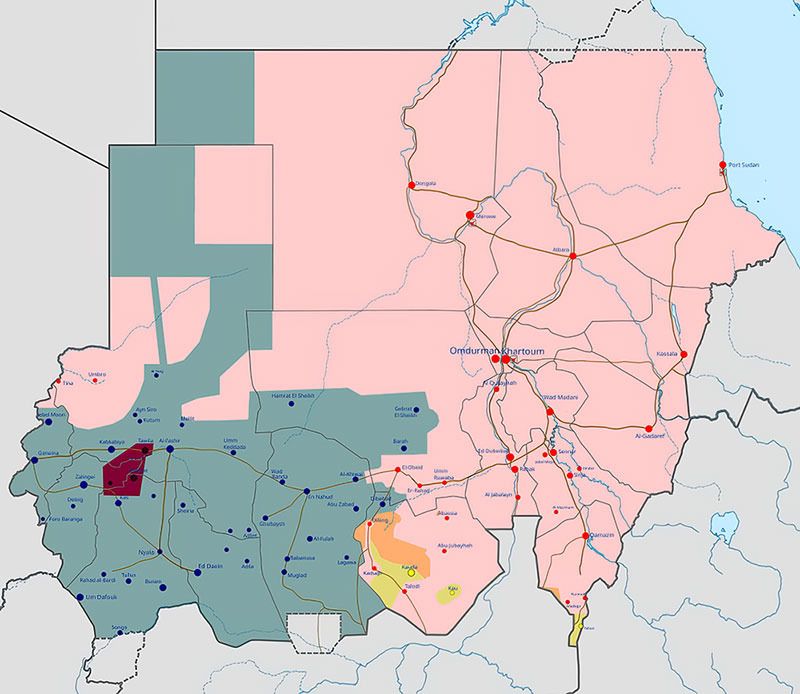
By the end of 2025, the long-suffering republic remains divided, and active fighting continues. Al-Burhan’s junta retains control of the capital and most of the country, including the Red Sea coast. The “Government of Peace and Unity” proclaimed by Hemedti controls the historic regions of Darfur and Kordofan in southwestern Sudan. For a long time, groups allied with al-Burhan held the major city of El Fasher, but last October it too fell—followed by a horrific massacre.
Rapid Internet Response Forces
In the first days after news of the El Fasher massacre, many in the Russian-speaking internet—mainly Israelis and foreigners sympathetic to them—asked a naive question: where is the world looking? Where are the UN resolutions, the condemnatory articles by leading journalists, and the flash mobs with Hollywood stars, as in the days of Israel’s Iron Swords war against Hamas terrorists? But such outrage is as naive as it is pointless.
From the West, Sudan appears as a global backwater, constantly mired in internal strife. Only locals are fighting here, without direct involvement of the “white man.” So there’s not even a place for the fashionable anti-colonial discourse of progressive circles. Only a hopeless enthusiast would be interested in figuring out what the latest Sudanese general, tribal alliance, or mercenary group is fighting for and against whom.
We were divided into groups and beaten. These were truly horrific scenes. People were killed right before our eyes. We saw people being beaten. It was real horror. I myself was beaten on the head, back, and legs. They beat us with sticks. They wanted to execute us. But when we got the chance, we ran, and during that time they detained others, those who were ahead of us
From a conflict studies perspective, the East African republic is a perfect testing ground for civil wars. There’s vast territory, economic backwardness, a predominantly young rural population, and deep-rooted clan and ethnic hostility. Finally, even the presence of gold and oil reserves works against the unfortunate country. A capable field commander, controlling a couple of mines and wells, can easily export raw materials for foreign currency—making war a profitable business. This is exactly the business Hemedti Dagalo is running now.
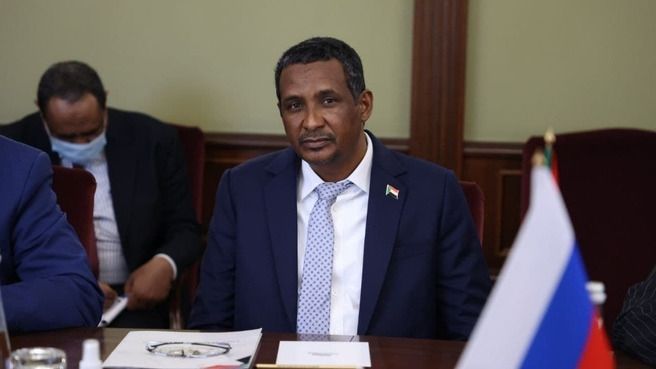
Hemedti at a meeting with a Russian government delegation, February 25, 2022. Photo: government.ru
In the Middle East, it’s no secret who is supporting the Sudanese adventurer from abroad—the UAE business world. Emirati companies control assets in RSF-held territory, and in return Abu Dhabi generously provides its ally with everything needed—including lobbying and propaganda support. There are already known cases where UAE representatives subtly hinted to Western speakers not to publicize Hemedti’s militants’ crimes.
The UAE pressures allies to secure support. In April 2024, this Gulf state canceled meetings with British ministers after London failed to defend the Emirates at a UN Security Council session on Sudan. According to The Guardian, two months later, British officials advised African diplomats to avoid discussing the UAE’s role in Sudan
And when the RSF did something that was literally seen from space, the Emiratis responded with their own campaign. In response to reports about El Fasher, they began telling stories about the crimes of the rival Sovereign Council’s troops. The facts themselves are undeniable: for example, pilots fighting for General al-Burhan regularly bomb enemy-controlled territory, not much caring whether the shells hit military targets or residential areas.
The breakup of the united state in the Third Civil War. Green shows the RSF-controlled zone, pink—the Sovereign Council’s, other colors—territories of smaller groups. Map: Wikipedia
In this media operation, the UAE was supported by official Israeli accounts, directly comparing the Sudanese Armed Forces to the Palestinian Hamas movement. Jerusalem and Abu Dhabi have many shared interests, while the Khartoum junta hardly evokes warm feelings among Israelis. After all, al-Burhan’s regime is largely a creation of Erdogan’s Turkey, with which Israel has had consistently poor relations in recent years. So pro-Israeli audiences must admit an unpleasant truth: in the context of the Sudanese tragedy, it’s not just Western leftists and Hollywood stars who can be accused of double moral standards.
If you enjoyed this article, consider making a donation — one-time or, even better, monthly. Your support helps us motivate our authors and become better with every article.
Our organization is recognized by the Internal Revenue Service (IRS) as a 501(c)(3) tax-exempt, charitable organization, which means that all contributions made to us are tax-deductible to the fullest extent permitted by U.S. law. Individuals may generally deduct charitable contributions of up to 60% of their Adjusted Gross Income (AGI) for cash donations made to qualifying 501(c)(3) organizations. For donations of appreciated assets (such as stocks or other long-term capital assets), the deduction is typically limited to 30% of AGI, based on the fair market value of the asset. C-corporations may deduct charitable contributions of up to 10% of their taxable income for donations made to eligible charitable organizations.
By submitting a donation, you confirm that you have read and accept the following documents: Privacy Policy and User Agreement, and also give consent to the processing of your personal data.
If you would like to unsubscribe from a monthly donation, please email us at: [email protected]