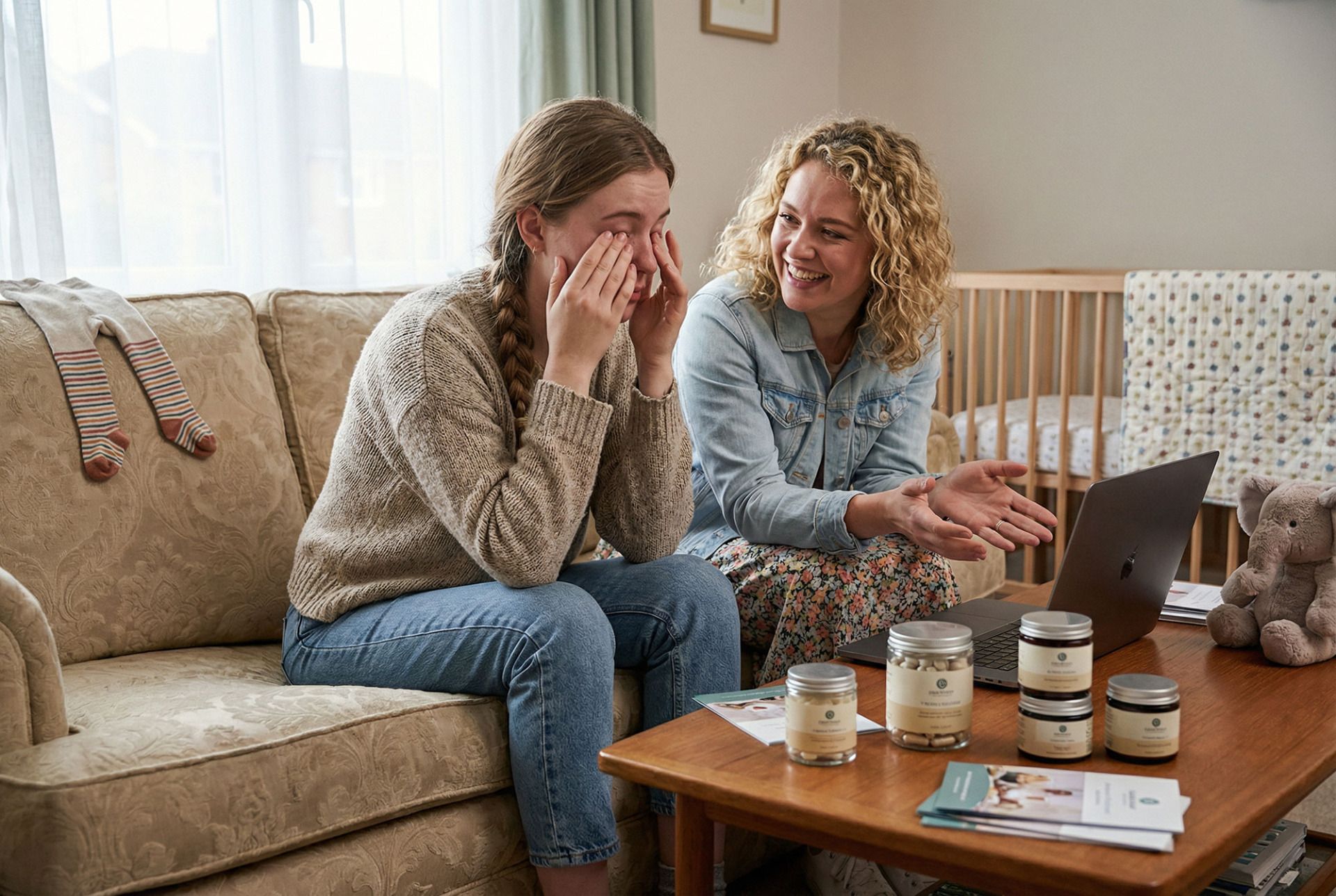
Multi-level marketing has been known in Russia since the early 1990s, when major international players like Herbalife entered the market. In the early 2000s, local equivalents emerged. The Novosibirsk-based NL stands out from competitors due to its significant reputation: some employees say they encountered aggression and manipulation, while others say this is the only company where they found understanding and a source of income. To understand this phenomenon, a Most journalist tried to infiltrate the NL sellers’ community.
Illustration: Most.Media / Google Nano Banana
This material was prepared by the team from the project“Blue Capybaras”, where mentors work with aspiring journalists.
A typical NL store looks like this: white walls, spotlessly clean floor, bright lights, neat rows of boxes and jars of supplements and cosmetics—and beautiful girls with wide smiles recording videos about the benefits of these products for their social media. I come into one of the Moscow stores pretending to be a customer who wouldn’t mind earning some extra money.
Manager Vera (name changed) is happy that our names start with the same letter and that I have the same earrings as she does—she says it’s fate. After hearing my story about having worked as a sales assistant in a tights shop and leaving due to low pay in search of a higher income, she shakes my hand, suggests we use first names—and opens the company app where her earnings are shown. Vera says that in her first months she quickly reached 50,000 rubles a month, and now receives over 200,000, supporting herself and her young daughter alone after a divorce. By the way, she’s also getting her daughter used to NL products—before kindergarten she gives her an energy drink: “It’s like a kids’ formula, only for adults and with vitamins and supplements.” Vera claims she studied medicine, and promises to show me how to mix the drink properly if I buy it.
NL International, the products Vera tries to sell me, is one of five major Russian network companies, founded in the early 2000s in Novosibirsk. Its main competitors (Siberian Wellness, Greenway, “Eltab“ and “Argo“) are also registered there.
It’s not clear why Novosibirsk attracted Russian networkers—companies themselves do not share this information.
NL has production in Novosibirsk, releasing supplements, skincare for women and men, and household cleaning products. The company claims that its raw materials come from America and the EU thanks to French partners (whose names are not disclosed). In 2024, the company’s revenue exceeded 14 billion (more than twice the sales volume of its closest competitor, Siberian Wellness), and profit was 1.7 billion rubles. This makes NL the richest Russian network company in the Novosibirsk cluster.
From the start, the company built its business on the classic MLM (multi-level marketing) model. This means products are distributed by independent distributors: they sell goods and also build their own networks of partners. This forms a chain where each participant’s income depends not only on personal sales, but also on the activity of people they recruited. The main income in this system comes from constantly bringing in new members.
That’s how network marketing works globally, and Russian companies in this segment haven’t invented anything new.
“I tried to prove to everyone: ‘There’s so much money, so many opportunities here’”
“When someone joins a network company,” recalls former NL partner Irina, “they’re told to write a list. The list is all your contacts, anyone you’ve ever known, close or not, to whom you can pitch the idea. Then they’ll work through that list.”
Irina learned about NL back in 2007. She was 23, living in Perm, working as a croupier in a casino for 400 rubles a shift, dreaming of buying her own apartment and saving for a mortgage. One day, a friend called—her former PE teacher from the Perm Pedagogical College, where Irina graduated in 2004. Maria was a couple of years older, and they were close during their studies. “Irinka, how are you? What are you up to now? Anything new?” she asked, inviting her to a meeting, promising to tell her about an earning opportunity. There, it turned out Maria was an NL partner. She brought her mentor to the meeting, introducing her as ‘a serious and businesslike woman.’
According to Irina, NL partners hold the first meeting in a calm atmosphere, having a “heart-to-heart talk.” They start by asking about interests and hobbies, getting to know the person, and then explain how to make life easier and never have to work again.
Her next meeting with NL managers was in the company office. “When you’re invited to network [business], they promise mountains of money, cool parties, and a community of like-minded, ambitious people,” Irina says. She remembers being promised that “your pockets will be bursting with money.”
Payments in NL are not from markups—the product Irina sold was at the same price as on the website or in the store. The main income is from recruitment: the more people you recruit, the more they buy while in your system, the more “cashback” you earn from those purchases.
When Irina started calling all her contacts from the list, very few responded. “I tried to prove to everyone: ‘There’s so much money, so many opportunities here,’” she says.
Irina called over a hundred people, but managed to recruit only nine: “Of course, I got tired after so many rejections. Motivation drops immediately.”
A partner’s income depends on PV, the company’s internal currency, which is credited when NL products are sold—regardless of whether it’s the person themselves or their network buying. According to Irina, payouts were made only for reaching 200 PV in three months. “That was 20,000 rubles at the time. And you’d get your return of 5,000 rubles,” she explains. If you don’t reach the minimum, you don’t get paid.
NL’s internal hierarchy is built on qualifications or a ranking system. The more PV you earn, the more opportunities you get. “For example, this month we’re closing a qualification to go to the company’s birthday. There’s a big party, the president will speak, all the top leaders. And you can’t not go. What, are you going to tell your team you didn’t go? How will you sell if you didn’t go? So, you have to invest money, even though my salary was 16,000,” Irina recalls.
Illustration: Most.Media / Google Nano Banana
She kept buying more company products to reach the required PV level. She even borrowed 30,000 rubles from her parents, hoping the investment would soon pay off. All this was accompanied by calls from her mentor Maria: “Why are you sitting around like a dummy? Get your qualification up, you can make money off them.”
While in NL, Irina thought no one outside the company understood her. “Why do you need your old crowd? They’re dying out because they have no ambition, no development, they live their usual lives. Look at yourself and look at them,” everyone she interacted with in the networkers’ community told her.
According to her, this attitude was “broadcast everywhere,” and mentors and partners constantly convinced Irina of the exclusivity of NL people. She left the company in the mid-2010s.
In early 2026, at the NL store, there’s no obvious intensive recruitment of new distributors at first glance. Vera, who’s walking with me around the sales floor, simply says she “hooked” everyone around her on NL products: from former teachers to her mother, who was initially against her doctor-daughter going into sales. Then she suggests I bring friends and classmates to the store to earn money. Nothing complicated, she says—you just recommend the product, people buy it, and you get a cash return. The only condition is to buy the product for yourself to better understand and recommend it.
We exchange contacts, and Vera asks me to message her if I decide to join the company. As we part, the NL partner—whom I’ve just met—unexpectedly hugs me, as if we’re family or close friends.
“If you’re not ready to be a wolf who deceives, you won’t make money there”
According to Alexey Malakhov, editor of the financial security section at T-J and an expert in fighting fraudsters, the health sector is most attractive to networkers: “First, the entry threshold is zero. To launch a medicine, you need years of trials and a bunch of licenses, but a supplement is basically food. Get a paper saying there’s no arsenic inside—and off you go. You can even sell chalk, call it bio-calcium with silver ions, and legally no one can touch you, because no one guarantees a therapeutic effect in the documents.”
Second, selling supplements is another tool for psychological manipulation. “They sell a clear dream—take a pill and lose weight, become younger, or get cured,” says Malakhov. “If it helps or the placebo effect works, the product is wonderful. Didn’t help? It’s your fault. Didn’t drink enough water, took it at the wrong time, or the classic: didn’t believe enough.”
Malakhovclassifies NL as network marketing, but clarifies that the company uses mechanisms similar to those in financial pyramids. “Pyramids often don’t have a tangible product. Usually, they sell cashback programs, success matrices, or all sorts of crypto stuff,“ explains Malakhov. But even if a pyramid sells a real product, according to the expert, the income from it is about 10%. The main earnings come from the percentage a person gets from the people they recruit.
The similarity of network marketing to pyramids has long been noted in scientific literature.
For example, Central European University law professor Tibor Tajti, in his 2021 work Multi-Level Marketing and Pyramid Schemes, writes that the line between legal network marketing and pyramid schemes is often formal—even if network companies sell real products. MLMs and pyramids are usually analyzed as structurally similar systems based on hierarchical income distribution and recruiting new members. This was discussed, for example, by Israeli scholar Yair Antler in Multilevel Marketing: Pyramid-Shaped Schemes or Exploitative Scams? (2023) or Houston Center for Business Ethics researcher Daryl Koehn (Ethical Issues Connected with Multi-Level Marketing Schemes, 2001).
“If you’re not ready to be a wolf who deceives and walks over others, you won’t make money there,” concludes Malakhov. “That’s exactly why network marketing has this aura of deceit.”
“Just know that you get a percentage from this”
You can become an NL partner not only at their offices, but also online by simply filling out a form on the website. I try this option too. I’m assigned to mentor Svetlana (name changed) from Magnitogorsk. Since childhood, she was told that getting a job at the local steel mill was a great success. Svetlana went to work there. “And then, you know, after a while I’m like: ‘Wait, isn’t this so cool? You can live differently? You can earn money differently? You don’t have to go to work every day?’“ she describes her feelings from her first NL earnings (now she also works as an Insta-blogger-numerologist).
The mentor explains there are two ways to earn—recommend the product and recruit people into the business. She advises taking the company’s free training in a closed Telegram chat. In the first post I see there, it says: “Learn to do the basics yourself, teach your people to do the basics, teach your people to teach their people to do the basics.” The details are explained in a video message from one of the company’s mentors:
“We have a huge number of people in our team, but for some reason this huge number doesn’t know that they’re sitting on a barrel of money. You just need to get up from this barrel, open it, and start sorting through everything stored in it—and in this barrel are your potential partners and your future clients.”
To activate the contract, someone must buy a product worth 70 PV from my ID, about 8,000 rubles. The training advises buying the product yourself and getting to know it—and earning at the same time. But you can’t get real cash back for these 70 PV. They can only be used as a discount on future company purchases.
You’ll get real money when your account has 200 PV (about 23,000 rubles)—this amount can be purchased by the partner or by people they bring in. For this volume, you get 3,640 rubles, plus you can get a discount of 4,270 rubles on future purchases.
After completing the training, I return to my mentor with a question: what if my friends try to talk me out of it? “Look, about support: it’s never there at first. Never... I always say, you know how? ‘Well, damn, it’s not like swinging a shovel’.“ I also worked as an employee,” assures Svetlana. “You have me, I’ll always help you.“.
“Losing my wife to NL. Has anyone experienced this? Please help”
If you search “NL reviews” in your browser, you’ll see hundreds of stories about people trying to pull their friends and family out of this company. Users complain that their loved ones become deeply immersed in the network marketing community, forgetting about the reality around them.
Six years ago, a post was published on Pikabu titled “Losing my wife to NL. Has anyone experienced this? Please help”: a man writes that in 2016–2017, his wife became interested in NL. She was working as a manicurist—“doing nails.” “Apparently, one of her clients got her into this stuff, since none of my wife’s friends were involved in this sect,” the user writes.
After a year and a half, the woman went on maternity leave and started attending NL meetings. According to the man, his wife spent all her free time on social media, listening to “some mentors” and writing down their words in a notebook.
The man suggested his wife open her own nail salon. He had money set aside to buy a summer house or garage, but was ready to invest it in her business if she left NL. The woman refused—and divorced her husband. The author declined to comment: “It was a long time ago, we divorced, and NL played a key role.”
A similar story happened to Evgeny—he also broke up with his wife because of NL (he declined to comment for this publication). In a review published last year, he said his wife had a friend who invited her to NL: “At the time, my wife was on maternity leave, had no official income except child benefits—these are exactly the kind of people greedy and cunning recruiters target.”
Illustration: Most.Media / Google Nano Banana
Gradually, Evgeny’s wife started spending all her free time on social media, writing down mentors’ speeches, and recruiting people into the company. In five years, she “turned into a person who blindly chases her own success.” All attempts to talk ended in failure: “I realized they’d brainwashed her that anyone trying to change the system or pull her out—those are just unnecessary people to be discarded and forgotten,” Evgeny complained.
In scientific literature, these effects are described as a typical feature of MLM communities: participants are told the group is special and outsiders are devalued, which increases involvement and reduces the likelihood of leaving.
According to clinical psychologist and cognitive-behavioral therapy specialist David Baghramyan, the easiest people to recruit into network marketing are frustrated individuals. As an example, he mentions women on maternity leave.
According to the psychologist, women find themselves in situations where they’re dissatisfied with their finances and “they want to earn faster.“ Network companies usually present themselves as a path to quick wealth.
“The person at the very bottom faces the most risks, while the guys at the top rake in the profits”
My own story with NL ends without drama or financial loss. I don’t buy NL products or participate in business chats—I tell my mentor Svetlana that I need time to decide if I want to be a partner. After a month and a half, my status in the personal account changes from partner to regular customer. No one from the company tries to contact me or get me back into the business; I don’t have to spend my money or time calling hundreds of people. But not everyone is so lucky.
Anna and her husband joined NL 20 years ago. Before that, they had their own dance school in Nizhnevartovsk, but business was tough. Anna learned about NL from her husband’s friend; the couple were attracted by the ready-made system and the opportunity to constantly increase their income. Recruitment wasn’t a problem, since people knew the couple had been in business for a long time and trusted them. According to Anna, after a year and a half, she and her husband earned 350,000 rubles a month.
However, Anna didn’t always agree with the business practices in her structure. She says mentors required new recruits to make a large turnover right away. Newcomers were expected to buy 100,000 rubles worth of products in their first month, Anna claims. “And many people, of course, didn’t have the money. They took out loans,“ she recalls.
Mentors advised Anna to give beginners products on credit from her warehouse if they couldn’t afford to buy them. Anna’s store was supposed to compensate the company for these debts. “And there were people who didn’t pay back. Who did? I did. For them, yes. And sometimes I was left without products, just with debts. And the mentors acted like it wasn’t their problem,” she says.
In 2018, she completely terminated her contract with NL and refused to return when asked a couple of years ago.
Another former NL distributor, Roman Volkov, sued the company after it unilaterally terminated his contract in December 2023. In his Instagram, he said that in November 2023 he was ranked fifth in NL’s business ratings, and his structure’s turnover was 2.608 million PV (about 400 million rubles). The company explained the termination by saying that he hadn’t recruited new people or promoted the company on social media for a long time. Roman says these requirements weren’t stated in the company’s standards. He just fulfilled the conditions he knew about—and achieved passive income, he claims. Now Volkov is trying to get NL to pay his full income in court. He declined to comment for this publication: “For me, that story is over.“
“The person at the very bottom faces the most risks, while the guys at the top rake in the profits. Their job is to motivate some new slave—oops, worker—into the company, to shift the risks onto them and extract profit from them. Compared to regular employment, it’s awful, of course,“ comments financial security expert Alexey Malakhov. Economic models in scientific research confirm that in most MLM systems, profits are concentrated at the top levels of the structure, while a significant portion of participants either earn very little or end up at a loss.
If you enjoyed this article, consider making a donation — one-time or, even better, monthly. Your support helps us motivate our authors and become better with every article.
Our organization is recognized by the Internal Revenue Service (IRS) as a 501(c)(3) tax-exempt, charitable organization, which means that all contributions made to us are tax-deductible to the fullest extent permitted by U.S. law. Individuals may generally deduct charitable contributions of up to 60% of their Adjusted Gross Income (AGI) for cash donations made to qualifying 501(c)(3) organizations. For donations of appreciated assets (such as stocks or other long-term capital assets), the deduction is typically limited to 30% of AGI, based on the fair market value of the asset. C-corporations may deduct charitable contributions of up to 10% of their taxable income for donations made to eligible charitable organizations.
By submitting a donation, you confirm that you have read and accept the following documents: Privacy Policy and User Agreement, and also give consent to the processing of your personal data.
If you would like to unsubscribe from a monthly donation, please email us at: [email protected]