Masha Moskalyova is a girl whose fate shocked even those familiar with political repression. After the 12-year-old drew an anti-war picture at school, she endured several FSB interrogations, searches, psychological pressure, long months in a shelter, separation from her father—who was imprisoned for a couple of anti-war posts on social media—and, finally, forced emigration. We spoke with Masha about what she went through and how her life is now.
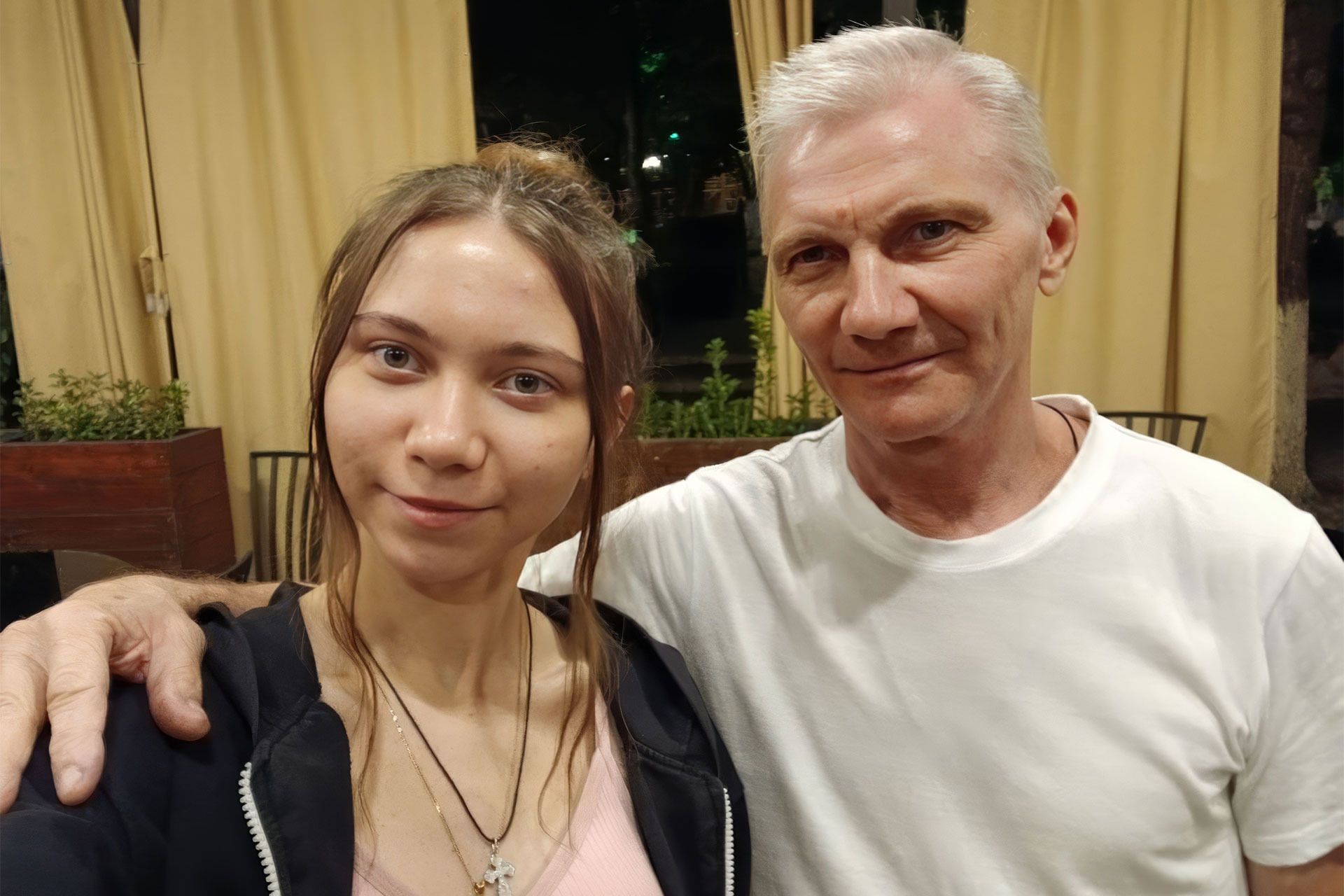
Masha and Alexey Moskalyov
At the start of Russia’s full-scale invasion of Ukraine, Masha lived with her father Aleksey Moskalyov in the town of Yefremov, Tula region, and was in the sixth grade at a regular secondary school, No. 9. As she recalls now, the start of the war scared her, like any other child, but at that time her peers cared little about what was happening in Ukraine. She mostly talked about it with her dad—both of them saw the war first and foremost as a tragedy.
Maria remembers she didn’t intend to protest on purpose—she just drew what she felt. This happened in April 2022.
“The teacher gave us the assignment herself—to draw something that could support our soldiers. My classmates really did start drawing tanks and things like that. I just drew what I thought was right. How could I support the killing of people? I wrote the truth, because I simply couldn’t draw anything else on this topic,“ Masha says.
According to the girl, the teacher at first didn’t even see her drawing, since she usually didn’t collect the students’ work. That was the case this time too. But the image of a Ukrainian family defending themselves from Russian rockets and the “No to War” slogan caught her classmates’ attention—and they reported Masha.
“I don’t think they wanted to stand out in front of the teacher. It all comes from the family, and their parents really taught these kids that Russia is a wonderful country and Ukraine attacked it. At least, they truly believed it, and by reporting me, they thought they were doing the right thing,“ she recalls.
Interrogations and “Political Conversations”
The teacher immediately reported the “terrible incident” of the child’s drawing to the principal, after which the girl’s life became a nightmare.
“That same day, leaving school, I saw police, the vice principal, and teachers at the door. I was really surprised, because I’d never seen police come to our school before. I suspected it was because of the drawing, so I decided not to go out to them right away and only went home after the crowd dispersed. At home, my dad told me that when he came to the school to pick me up, the police spoke to him. They showed him my drawing and started lecturing him that he’d raised his daughter to be ‘unpatriotic’,“ Masha says.
After this, the authorities got serious about the Moskalyov family. After monitoring Masha’s father’s social media, law enforcement found a comment on Odnoklassniki they considered “discrediting” the army. Alexey Moskalyov was fined 32,000 rubles, and FSB officers began taking the sixth-grader out of class for interrogations.
“There were three such interrogations in total. Sometimes they took me from after-school care, sometimes right from lessons. Even though I was a minor, they spoke to me alone, without adults present. At the same time, they interrogated my dad in a separate office,“ Masha recalls.
It seems the security officers themselves didn’t fully understand what to talk about with a child born in 2009: they asked Masha what she wanted to be, if she wanted to work in the police after school. Meanwhile, they started putting even more pressure on Alexey, openly threatening to take his daughter away. The persecution by the security services truly frightened the girl. The worst part was that teachers openly helped the FSB, creating all the conditions for psychological terror.
“Once, the teacher tricked me into staying after school when I was about to go home—deliberately so the FSB officers could get to the school in time. She asked me, unusually gently, to cut out some paper pictures, and when they arrived, she led me outside and handed me straight to the FSB. After the third interrogation, my dad and I decided there was no point staying at that school anymore,“ Maria says.
Shelter
After Masha switched to distance learning, it seemed like the family’s life was getting back on track. But before New Year’s, a case was opened against Alexey for “repeat discrediting” of the army. On December 30, early in the morning, police, emergency services, and firefighters arrived at the Moskalyovs’ home. Twelve masked people, armed with a grinder, began sawing the apartment door, where father and daughter were inside. When Alexey opened the door, they forced him face down on the floor and began a harsh interrogation. Masha was taken to another room.
“I started having a panic attack, I couldn’t say anything. Then they called child protective services and began searching the apartment. It was a real nightmare: they started overturning furniture, beds, and sofas, threw all the documents on the floor, and trampled on them. They took my dad’s passport, my birth certificate, apartment documents, and our phones. They arrested my dad and took me to a shelter. I remember how, before leaving, dad had to let our cat out onto the street, because he knew she would just starve in the empty apartment. That cat had lived with us for three years and was really part of our family,“ the girl recalls.
So, on the eve of 2023, Masha found herself in a shelter for the first time. Today, she notes that the staff’s attitude and the conditions there were fairly good, but for a girl separated from her closest person, it didn’t help. Masha was completely in the dark about what would happen to her and her father. She didn’t even have a phone to call anyone she knew. Meanwhile, Alexey was taken to the police station and beaten during interrogation.
“Later, my dad told me how, after the beating, they turned on the Russian anthem at full volume and locked him in an office. He had to listen to the anthem for two hours, after which he felt ill and they had to call an ambulance,“ Masha says.
“The Main Thing Is, Study Well”
After the interrogation, Alexey was released and was able to pick up Masha from the shelter. All their relatives turned away from them, and it was complete strangers—volunteers and activists—who started helping the Moskalyovs. They suggested the family leave Yefremov, and father and daughter moved to the nearby town of Uzlovaya. There, Alexey found a job at a local factory, but their peaceful life didn’t last long. On March 1, Alexey was detained by police, and Masha was sent back to the same shelter in Yefremov she already knew.
“They brought me there only in the evening, and I was hungry all day. They burst into our apartment early in the morning, and I hadn’t even had breakfast. The shelter was total isolation again. They wouldn’t let volunteers or activists visit, wouldn’t let me have a phone, and wouldn’t pass along any packages,“ Maria recalls.
For Masha, the torture of not knowing began again.
“I didn’t know what was happening with my dad, or if I would ever get out. I had a notebook with some phone numbers of people I knew, and I would go to the caregivers and ask to make a call,“ Masha shares.
Only after she went to the shelter director was the girl allowed to make a call—but only in the director’s presence and only to her mother or other relatives, not her father.
Masha’s mother had disappeared from her life when she was three and had never shown interest in her daughter since. According to Maria, the only “attention” she ever got from her mother were New Year’s calls—and not even every year. Even when a tearful Masha called her from the shelter, her mother had no desire to meet.
“She always had excuses ready, that she was busy, working, and couldn’t come. But at that time, I was so scared and miserable I cried every day. My mom would only say: ‘The main thing is, study well there’,“ Masha recalls.
After the Moskalyov family’s story became public, government officials, including the Children’s Rights Commissioner Maria Lvova-Belova, started visiting the girl in the shelter. From the officials, the girl learned that her father had tried to escape house arrest, but was detained in Belarus and placed in pretrial detention.
“They tried to convince me that my dad wanted to abandon me, but I know that’s not true. He just realized he couldn’t help me from prison, and the activists helping us explained they couldn’t evacuate us both at the same time. If my dad had managed to leave, he definitely would have looked for ways to help me,“ Masha explains.
Olga Sitchikhina, Masha’s mother, didn’t want to take her daughter from the shelter for a long time and only did so under pressure from officials, who used both stick and carrot: for example, they helped Olga pay off her loans. The girl agreed to live with her mother. According to Masha, the most important thing for her was to get out of the shelter, to access the internet and find lawyers and others who could help her father.
So Masha ended up in a family that was formally her own, but in reality, felt like strangers. Olga Sitchikhina and her household were pro-war and could enthusiastically discuss the latest “atrocities of Ukrainians against Russians” over dinner. However, life with the family was still better for Masha than the shelter. Most importantly, Maria now had contact with the outside world and could correspond with her father.
Meanwhile, Alexey Moskalyov was sentenced to 1 year and 10 months in a penal colony for “discrediting the army.”
“The letters took a long time, because my dad was constantly being moved from place to place. Once, my father wrote that his eyesight had gotten much worse, and I started reaching out to everyone we knew for help: to get him seen by a doctor in the colony, get glasses or medicine. But it was still very hard to support each other through letters. To really understand how someone is, you need to hear their voice,“ Masha shares.
After many months, Alexey Moskalyov was finally allowed to call his daughter. According to Masha, during the first call she could barely say anything through her tears. At first, they spoke almost every day, but then the prison administration imposed new restrictions. In one call with his daughter, Alexey mentioned the name of a journalist or human rights activist who had written to him in prison, and the prison authorities decided he was “indoctrinating the child with politics.” Nevertheless, calls were sometimes allowed.
New Life
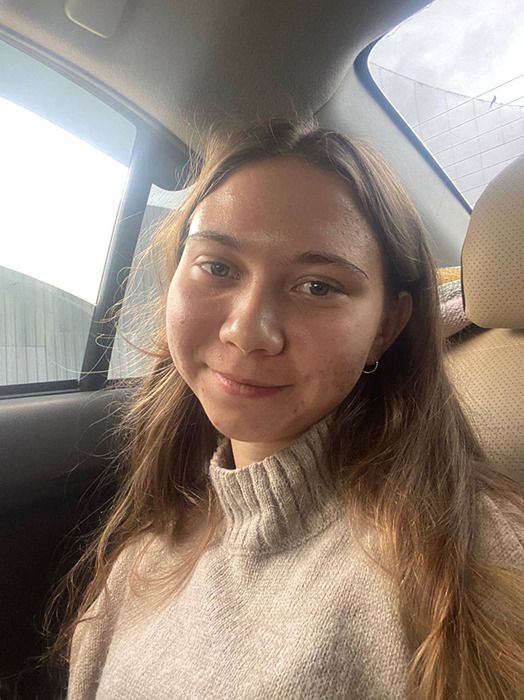
Masha waits in the car for several hours near the colony for her dad to be released. Photo provided by Masha Moskalyova
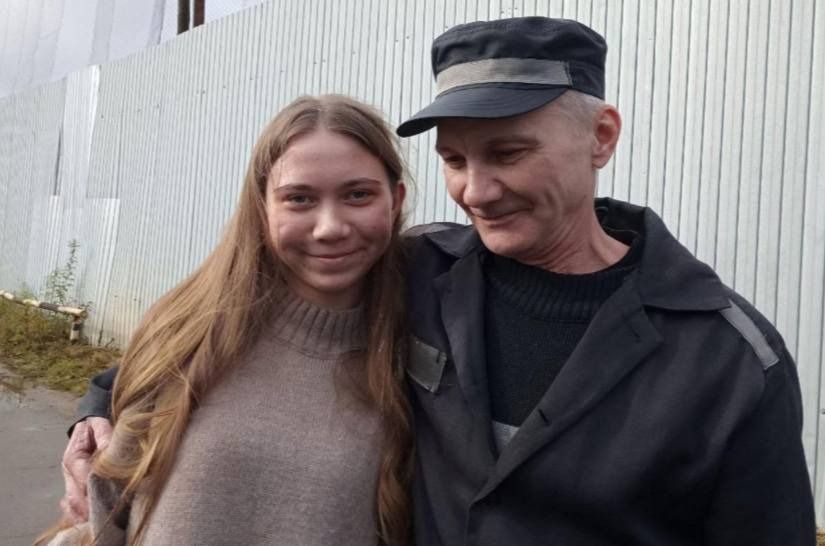
Until the very last moment, Masha didn’t know if her father would be released at the end of his sentence or if a new criminal case would be opened against him. She insisted on meeting her dad at the colony in person, and after several hours of waiting, she finally saw him—emaciated, but happy.
Masha meets her dad after his release from the colony. Photo provided by Masha Moskalyova
However, the family was immediately made to understand they would not be left in peace. When Masha met her father, police officers were on duty nearby, openly recording the license plate of the car that brought her to meet him. In the first days after his release, neighbors told the Moskalyovs that police again tried to enter their apartment when they were out.
Father and daughter realized they urgently needed to leave the country. After they left, friends told the Moskalyovs the police and some people in military uniform had been looking for them again. Alexey and Masha had to leave in a hurry for a neutral country, but they managed to take their beloved dog with them.
Now the Moskalyovs are waiting for a decision on their humanitarian visa to Germany. Masha is now 15, and she studied remotely until it was time to take her ninth-grade exams. Under Russian law, this can only be done in person. But Maria cannot return home now. For now, the girl is trying to study on her own so as not to fall behind, and is looking forward to the moment she can go to a real school in a new country. She enjoys drawing and is even trying to write her first stories—so far, deliberately far from her real-life experience, but still helping her adjust to a new life.
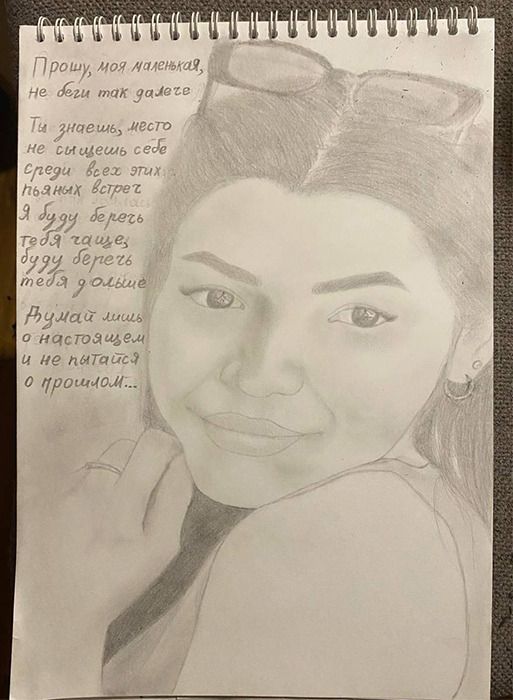
Masha’s drawing
As for Russia’s future, Masha isn’t very optimistic: “Even if the government changes, people probably won’t change right away. I’m afraid that even if something gets better in our country, it won’t happen soon.“
If you enjoyed this article, consider making a donation — one-time or, even better, monthly. Your support helps us motivate our authors and become better with every article.
Our organization is recognized by the Internal Revenue Service (IRS) as a 501(c)(3) tax-exempt, charitable organization, which means that all contributions made to us are tax-deductible to the fullest extent permitted by U.S. law. Individuals may generally deduct charitable contributions of up to 60% of their Adjusted Gross Income (AGI) for cash donations made to qualifying 501(c)(3) organizations. For donations of appreciated assets (such as stocks or other long-term capital assets), the deduction is typically limited to 30% of AGI, based on the fair market value of the asset. C-corporations may deduct charitable contributions of up to 10% of their taxable income for donations made to eligible charitable organizations.
By submitting a donation, you confirm that you have read and accept the following documents: Privacy Policy and User Agreement, and also give consent to the processing of your personal data.
If you would like to unsubscribe from a monthly donation, please email us at: [email protected]