The sharp and simultaneous escalation of Russian-Azerbaijani and Russian-Armenian relations that occurred recently reveals much about the Kremlin’s entire foreign policy.
The current surge in tensions between Moscow and Baku began with a routine event for present-day Russia — another instance of police lawlessness against those whom, at a grassroots level in Russia, are called “non-Russians,” and at the official state level — “migrants.” The incident took place in Yekaterinburg. This time, the valiant guardians of Russian order went a bit too far. Instead of limiting themselves, as has become tradition, to cutting off the ears of detainees, they beat two of them — 60-year-old Huseyn Safarov and his 55-year-old brother Ziyaddin Safarov — to death.
As usual in such cases, it was announced that the detainees died of heart failure. However, Azerbaijan today is not a country where such incidents can be committed with impunity against its citizens.
The murdered Azerbaijanis were sent back home, and a forensic examination conducted in Azerbaijan revealed that they died as a result of brutal beatings.
Aliyev’s response to the events in Yekaterinburg was unprecedentedly harsh. Azerbaijani security forces detained seven people at the office of the Russian mouthpiece in Baku — “Sputnik Azerbaijan,” including its chief editor Igor Kartavykh and editor-in-chief Evgeny Belousov, who were accused of belonging to the FSB. Officially, however, they are charged with fraud, illegal entrepreneurship, and money laundering. Azerbaijan also canceled all joint Russian-Azerbaijani cultural and interparliamentary events.
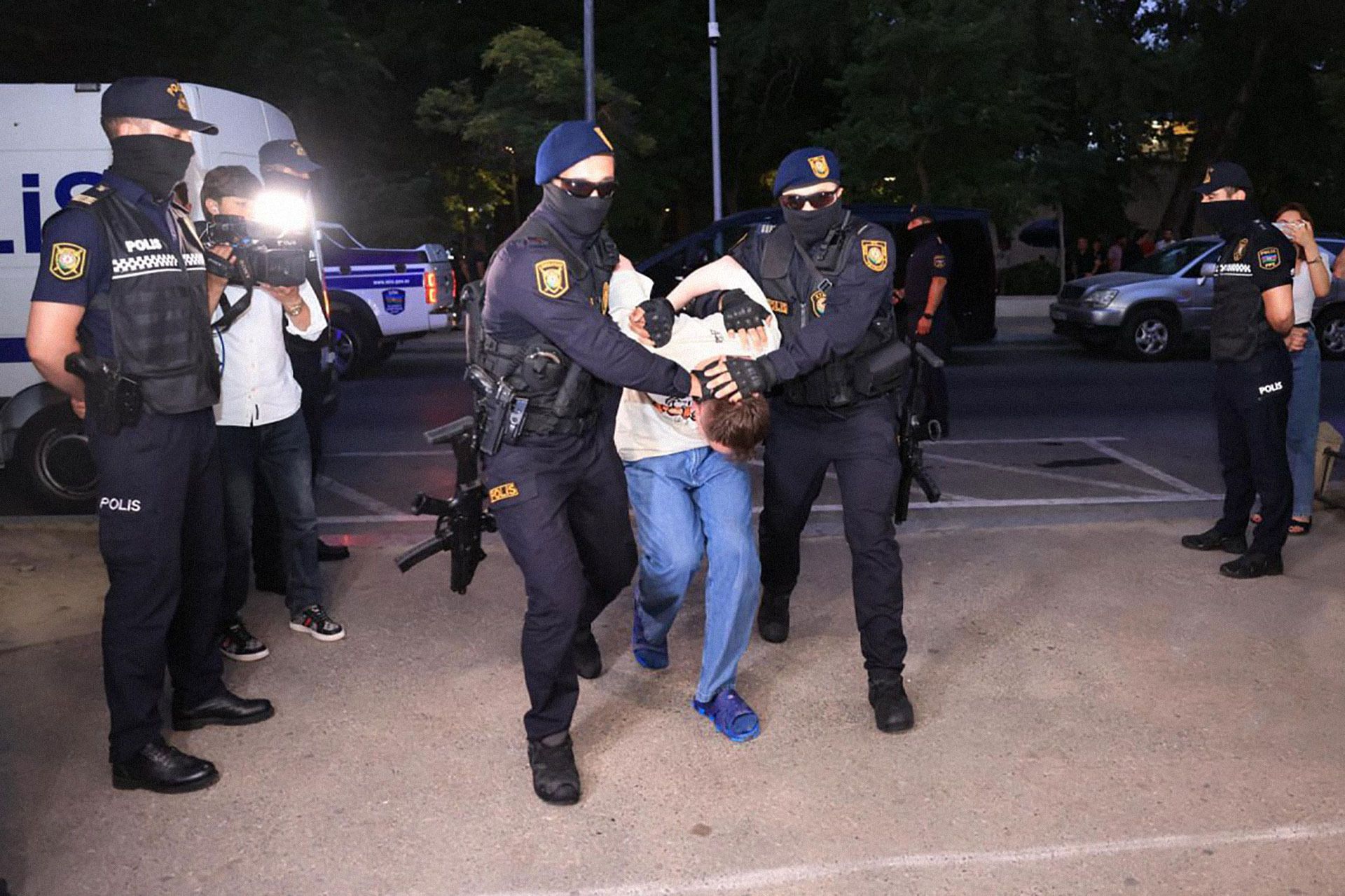
The picture was completed by footage of the detention of ten Russians in Baku, later accused of drug trafficking and cybercrimes. Azerbaijani security forces forced them to walk in a crouched line, laid them “face down on the floor,” and dramatically twisted their arms behind their backs before shoving them into police vans. Essentially, this demonstrative action mirrored the police arbitrariness against migrants that has been ongoing in Russia throughout almost the entire Putin era.
Imperial Russia probably hasn’t experienced such humiliation for about 200 years, since the defeat of the Russian embassy in Iran and the murder of Russian ambassador Alexander Griboyedov there in 1829.
Z-bloggers threw a full-blown hysterics over this, inventing possible Moscow countermeasures. The farthest in this went TV propagandist Vladimir Solovyov, hinting at the possibility of war between Russia and Azerbaijan.
But the Russian Foreign Ministry merely lamented the dismantling of bilateral relations, and Putin’s press secretary Peskov promised that “we will defend the legitimate interests of our citizens through diplomatic channels.” In other words, there will be no war, especially not now.
Azerbaijan, with its quite serious and modern army, is backed by the Turkish army as an unbreakable wall. And what the Turkish army is capable of was demonstrated back in February-March 2020 in Syria’s Idlib, where a large Russian grouping suffered a crushing defeat by the Turkish armed forces. In the five-day battles, 3,500 Russians and their allies from the Syrian dictator Bashar Assad’s army were counted dead.
In September-November of the same year, in the battle for Karabakh, Russia’s official ally — Armenia — was defeated by the Azerbaijani army, well trained by Turkish instructors. Moscow did not even move to help its ally at that time. The main reason for this Russian passivity was that Turkish President Recep Erdogan openly warned that the Turkish army and its air force would intervene if any foreign state attempted to interfere in the conflict — and to underscore this, he stationed six F-16 fighters at one of Azerbaijan’s airfields.
Putin did not intervene. At that time, he was too busy preparing for the final stage of the attack on Ukraine.
Today, bogged down in Ukraine, Putin certainly cannot afford to attack Azerbaijan, backed by Turkey. But he can strike where it is least expected. If he cannot openly attack strong Azerbaijan now, why not strike weak Armenia, which has also slipped from Moscow’s control?
Indeed, amid the unprecedented deterioration of relations with Azerbaijan and Armenia, Moscow, according to Ukrainian intelligence, is transferring its troops to Armenian territory. Probably to the base in Gyumri. However, this is a hopeless endeavor. The base is small; in its heyday, about 2,000 soldiers and officers were stationed there. Considering that over the past three years Russian troops serving there have been actively sent to Ukraine, it can be assumed that this is just an attempt to restore the number of this Russian military base to prewar levels. What can these 2,000 Russian soldiers do there now? Storm the million-strong Yerevan? Ridiculous. Talking about war with Azerbaijan is out of the question.
Having no leverage over Azerbaijan, the Kremlin tried to seize Armenia. The tactic is to avoid losing it as its stronghold in the South Caucasus. For this, various “movements” and “protests” funded by Moscow are supported here, aimed at bringing to power in Yerevan a government obedient to Russia.
Meanwhile, Armenia’s Foreign Ministry recently unexpectedly expressed readiness to join the pro-Russian Shanghai Cooperation Organization (SCO). Against the backdrop of the catastrophic deterioration in Armenian-Russian relations we have observed lately, this move seems somewhat discordant. Just days before, Armenia again refused to participate in the meeting of the Kremlin-aligned military-political bloc — the Collective Security Treaty Organization (CSTO). And suddenly, readiness to join the SCO. What does this mean?
In fact, nothing. Yerevan is not changing its direction; there should be no illusions here. It’s just that the SCO headquarters and its Secretariat are located not in Moscow, but in Beijing. And that says a lot. Notably, the announcement of Yerevan’s refusal to participate in the CSTO summit was also made by the Armenian Foreign Minister not coincidentally in China, during his recent visit there.
Armenia is simply changing its “roof.” What else can it do? Russia betrayed it in the Karabakh conflict, America under Trump is utterly unpredictable. The Europeans won’t provide quick military aid to the small Caucasus country, especially given the war in Ukraine.
French President Emmanuel Macron regularly makes loud statements supporting Armenia, but these are no more than political declarations, and Armenia now needs very concrete help and guarantees.
In the absence of real help from the above-mentioned states and organizations, which verbally support Yerevan but in practice leave it alone against the powerful alliance of Baku and Ankara, Beijing’s guarantees give Armenia’s leadership confidence.
Just now, Nikol Pashinyan’s government suppressed another coup attempt in the country. Politicians who openly showed their pro-Moscow orientation were arrested: Armenian Apostolic Church archbishops Mikael Ajapahyan and Bagrat Galstanyan, as well as Russian oligarch Samvel Karapetyan, who controls much of Armenia’s energy sector.
Meanwhile, on July 6, Azerbaijani President’s special envoy Elchin Amirbekov stated that Baku and Yerevan have finally agreed on the text of a peace treaty. Problems between the two countries remain, but signing a peace treaty between them could become an event of enormous importance for the entire region.
Armenia and Azerbaijan can put a final, bold full stop to their mutual claims and begin a historic movement toward each other, not toward Moscow.
Putin still has Georgia with its pro-Russian leadership in the South Caucasus, but that gives him little. First, even that leadership periodically reminds him that Russia occupies 20% of Georgian territory. Second, if he decides to send troops to Tbilisi, he will definitively lose Georgia as well.
Armenia was a suitable target for expanding his influence southward, but now, thanks to his “wise” policy, everything has become complicated — close to grasping but unable to bite. Xi Jinping may not like that.
In other words, Russia is at a dead end in the South Caucasus. And this dead end serves as a good illustration of the Kremlin’s entire foreign policy.
Main photo — Russians detained in Baku, suspected of drug trafficking, brought to court on July 1, 2025. Photo: Report via Telegram
If you enjoyed this article, consider making a donation — one-time or, even better, monthly. Your support helps us motivate our authors and become better with every article.
Our organization is recognized by the Internal Revenue Service (IRS) as a 501(c)(3) tax-exempt, charitable organization, which means that all contributions made to us are tax-deductible to the fullest extent permitted by U.S. law. Individuals may generally deduct charitable contributions of up to 60% of their Adjusted Gross Income (AGI) for cash donations made to qualifying 501(c)(3) organizations. For donations of appreciated assets (such as stocks or other long-term capital assets), the deduction is typically limited to 30% of AGI, based on the fair market value of the asset. C-corporations may deduct charitable contributions of up to 10% of their taxable income for donations made to eligible charitable organizations.
By submitting a donation, you confirm that you have read and accept the following documents: Privacy Policy and User Agreement, and also give consent to the processing of your personal data.
If you would like to unsubscribe from a monthly donation, please email us at: [email protected]