Following the column by commentator Tatyana Rybakova “The War Won. Why Putin Decided to ‘Squeeze’ the Economy” on “Most,” a discussion arose with economist Nikolay Kulbaka. Their conversation quickly went beyond the text’s topic. Moreover, the interlocutors decided to continue the discussion after the publication of the Russian Federation’s draft budget. For now, they debated whether a course toward Stalin-type industrialization has been taken and whether such economic policy is possible in Russia’s current realities.
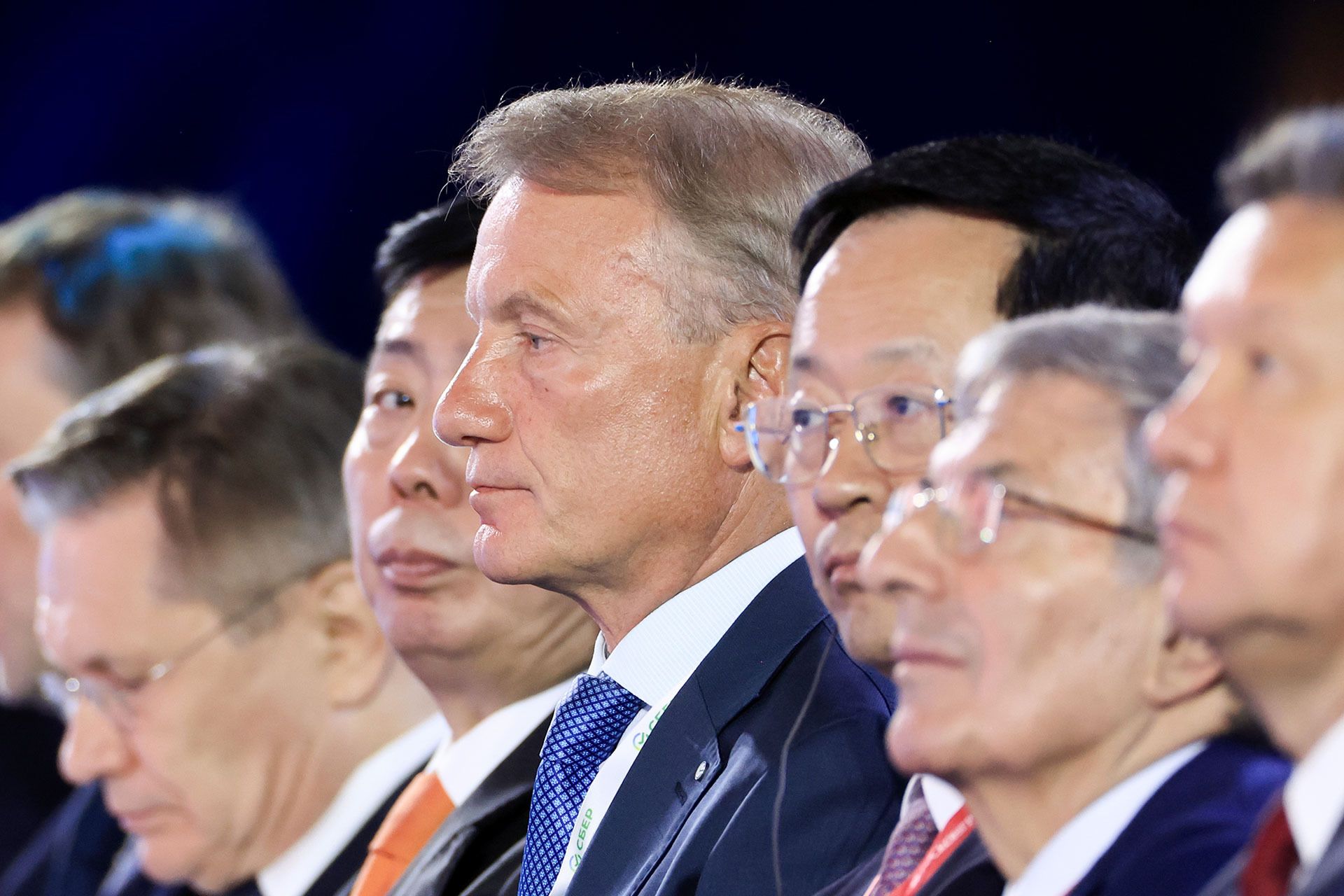
Herman Gref at the plenary session of the 10th Eastern Economic Forum, June 5, 2025. Photo: Roscongress / Stepan Pugachev
Tatyana Rybakova: By supporting the Central Bank’s tough policy at the Eastern Economic Forum, Putin, in my view, is moving to the next stage of structural economic transformation. This stage reminds me of Stalin’s in that through strict monetary policy and uneven distribution of financial resources, primarily wages, people will be pushed (let’s say, financially) toward sectors needed for the war effort. This is primarily the defense industry complex, enterprises linked to state orders — and, of course, the war itself.
Why do I think so? Because in conditions where increasing capital — that is, all kinds of assets, from financial to equipment, and most importantly technologies — is impossible, improving production efficiency and expanding it can only be done by lowering labor costs. There are only two components of production growth: labor and capital. Since there are problems with capital, we will reduce labor costs.
Nikolay Kulbaka: First, I would separate two things: policy toward people and industries — and policy toward macroeconomics. These are fundamentally different matters. Let’s start with the fact that strict monetary policy or monetary control is a phenomenon; it actually acts as a cementing factor for Russia’s situation.
Let me explain why. Russia has no free labor force, no free economic capital, equipment is almost fully utilized (I believe the Central Bank keeps track of this) — in fact, the economy has now exceeded its production capacity. Under such conditions, the state theoretically has two ways to bring the economy back to normal bounds: restrictive fiscal policy and restrictive monetary-credit policy. Restrictive fiscal policy is currently impossible because the state spends monstrous amounts of money on the war.
Restrictive monetary policy is the only lever that prevents the Russian economy from overheating monstrously. Because with shortages of resources, labor, and capital, pumping money from the budget would simply lead to fantastic inflation. Therefore, strict monetary-credit policy is the only sensible strategy possible under the constraints set by Putin’s foreign policy.
An example of such economic policy often cited is the so-called wartime Keynesianism during World War II, when the American economy grew significantly. But the American economy then had considerable reserves because it had not fully recovered from the Great Depression and had a huge amount of unused capacity — that’s the first point. The second is that during that period, the American labor force sharply grew due to women entering industrial enterprises. The Russian economy currently lacks such resources; moreover, we see a significant reduction in the number of labor migrants.
So there is no alternative to strict monetary-credit policy for the government. It is a forced measure, limited only by a compromise with major oligarchs who demand the “banquet to continue.”
Now, regarding the sharp decline in attractiveness of the civilian sector and the shift of people to the military sector. The problem is that expanding the military sector is already impossible, and it seems that most people in the government and Putin’s circle understand this. Because besides the shortage of labor, there is also a huge shortage of production capacity. Real growth occurs in industries like drone assembly: on the one hand, screwdriver assembly requiring few people, and on the other — despite the importance of these enterprises for the war effort — a tiny part of the industry. To increase, for example, missile production, a new serious factory must be built, since Russia currently lacks free production capacity. That means equipment must be produced or imported, installed, and set up. First, this takes a long time; second, hardly any other country will supply such volumes of equipment. Therefore, creating new production of serious military equipment in Russia today is basically impossible.
By the way, under Stalin, during the transition to a war economy in 1941, civilian factories switched to military production, but most of it was simple, cheap stamping and assembly, which could be done by unskilled workers and represented mass consumer goods. Modern military equipment, however, is high-tech and cannot be made on the fly. And even now, the growth of military production is slowing; increasing it further, even by massively transferring people from the civilian sector, is impossible.
The Russian military economy has practically reached its peak — that’s the most important thing. And, as far as I understand, the top leadership has already realized this well.
T.R.: Yes, wartime Keynesianism in Russia ended so quickly — in fact, in less than two years — precisely because there were no reserves like the US had during World War II; all resources were used up much faster. I also agree with you that Russia’s production capacity is at its limit — but only in terms of traditional weaponry.
For example, regarding drones: I disagree that this production is tiny and will remain so. During one recent attack on Kyiv, about 800 drones were used. Their use has multiplied during the war. Yes, it’s screwdriver assembly, but it scales very easily — precisely because it requires little besides labor. It can be a simple covered hangar, a basic assembly line staffed by, as you rightly noted, not very skilled people. So the focus is now on drone production, and apparently production is expanding.
Then I’d also like to note another aspect of today’s military industry: radio electronics and software — for electronic warfare, network defense, hacking, surveillance, etc. This high-tech sector requires quite specific qualifications. And pulling in qualified people from civilian sectors is becoming an acute need — especially considering that a significant number of IT specialists left in 2022 and some continue working for services or employers outside Russia.
Yes, these two needs probably won’t cause a large-scale flow like in Stalin’s times, but today Russia is much smaller in population and territory.
Yes, they probably won’t build new Uralmash or Chelyabinsk Tractor Plants. But they will expand drone production, expand workshops for more modernized missiles within existing factories, and develop the military IT sector. The vector is the same — Stalinist — but the scale is different.
N.K.: I agree with you, but let’s not forget one thing. If we now look at the volume of the military-industrial complex in Russia’s economy, it’s at most 10%. This means that even if the sector expands at a fantastic rate of 10% per year, that would mean an annual increase of about 1% of the entire economy. Within the country, that’s still a very small share.
Also, let’s not forget that there are vital sectors that the state closely monitors — for example, food industry, transport. Saying that right now there will be a clear priority shift to the military sector with everything else neglected is incorrect. That’s the first point.
The second point is that this is definitely not a Stalinist path, because that involved massive forced labor, which is definitely not happening in Russia now.
Another point is that military production doesn’t require a huge number of people. I repeat: even if drone production expands two or three times in the next year or two, in the scale of the national economy and even the defense industry, it will be a very small, almost invisible part.
There is a concept called inter-industry balance. When you start producing military products, you inevitably pull civilian production along — because you need more metal, more computer circuits, more logistics services, and so on. You can’t increase military production by decreasing civilian production; that won’t work.
By the way, in Stalin’s times during the Great Patriotic War, enterprises were simply massively converted to military production. But even then, it went so poorly that if not for lend-lease food aid, there would have been famine. In cities without the possibility of gardening or foraging, like Murmansk and Arkhangelsk in 1941-1942, there was famine and mortality rose significantly. Lend-lease saved them.
No one will go for that now. There will be an attempt to balance: without putting civilian sectors in too difficult a position, they will try to expand the military sectors somewhat.
At the same time, it must be clearly understood that the problem is not only that there are no people in the economy — there is also a lack of serious money.
Note that this year investments in Russian Railways were cut by one and a half times. Simply because investments given to Russian Railways in 2024 did not significantly increase the capacity of railways. And if there is no result, why give money? This is a serious problem.
The state has faced the situation where it seems there was money, oil sells well. But the problem is that the faster you invest money in a sector, the larger part of that money goes to waste. The sector can’t process the money faster than certain limits set by existing technologies.
To grow a tree, you need to water it for several years. If you pour the same amount of water under it in six months, the tree will die. The same roughly happens in the economy when you start pouring in huge amounts of money.
This money goes into corruption, goes into unknown things, and no official who receives large sums will ever say “No, guys, stop, we don’t need this money, we won’t be able to absorb it.” They will take it because they understand: otherwise, they will be removed and replaced by someone who will say “Yes, we will absorb it all, we will do it.” So the problem now is not just to find and invest money, but to absorb it more balancedly.
T.R.: You’ve just given many interesting points for further discussion.
First: regarding the small share of drones in overall production. Look, now a third of all enterprises operate at a loss — and if you consider the civilian sector, I think the percentage of loss-making enterprises is even higher. Simply because of high loans and few businesses can survive without credit, with falling demand, with many financing channels closed, without scaling, without purchases, including imports. And all this is either closing or becoming more expensive. So the share of military production can rise not only by expanding this production but also by shrinking civilian sectors. That is, if the civilian sector contracts, then arithmetically the military sector expands. That’s the first, but not the main point.
Second, you rightly noted that the state now pays great attention to food supply. Looking at the ongoing nationalization (or simply asset seizure), many food companies have been taken. Starting with “Makfa“ pasta and ending with the recent seizure of a concern producing sunflower seeds, crackers, and other snacks. And they don’t even bother inventing grounds anymore — it’s enough that a person has or had a residence permit, lives or lived abroad, once had a foreign company, most of which were created to optimize financial flows.
What can be noted here? These companies generally target cheap products for the poor. Pasta, sunflower seeds, Danone — cheap dairy, Baltika — cheap beer. The state takes the lower price segment and then, as we understand from Danone or Baltika, transfers it to the right hands. They are also starting to seize agro-industrial complexes now. Take “Rusagro” — it’s not just grain, it also includes vegetable oil, various processing enterprises. This is also either products for the poor or products for livestock farming — like compound feed.
That sector is supported and will be supported by the state, but normal private business there will not exist. It can’t even be called state-owned because it will ultimately belong not to the state but to those controlled by the state and connected with it. Effectively, it’s pseudo-private business. That’s the second point, and I think it’s quite important.
The third point is support, including financial. You correctly noted that recipients of state funds never say they got too much — they always absorb it, and the more funds, the less efficient. I absolutely agree with you on this too.
But considering that, as I understand, the authorities are set for a long war — not necessarily a hot phase, but the trend toward military confrontation is chosen — I think the state will redirect financial flows to priority sectors. And as you rightly noted, that’s not only the military sector itself but also its supporting sectors. These are companies working on state orders from the civilian sector, the same “food industry” because both soldiers and workers need to be fed. Apparently, also some other directions: for example, recently Putin’s niece Anna Tsivilyova boasted that thanks to the special military operation prosthetics are rapidly developing.
And regarding this, I’d like to ask: don’t you think, first, that such a redirection of financial flows will happen, and second, that this redirection will lead to certain changes in these sectors for the worse? This could reduce the efficiency of the entire production complex. Because when Russian Railways, after receiving lots of money, can’t expand logistics, everyone suffers. The same applies to agro-industrial complexes, food industry, and many other sectors important to the state from a military point of view.
N.K. First, you said absolutely right — let’s not use the term “nationalization.” I have been following this process for a long time and specifically analyzed who got the assets of the departed foreign companies. These are people aged 60-65+. Maybe not all of them are very public figures, but they have long been in business.
In fact, they just pick up what lies poorly. So no nationalization is happening. It’s more accurate to say “feeding” transfer.
Because in the current business system — and we still live by market laws — even when we talk about a 100% subsidiary of a state enterprise, it lives and develops independently, and the parent company can’t influence it. I’ve encountered this many times in real business. It’s still a market.
We’re not talking about taking enterprises that provide food for the poor. Those who do that don’t think that way. They have no such strategy or criteria; their principle is completely different. We have a bit of a vision aberration because we tend to perceive the state as a single planning organism. In reality, that’s far from true: agencies act largely according to their own criteria. They have many conditional KPIs that often contradict each other. And each department has completely different goals.
Usually property seizure happens by these criteria: either a person lost their “protection,” or, let’s say, the person made a mistake, or simply appeared a weak link to latch onto. Nothing else happens.
Why seize food companies? Because such companies produce a lot of cash, which is interesting in any conditions.
I recall an interesting conversation. It took place in Ukraine before Crimea’s annexation. Then Ukrainian guys told me: you’re lucky, you have oil and gas, and nobody messes with small sectors. But here, prosecutors grab everything, down to small businesses, because we don’t have big things that interest them. Another conversation with a commercial director of a company — I won’t name the sector just in case — he said literally: “We’re lucky; we’re not perceived as a large profitable sector. So the state’s influence on us is minimal. And we’re not afraid of being raided and having our business taken.”
So the problem is a bit different. As I understand the situation, there are two main reasons for the redistribution.
The first is that “Sauron’s eye” is now not looking at business, and there’s an opportunity to quietly grab something. Nobody will rush to defend their interests, plus you can always add a political component.
Putin is now unreachable; he’s focused only on geostrategic thoughts and won’t deal with resolving numerous conflicts. The Wildberries conflict showed this well. Since he won’t intervene, light arbitrariness is possible.
The second reason: most who seize assets understand that a window of opportunity has opened that will one day close. And at some point, when Putin leaves for one reason or another, it’s important to have large assets. It’s important to be big and strong. It’s important to have something to trade with other players. And it seems this redistribution is also done with the future in mind. Because currently, these seized assets bring very little money.
So they’re working for the future — picking up what lies poorly, and someday it can be replaced, sold, or traded for other preferences. That’s about the redistribution of property.
Also, the problem is that we still have the issue of an aging elite that came up in the 1990s and is generally quite old now. The issue of passing business to a new generation of owners remains. And the issue of survival in the country’s current conditions remains. All this happens against the backdrop of war.
R.T.: You raised a very interesting problem about the aging elite and assets passing to those aged 60-65+. And I immediately have two questions.
First question. Which sectors are currently most affected in terms of handovers? Are there sectoral preferences? I get the impression that the production of low-price segment goods, which will always have demand, is under the greatest pressure.
And the second question. Considering what we said about inefficient state investments and aging elite, won’t these sectors, after Putin’s departure — or maybe even before — be in the worst position? Because old commanders will either leave or be unable to act effectively, and the young elite, mostly drawn from close kin and circles, frankly show no examples of effective business or state management — only a few competent managers exist.
N.K.: Yes, you’re right, this won’t lead to increased efficiency. By the way, look at what happened over the last five to seven years with large businesses taken from effective owners before 2022 — I mean VKontakte, Magnit, and others — none of these “purchases” led to increased efficiency. On the contrary, in most cases profitability sharply dropped.
If we talk about which sectors suffer and where risks lie: there is no binding by sectors or anything else; everything that lies poorly is picked up. Someone picks up, say, premium businesses — for example, companies in healthy food.
The problem is not that a specific sector is picked — it’s that places without “protection” are picked. Where you can’t defend yourself, where claims can be made on the owner. It’s more a gangster showdown than a strategy.
Regarding the future, the real problem is what happens with the elite at the top. It remains a rather cohesive, closed group, tightly connected by family and corporate ties. At this level, successors are, at best, children or other relatives. There might be some support from spouses: Kirill Dmitriev, a high-level professional, got into this circle more through his wife [Natalya Popova — friend of Putin’s daughter Katerina Tikhonova] than by his own achievements. He jumped to that level thanks to his wife, otherwise, no one would have let him in.
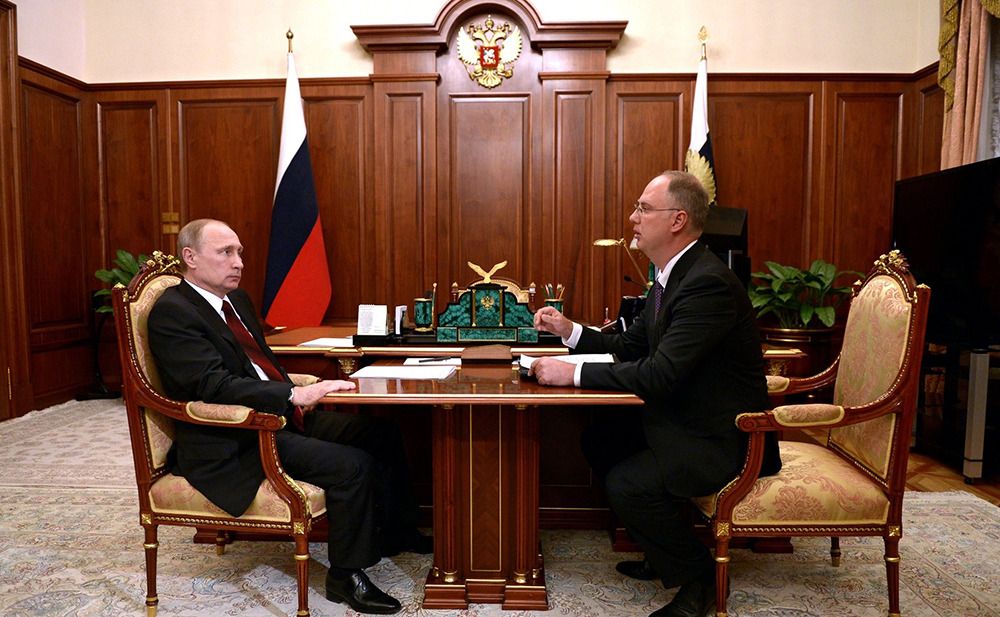
Meeting of with Kirill Dmitriev, March 2015. Photo: kremlin.ru
There are still few such people, and they don’t have many children either. Moreover, not all children want to get involved. Many want to do something creative, especially since they have money. So the personnel shortage at the top for business succession will be quite serious.
Moreover, an important point: at the stage of passing business to a young heir, the business becomes most vulnerable to attacks. Everyone understands this. No matter how you prepare the succession or raise the heir, in a predatory, far from Stalinist system, risks increase significantly. This is what they live with now.
R.T.: By the way, I want to point out regarding your comments on VK and Magnit. Yes, their efficiency dropped. But notice that recently the Ministry of Digital Development released a “white list“ of sites that will be accessible even if the internet is disconnected. VK is on it, and among retailers, only Magnit is currently included — which amused me. So, thanks to state support, they will get various preferences, which leads us to the next question.
Suppose I’m someone who grabbed some assets — effective or ineffective, from any sector. The state is ready to provide all support just for the asset to work and fulfill its role. But I understand that at any moment this asset, which became mine, can cease to be mine again, and there will always be reasons — in this case, probably even stronger than those for seizing it. The question is rhetorical: will I develop this asset? Or will I try to extract as much as possible from it? So what will happen to our industry as a result?
N.K.: I strongly suspect that a person who heads such an asset quickly starts perceiving it not as something temporarily entrusted to them. You know the saying: you take someone else’s money for a time, but you give your own forever. That’s exactly it. They now see it as their own. Remember our famous “red directors,” who could be replaced at any moment but still saw their enterprises as personal fiefdoms. They won’t see themselves as temporary holders who need to grab and run.
The problem is whether they can manage effectively. Experience suggests that most won’t. Surely some will attract good managers, some will turn out to be decent managers themselves, anything can happen. But most likely, this grab will cause enterprises great pain.
Imagine a small regional enterprise. A Moscow owner arrives. What can he do? Can he bring his own team? No, he can’t. Nobody will move to a small town several hundred kilometers from Moscow. So at best, he will bring a director, maybe a finance director. The old team will remain, quietly hate the “newcomer” Muscovites, put sticks in their wheels, and grumble behind their backs.
Moreover, this new team — and I’ve seen this many times in real business — will repeatedly step on the same rakes local specialists did. Because they lack experience here, in this specific place. They will try all options by trial and error, losing money, time, and resources. This serious problem already exists at many enterprises. Especially if you seize three or four sectors you don’t understand, you get a large inefficient conglomerate.
In the 2000s, the concept was to get rid of non-core assets, and it worked well. Companies tried to shed such assets because managing them properly was impossible. You work in many markets that contradict each other and need specialists from all those markets. Now assets from different markets with no specialists are being picked, and all markets are changing rapidly. You get a serious internal crisis. You hire a serious manager in Moscow, some deputy general director, put two or three sectors under him, and he’s overwhelmed trying to oversee and manage all of it. This really happens in such companies.
But I want to return to one point I somewhat disagree with: the eternal war.
I think there is no eternal war — it’s a concept that we will soon win. And this “we will soon win” just stretches on. The logic is: Russia has more resources, really will overwhelm with resources — human, financial, whatever. So at some point, the “Ukrainians” will deflate. Their front will collapse, anything. We just have to wait for that moment.
T.R.: Here, I probably disagree with you. I believe this concept ends right now, starting with Putin’s meetings in Anchorage with Trump and with Xi Jinping at the SCO. Because I saw a sharp tonal shift in Putin’s speech at the Eastern Economic Forum.
That is, the concept that we will crush Ukraine remains in minds — because psychologically, otherwise it would be very hard. But I don’t think even the top leadership believes the war will end there. Everyone thinks the confrontation with the West has already begun and will continue. Therefore, the war, in one form or another — cold or hot — will continue, and we will stand in it until the West retreats from us.
This is not about winning. Probably, this is different from Stalin’s idea of conquering everything and from the Cold War idea that communism’s victory is inevitable. But in the belief that “we will get what’s ours,” I think they are confident and ready to continue indefinitely.
You rightly noted that local staff will be forced to stay and quietly hate them. I want to add this: local staff won’t just quietly hate — they also understand that their career prospects are bleak, and moreover, at any opportunity, each of them will be replaced by “their own.” So local staff will try to, let’s say, capitalize on their position — basically, try to “take away” as much as they can if they can.
And about your point that current elites perceive assets as theirs and won’t dismantle them: there is an example of how the Central Bank cleaned up the banking space — banks went under new management. All these guaranteed banks quietly died or are close to it. Nothing was cleaned up; mostly, what wasn’t stolen before was stolen then.
So I think you’re wrong about them not dismantling because it’s theirs. They dismantled, dismantle, and will continue to dismantle.
We’ve been talking for over an hour, and it’s time to wrap up. So I’d ask: from your point of view, what will the Russian economy look like? Where is the trend heading? Or is it just some chaos that has yet to form into any concept?
N.K.: There will be no concept. All these ideological concepts that arise in the minds of some elite representatives — whether Dugin or not — are considered, of course, but when it’s time to solve a current task, all that ideology goes out the window; no one pays attention.
At the top, we will likely see something resembling South Korean chaebols. Semi-state, semi-private large corporations cobbled together, whose efficiency will be very questionable — especially since all these large companies have so far been supported mainly by budget money redistribution. But once the state has much fewer resources to support them, many will simply cease to exist, like the Great Russian Encyclopedia just did. Perhaps that’s an example of what might happen — it was less needed and so was among the first to go. But as soon as money decreases, feeding many will be cut. We see, for example, that NPO “Energia” has problems; many lack money. That’s the first part of my conclusions.
The second part is that externally this will not resemble China or North Korea but will likely follow the path of a somewhat chaotic Iran. Maybe with less ideology, trying to live from the bottom as it goes, trying to preserve some form of social state — at a very basic level, just enough to avoid starvation.
From below, there will be an attempt to create something like a social state for the poor, and from above, a large oligarchy for its own. And a layer of security forces will separate one part from the other, and a layer of propagandists will explain that we always lived this way and that it’s the best way of life. Something like that will happen.
T.R.: I just want to note that whenever people talk about the Iranianization of the Russian economy, it’s worth remembering that unlike Russia, Iran has not only a very high share of small business but also a mentality strongly focused on small trade, small crafts, and a large number of small agricultural producers. And all this small business, at various development levels in different sectors, is aimed at meeting the needs of primarily the poor population. So it’s much easier for the government there to handle something bigger than feeding the poor. Unlike Russia, where feeding the poor is not in the hands of the poor themselves — small business is usually poor — here the vector is that the state must do something, give something, somehow manage.
I’m looking forward to the budget projections for next year and beyond. There is already data that even this year war expenses turned out to be over 50% of total budget spending, not 40%. And since the National Wealth Fund is ending, there is a hypothesis that remaining treasury account balances will be used to finance state expenses. What are these balances? They are funds allocated for various national projects, from which money can be taken little by little. And given the low efficiency of these national projects, taking from them can be done without much negative effect — because, as they say, they won’t lose much, maybe just break something.
And precisely in these, so to speak, chaebols, the most interesting processes will happen. When the question of who lives and who dies will be decided both by comparative importance to the state and by the relative strength of the groups owning these chaebols. In such processes, the Russian economy acquires some quite surprising features, resembling not so much Iran or China, but some African countries. Where there are also fairly efficient businesses, but these efficient businesses are efficient only as long as they are owned by people at the top.
N.K.: I agree with you. And I suggest continuing this conversation when we understand what the next year’s budget will be. Because I’m very interested in that question, and much depends on it.
If you enjoyed this article, consider making a donation — one-time or, even better, monthly. Your support helps us motivate our authors and become better with every article.
Our organization is recognized by the Internal Revenue Service (IRS) as a 501(c)(3) tax-exempt, charitable organization, which means that all contributions made to us are tax-deductible to the fullest extent permitted by U.S. law. Individuals may generally deduct charitable contributions of up to 60% of their Adjusted Gross Income (AGI) for cash donations made to qualifying 501(c)(3) organizations. For donations of appreciated assets (such as stocks or other long-term capital assets), the deduction is typically limited to 30% of AGI, based on the fair market value of the asset. C-corporations may deduct charitable contributions of up to 10% of their taxable income for donations made to eligible charitable organizations.
By submitting a donation, you confirm that you have read and accept the following documents: Privacy Policy and User Agreement, and also give consent to the processing of your personal data.
If you would like to unsubscribe from a monthly donation, please email us at: [email protected]