Robespierre was a utopian who believed in lofty ideals and the possibility of free and just social change. This moral dimension of politics is almost an axiom underlying any discourse about revolution. Yet, his main “civil religion” remained faith in human virtue. That very idealism in politics is so lacking today.
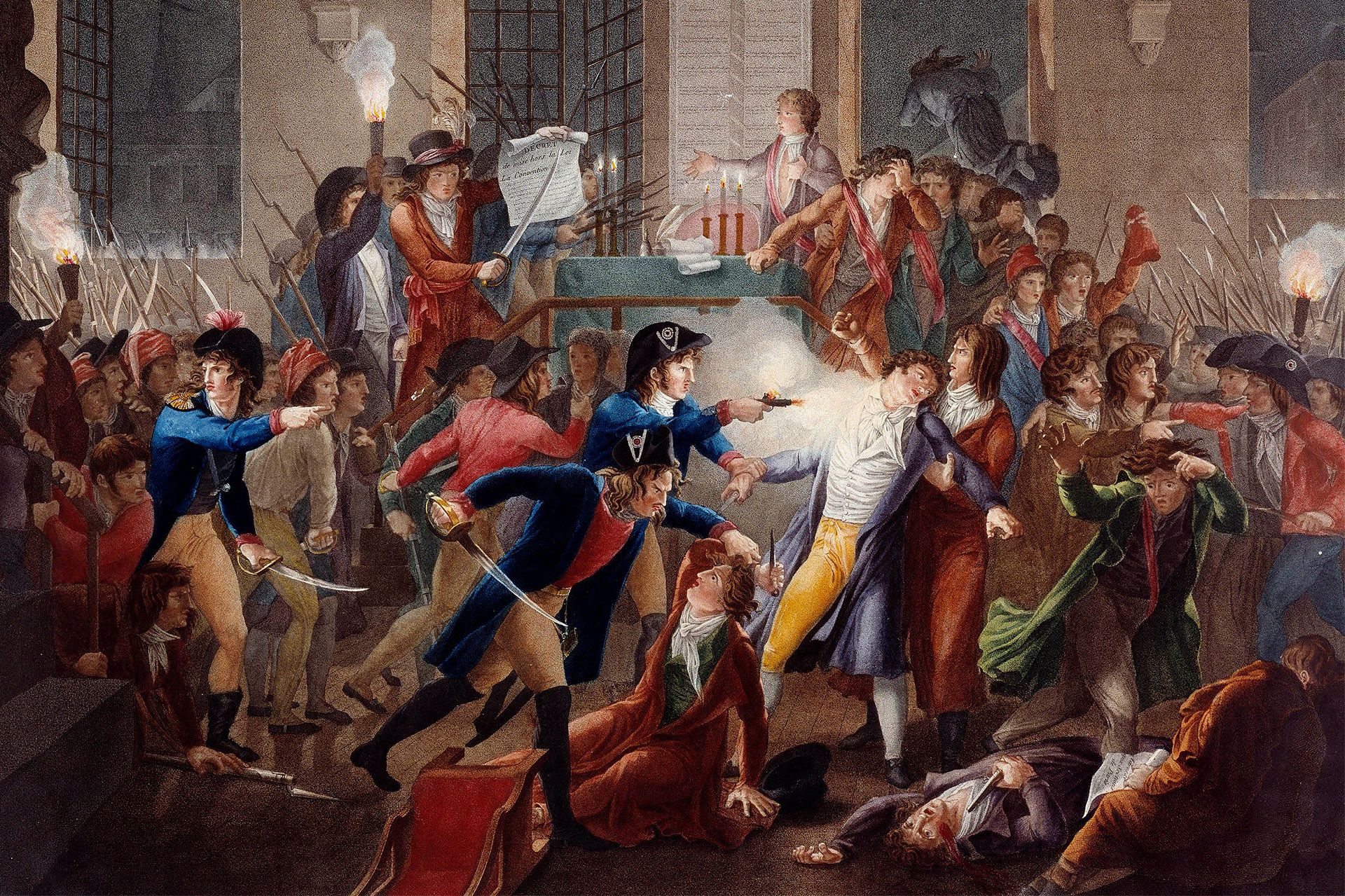
Painting (fragment) depicting the arrest of Robespierre, 19th century. Image: Jean-Joseph-François Tassaert
Let me begin with a quote: “In May 2011, the French state announced that it would auction Robespierre’s manuscripts at Sotheby’s, and the Robespierre Studies Society, together with the Institute of the History of the French Revolution and a number of other institutions and organizations, launched a fundraising campaign. They gathered a thousand subscribers, which made it possible to collect the necessary sum to acquire these manuscripts, now kept in the National Archives. Everyone contributed according to their means, realizing the importance of the history of the French Revolution for building our Republic.”
Unusual, isn’t it? After all, this is not about a state monopoly on history (which is the direction Russia is sliding towards, and ever faster). In a free country with no official ideology, people voluntarily donate their hard-earned money for documents about a man who… And here the questions begin. What motivated these people? The desire to preserve the memory of Robespierre—which reveals their political sympathies—or simply interest in the great revolution (noting that the French state does not claim it as its own, as can be seen at least by its archival policy)? Whatever feelings Robespierre may provoke, he leaves no one indifferent.
The original collection is titled “Robespierre. Portraits croisés”—“Robespierre. Crossed Portraits.” Its authors are contemporary historians, edited by such masters as Philippe Bourdin and Michel Biard. They write about Robespierre as if the distance of time has vanished: for them, he is not just a historical figure, but a politician whose ideas remain relevant 300 years later.
Here we see a young lawyer in provincial Arras, defending the poor and politically unprotected. And just a few years later, he thunders against the system that breeds inequality. At this point, Russian readers inevitably draw a parallel with Alexei Navalny.
More than half a century before Marxism arose, Robespierre predicted the need to change human consciousness in order to build a new society—in that order. Yet, this still formed a closed (and vicious) circle: for consciousness and virtue to change, society itself must change accordingly. And such change is impossible without the participation of each individual. Thus, we see Robespierre seriously considering education as a way to cultivate the citizen. He wants to make basic education not only universal and free, but also high-quality. But he has no time. At some point, Robespierre saw Terror as a way out of this dead end.
The authors of the collection see Robespierre as the inventor of a utopia “so unworkable politically that, when confronted with reality, it could not fail to lead to thousands of victims—the very Terror attributed to the Incorruptible, a dangerous idealist ahead of his time, and a forerunner of the totalitarian regimes of the 20th century.”
The Jacobin Terror arose as a situational—and terrible—solution. If you can’t change the system, destroy it.
Robespierre considered “pure, strict liberalism” another economic utopia—because it requires active state intervention. Clearly, modern neoliberals would not agree with him on this interpretation of their ideology. Especially regarding “the inherent human ability to use all one’s abilities as one wishes: its rule is justice, and its limits are the rights of others.” Thus, for Robespierre, individual freedom is not unlimited: it cannot encroach on another, and society’s task is to ensure the opportunity to exercise this natural right. Again, the search for a balance between freedom and justice. And again, he touches the nerve of today’s political theory—on the limits of freedom and responsibility.
The demands Robespierre makes of individuals and his own era were later repeated more than once in France itself. But he was the first on this path, building an intellectual bridge between the Enlightenment, its self-negation in the revolution, and the era that followed. In his own way, this is confirmed by the respected historian Jacques Le Goff, who believed that feudalism in its basic forms lasted until July 1789. Does this mean Robespierre was the great and bloody finisher of that era?
The main quality for which Robespierre was valued and is still valued—honesty. A sobering diagnosis for our time, when honest politicians seem almost extinct.
Between freedom and justice, balancing the two, lies equality—perhaps the main theme of Robespierre’s pre-revolutionary reflections, which was natural and close to him as a person. In lengthy court debates, acting as a lawyer, he formulated his first principle: “Equality is the source of all good; extreme inequality is the source of all evil.” In today’s world, where inequality is growing at an unprecedented pace, this is more relevant than ever.
The authors give another, even more telling example from the revolutionary era: “When deputies try to preserve in their provinces the traditional right of a father to control the distribution of family property, their opponents call this proposal a ‘vicious social system’ threatening both morality and the principle of equality in the new social order. Robespierre is among them; he fiercely criticizes patriarchal authority, considering it harmful to relations between fathers and children, which should be based on ‘nature, care, tenderness, morals, and the virtue of fathers.’ He even suggests that ‘a person’s property after their death should return to society, since society is interested in equality.’” Robespierre was thinking about equality in the family almost two centuries before it became mainstream in modern political discourse.
The historic chance that befell him was dizzying: in fact, he was one step away from putting his ideals into practice.
Perhaps more importantly, he developed his theory of the republic in the process of state-building itself, adapting theory to practice. And the compilers of the collection are unanimous: “By putting equality of rights first, advocating for fair taxation without infringing on property rights, and stubbornly fighting almost alone against exclusion, he turned reciprocity, citizenship, and universal suffrage into some of our main democratic demands. This is his contribution to modernity.”
Robespierre Square in Marseille with the inscription “...Author of our republican motto: Liberty Equality Fraternity.” Photo: Thermidorimage / Wikipedia / CC BY-SA 4.0
Rousseauism, which nurtured and shaped Robespierre, by default recognized the impossibility of influencing politics and changing the world for the better. However, Robespierre believed in the effectiveness of politics—while closely linking it to judgment. He was the first politician of the revolutionary era to form his own opinions on all political issues—from the ways laws are discussed and adopted to views on colonial issues and war. From today’s perspective, Robespierre should be considered a professional politician. Not only because he received a salary for holding several positions (by the way, quite modest), but also because he believed that much could be achieved through speech and persuasion, through exposure. Today, famous corruption investigators pursue the same goals.
“Politics passes judgment”: this phrase attributed to Robespierre could have been the motto of the Jacobin Terror. And morality, in his view, can and should save politics, mired in courtly depravity and stripped of all meaning. Hence the passionate pathos of his denunciatory speeches against political opponents. Even the infamous accusation of Danton for corruption, Robespierre presents as amorality: it’s not so much that stealing is bad, but why people steal.
Although Georges Danton was executed not for corruption, but for participating in a conspiracy against the Republic. According to legend, when he was being taken to his execution in April 1794 past Robespierre’s house, the former revolutionary justice minister shouted: “Maximilien, you will soon follow me!” Three and a half months later, the Convention accused its former chairman of usurping power and sent him to the guillotine.
Even after establishing a regime of terror, he still did not become a dictator, and the Convention retained, if not a fully legal, then an effective way to fight him. He never completely disarmed his opponents.
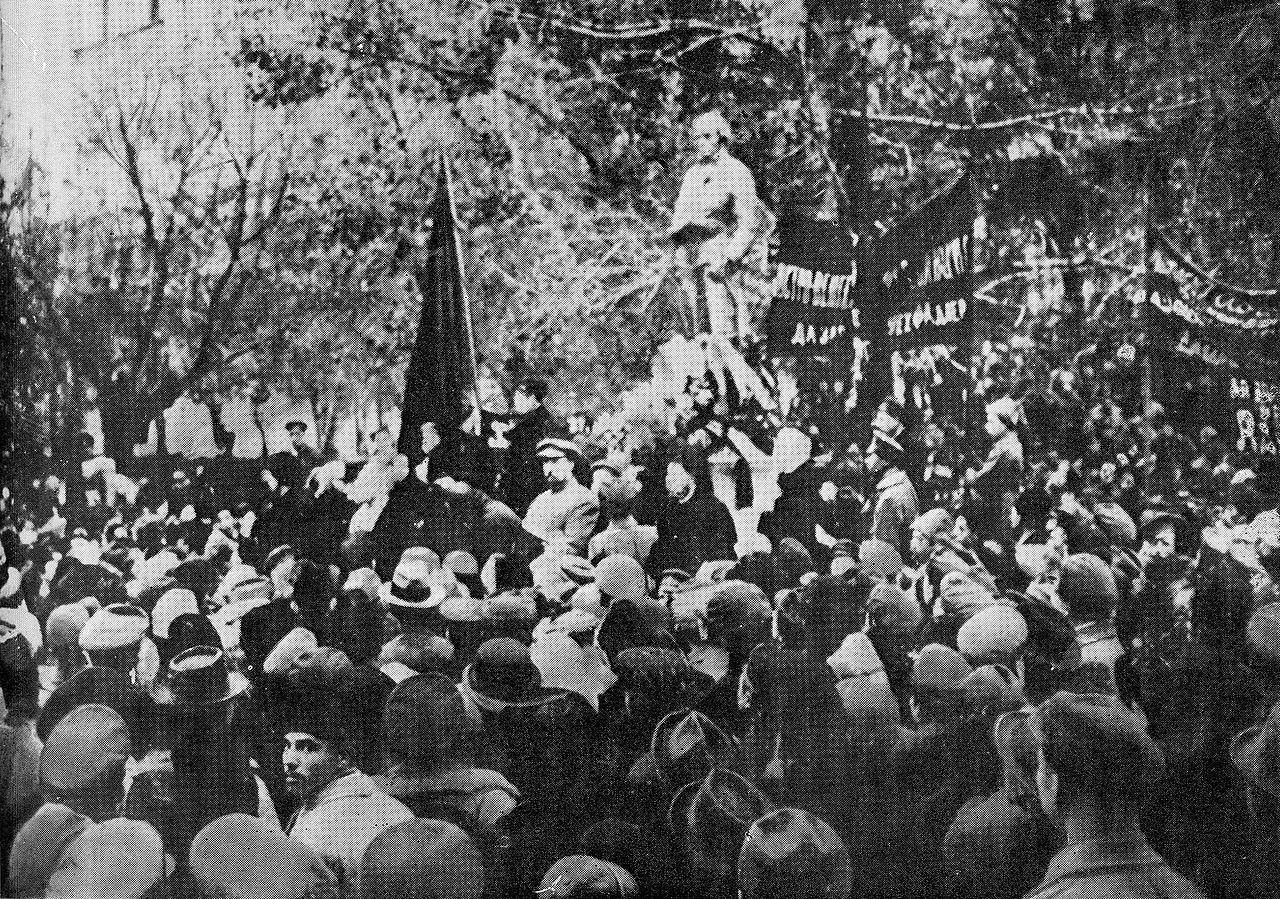
The “Soviet” Robespierre is a separate topic for the authors: “The October Revolution of 1917 in Russia turned the course of world history upside down; it became a stage in a long historical tradition in which great revolutionaries, including Robespierre, hold a special place. In young Soviet Russia, monuments to Robespierre multiplied, and his role—now a positive one—was played in theatrical plays.” The great French historian Albert Mathiez was delighted by this in an important text with the telling title “Bolshevism and Jacobinism” (1920), although he later distanced himself from his hasty words—disappointed by the political development of the Soviet Union.
The unveiling of the Robespierre monument in Moscow in 1918. Photo: Wikipedia
As Stalin’s Thermidor arrived, Robespierre’s status became more complicated and he remained a dual figure on the left: classified as “petty bourgeois” at the height of Stalinism, he was still celebrated vigorously in 1935–1936, for example, in the works of the repressed historian Nikolai Lukin—and by the Popular Front government in France, which needed republican unity but feared alienating the most moderate members of the political coalition.
The last three hundred years have passed under the signs and omens of the Enlightenment and Revolution, their acceptance or rejection. Robespierre sharply saw unbearable evil and sincerely wanted to improve the world, to revolutionize, reform, and rebuild it. “The authors of the weekly ‘L’Humanité dimanche’ in the May 21, 1975 issue, offered a whole chain of epithets: ‘Incorruptible? Careerist? Fanatic? Philosopher? Misogynist? Bloodsucker? Pacifist?’ But the man Maximilien Robespierre cannot be reduced to any one definition; the figure of the Incorruptible encompasses them all and ultimately transcends them,” the compilers of the collection conclude.
Robespierre. Portrait Against the Backdrop of the Guillotine / Edited by M. Biard, F. Bourdin; [trans. from French by A. Yu. Kabalkin]. — M.: KoLibri, Azbuka Publishing, 2025.
If you enjoyed this article, consider making a donation — one-time or, even better, monthly. Your support helps us motivate our authors and become better with every article.
Our organization is recognized by the Internal Revenue Service (IRS) as a 501(c)(3) tax-exempt, charitable organization, which means that all contributions made to us are tax-deductible to the fullest extent permitted by U.S. law. Individuals may generally deduct charitable contributions of up to 60% of their Adjusted Gross Income (AGI) for cash donations made to qualifying 501(c)(3) organizations. For donations of appreciated assets (such as stocks or other long-term capital assets), the deduction is typically limited to 30% of AGI, based on the fair market value of the asset. C-corporations may deduct charitable contributions of up to 10% of their taxable income for donations made to eligible charitable organizations.
By submitting a donation, you confirm that you have read and accept the following documents: Privacy Policy and User Agreement, and also give consent to the processing of your personal data.
If you would like to unsubscribe from a monthly donation, please email us at: [email protected]