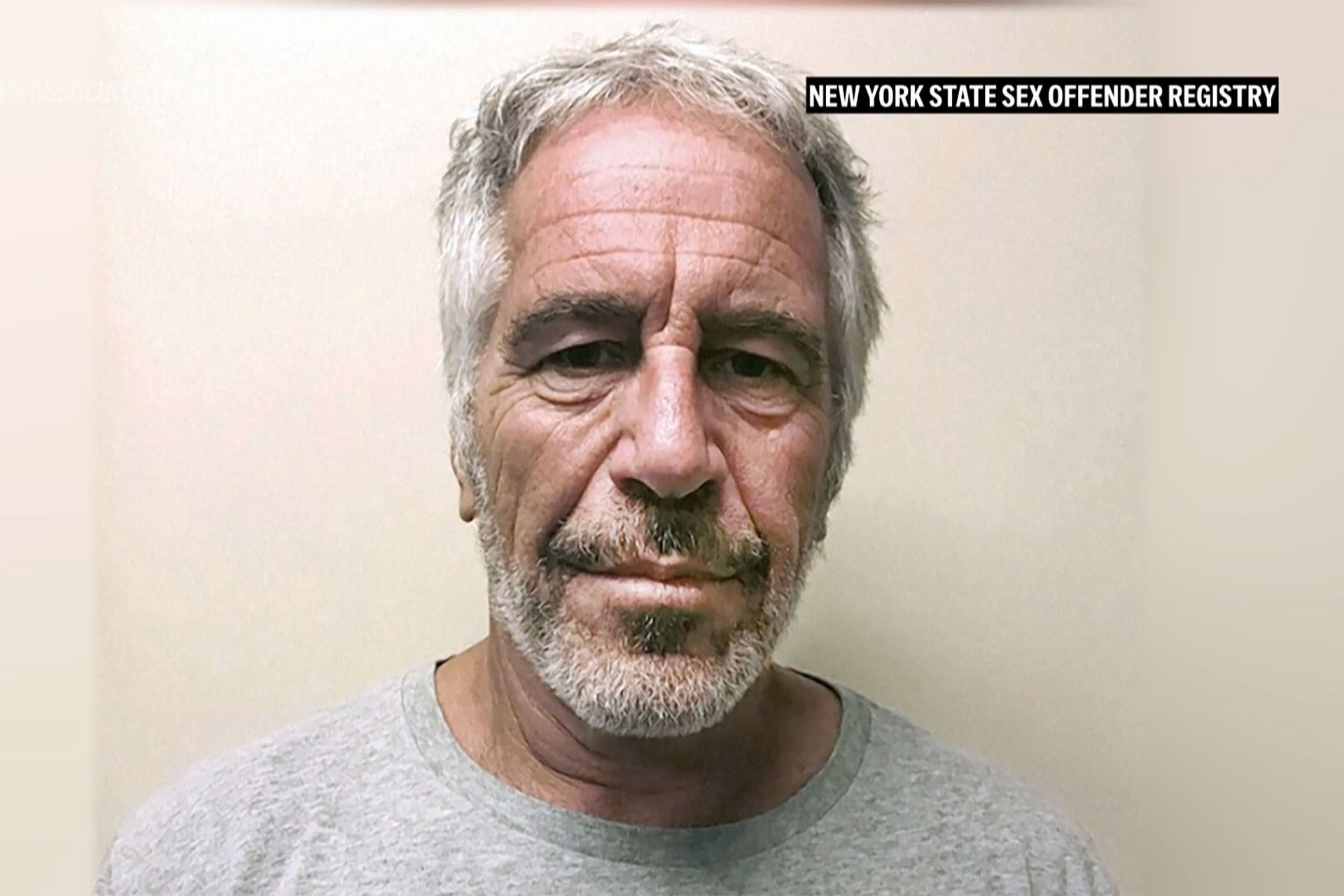
One of the most talked-about topics around the world is the dossier on American financier Jeffrey Epstein, who for decades organized elite sex parties with billionaires and politicians. On July 6, 2019, this man, already convicted of pimping and involving minors in prostitution, was arrested on new sex trafficking charges. A month and four days later, Epstein was found dead in his jail cell; the official version is suicide. Many see his email archive as a basket of dirty laundry from a notorious matchmaker and pedophile who meticulously documented the sexual preferences of his high-profile clients. In reality, things are much more complicated.
Frame from video: apnews.com
Recently, enthusiasts published a portion of Jeffrey Epstein’s dossier with a Gmail-style interface. Through thousands of emails—personal correspondence, business negotiations, news discussions—a more detailed portrait emerges. The portrait of a man tired of being a despised matchmaker, who set out to influence major international affairs—including with the help of Russian elites. The “Russian angle” runs like a dotted line through the entire correspondence of this would-be Augustus Milverton of world politics. Let’s take a closer look.
The Flynn Case: “No smoking gun”
Many people have already forgotten this scandal, but at the time it caused serious trouble for Donald Trump’s first administration. The rumors around Michael Flynn became a key element of the Russian probe—the investigations into alleged Russian interference in the 2016 US presidential election.
Who is Flynn and what did he do wrong? We’re talking about a retired (since 2014) US Army lieutenant general, a veteran of the wars in Afghanistan and Iraq. Flynn, initially a supporter of the Democratic Party, led the Defense Intelligence Agency under Barack Obama for two years. After retiring, he went into consulting, then joined Donald Trump’s 2016 campaign team.
On January 22, 2017, Flynn was sworn in as National Security Advisor to the 45th US President. However, by then, the general had already acquired questionable foreign ties. At the time of his appointment, Flynn was under federal investigation for lobbying for Turkey; the new advisor lobbied for abandoning the alliance with the Kurdish self-defense forces in the Syrian conflict—an American-Kurdish alliance that Ankara disliked.
In the end, Michael’s career was ruined not by his Turkish, but by his Russian connections.
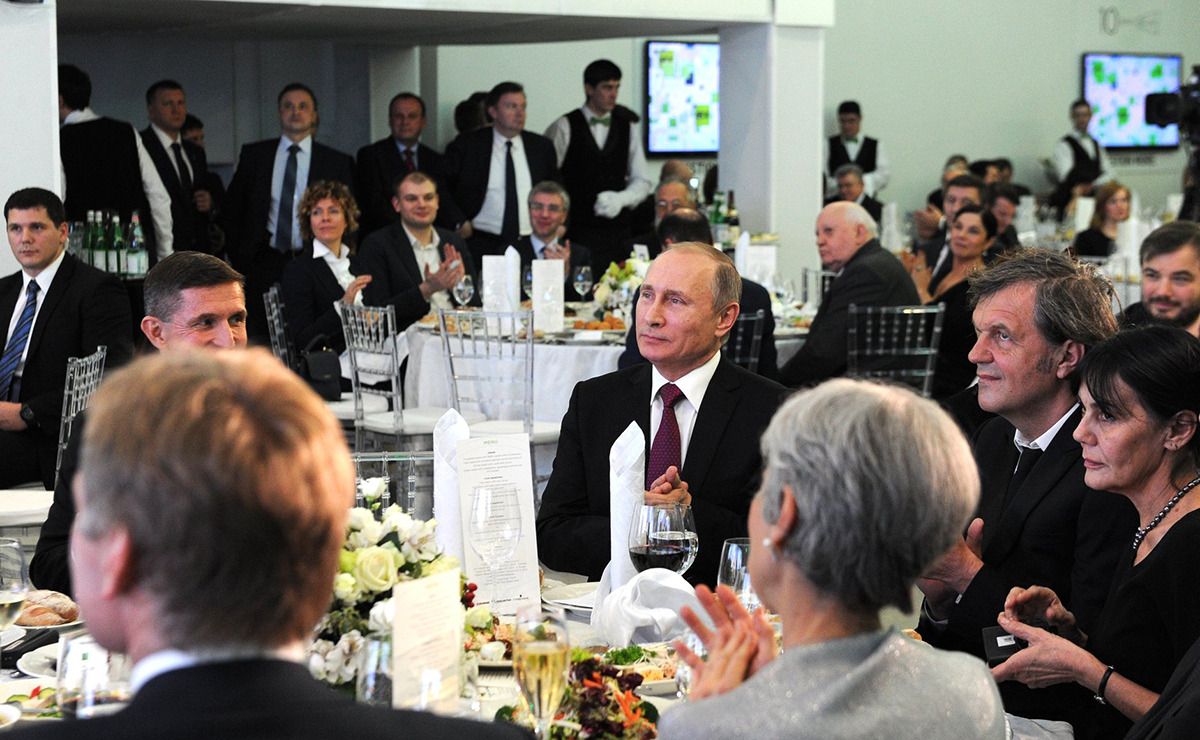
He collaborated with the pro-Kremlin agency RT, and on December 10, 2015, participated in a gala in Moscow marking the agency’s tenth anniversary. The American drew attention for sitting at the same table as Vladimir Putin and giving a speech on world politics. And he didn’t do it for free: as Congress found out a year and a half later, the Russian side paid him $45,000—in violation of the US Constitution, which forbids retired officers from accepting money from foreign governments.
Vladimir Putin at the 10th anniversary celebration of RT. To Putin’s left is Emir Kusturica, to his right is Michael Flynn. Photo: kremlin.ru
In the winter of 2017, Flynn was caught again. It turned out that in November 2016, the retired general, already close to Trump’s circle, had unofficial contacts with Russian Ambassador to the US Sergey Kislyak. They discussed lifting the then “Crimean” sanctions. A scandal broke out, and Flynn only made things worse by publicly lying that he hadn’t discussed sanctions with Kislyak, despite evidence to the contrary. On February 13, 2017, Trump had to fire his national security advisor—just three weeks after his swearing-in.
Flynn himself then faced charges of giving false statements. Epstein was indirectly involved in this process. Back in February 2017, in a conversation with an insider, his lawyer friend Reid Weingarten shared doubts about whether to take the case of the “Russophile” general. And in June 2018, Epstein helped controversial writer Michael Wolff work on a piece about this topic. It seems Jeffrey was trying to add drama while reducing specifics. Maybe Trump pushed Flynn to lie, maybe not. Prosecutor Robert Mueller seemed determined—but so far, the case looked more politically motivated, with no hard evidence that the ex-advisor’s lies were connected to the alleged Russian probe.
There is no hard evidence [no smoking gun], except for a number of often egregious, custom-breaking events that occurred over sixteen months of the current president’s term. Indeed, much of the evidence is based on the president’s public statements and tweets about these events.
- from Epstein’s letter to lawyer Brad Karp, the intermediary between him and Wolff
In the end, that’s what happened—Mueller’s investigation essentially failed. On November 25, 2020, Flynn received a presidential pardon from Trump as he finished his first term. Now, the retired general with a tarnished reputation is no longer aiming for a White House comeback, but frequently pleases the US ultraconservative public with antisemitic and pro-Putin statements.
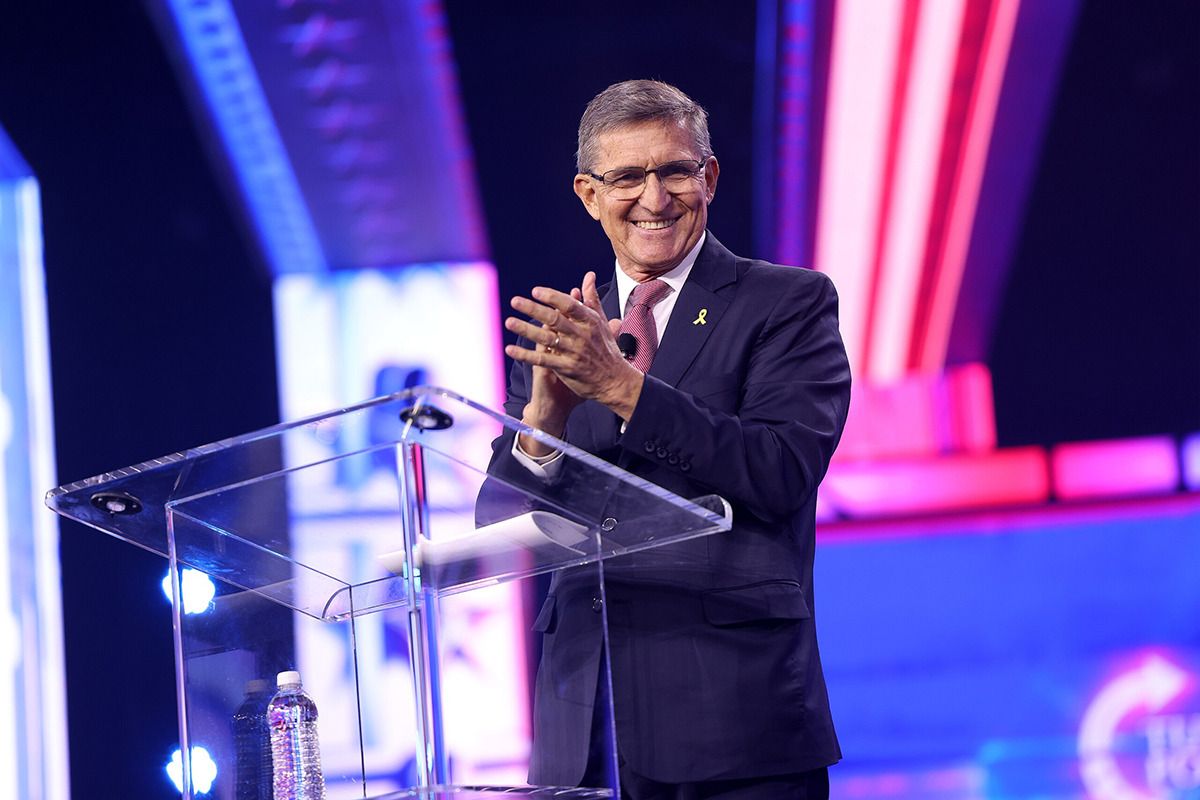
Former US National Security Advisor Michael Flynn speaks at AmericaFest 2024 in Phoenix, Arizona. December 20, 2024. Photo: Wikipedia / Gage Skidmore / CC BY-SA 2.0
The Manafort Case: “Any connection is a disaster”
Here we have a similar episode—another prominent figure from the US right-wing political scene caught in dubious schemes and deals with foreign partners. The difference between Flynn and Manafort is that the latter built his career in opposition to basic notions of right and wrong from the start.
Paul Manafort is one of the most famous lobbyists in US history. He became known for providing consulting services to notorious foreign leaders like Ferdinand Marcos of the Philippines, Siad Barre of Somalia, and Mobutu Sese Seko of DR Congo (Zaire).
Interestingly, in 2013, Manafort could have changed the course of Russia-Ukraine relations for the better.
While working for President Viktor Yanukovych, Manafort tried to persuade him to reconcile with the opposition and sign association agreements with the EU, but failed.
In 2016, Manafort decided to work at home and headed Trump’s campaign headquarters. Ironically, his boss’s success brought the political consultant nothing good. First, Ukraine’s new authorities sent an inquiry: Kyiv did not accuse the foreigner of anything, he was interesting only as a witness to corruption under Yanukovych. After that, Manafort attracted the attention of investigative journalists and law enforcement in the US. It turned out he had both received money from Russian businessman Oleg Deripaska and held private meetings with Russian lawyer Natalia Veselnitskaya, allegedly close to the Kremlin.
The result was an even bigger case than Flynn’s. Manafort faced a whole list of charges, including money laundering, tax evasion, witness tampering, and violating FARA obligations. In 2018-2019, the lobbyist was sentenced to a total of 7.5 years in prison by the US justice system. But eventually, he too received Trump’s mercy: in December 2020, Paul was pardoned.
So what does Epstein’s file have to do with it? The investor-pimp’s correspondence shows that for a while, Manafort became so toxic that even longtime partners wanted nothing to do with him. No one wanted to help.
On October 11, 2017, former Treasury Secretary Larry Summers advised Epstein to tell mutual friends (specifically, Trump associate Tom Barrack) that “any public connection with Manafort would be a disaster.”
Unofficial Contacts in Moscow: “Sergey will help you”
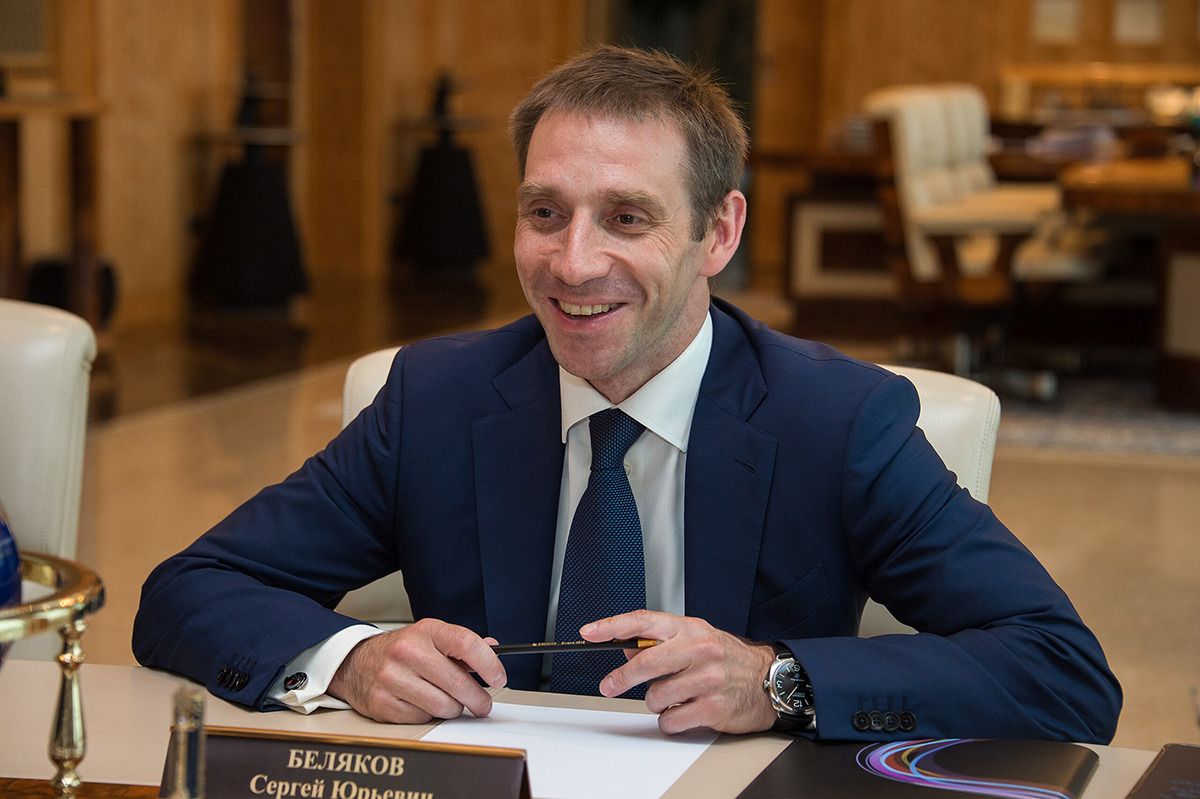
In the mid-2010s, Epstein apparently acquired his own contact in Moscow. As reported independently by Russia’s “Dossier” and the international project dropsitenews.com, this person was Sergey Belyakov, former Deputy Minister of Economic Development of Russia, who at that time oversaw the St. Petersburg International Economic Forum.
Chairman of the Board of the St. Petersburg International Economic Forum Foundation Sergey Belyakov at a meeting with acting President of the Republic of Tatarstan R.N. Minnikhanov, July 21, 2015. Photo: Wikipedia / Tatarstan.ru.
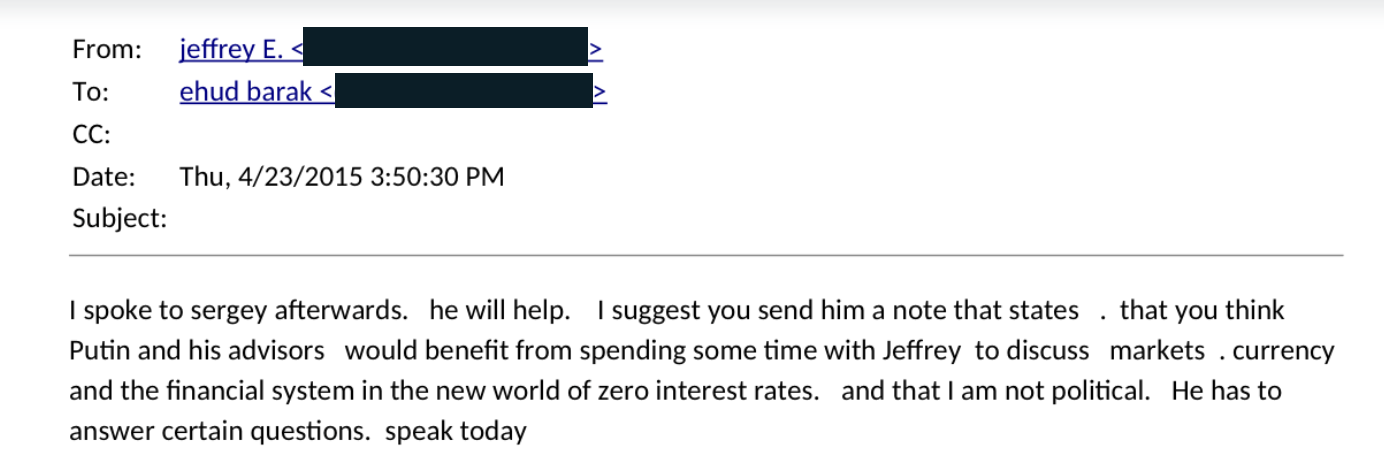
According to dropsitenews.com authors Ryan Green and Mustafa Hussein, Epstein tried to use his communication with Belyakov as a channel for secret diplomacy. It was claimed that in April 2015, the American recommended his Russian acquaintance to an old friend, former Israeli Prime Minister Ehud Barak, whose email was hacked in the summer of 2025. Ten years ago, Barak was allegedly looking for a backdoor to the Kremlin to discuss the Iranian nuclear program and the settlement of the Syrian civil war.
I spoke with Sergey… he will help. I suggest you send him a note saying that you think it would be useful for Putin and his advisers to spend some time with Jeffrey to discuss markets, currency, and the financial system in a new world with zero interest rates. And that I am not involved in politics. He needs to answer certain questions.
According to Green and Hussein, Epstein didn’t let his partner down. In June 2015, with Belyakov’s help, Barak really did meet with representatives of the Russian elite. The talks involved at least Russian Foreign Minister Sergey Lavrov and Central Bank Chairwoman Elvira Nabiullina.
The “Dossier” in its investigation described a different level of issues Epstein and Belyakov might have addressed. Allegedly, the American complained to the Russian about his compatriot, Moscow escort Guzel Ganieva: “Trying to blackmail a group of influential businessmen in New York.“ Belyakov reassured him that nobody “stood behind” Ganieva and that she could be pressured by banning her from entering the US—a “major threat to her business.”
Apparently, the partners resolved the sensitive issue for the time being. But six years later, Ganieva would still become the center of a public scandal, accusing New York tycoon Leon Black of sadistic tendencies. Black would win the case against the Russian woman without the help of his acquaintance Epstein—who by then had been dead for six years.
Looking for New Contacts in Moscow
In the summer of 2018, Epstein apparently decided his Russian connections were insufficient. As revealed in his published letters, he wanted to reach out directly to Putin and Lavrov. As an intermediary in this new venture, the American used Thorbjørn Jagland—former Norwegian prime minister and ex-secretary general of the Council of Europe.
On June 24, 2018, Epstein wrote a strange letter to the Scandinavian politician, clearly hinting at compromising material on Trump that might interest the Russians. The investor-pimp claimed to have already shared the necessary information with the late diplomat Vitaly Churkin, Russia’s permanent representative to the UN Security Council from 2006-2017.
Churkin was magnificent. After our conversations, he understood Trump. There’s nothing complicated about it, you just need to understand the simplest things.
With 99.9% certainty, nothing came of this correspondence. Jagland diplomatically promised to “pass everything to Lavrov’s aide next Monday”, but it’s far from certain that the respectable diplomat really wanted to help a man with such a dubious reputation. And even if the Norwegian did inform the Russian leadership, they may have doubted the reliability of such an ally. “There’s no evidence in further correspondence that Epstein gained any new Russian contacts,”summed up CBC News’s Mike Crowley.
Now we can only guess whether Epstein had real kompromat on Trump that he could sell to the Kremlin, or if his whole flirtation with Jagland was pure bluff. What’s certain is that by then, the American saw himself as a secret “kingmaker” capable of manipulating world capitals for his own interests.
Trump and the Saudis: “Is it a coincidence that the Russian guy knows everything?”
On May 30, 2019, Epstein corresponded with Michael Wolff—the same person he’d helped a year earlier with the Flynn case article. This time, Jeffrey didn’t restrain his partner’s enthusiasm; on the contrary, he tried to stoke it. Epstein proposed a conspiracy theory: Trump has a corrupt connection with the Saudi authorities.
The intermediary here was supposedly a certain The Russian. This trickster first sold MBS—clearly referring to the kingdom’s crown prince Mohammed bin Salman—a painting at an inflated price, then bought Trump’s Florida mansion; symbolically, it was a dispute over this property in 2004 that ended Donald and Jeffrey’s friendship. Immediately after, the US president vetoed an anti-Saudi Congressional resolution, essentially giving the Arab partners the green light for intervention in Yemen.
Is it a coincidence that the Russian guy who bought the Palm Beach house and knows everything is the same guy who last year sold the painting to MBS for $450 million? I have a guy who knows about this, and it’s really worth one and a half million.
- From Epstein’s correspondence with Wolff, May 30, 2019
The person who fits Epstein’s description perfectly is Dmitry Rybolovlev—former de facto owner of “Uralkali” and owner of the French football club “Monaco.” At various times, he really did sell a painting attributed to Leonardo da Vinci “Salvator Mundi” at a record price and buy Trump’s Florida mansion; both deals raised many questions, but a direct connection between them remains debatable.
In any case, Epstein tried to promote this theory and… it became one of the last affairs in his not-so-righteous life. A little over a month later, he would be arrested (an old sex trafficking case from the 2000s would resurface—Jeffreyinsisted to the end that there was nothing to worry about). And early in the morning of August 10, 2019, the businessman’s body would be found in a special unit of a New York prison Metropolitan Correctional Center.
None of the precautions that the administration of this venerable institution supposedly took to ensure the inmate lived until trial worked. Epstein’s “planted” cellmate was suddenly transferred at the last moment, both guards disappeared, and the video surveillance inexplicably failed at the crucial moments for Jeffrey. The man who tried to live off other people’s secrets left his own death as his greatest mystery.
If you enjoyed this article, consider making a donation — one-time or, even better, monthly. Your support helps us motivate our authors and become better with every article.
Our organization is recognized by the Internal Revenue Service (IRS) as a 501(c)(3) tax-exempt, charitable organization, which means that all contributions made to us are tax-deductible to the fullest extent permitted by U.S. law. Individuals may generally deduct charitable contributions of up to 60% of their Adjusted Gross Income (AGI) for cash donations made to qualifying 501(c)(3) organizations. For donations of appreciated assets (such as stocks or other long-term capital assets), the deduction is typically limited to 30% of AGI, based on the fair market value of the asset. C-corporations may deduct charitable contributions of up to 10% of their taxable income for donations made to eligible charitable organizations.
By submitting a donation, you confirm that you have read and accept the following documents: Privacy Policy and User Agreement, and also give consent to the processing of your personal data.
If you would like to unsubscribe from a monthly donation, please email us at: [email protected]