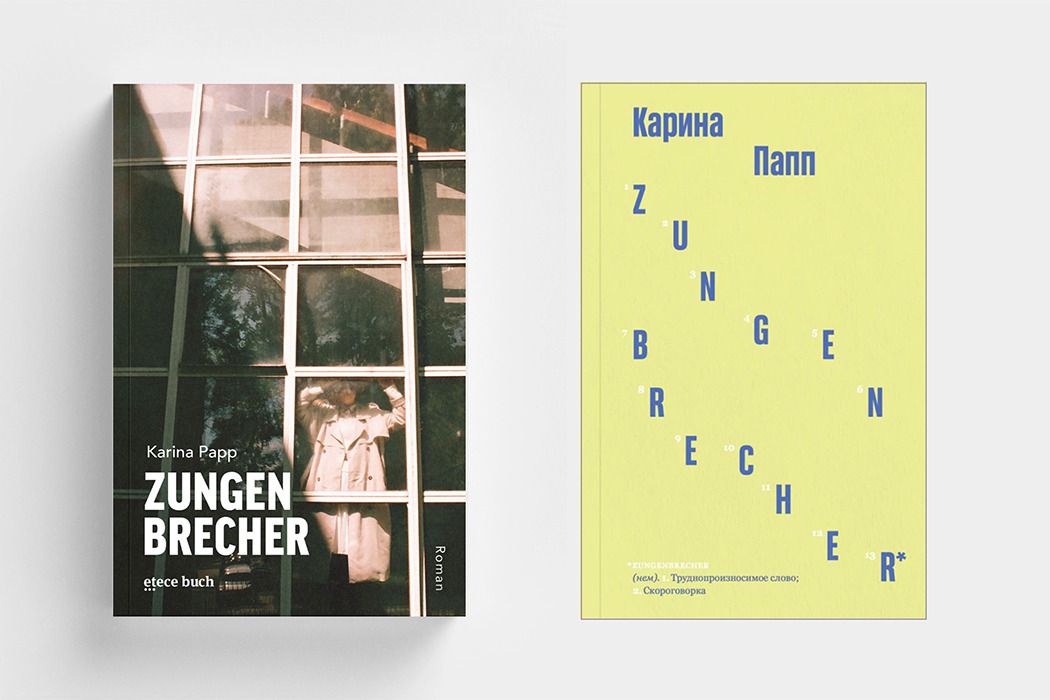
Kira, the main character of the novel Zungenbrecher, moves to Germany, learns German, works the night shift cleaning the kitchen of an expensive restaurant, falls in love with a girl, looks for her place in her new life, and tries to rebuild her relationship with her own past. The novel is structured like a kind of foreign-language textbook: the chapters are named after proficiency levels, and between them there are exercises for readers. At the heart of the novel is the personal experience of its author Karina Papp — a translator and writer with Hungarian roots, born in Riga and educated in St. Petersburg. Later, this multilayered identity was joined by emigration to Germany, queer experience, and the events of recent years — Russia’s full-scale invasion of Ukraine, volunteer work, and attempts to redefine her relationship to the Russian language, her country of origin, and her own place in the world. She wrote her first novel in German, a language that is not her mother tongue, and made a principled decision not to translate it into Russian herself — because her relationship with her native language after emigration and Russian aggression became one of the book’s central themes.
Karina Papp. Photo: Anna Malgina
- Why did you write the book in German rather than Russian, which is your native language?
- The story I was writing had lived inside me for many years. I think more than ten. Since this is probably also, in part, the story of my personal life — of a person in their late twenties who moved from one country to another, from Russia to Europe, and tried to find a place there somehow. So material for the story accumulated over many years. And when I felt some kind of writerly confidence in myself (this was already after the publication of my first short story, which was published in the journal “Ignorance” in 2020), it became clear that publishing my text in Russian would not be possible, because the laws were becoming ever stricter, and my story was in many ways tied to the realization of my own queer identity. And I absolutely did not want to censor myself in any way or remove that motif from the text; it was central to my text. So I simply understood that the book could not be written. And I was very upset. I realized then that there would be no novel at all. I did not want to write it for the drawer, hoping that one day it might eventually be published…
But when a German publishing house asked whether I had any ideas for a larger text, I said: of course, yes. Because if a publisher or a production company asks whether you have any ideas, you say: of course. Despite the depressive state, despite the fact that for half a year you are mostly volunteering and doing nothing else. But of course there are ambitions, and ideas too. And when I received an offer from a German publisher, I looked at the potential text, at the story itself, differently. Perhaps then the form of this project finally came together for me — as a literary performance, as I now call it, an experimental novel.
I didn’t write the text in Russian because, as a queer writer in 2022, I could not imagine that my text would have a life. That year another bill was introduced in the State Duma proposing to tighten administrative punishment for “propaganda of non-traditional sexual relations”. Those news stories left me paralyzed.
It seemed to me that there was no place for me in the Russian language. I was already constantly having to convince myself that it was “appropriate” to speak in Russian amid the full-scale invasion of Ukraine. Let alone write a love story.
Of course, queer people write in any times, under any conditions. But for me personally, at that specific moment, I simply did not have the strength to create this text. And only with the help of another space — a linguistic space — was I able to relax, breathe out, and start writing.
The creative process is often difficult work. And the possibility of switching into another language helped me write this book.
- You say that queerness is one of the main themes. But for me the main thing is still, probably, language. I know there is no translation of the title in the Russian edition. But how would you translate it yourself? How do you explain it to your mother, for example? And what do your friends who don’t speak German call the book?
- We still don’t know what people who don’t know how to pronounce the title call the book in Russian. That is also a continuation of the performance. We thought for a very long time about the title in the Russian translation — me, Anya [Rakhmanko, translator of “Zungenbrecher”], and our editors. In the end we decided that the best continuation of the performance would be that a word which in German also means “a hard-to-pronounce word” would be practically impossible to pronounce in Russian. So “Zungenbrecher” remains “Zungenbrecher”. If someone can’t pronounce it, they can call it “Karina Papp’s book”, “Karina’s first novel”, “the strange novel”, “the novel whose title cannot be pronounced” — something like that.
I didn’t want to translate the title with the word “tongue twister”. Although technically yes — tongue twister, zungenbrecher — that is a tongue twister. But the word “tongue twister” has a different linguistic play, and so the title loses the meanings embedded in “Zungenbrecher”. In German, Zungenbrecher literally means that which breaks the tongue. Its second meaning is a hard-to-pronounce word. A tongue twister is about something entirely different.
Zungenbrecher is also, in part, a device we use when learning a language, whether our own or a foreign one. Something difficult to pronounce. Like, for example, the heroine of the book finding it hard to talk about her queerness. Or about the war. Or about the fact that she is Russian. Something connected with the suppression of identity, which has to be brought out through language.
- And has your mother read your novel?
- As I understand it, my mother has not read the book. She knows it exists; even at the stage of editing the German text I told her what the book was about... My sister is reading it and says she likes it.
But I always felt strong support from my mother regarding the writing of this text. In the book there is a monologue by Kira’s mother, which is largely biographical [this passage refers to domestic violence — Most Media]. It was fairly easy for me to write in German — publishing it was the hard part. But when we got to translating this section into Russian, I became genuinely frightened. That was the first and only place where I thought: “Oh, and how is this going to come out in Russian?” But in the end I wrote to my mother and showed her the whole chapter. She said she really liked how it was written.
I told my mother about the specifics of autofiction as a genre, that it is a literary text and that so much of it has been reworked, and the father and mother figures have very little in common with my real parents. But I think it may be difficult for her to read. Zungenbrecher is the story of women whom their parents do not accept. Many elements of the narrative are invented, rewritten, but still I am like Kira’s prototype, and they are like the parents’ prototypes — we are emotionally connected to this text.
- Why did you need distance — the double narrative, Kira and the writer?
- At first I was writing Kira’s story. I wrote it in the first person. Often the material was my very personal experience, and describing it was difficult and painful. Sometimes I wrote passages in Russian, sometimes in English. At some point I realized that I was a little calmer when I wrote in English. And I started — among other things — making notes about how I was writing. That is how an additional layer appeared in the narrative: I began to tell not only what was happening to Kira, but also how the narrator was working on the text in 2022, 2023, and 2024. And at some point I decided to shift Kira’s story into third-person narration, to increase the distance between my personal experience and the literary text
I started translating the text into German already knowing that it would be published by a German publishing house. And that, of course, was also a special kind of editing. I increased the distance, saw the story from the outside.
So it ended up going from first person to third, from Russian to English, then to German. Three degrees of distance, three frames. I’m curious how visible that is in the Russian translation.
- Why didn’t you translate the text into Russian yourself?
- I worked on this text knowing that it would be published in my non-native language. And when it became clear that the text would come out in Russian, it seemed logical that I would translate the book myself. But I felt some kind of natural resistance.
The more real the idea of publishing my novel in Russian became, the harder it was for me to imagine how I would work with it in Russian. First of all, I didn’t really want to come into contact with this material again. Besides, I understood that if I translated the book myself, the very form of the book would change. “Zungenbrecher” is a novel-translation. When we talked all this through in a private conversation with Anya [Rakhmanko, the translator of “Zungenbrecher”] — and Anya, besides being a translator, is also one of my best friends — I said it would be wonderful if she translated the text. At first Anya resisted, but after a few conversations it became clear that this really was a beautiful solution for this novel. It was important to come up with a way to preserve the foreignness of this book. Native as foreign. For Anya, my Russian is still not her Russian. As someone who has lived in a German-speaking environment and works with German, Anya can catch different stylistic shades — where the language is purely German, and where it is Ausländer-German. We wanted to preserve the device, to continue the literary performance. And those rough edges, some grammatical oddities that I introduced into German — to transfer them into Russian.
- I was struck by this description: “Russian is my home with abusive patterns. One Russian word can comfort me, one Russian intonation can knock me off my feet. In Russian I do not feel whole, complete. In English I am always the one who is learning, and that means when I speak, I have the right to make mistakes”. What is your relationship with the Russian language like now? Is it still a language of violence? How closely is language tied to politics?
- I believe that the Russian language does not belong to the territory of the Russian Federation. The Russian language in which I wrote this book belongs to me and to my community, including the queer community. And now, five years later, my relationship with the Russian language has become different. There are more and more Russian-language texts that I stand in solidarity with, that support me. These are both literary texts and the texts of bloggers, people I read on Instagram or Telegram. They are written in a Russian language that is looking for new forms of expression. In this language, people argue, do activism, protest against violence.
It is a language of resistance. But because it is, to some degree, detached from the territory, from the Russian Federation, my Russian — the Russian I feel comfortable in — is like a Russian we took with us, carried into emigration, and now are trying to develop and nourish.
I don’t want to write in Russian as the language of “great Russian literature”. I continue to think about the Russian language, but today I feel more comfortable in it. And I want to keep working with it. I’m starting work on my second novel, and I want it to be published in Russian. I’ll write in Russian and English, maybe also in German. Apparently, this is becoming part of my writing practice — writing in different languages. But I would like my next novel to be published in Russian.
- The book includes an unexpected element: between chapters there are exercises styled like textbook tasks. The reader is asked not to insert missing articles, but to reflect on their own biography, fears, identity, and which words are still hard to say aloud. How did they come about and why are they needed in the text? Is that also part of the performance?
- I originally conceived the book as something that would be more like a foreign-language textbook. That was one of the very first ideas in terms of the text’s formal structure. So the text retains a division into modules, which mark the chapters. And there are exercises there too. I wanted to invent a device that would weave the format of exercises from language textbooks into the structure of the novel. I took the format of exercises from foreign-language textbooks, but changed their essence. The book’s heroine Kira is learning not only German. She is learning how to live. She is growing up; she is learning to be more honest, to accept herself. In other words, she is learning not only to speak German — she is learning to speak at all.
I very much wanted to keep that playful element — to show how getting to know a new language is like getting to know yourself.
But for me, all the elements of the book are up to the readers. You can skip chapters, skip exercises, skip pages. If someone finds the exercises uninteresting — don’t do them. And if someone wants to engage and work through them — I’m only glad. For me it is another element of the text that makes the book more interactive.
And one more thing about the modules. This structuring helped me enormously in building the narrative. In the table of contents you can see that the story begins at B1 level. Module 1 — Berlin, B1. Then St. Petersburg — B2. Berlin — C1. Budapest — A1. And Berlin again — A2.
And there is a key hidden in that, one that is clear to people who study languages. As adults, we do not start from the very beginning. We start from some non-first level. I often call this book a book about second adulthood. Coming of age for the second time. In “Zungenbrecher”, Kira grows up in another language, one in which she found herself as an adult. She grows up from level B1. We move along with her — B1, then B2, then C1 — Advanced! At this level of language learning (and self-knowledge?) we think: well, that’s it, now I understand everything. And then something happens, and we are back at A1.
In Kira’s story, that leap was marked, among other things, by a move into another language — Hungarian. She had to learn how to speak again. But the same thing happens not only in language. You start a new relationship — and again A1. You move to another city. You have a child. Some big event happens. And you are back at A1. And you think: how did that happen? I’m already 45, 58, and I’m at A1 again. But never mind, we move on. We always begin in the middle of the book, not at the very beginning. Because before that there were already other B1s, other B2s, other C1s. And it was this constant movement that I wanted to convey.
- I noticed that when I saw A1 and Budapest. I wanted to ask about this part of your identity. Would you be able to call yourself a Hungarian writer?
- Hungarian passport writer.
- Well, wait, your father and grandfather are Hungarian after all.
- It’s some kind of eternal longing for my unrealized Hungarianness, toward which I still strive. And I write about that in the book too. When I arrived in Budapest and found myself among those Hungarian letters, words, names, to my surprise I felt very comfortable, as if in my right place. But for a long time my Hungarian identity existed more as something absent, a negative space. My Hungarian surname, my father’s Hungarian first name — they made me seem more strange, more foreign, than they gave me a sense of belonging. And that negative space only began to fill after I moved to Germany. When I started studying Hungarian, Hungary’s history, working on Hungarian projects, after I lived in Budapest for several months — that was when I began building my own connection to my family’s Hungarian past.
So I probably wouldn’t call myself a Hungarian writer. But I definitely want to keep immersing myself in this language and this culture.
- Is there a moment in the book that you love most?
- I have always had a special tenderness for the passage at the end of the second module, when Kira, instead of coming out, reads Anastasia Pyari’s poem “We Are Having Sex”. I think it is a very gentle passage. The narrator treats her heroine like a young being, tries to support her. And I think that is one of the major themes of this text. The desire to support ourselves in our youth. To look back from another point in time at how hard it was for us then, but already knowing that in the end everything will be all right. This backward gaze into the past is one of the main threads connecting the book’s heroine Kira and the narrator, the real events of my life and the fictional world I created for this text.
If you enjoyed this article, consider making a donation — one-time or, even better, monthly. Your support helps us motivate our authors and become better with every article.
Our organization is recognized by the Internal Revenue Service (IRS) as a 501(c)(3) tax-exempt, charitable organization, which means that all contributions made to us are tax-deductible to the fullest extent permitted by U.S. law. Individuals may generally deduct charitable contributions of up to 60% of their Adjusted Gross Income (AGI) for cash donations made to qualifying 501(c)(3) organizations. For donations of appreciated assets (such as stocks or other long-term capital assets), the deduction is typically limited to 30% of AGI, based on the fair market value of the asset. C-corporations may deduct charitable contributions of up to 10% of their taxable income for donations made to eligible charitable organizations.
By submitting a donation, you confirm that you have read and accept the following documents: Privacy Policy and User Agreement, and also give consent to the processing of your personal data.
If you would like to unsubscribe from a monthly donation, please email us at: [email protected]