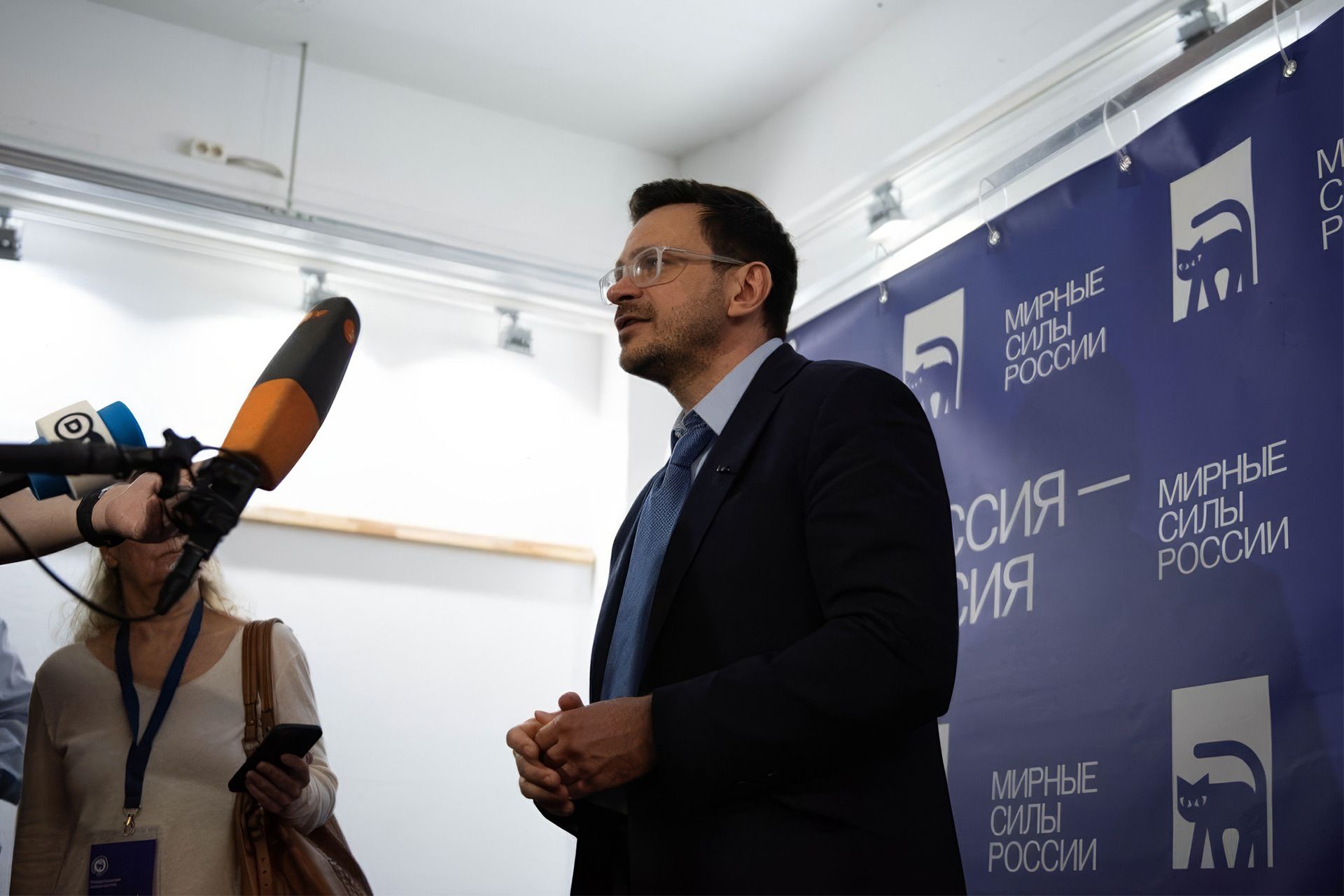
In June, Russian opposition figures led by Ilya Yashin created the Peaceful Russia party in Berlin, which stands against the war and Vladimir Putin. But its vision of the country’s future largely reproduces the same centralized model of power that the opposition itself usually criticizes
Photo: SOTAvision
Over the 26 years of his rule, Vladimir Putin has built in Russia a rather rigid imperial regime of the “vertical of power”. All governors are in practice appointed from the Kremlin, and regional political parties that could oppose this hyper-centralism from the perspective of local civic communities are banned.
It is hard to call this policy merely a Soviet legacy. It inherits a much older doctrine of “Moscow as the Third Rome”, which emerged back in the 16th century. This doctrine endowed Moscow with a “sacred” right to unite and control Slavic lands.
This is precisely what explains the centuries-old rivalry between Moscow and Kyiv, whose first architectural monuments appeared when there were still dense forests on Muscovite lands. That is why the recent barbaric strike by Russian drones on the Kyiv-Pechersk Lavra, a UNESCO World Heritage site, looks highly no coincidence and symbolic. Nevertheless, the head of the Moscow Patriarchate, Kirill, actively supports the war against Ukraine, calling it “holy“.
The hierarchs of the MP consider themselves “the most true Orthodox Christians”, but in fact they have found themselves isolated from the entire Orthodox world, breaking ties with the Ecumenical Patriarch and many local churches. Moscow Orthodoxy has long openly demonstrated that it is merely one of the tools of Kremlin imperial power, whatever its ideological guise
Political scientist Alexander Morozov believes that in the situation of the prolonged war with Ukraine, Moscow’s mental centralism is completely collapsing, while in emigration a post-imperial Russian language is taking shape. By the way, the collapse of this centralism can already be seen literally too — under the blows of Ukrainian drones that are piercing Moscow’s “impregnable” air defenses. But still, in my view, Alexander is too optimistic. Because most opposition figures and researchers who have “relocated” abroad continue to think in capital-centered, centralist patterns.
How will the post-Putin “strong center” differ from Putin’s?
Russian scholars Irina Busygina and Mikhail Filippov, now teaching at American universities, believe that a “strong center” will be necessary for a post-Putin transition. But in their view, this center should be strong not in Putin’s aggressive imperial sense, but in a way that ensures democracy, “maintains a common legal space, and guarantees the unity of rules”.
This idea somewhat resembles Mikhail Gorbachev’s project for concluding a new union treaty in 1991. That project was quite democratic, was based on the Universal Declaration of Human Rights, and provided for the republics’ maximum self-government. However, it was largely undermined by the capital role of Moscow закрепed in it. But most republics no longer wanted to see a common capital in this historical symbol of imperial “gathering of lands”.
And today many opposition politicians and researchers in exile are too fascinated by setting “all-Russian” agendas, although it is still completely unclear what regions the post-Putin Russia will structurally consist of. It would be wise to think through that structure specifically, involving the regions in participating in it, rather than inventing some centralist principles right away.
First, the regions should gain their political agency and sovereignty through the free election of their own parliaments. Then social and economic interdependence will inevitably raise the question of a new federal treaty. The United States, as the first federation on the planet, were created precisely on the basis of this dialectic. And by the way, the supporters of independence did not make some large city their capital; they deliberately built the relatively small Washington in the District of Columbia.
It is worth recalling that in most other federations in the world (Canada, Australia, Brazil, Switzerland), the capital does not coincide with the largest city either. And in Russia, Moscocentrism remains the basic principle, and this predetermines the political and economic dominance of one megacity over other constituent entities, blocking any attempts to build an equal federation.
The preservation of this Moscow-centered model is often justified by fears of the “collapse of the country”. But if any region, because of its particular ethno-cultural specificity or other factors, wishes not to join a new federation but to remain independent, that should be its full right. In that case, it would itself significantly complicate its own problems — customs posts with neighbors would have to be established, bureaucracy would have to be sharply expanded, and so on. But if this right is absent in any post-Putin future, then we will face yet another return of Russian history to the imperial track. A self-sufficient “strong center”, assumed by default in Moscow itself, will inevitably suppress the negotiated space of the regions.
Moscow economists working abroad, Vasily Burov and Alexey Yakovlev, also write about the post-Putin “transition period”. And again, like Busygina and Filippov, they proceed from Moscocentrism as something “self-evident”. For example, they discuss the need for a future “budgetary treaty with the regions”, but immediately warn against “full federalization with a weak center”. But if they advocate new federal principles, why and on what basis do they a priori speak on behalf of some “strong center”? Who elected them to that role? In a real federation, Moscow should be, yes, the most populous, but still only one of equal regions.
“Russia is still a Moscocentric country”, notes another economist, Igor Lipsits, critically assessing the fashionable idea of moving the headquarters of major state companies to the regions. “All decisions are made in Moscow, communication is in Moscow, meetings are in Moscow... Therefore, any state company that lives in continuous symbiosis with the apparatus of the federal government tries not to leave Moscow. That is how Russia is arranged. Moscow is the center of life, and it can lose its importance only if Russia falls apart altogether”.
It is simply astonishing that neither the United States, where major companies are spread across different states, nor Germany, where they are registered in different Länder, have yet fallen apart. But the stereotype of the Russian “strong state” inevitably implies Moscocentrism.
The opposition party Peaceful Russia, created in June in Berlin, also appeals to the “strong state”. It, of course, stands against the war with Ukraine, but it is striking that its political wording is almost no different from that of the ruling United Russia party. The leader of this party, Moscow politician Ilya Yashin, declares: “We are a party of healthy patriotism and defend Russia’s interests”. In essence, the difference from United Russia here lies only in the interpretation of some terms.
If independent researchers and opposition politicians in exile were truly offering post-imperial projects, Moscocentrism in them would not be something unconditional and obvious at all. For example, at the time of the European Union’s creation, its members agreed that the EU’s political center would not be some former imperial capital like Berlin or Paris, but the relatively small Brussels. And in the case of a real de-imperialization of Russia, something similar should be expected. And an a priori Moscocentrism means the preservation of the imperial paradigm.
A European term unknown in Russia
Subsidiarity is a term rarely used in Russian political vocabulary, but for European law it is one of the basic ones. This principle means building policy “from the bottom up”, when most issues are decided at the level closest to citizens, and only those that local administrations cannot handle on their own are transferred to higher levels.
For example, municipal governments handle the main social issues of their residents, but delegate intermunicipal communication problems to the regional level. Accordingly, regional parliaments also pass many local laws, while leaving interregional interaction issues to the federal authorities — of course, provided they are freely elected and accountable to citizens. It is by such a principle that trees grow and houses are built. And some Russian opposition figures, as well as the Kremlin authorities themselves, are trying to build a house starting with some “common roof”, and then force all regions under it.
If you enjoyed this article, consider making a donation — one-time or, even better, monthly. Your support helps us motivate our authors and become better with every article.
Our organization is recognized by the Internal Revenue Service (IRS) as a 501(c)(3) tax-exempt, charitable organization, which means that all contributions made to us are tax-deductible to the fullest extent permitted by U.S. law. Individuals may generally deduct charitable contributions of up to 60% of their Adjusted Gross Income (AGI) for cash donations made to qualifying 501(c)(3) organizations. For donations of appreciated assets (such as stocks or other long-term capital assets), the deduction is typically limited to 30% of AGI, based on the fair market value of the asset. C-corporations may deduct charitable contributions of up to 10% of their taxable income for donations made to eligible charitable organizations.
By submitting a donation, you confirm that you have read and accept the following documents: Privacy Policy and User Agreement, and also give consent to the processing of your personal data.
If you would like to unsubscribe from a monthly donation, please email us at: [email protected]