The escalation of mutual threats between Lukashenko and Zelensky has been steadily intensifying over the past three months. And it has not been only words: things are quite serious
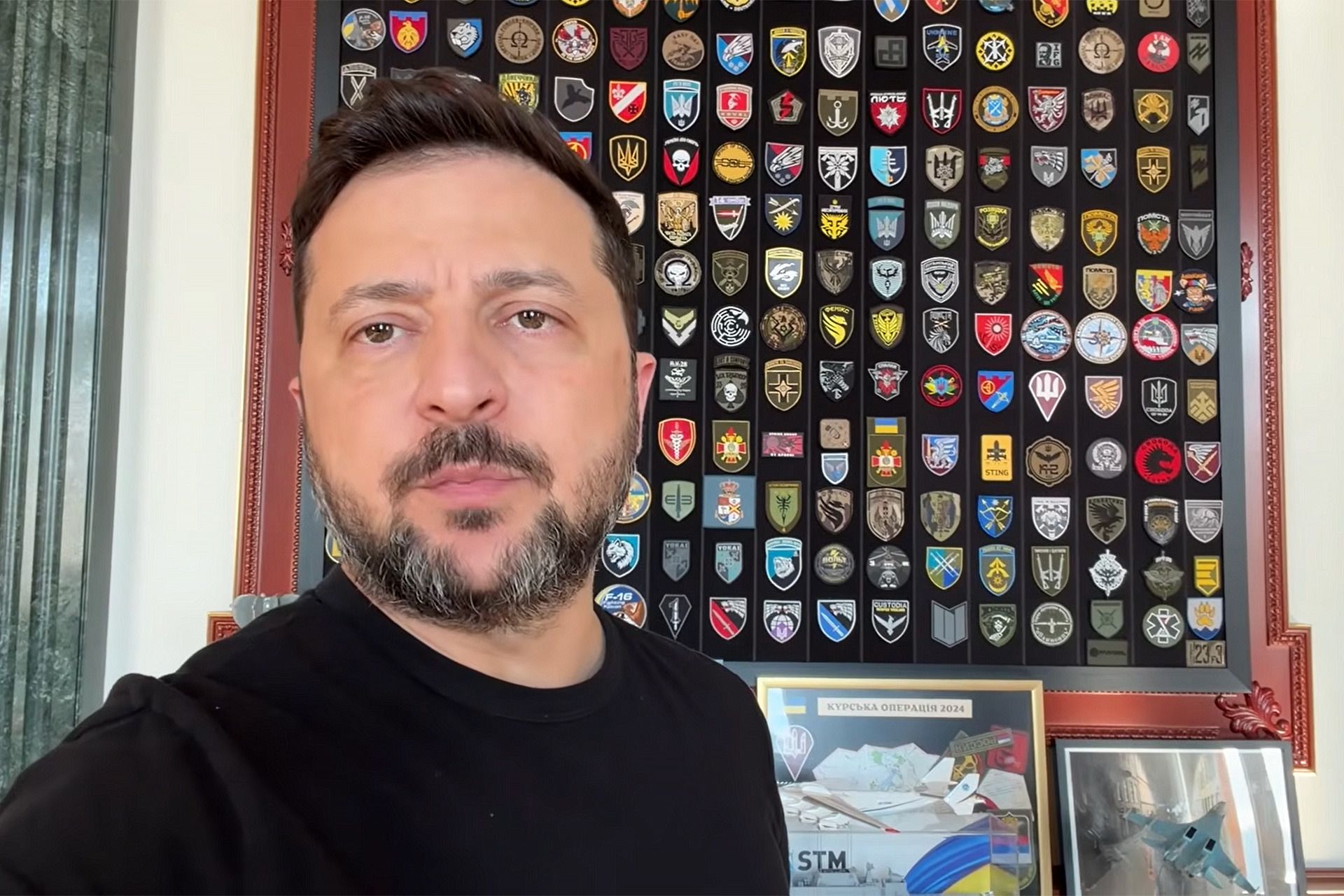
Frame from video: Office of the President of Ukraine
Last Thursday, Ukrainian President Volodymyr Zelensky at a press conference in Kyiv gave Belarusian leader Alexander Lukashenko a week to remove from his country's territory four powerful relays that direct Russian drones over Ukrainian cities and villages, and also to stop supplying oil products to Russia. Otherwise, the Ukrainian leader added, “we will do it” (Ukraine).
“On his territory, along two regions bordering Ukraine, there is equipment that corrects fire on the Ukrainian population, precisely on the population.... They are killing civilians there. There are relays on the corresponding towers. Can he remove this? Why say that he does not want to take part in the war? Let him remove this equipment, let him switch off this equipment... I think a week will be enough for him to do it... If he does not do it, we will”, Zelensky said.
And so that no one would have any doubts about the seriousness of his intentions, Zelensky almost verbatim repeated his ultimatum to Lukashenko on June 20 in his traditional daily address to the nation.
The escalation of mutual threats between the presidents of Ukraine and Belarus has been steadily intensifying over the past three months. And it has not been only words.
At the end of March, Lukashenko carried out a so-called “comprehensive inspection” of the Armed Forces of Belarus. The phrase itself vividly recalled the “sudden inspections” (de facto operational exercises) of Russian troops, which Putin repeatedly held in 2021-22 on the eve of Russia's full-scale invasion of Ukraine.
Following the results of his inspection on April 1, Lukashenko stated that “there can be no peaceful time at all”, and that the exercises were “as close as possible to combat conditions, without allowances for weather or time of day”. It is characteristic that literally the day before, he flew to Pyongyang, where he signed a friendship and cooperation treaty with the head of North Korea's dictatorship, Kim Jong Un“.
Ukrainians, naturally, continuously monitor everything that happens on the other side of the Ukrainian-Belarusian border, and for a long time noted that nothing dangerous was happening there yet. However, on May 1, Zelensky wrote: “The day before, there was rather specific activity at sections of the border between Ukraine and Belarus — from the Belarusian side. We are carefully recording everything, controlling everything, and, if necessary, we will respond. Ukraine is ready to defend its people, its sovereignty, and everyone should understand this, especially those whom they are trying to drag into any aggressive activity against Ukraine”.
The Ukrainian leader added that “according to intelligence data, roads are being built in the border areas of Belarus in the direction of Ukrainian territory, and artillery positions are being equipped”.
All of this looked very alarming. It was obvious that none of the neighbors intended to attack Belarus: Ukraine is occupied with a full-scale war with Russia; Poland and the Baltic states, if they are preparing for war, are only preparing defensively. From all this, the conclusion followed that Lukashenko's regime was preparing to take full part in the war against Ukraine. Putin has been seeking this for four years already.
At the end of May, Zelensky warned Lukashenko against taking part in such an adventure, noting that the Ukrainian Armed Forces had identified 500 targets on Belarusian territory. In response, Lukashenko said: “Maybe they identified 500 targets. We have one target, a very serious one, with exact coordinates”.
However, on June 15, Lukashenko offered Zelensky a public apology for this threat: “Perhaps I did overdo it somewhere, but this was a response to his groundless statements: “Yes, we have 500 targets, yes, we know where Lukashenko is. We will strike with missiles and drones tomorrow...If Volodymyr Oleksandrovych was offended, I apologize to him for these words. Perhaps it was not necessary, considering that he is still at war. Perhaps I should not have spoken so sharply about it“. And he added that Belarus is ”very vulnerable in military terms“. ”We have said many times that it is absolutely unacceptable for the war between Ukraine and Russia to spill over onto Belarusian territory“, he said.
It is characteristic that the Belarusian dictator's sharp change in tone happened even before the spectacular Ukrainian missile and drone strikes on Moscow on June 16 and 18, during which a number of major facilities were damaged, in particular, a warehouse on the territory of Moscow's largest shopping center, Sadovod, as well as the Moscow oil refinery in Kapotnya, which produces 40% of the gasoline and 50% of the diesel fuel for the 13-million-strong city. The plant was so badly damaged that it was shut down.
As it seems, Lukashenko's tone changed first of all in connection with previous foreign policy events. In particular, in connection with exercises conducted by French strategic aviation capable of carrying nuclear weapons. The exercises were carried out jointly with Polish F-16s.
Before that, Britain held strategic exercises — another European NATO country that, along with France, possesses nuclear weapons.
The picture is also complemented by a recent statement by the commander of the German Air Force, Holger Neumann, who in an interview with The Telegraph said that if it comes to war with Russia, NATO will deliver massive retaliatory strikes against targets in the Kaliningrad region, on the Kola Peninsula, in the Black Sea area, as well as at the basing sites of the Baltic Fleet in the St. Petersburg area.
“If they call me right now and say that the corresponding situation has arisen, we must be ready immediately. And we are ready”, Neumann emphasized.
The massive Ukrainian drone strikes on Moscow, St. Petersburg, and even Tyumen also sobered Putin and his junior partner Lukashenko.
And so, against the backdrop of all these developments favorable for Ukraine, Zelensky's ultimatum to Lukashenko was heard. For Lukashenko in today's realities, it is practically impossible to fulfill. Because even if the Belarusian dictator wanted to meet these demands from Zelensky, he would not be able to do it. Today he is no longer the full master of his country, as he once was.
Out of fear of losing power after the Belarusian revolution of 2020, Lukashenko himself turned his country into a Russian protectorate with his own hands. The invasion of Russian troops into the territory of Ukraine in February 2022 took place, among other things, from the side of Belarus. Lukashenko allowed Russian nuclear weapons, Russian military bases, and relays for Russian drones to strike Ukraine to be placed on his territory. Belarus produces parts for Russian missiles and oil products for Russian consumers, including the army itself.
Zelensky, of course, knows all this very well. But in that case, his demands on Lukashenko are not an ultimatum, but casus belli (a cause for war). And if so, it is worth considering what is causing this now.
Dizziness from success? Undoubtedly. There really are successes.
Under conditions of restricted supplies of anti-missiles from the United States, both for objective and subjective reasons (Trump and his supporters in the American leadership), and with the still limited capabilities of the European military industry, Ukraine has achieved impressive success in creating its own air defense means — drones and missiles — and is continuously increasing their production.
Ukraine is moving toward a predominantly professional basis for staffing its Armed Forces, which in the situation of public fatigue from the war should strengthen the motivation of fighters.
The Russian army's “spring-summer offensive” is stalling, losses are growing, and according to my calculations, based primarily on Russian data, they have already reached more than 400,000 killed alone. The head of British intelligence, Anne Keast-Butler, estimates the number of killed Russian servicemen at 500,000 personnel. And that is not counting nearly a million wounded. In addition, Ukrainians today are liberating more of their territories than the Russian Federation is capturing.
However, preemptive Ukrainian strikes on Belarus will inevitably lead to this country entering the war against Ukraine.
Lukashenko has said that in the event of mobilization he could increase the army to half a million people. Is this realistic for a country of 9 million? Yes, quite. It is generally considered that the limit of a country's mobilization resources is around 10% of its population. But that is almost the limit of possibilities. 500,000 people out of 9 million is almost twice below that threshold.
If the Ukrainian leadership is counting on Lukashenko's overthrow by the Belarusians themselves, it will make the same mistake as the Trump administration in Iran. The US president clearly hoped for the overthrow of the ayatollah regime in Iran after the start of the American-Israeli operation against that country. And an uprising could certainly have begun if Iran had suffered a crushing defeat in this war. But that did not happen, and the Americans achieved the opposite — the unification of Iranians against the United States.
The same will happen in Belarus, if, of course, it is not instantly crushed by Ukraine. But that would require a full-fledged ground invasion, for which Ukraine does not currently have the forces. Long-range Ukrainian strikes will only unite Belarusians around Lukashenko, just as the invasion of Ukrainian troops into the Kursk region united the population of the Russian Federation.
Thus, in the event of preemptive strikes on Belarus, Ukraine will get yet another full-fledged front and another, quite serious, adversary. That would be a terrible mistake by Kyiv. However great the desire to defeat the enemy and his proxies may be, sometimes restraint and statesmanship are more important.
If you enjoyed this article, consider making a donation — one-time or, even better, monthly. Your support helps us motivate our authors and become better with every article.
Our organization is recognized by the Internal Revenue Service (IRS) as a 501(c)(3) tax-exempt, charitable organization, which means that all contributions made to us are tax-deductible to the fullest extent permitted by U.S. law. Individuals may generally deduct charitable contributions of up to 60% of their Adjusted Gross Income (AGI) for cash donations made to qualifying 501(c)(3) organizations. For donations of appreciated assets (such as stocks or other long-term capital assets), the deduction is typically limited to 30% of AGI, based on the fair market value of the asset. C-corporations may deduct charitable contributions of up to 10% of their taxable income for donations made to eligible charitable organizations.
By submitting a donation, you confirm that you have read and accept the following documents: Privacy Policy and User Agreement, and also give consent to the processing of your personal data.
If you would like to unsubscribe from a monthly donation, please email us at: [email protected]