“The Battle of Algiers” has been considered the most influential political film for 60 years now. The resonance after the release of this film, shot in the traditions of Italian neorealism, sparked a wave of decolonial movements in different countries. Gillo Pontecorvo’s film with Ennio Morricone’s soundtrack is included in rankings of the greatest cinema of all time, and the methods of underground struggle are still used by activists around the world, including Russia.
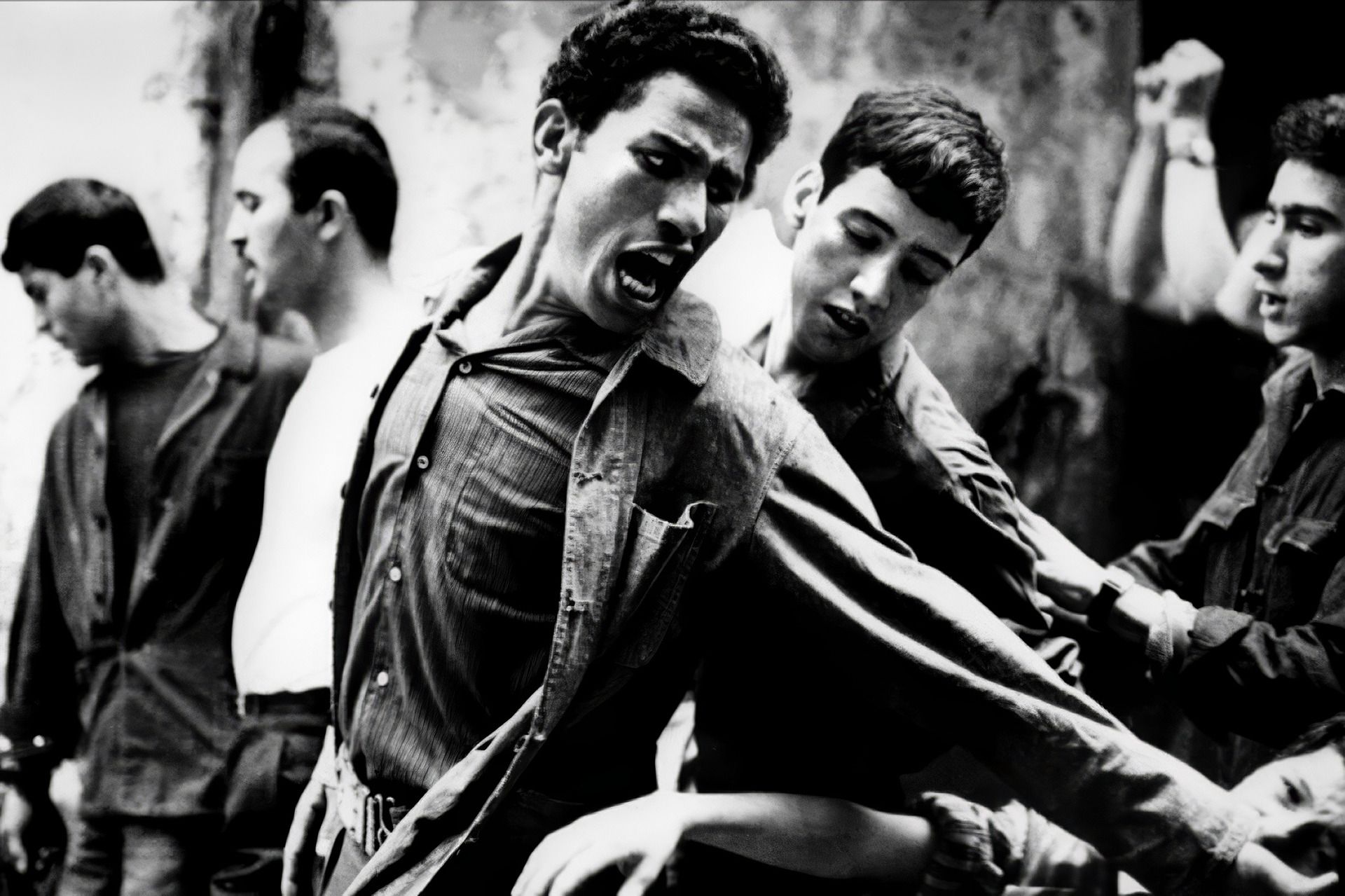
Still from Gillo Pontecorvo’s film “The Battle of Algiers” (1966). Source: Kinopoisk
The premiere of the film “La battaglia di Algeri” took place on August 31, 1966, at the Venice Film Festival. There the film won the top prize — the Golden Lion. This docudrama, an Italian-Algerian production, tells the story of Algeria’s war for independence (1954-1962).
In the middle of the last century, Algeria remained a French colony. The country managed to win independence in 1962 after a bloody struggle with the metropole. France used arrests, torture, and the killing of civilians against Algerians — all those ugly methods that empires still use in colonial wars to this day.
The film came out literally just a few years after the events described. How fresh the wounds of defeat were for the French is shown by the fact that the French delegation left the Venice festival. In France, the film was first officially banned, and then, because of political pressure and threats, it was not released for about five years — right-wing activists threatened to blow up any cinemas that dared to show it.
***
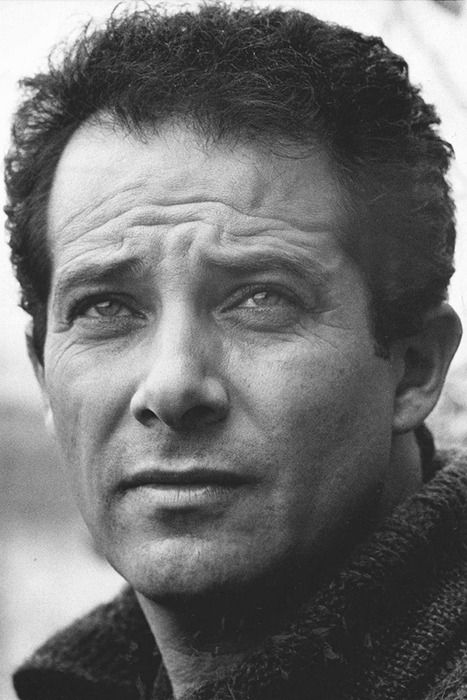
The director of “The Battle of Algiers” is the Italian Gillo Pontecorvo. After Mussolini’s regime passed a series of antisemitic laws in 1938, 19-year-old Gillo, who was Jewish by origin, moved to Paris. There he became acquainted with the world of cinema and leftist ideas. In 1941, Pontecorvo joined the Communist Party and returned to Italy to take part in the anti-fascist resistance. Under the call sign “Barnaba”, he became one of the leaders of the partisan movement in Milan in 1943-1945.
Gillo Pontecorvo. Photo: DR
In 1956, Pontecorvo left the Communist Party in protest against the Soviet invasion of Hungary, but he retained left-wing beliefs until the end of his life. Before “The Battle of Algiers”, the director had already made two political films, and he would make two more after it. However, “The Battle” would remain the peak of his career.
The screenplay for this film was based on the memoirs of one of the Algerian revolutionaries, Yacef Saadi. He was born into a poor family of Berber origin. During the struggle for Algeria’s independence, he was one of the leaders of the “National Liberation Front” — the guerrilla movement that played a key role in the war. In 1957, Yacef was detained by the French army and sentenced to death. However, due to the changed political climate in France, the sentence was commuted to imprisonment. He, who was poorly literate, dictated his memoirs to a fellow inmate in prison.
After Algeria gained independence, Yacef was pardoned and released. Then he, a passionate film lover, began looking for a director willing to adapt the story of his homeland’s war for independence. After several refusals, the revolutionary reached Pontecorvo. He agreed, although at first he considered the script too propagandistic. In the end, the screenwriters were the Italian writer Franco Solinas and Pontecorvo himself, while Saadi played one of the main roles in “The Battle of Algiers” and served as co-producer of the film.
In other words, the main creators of the film about resistance had real guerrilla experience.
***
The film was a resounding success: besides Venice, it was also praised in the United States, where in 1967 it was nominated for an Oscar as Best Foreign Language Film, and in 1969 it received two more Academy Award nominations — for directing and screenplay (a rare case in film history when the same film was nominated for an Oscar in different years).
So what is it about “The Battle of Algiers” that so amazes viewers?
In genre terms, it is a reconstruction. However, Pontecorvo achieved an effect of incredible “documentary realism”. In American advertising of the time, they even specifically explained that there are no actual newsreel shots in the film at all. The film consists of sequential episodes resembling a news chronicle. The project featured nonprofessional actors — Algerians who were contemporaries and witnesses of the events. Yacef Saadi in fact essentially plays himself in the role of the revolutionary Djafar El-Hadi. The only exception was the French actor Jean Martin. Incidentally, he also had real experience participating in the anti-fascist resistance. Martin embodied the main antagonist — the colonel of the colonial forces, Philippe Mathieu.
Still from Gillo Pontecorvo’s film “The Battle of Algiers” (1966). Source: Kinopoisk
The film was shot in the tradition of Italian neorealism — handheld camera, high-grain film, natural locations without studio sets or staged lighting. The characters speak in a natural, living language: Algerian rebels speak Arabic among themselves, and French soldiers speak French.
There is no single main character in the film; it is a collective portrait of Algerian resistance. And this is a deliberate decision by the Marxist director.
The music adds to the film’s grandeur. Pontecorvo himself sketched the first outlines of the soundtrack, and then Ennio Morricone refined them into a masterpiece. In addition, the guttural cry of Algerian women, one of the real symbols of resistance, is organically woven into the musical theme of the protests.
***
Still from Gillo Pontecorvo’s film “The Battle of Algiers” (1966). Source: Kinopoisk
The film feels close to life also because it does not idealize the rebels. They kill police officers and collaborators, and carry out terrorist attacks. At the same time, the French in the film also do not look caricatured. Colonel Mathieu is shown as an intelligent man with personal courage. The film reflects violence “in an especially painful form, — Pontecorvo acknowledged, — and its consequences are the same, even when it is used by those on whose side historical justice lies; its use is a tragic necessity“.
At the same time, from the very first frames the film makes you feel keen sympathy for the oppressed. Here is the exposition: the wide boulevards of the Europeanized part of Algiers and the narrow streets of the Arab district, the Casbah. The film vividly shows how racialization works. French soldiers easily let through at checkpoints those who look “European”, and detain those who look Muslim.
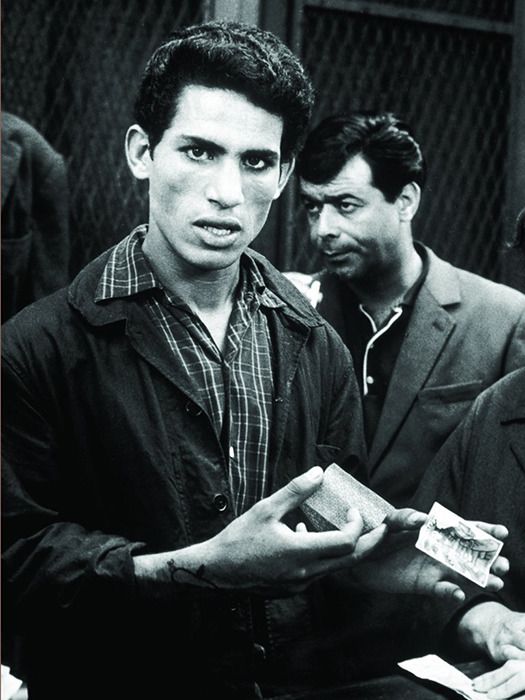
Still (fragment) from Gillo Pontecorvo’s film “The Battle of Algiers” (1966). Source: Kinopoisk
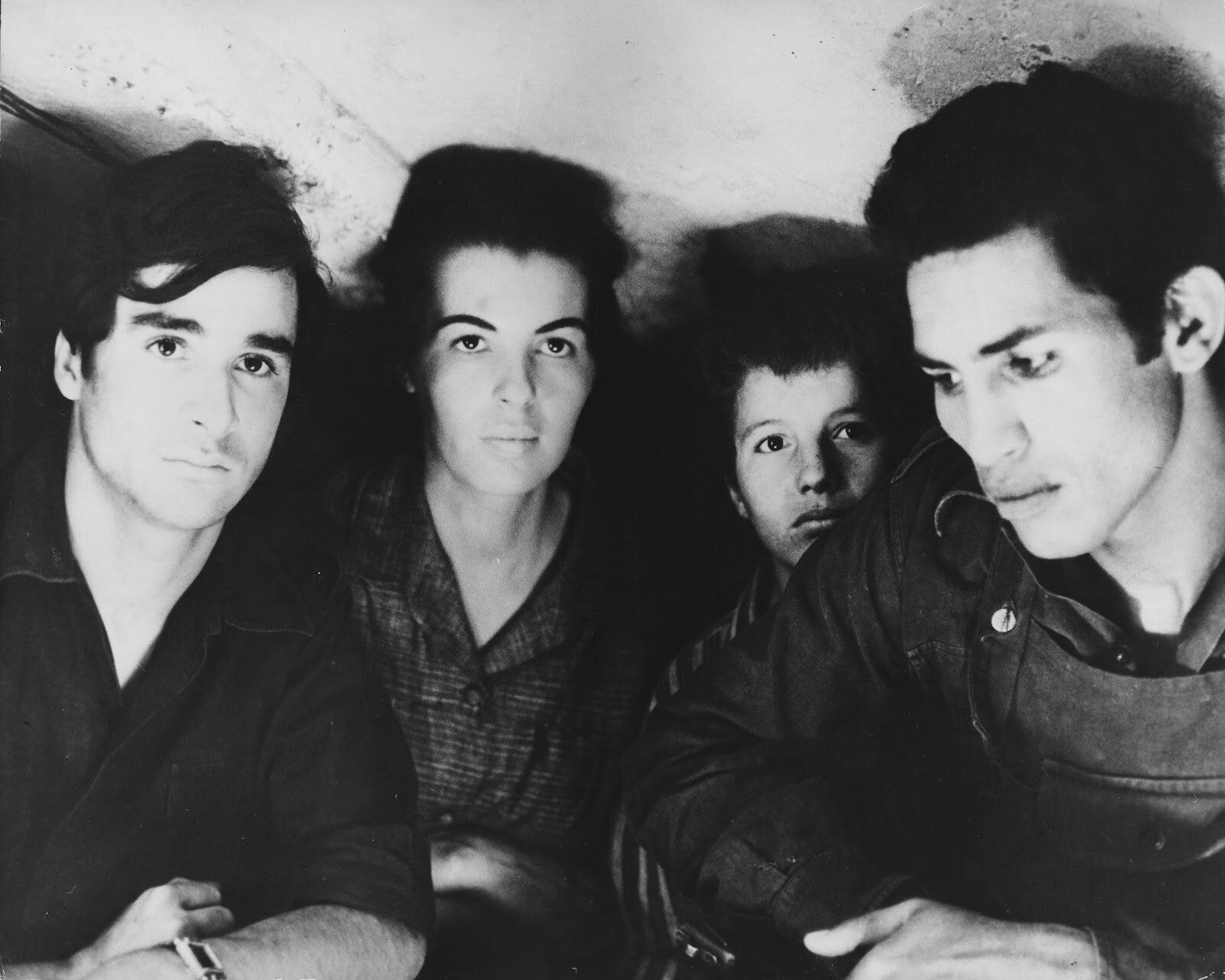
There is no single protagonist in the film, but Ali la Pointe is the most vividly drawn character. The future national hero of Algeria grew up in extreme poverty and therefore never even learned to read. At the beginning of the film, we see him cheating at the market and then running from the police. And when a random passerby, a white Frenchman, trips him for amusement, I feel rage. And after living through two hours of Pontecorvo’s drama, I cry when Ali la Pointe, together with his comrades — Hassiba Ben Bouali, Mahmoud, and Little Omar — refuses to surrender. Thirty seconds later, French soldiers will blow them up together with the house and the civilians nearby.
Still from Gillo Pontecorvo’s film “The Battle of Algiers” (1966). Source: Kinopoisk
Beyond the fact that “The Battle of Algiers” turned out to be a cinematic masterpiece, it also became a visual manual for guerrilla warfare against colonial forces. It inspired people in all corners of the planet: from Mozambique and Angola to Northern Ireland, from Palestine to the Black Panther movement for Black rights in the United States. The film was used as a practical guide for urban warfare and for organizing underground networks. “The Battle of Algiers” was Andreas Baader’s favorite film — the terrorist and one of the leaders of the far-left Red Army Faction (RAF) in Germany.
It is ironic that the film was seen as a practical guide not only by revolutionaries, but also by intelligence services. Thus, in 2003, the U.S. Department of Defense deemed it necessary to screen the film for its staff. The screening was organized by the unit responsible for special operations and low-intensity conflicts, and the goal was to reflect on the French counterinsurgency experience in the context of the resistance already unfolding in Iraq.
Still from Gillo Pontecorvo’s film “The Battle of Algiers” (1966). Source: Kinopoisk
And what about the USSR? In the Soviet Union, the rights to screen the film were purchased, it was dubbed, but it was never released in theaters. Probably the film seemed too truthful and dangerous. After all, despite its left-wing rhetoric, the USSR remained in many respects an imperial project. In modern Russia, left-wing ideas have been marginalized.
But “The Battle of Algiers” leaves few people indifferent even today. An “Easter egg” referencing the film can be seen, for example, in Paul Thomas Anderson’s 2025 film “One Battle After Another”. Thus, the main character played by Leonardo DiCaprio, an aging “leftist”, watches “The Battle of Algiers” while lying on the couch. And in Russia, although only a few cinephiles know about the film, the methods of the Algerian rebels are used in organizing some activist anti-war communities.
If you enjoyed this article, consider making a donation — one-time or, even better, monthly. Your support helps us motivate our authors and become better with every article.
Our organization is recognized by the Internal Revenue Service (IRS) as a 501(c)(3) tax-exempt, charitable organization, which means that all contributions made to us are tax-deductible to the fullest extent permitted by U.S. law. Individuals may generally deduct charitable contributions of up to 60% of their Adjusted Gross Income (AGI) for cash donations made to qualifying 501(c)(3) organizations. For donations of appreciated assets (such as stocks or other long-term capital assets), the deduction is typically limited to 30% of AGI, based on the fair market value of the asset. C-corporations may deduct charitable contributions of up to 10% of their taxable income for donations made to eligible charitable organizations.
By submitting a donation, you confirm that you have read and accept the following documents: Privacy Policy and User Agreement, and also give consent to the processing of your personal data.
If you would like to unsubscribe from a monthly donation, please email us at: [email protected]