A retrospective of Artemisia Gentileschi at the Jacquemart-André Museum — the main Paris exhibition of the current season. The curators tried not to linger too much on the scandalous details of their heroine’s biography, which are now well known, but rather to take a closer look at her art. However, without the story of the rape of 17-year-old Gentileschi, it is hardly possible to penetrate her artistic world. The mission was made impossible by the artist herself: her art is the answer to her own biography. How else to explain the anger and rage that guided her brush, and the very choice of subjects in which the woman always dominates the man or avenges her sullied honor?
One and a half centuries ago, an extremely interesting document was discovered in the National Archives of Rome. Before the scholars lay the records of the court case concerning the rape of the painter Artemisia Gentileschi, which shocked the capital of the Papal States in 1611.
This discovery, although it reminded people of the work of a once-famous but by then forgotten Caravaggist, did her no favors. Since then, attention has focused more on the events of her turbulent life rather than on her place in art.
Another difficulty adds to this — the incredible events of Artemisia Gentileschi's life stubbornly align with our contemporary issues, primarily #metoo, and the constant artistic processing of the tragedy aligns with the hashtag #IAmNotAfraidToSay. Thus, they enter the perspective of a modern viewpoint.
Rape and trial
So, in 1611 in Rome, seventeen-year-old Artemisia Gentileschi declared that she had been raped by her teacher Agostino Tassi.
The promising young painter was living at the time in her father’s house, the painter Orazio Gentileschi, whom she already surpassed in talent at an early age. Still, she had to study in his studio — women were not allowed to study art at the Academy at that time. At the Paris exhibition, where her works are compared with her father’s, it is clear that Orazio Gentileschi’s painting is more elegant and refined, but the daughter’s works are more energetic and powerful.
Agostino Tassi, a master of architectural quadratura and a good acquaintance of her father — they painted frescoes together in one of the Roman palaces — was hired as Artemisia’s private teacher. However, the lessons did not last long.
Only a few months later, Orazio filed a complaint against his friend: the teacher brutally raped his daughter on May 9, 1611. The trial began, which became a test for Artemisia no less severe than the rape itself. The case gained huge publicity. The chronicle of the nine-month-long trial preserved her testimony with all the disgusting details. The questions asked by the judges and the courageous answers of the victim can easily be imagined in a 21st-century forensic examination:
“He threw me on the edge of the bed, pressing his hand on my chest, and pushed his knee between my thighs so I couldn’t move them. To keep me from screaming, he gagged me with a handkerchief. Then, directing his member to my nature, he began to push and insert it into me: I felt intense burning and pain. Because of the handkerchief, I couldn’t scream, but I still called for help as best I could. Before he inserted it again, I squeezed his member so hard that I tore a piece of flesh. But he continued his act. He stayed on me for a long time, and when he finished, he fell off.”
Artemisia grabbed a knife, but Tassi managed to dodge. Whether her tears moved the rapist or he tried to avoid responsibility, a promise to marry followed: “I just need to first untangle my current situation.” The situation was that Tassi was already married. With assurances that “the shame would be covered,” he forced Artemisia to submit several more times; the relationship lasted about six months, but the marriage never materialized, so Orazio took the matter to court.
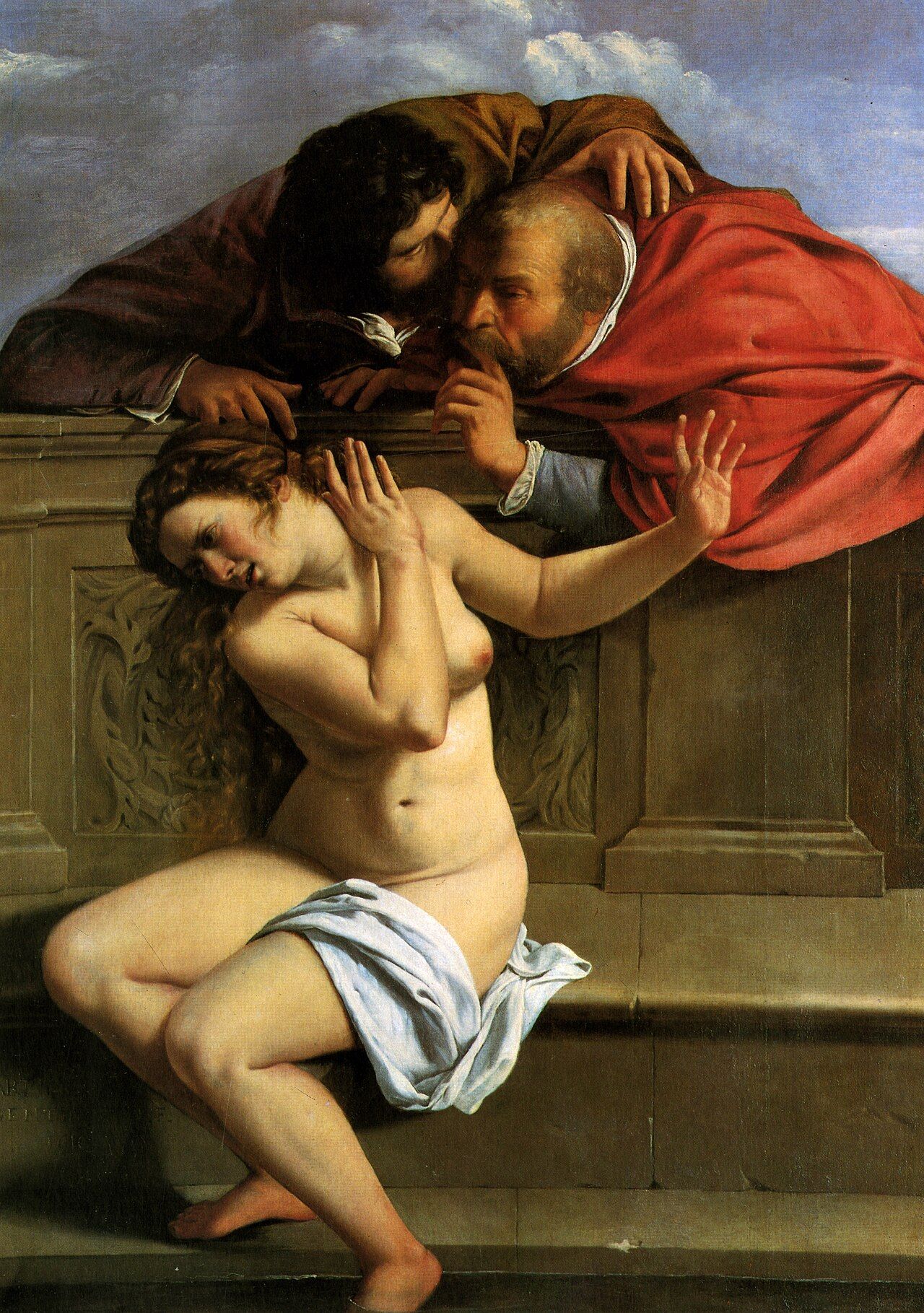
Artemisia Gentileschi. “Susanna and the Elders,” 1610.
The judges were not interested in the rape itself; their task was to determine whether the Gentileschi family had been insulted. In other words, whether Artemisia was a virgin at the time of the rape. If not, Tassi was not guilty of anything. “Was there blood after the intercourse?” the court asked. Artemisia answered frankly: “It happened during my menstruation, I don’t know.” The judges had other doubts — Artemisia was not like other girls in her circle — she was a painter, depicting the nude body, and her paintings show frank female sensuality. Even 300 years later, one of her paintings continued to be censored — the naked breast of an allegorical female figure was covered with drapery. The original version was discovered only in the 20th century through X-ray analysis.
Tassi called her a liar and swore that “nothing happened,” while Artemisia was a “whore.” He had powerful patrons, yet he did not inspire the court’s trust. In Rome, the artist’s reputation was poor; he had long been nicknamed “Lo Smargiasso” (“The Braggart”), and stories about his travels, where he learned to paint seascapes, told that he had actually been sent to the galleys for some other crime.
Meanwhile, the defendant contradicted himself in testimony. At first, he said he had never been alone with the accuser, then claimed he came to defend her honor (how?). Unexpectedly, his own daughter-in-law testified against him — he had also raped her. One of his former wives would bring the same accusation to court. His current wife disappeared altogether, with rumors that Tassi had killed her. He himself openly claimed this, accusing his wife of infidelity. The wife soon reappeared, but then a new accusation arose — of attempted bigamy.
The case became completely tangled when Artemisia’s father filed another complaint — according to him, Agostino wanted to steal his painting. Tassi responded by claiming that Orazio was sleeping with his daughter and tried to shift all blame onto him. Questions arose — why was the rape complaint filed so late? And was Artemisia really his daughter? Had he not raped the mother first, and now, after her death, the girl?
All this time, Artemisia endured humiliation and medical examinations. She was even subjected to torture — a common measure in the judicial process at the time. She risked losing the ability to paint forever — ropes were tied around her fingers and tightened, risking breaking bones.
In the end, Agostino was found guilty and sentenced to five years’ exile from the Papal States. The sentence was never carried out.
Judith and Holofernes
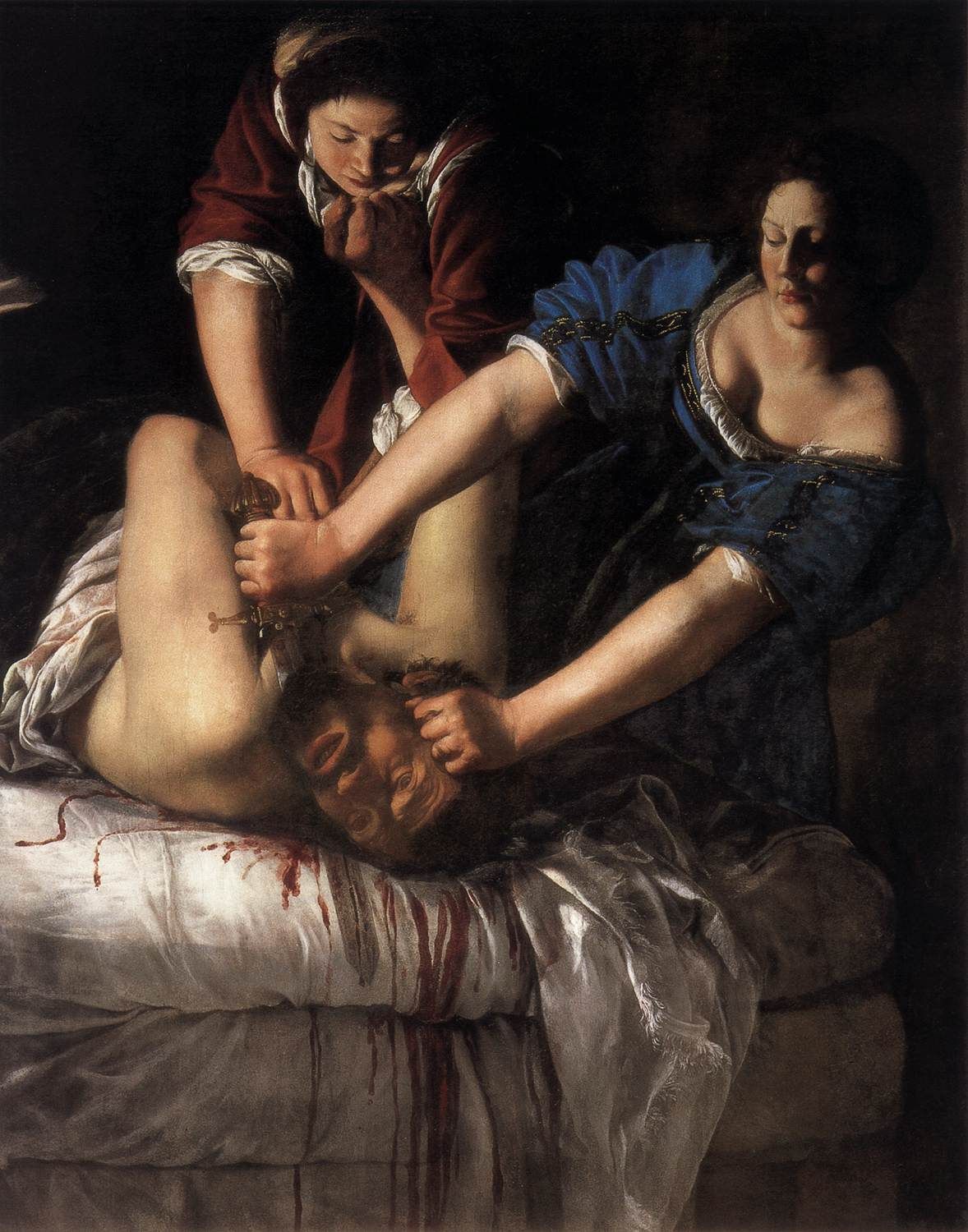
Immediately after the trial, Artemisia painted probably her most famous work: “Judith Beheading Holofernes,” thus pronouncing her own judgment on Tassi: she gave his features to Holofernes and portrayed herself as Judith. Gentileschi was a follower of Caravaggio, who also approached this subject. Comparing the two paintings helps understand the feelings that drove the artist.
For Caravaggio, the main character is Holofernes; the artist is interested in the sufferings of the dying man, and his Judith distances herself from the body with barely concealed disgust and revulsion. Gentileschi’s heroine cuts her opponent like a pig in a slaughterhouse — calmly, confidently, with satisfaction from a job well done. Blood splashes on the sheets — a reminder of the blood the court was so concerned about? Judith holds a knife — the very one Artemisia tried to defend herself with?
Artemisia Gentileschi. “Judith Beheading Holofernes,” c. 1620. Uffizi Gallery
A few days after the trial, Artemisia married. To save the family’s honor, she was married off to a minor Florentine painter, Pietro Antonio Stiattesi. Her biography finally ceased to be a court chronicle and became a life story, though still an unusual one — Artemisia Gentileschi became a renowned painter. She was one of the first women admitted to the “grand genres,” historical painting, biblical and mythological subjects. A series of travels and relocations began, major commissions and work for princely and royal courts.
In 1613, Artemisia moved to Florence with her husband, where Cosimo II de’ Medici commissioned her to paint the most explicit works of her career. In these and subsequent works, rage and cruelty, anger and revenge accumulated during the trial, take residence. Throughout her life, Artemisia painted portraits and scenes capable of reflecting these feelings — Virginia, whom David took by force; Lucretia with a knife in hand after being raped by Sextus Tarquinius; Danaë, locked up by her father; Susanna and the elders spying on her. Even in works where violence is not depicted directly or indirectly, the woman still triumphs over men, overpowering them with her beauty, courage, or sensuality, as in the recently discovered image of Galatea.
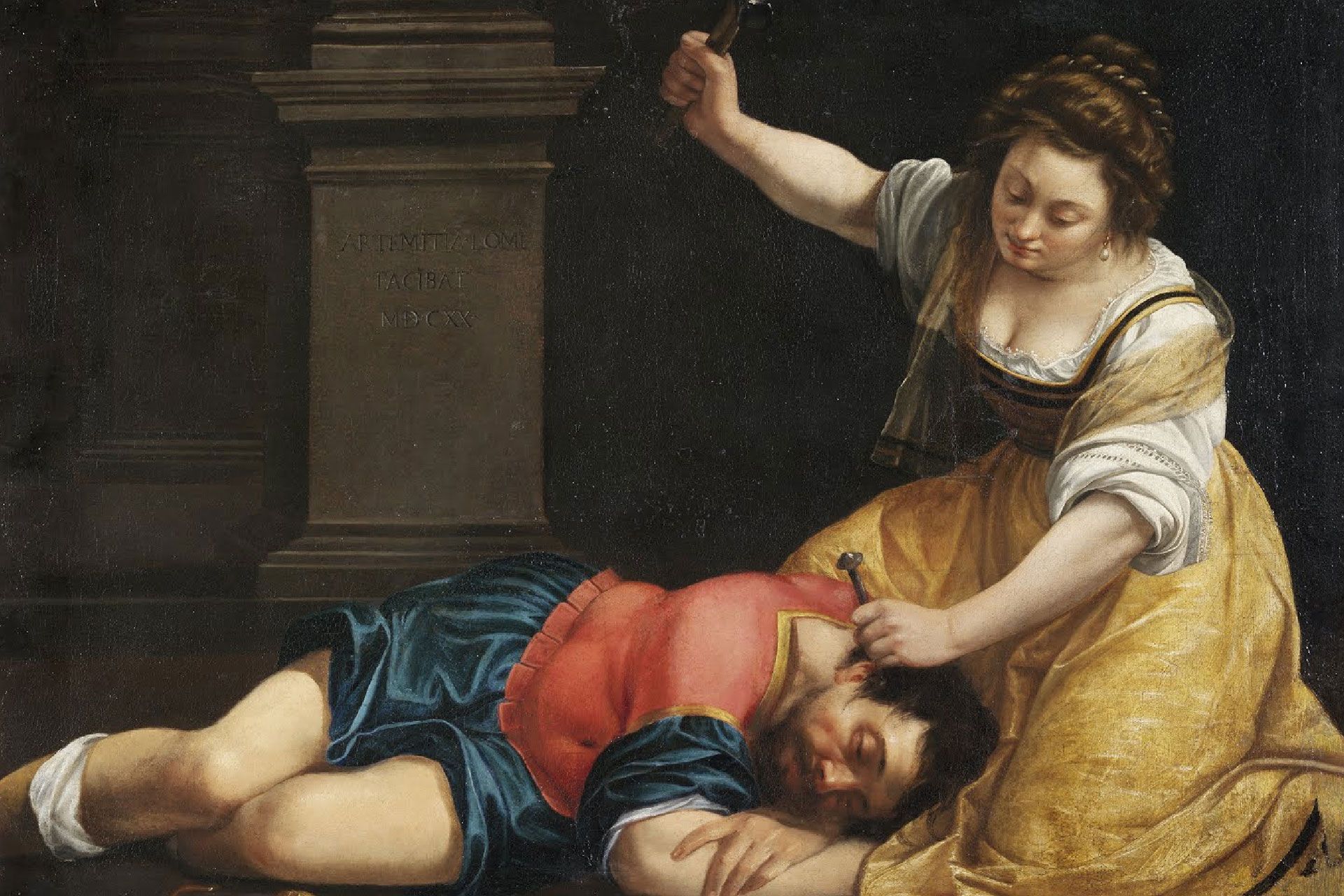
In 1620, still in Florence, Gentileschi painted the biblical subject “Jael and Sisera.” Jael kills the commander of the Canaanite army hiding in her tent. She drives a tent peg into his head and pierces his skull, pinning him to the ground. In Gentileschi’s painting, Jael has already placed the peg on Sisera’s head and is raising the hammer, ready to strike. On her face is the same satisfaction from a completed deed as Judith’s. “Whose head is she driving the peg into?” writes Les Beaux Arts magazine, “Sisera’s or the male dominion’s?” Possibly the very same Agostino Tassi’s head.
In Florence, Gentileschi bore four children and met the great love of her life — Francesco Maringhi, a brilliant and educated nobleman. From 1623, the lovers began living together in Naples; her husband disappeared from her life. She worked endlessly, painted portraits, but led such a lavish lifestyle that she accumulated more and more debts with each fee.
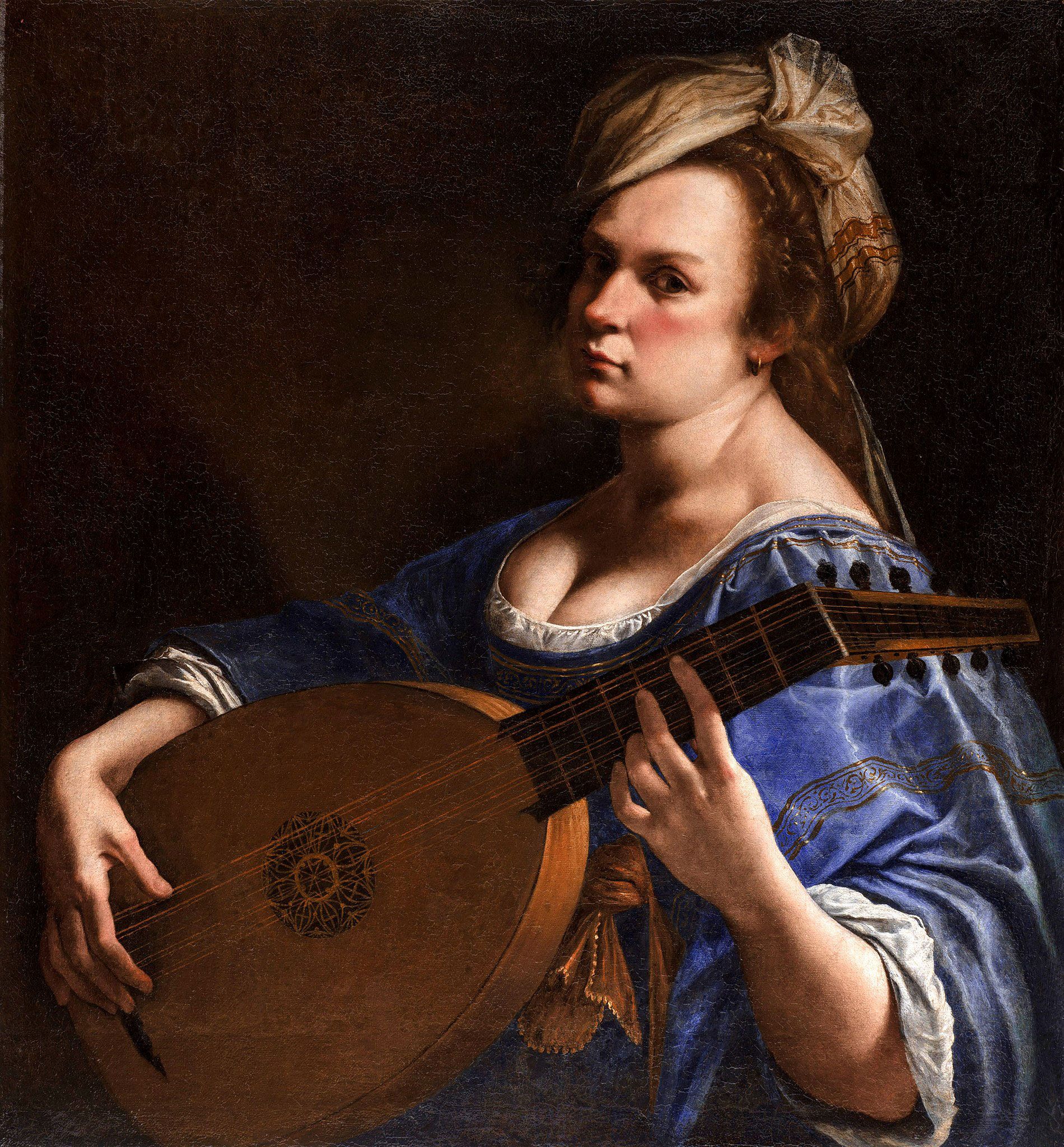
Artemisia Gentileschi. “Self-portrait as a Lute Player,” between 1615 and 1618.
And yet, Artemisia Gentileschi was the first woman able to live by her art and raise her daughter Palmira, whom she took with her on endless travels. This was the best period of her life. Maringhi introduced her to intellectual circles, acquainted her with the nephew of the great Michelangelo, Michelangelo Buonarroti the Younger, and with Galileo, who secured her a place in the Academy. She enjoyed European fame and success. She briefly returned to Florence, then traveled to Venice, Rome, again Naples, and even London, where King Charles I invited her, and finally back to Naples, this time for a long stay.
Surprisingly, the surviving part of her correspondence indicates that Artemisia wished to be buried in Rome, to remain a Roman, or at least considered this possibility, especially in connection with her membership in the Academy of Saint Luke. Yet she died in Naples during the great plague, and there is no evidence that her body was transferred to Rome. The location of her grave remains unknown. Despite recognition during her lifetime, in the following centuries Artemisia Gentileschi was almost forgotten, and her role in art was reduced to that of a female painter. Her works were often attributed to contemporaries, particularly her father. In the 19th century, she was practically absent from art history literature.
New fame
In the 20th century, the name Gentileschi again attracted attention. The credit for this rediscovery belongs to the great Italian art historian, researcher of Caravaggio and his followers, and master of attributions Roberto Longhi. Longhi was struck by the energy of her works — yet he still reduced her to a kind of curiosity.
In the 1970s, Artemisia Gentileschi’s art finally began to be taken seriously — this time thanks to feminist theses. In 1976, an exhibition “Women Artists: 1550-1950” was held in Los Angeles and then Brooklyn. It included six works by Gentileschi, including the famous “Susanna and the Elders” (1610), and from there began her new fame. For the first time, several of Artemisia’s paintings were presented together, allowing an appreciation of the power of her art.
The exhibition’s curator and catalog co-author was Linda Nochlin, a well-known art historian and feminist. In 1971, she published an essay in ArtNews titled “Why Have There Been No Great Women Artists?” arguing that the cause was not lack of talent but exclusion from the system (academy, commissions, study of the nude model, etc.). In the exhibition catalog, Artemisia is presented as an outstanding artist, not as a woman in a man’s world.
Since then, exhibitions of Artemisia Gentileschi have been held in various countries around the world; a novel and a film have been made about her. In the last five years, her works previously attributed to other authors have been regularly discovered or reattributed.
Two works, considered by an anonymous artist and hanging in a Lebanese palace, were discovered after the explosion in the Port of Beirut in 2020. At the same time, the painting “David and Goliath” unexpectedly appeared at a major auction, and experts responsible for its restoration confirmed the authenticity of Gentileschi’s signature on David’s blade. And again, the blade!
In 2023, curators of the exhibition at the National Gallery of Naples recognized Artemisia as the author of four paintings sent by other museums, where they had been attributed to other artists. Among them is “The Abduction of Europa,” a nearly autobiographical subject.
Finally, that same year the British Royal Collection announced that a painting by Artemisia Gentileschi was found at Hampton Court Palace. For the last two centuries, it had been attributed to a French school artist, the work was in poor condition, stored in reserves, and only restoration revealed the true author. And again the subject — “Susanna and the Elders” — returns to the fate of the artist. Artemisia Gentileschi poured her fate into her paintings — and now they continue her incredible journey.
Main photo — Artemisia Gentileschi. “Jael and Sisera” (detail), 1620. Museum of Fine Arts, Budapest
If you enjoyed this article, consider making a donation — one-time or, even better, monthly. Your support helps us motivate our authors and become better with every article.
Our organization is recognized by the Internal Revenue Service (IRS) as a 501(c)(3) tax-exempt, charitable organization, which means that all contributions made to us are tax-deductible to the fullest extent permitted by U.S. law. Individuals may generally deduct charitable contributions of up to 60% of their Adjusted Gross Income (AGI) for cash donations made to qualifying 501(c)(3) organizations. For donations of appreciated assets (such as stocks or other long-term capital assets), the deduction is typically limited to 30% of AGI, based on the fair market value of the asset. C-corporations may deduct charitable contributions of up to 10% of their taxable income for donations made to eligible charitable organizations.
By submitting a donation, you confirm that you have read and accept the following documents: Privacy Policy and User Agreement, and also give consent to the processing of your personal data.
If you would like to unsubscribe from a monthly donation, please email us at: [email protected]