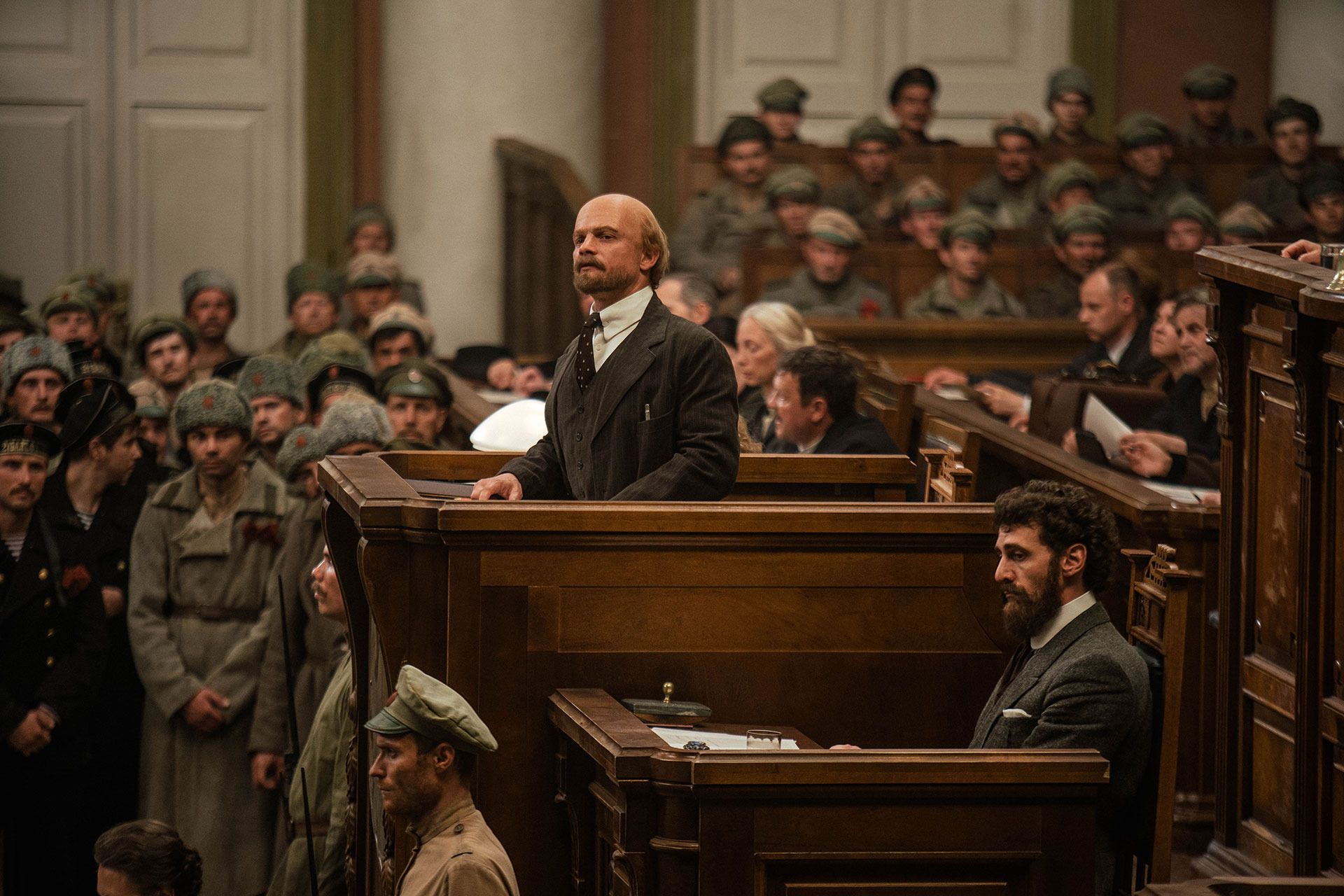
This fall, the 16-episode series “Chronicles of the Russian Revolution” by Andrei Konchalovsky was released on the Start online cinema platform. The creators of the series openly claim: all freedoms in Russia are only harmful. Which, however, is the norm for Russian historical series.
Photo: kinopoisk.ru
I don’t watch many post-Soviet series made in Russia. Because most of them seem programmed by guardian robots. Especially when it comes to revolutionary events in domestic history.
The memory of the revolution in post-Soviet Russia was immediately attempted to be erased. Of course, revolutionary events are often tragic and impossible to idealize. But it is still necessary to remember them — they are an integral part of any national history that radically changed it. For example, in France and the USA, the main holidays are connected with their revolutions, although at the time these dates did not seem “festive” to everyone.
It is telling that in Russia the former “red calendar day” of November 7 was attempted to be replaced by National Unity Day on the 4th. This was a clear illustration of a failure into some medieval history. The semi-mythical date of the “expulsion of the Poles from Moscow” in 1612, which eventually led to the accession of the Romanovs, that is, the restoration of autocracy. The meaning of this “holiday” is absolutely opposite to the revolutionary one.
And by the way, it is no coincidence that this holiday replacement happened in 2005. A year earlier, the Orange Revolution took place in Kyiv, which greatly frightened the Kremlin. The then Ukrainian president Kuchma decided to reproduce the Russian monarchical model of power transfer and appoint Yanukovych as his “successor.” But the citizens of Ukraine rose up and demanded truly free elections. Since then, the theme of fighting “color revolutions” has become one of the dominant themes in Kremlin propaganda.
At the same time, the so-called “St. George ribbon” appeared — as a symbolic opposite to the Kyiv orange. If orange meant hope for revolutionary renewal, then the St. George ribbon was a bet on historical conservatism. And probably not by chance, two of the heroes in the film “Chronicles of the Russian Revolution” — Nicholas II and the secret police officer Prokhorov — wear St. George crosses, and the former even awards the latter with one.
Former Soviet director Andrei Konchalovsky made a completely anti-Soviet series. In Soviet cinema, revolutionaries were shown as heroes, and the tsarist secret police as soulless executioners. Here, everything is exactly the opposite.
Revolutionaries are portrayed grotesquely; Lenin is some kind of semi-comic character, though fiercely cruel. Zyuganov even promised to put Konchalovsky “on trial.” Conversely, secret police officer Prokhorov embodies crystal-clear honesty and incorruptibility.
This approach is reminiscent of another recent Russian series — “GDR”, which tells about the events of the late 1980s. There, the Gorbachevs are also shown quite comically, and all perestroika events look like complete chaos and an enemy conspiracy, fought by one honest and incorruptible patriot — a KGB officer. Considering who has been the master of the Kremlin for a quarter of a century, it’s clear why such plots have become absolute mainstream in today’s Russia.
It is also quite amusing how at the start credits of each episode of “Chronicles of the Russian Revolution” it says: “Alisher Usmanov presents.” Well, of course, would a billionaire present some positive film about revolutionaries?
But overall, Konchalovsky’s picture looks like a major historical undertaking — 16 episodes cover the period 1904-1924. And the entire collapse into revolutionary chaos begins with the famous tsarist manifesto of 1905 on civil liberties. The creators openly declare: all freedoms in Russia are only harmful.
The Constituent Assembly, which met for one day in 1918, is also shown quite grotesquely. There is some meaningless chatter, and the director didn’t even recall that the Assembly had proclaimed Russia a “democratic federal republic.” Interestingly, the Bolsheviks who dispersed it suddenly lose the grotesqueness they had in the early episodes and turn into “strong politicians,” rightfully achieving supreme sole power in Konchalovsky’s eyes.
Lenin retains his semi-comic image until the end of the series. But the young Stalin is shown with clear authorial sympathy. And in the finale, he easily assumes the role of the natural leader of the Bolsheviks, while all other members of the Politburo (Trotsky, Zinoviev, Bukharin, etc.) appear to him as some ridiculous historical obstacle.
The central plot of 1917 is done in the style of absolute conspiracy theory. There, secret police officers, disappointed with the “incompetence” of the Provisional Government, secretly contact the Bolsheviks themselves and help them stage an armed coup. The counterintelligence general even drinks Georgian wine with Stalin. Later in the plot, the main officers of the Secret Police Department join the Cheka.
Of course, all this can be attributed to the author’s perspective. However, the series (with elements of historical newsreels, a strict voice-over, etc.) is presented almost as a documentary. And it is shown not only on the online cinema platform but also on the main “Russia 1” TV channel.
It’s unlikely that a truly independent director would be allowed such “liberties” if there were no specific state order behind it. And that order is clearly visible. The revolution as civil self-organization must be shown as a historical horror. The interests of the state come above all. But some revolutionaries establishing “strong power” still look positive. They are the legitimate successors of pre-revolutionary state figures. This closes the historical circle.
This is effectively Medinsky’s official doctrine today about the “continuity and succession” of Russian history.
The Moscow Tsardom, Russian Empire, USSR, and Russian Federation are not different states succeeding each other in ideological struggle, but the same country changing political forms. From this viewpoint, all revolutions dividing these regimes should be forgotten. And if shown — then as some phantasmagoria, resulting in the same “patriots” coming to power.
One recurring theme throughout Konchalovsky’s series is very telling. It is the fear of “Russia’s disintegration.” First, in 1911, Prime Minister Pyotr Stolypin warns of it — the main danger is not even revolutionaries but some foreign enemies who “plot the empire’s collapse.” Then, in 1916, the “elder” Grigory Rasputin warns about it. In 1917, these “enemies” are shown with grotesque realism — employees of the British embassy in Russia openly speak about the desirability of its “collapse.” Finally, in 1918, the left SR leader Maria Spiridonova fears “disintegration.”
And Stalin’s great-power patriotism is implied — he advocates for a “united Russia” and criticizes Lenin’s fantasies about a union of republics.
So if Andrei Konchalovsky takes a liking to creating major historical series, perhaps the next one will be about another 20 years, roughly from 1980 to 2000. At first, the elder Politburo members wanted to “hold the country together.” But then a sudden new revolution called “perestroika” arrived, with terrible chaos of freedom and yet another empire collapse. However, in 2000, Russian history returned to the imperial track with an irreplaceable “tsar.”
The paradox is that even in the late Soviet era, which we consider totalitarian, there were directors who managed to show us a very different story. The cult series of our pioneer years by Pavel Arsenov “Guest from the Future” was essentially about freedom and the fight against cosmic pirates who seized power. And all our children’s films about Buratino, Cipollino, and Gelsomino were revolutionary too!
Post-Soviet film series production most often turns out to be counter-revolutionary. The idea of the “GDR” series is that there should have been no revolution in East Germany and no tearing down of the Berlin Wall. Instead, people should have listened to the wise KGB officer, who strikingly resembles Putin.
One can also recall the notoriously known series “The Sleepers” (2017). There, loyalist writer Sergey Minaev and director Yuri Bykov paint a conspiracy picture: enemies who infiltrated Russian power and business “wake up” one day. And again, an honest and incorruptible FSB officer fights them.
This is the general framework, a kind of matrix of post-Soviet Russian historical cinema. And it’s a pity that a director of many good films like Andrei Konchalovsky has also fitted into it.
If you enjoyed this article, consider making a donation — one-time or, even better, monthly. Your support helps us motivate our authors and become better with every article.
Our organization is recognized by the Internal Revenue Service (IRS) as a 501(c)(3) tax-exempt, charitable organization, which means that all contributions made to us are tax-deductible to the fullest extent permitted by U.S. law. Individuals may generally deduct charitable contributions of up to 60% of their Adjusted Gross Income (AGI) for cash donations made to qualifying 501(c)(3) organizations. For donations of appreciated assets (such as stocks or other long-term capital assets), the deduction is typically limited to 30% of AGI, based on the fair market value of the asset. C-corporations may deduct charitable contributions of up to 10% of their taxable income for donations made to eligible charitable organizations.
By submitting a donation, you confirm that you have read and accept the following documents: Privacy Policy and User Agreement, and also give consent to the processing of your personal data.
If you would like to unsubscribe from a monthly donation, please email us at: [email protected]