George Orwell’s novel “1984” was published in 1948. Since then, this text has been turned into dramatic plays, an opera, and even a ballet — but there have been no major musicals yet (not counting the unsuccessful 2020 production in Australia, which lasted 17 days on stage). An international creative team bringing together Russian-speaking artists and directors from seven countries is preparing a new production for release. The lyrics for the musical “1984” were written by poet Vera Polozkova, and the music was composed by Alexey Krasovitsky, the leader of Animal Jazz
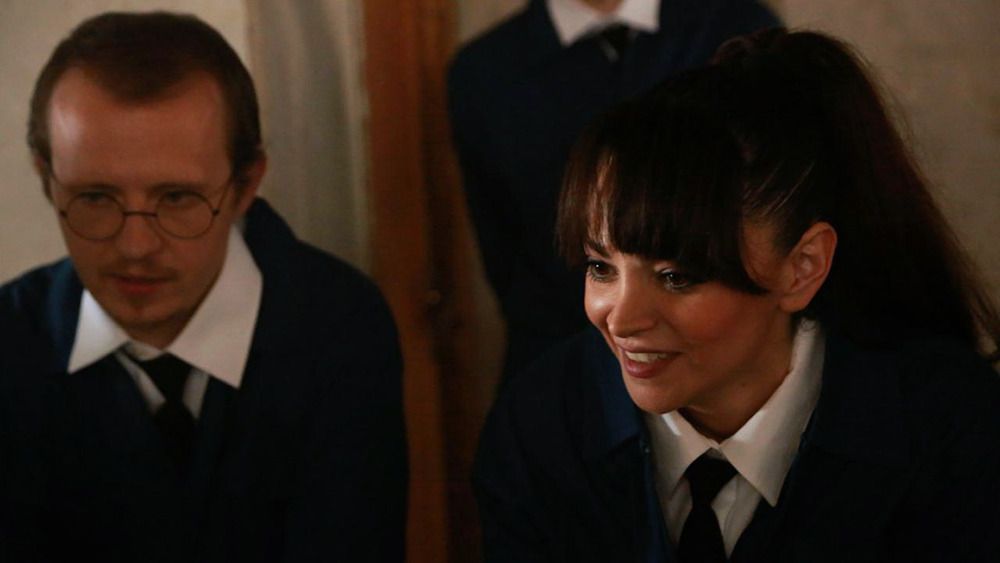
Photo from the filming of the music video for the song from the musical “1984”, “I’m Going With You”, provided by the musical’s creative team
Before “1984” became a Russian-language musical, theater producer Sergey Tselikov gave Orwell’s novel’s biography a small review. Over the decades, the novel had been adapted for film and the dramatic stage, turned into an opera, a ballet, puppet theater, and multimedia productions. Tselikov studied recordings of productions, watched how theater tried to deal with Oceania, the Ministry of Truth, and Room 101. He also thought about a film adaptation, even though Michael Radford’s 1984 film had become a classic (and there had been two others). Then the idea of animated animation was born. It never came to fruition, but the question of what language “1984” actually suits today remained.
The answer was sought together with director Konstantin Kamensky, Tselikov’s partner in the creative team behind the play “The Master and Margarita”. They found it not so much in the structure of Oceania as in Winston himself.
What if the main character were made a musician — a person who, in a world of standardized language, is capable of composing his own words and melodies? That is how Winston got another occupation besides rewriting the past at the Ministry of Truth: he became a bard.
Winston is played by Alexander Krasovitsky, the leader of the bands Animal ДжаZ and Zero People. He also wrote the music for the production. So the transformation of Orwell’s hero into a songwriter looks less like a theatrical convention and more like a way to bring him closer to the performer. In total, “1984” has fourteen original songs, with lyrics written by Vera Polozkova.
Julia is played by Theona Dolnikova, who was at the origins of the musical as a genre in post-Soviet Russia; it is enough to recall her roles in “Metro” and “Notre-Dame de Paris”. In recent years, Dolnikova has appeared often on TV, toured, and worked on other projects — including participating in the French The Voice, where she joined Patricia Kaas’s team. She is returning to the musical genre after a long break.
Vladimir Daraganov and Theona Dolnikova during the filming of the music video for the song from the musical “1984”, “I’m Going With You”. Photo provided by the musical’s creative team
Vera Polozkova said in an interview that she had never done such a large amount of poetic work in such a short time. It was due both to complete mutual understanding with Alexander Krasovitsky (despite the remote nature of the collaboration) and to the fact that the novel “1984” is truly close to the poet; she has reread it many times.
In the songs, which in the new production stand alongside the characters’ dialogues, there is a sense of a forbidden language. The structure of the musical numbers is quite accessible; it is mature songwriting of an international standard, standing up to any comparison with the classics of musical theater. And the theme of secret knowledge, a means of communication available only to two lovers, keeps appearing in the lyrics. It is a way to preserve one’s own speech in a world where the state systematically takes away a person’s words, memory, and right to personal feeling. Winston’s relationship with Julia becomes a second such territory alongside music. In Orwell’s world, it is not enough for the state to control a person’s actions: it also claims their desires. That is why the love story gradually moves to the center of the production, while the political dystopia simultaneously becomes the story of two people trying to keep at least a small space for themselves, where Big Brother has no access: “What if the powers of eternal darkness are limited only by us?”
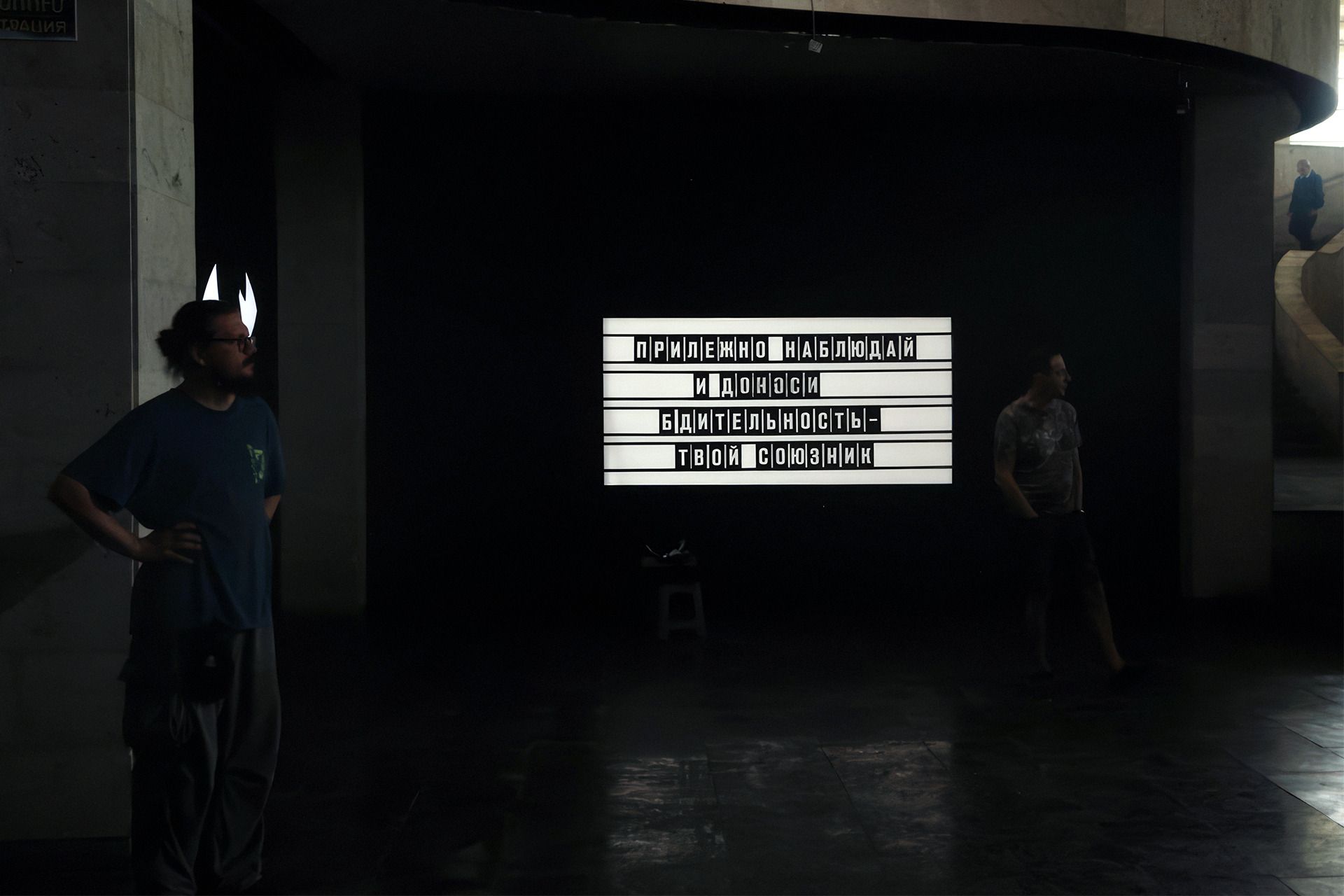
The problem is that private space practically does not exist here. Big Brother in this version does not hide somewhere behind the walls of the Ministry of Love. His world is arranged like an endless television show. On stage there are screens, cameras, bright light, a space in which a person is constantly watched and where the personal can instantly become public.
One of the main guides through this world is the TV Host. He is played by Yevgeny Pronin, known to a wide audience for Russian films and TV series, and now an actor at the Mikhail Chekhov Riga Russian Theatre. Power in “1984” does not necessarily speak in an official voice or look intimidating. It can be charming, modern, and well produced. Accustomed to working in front of the camera, Pronin in the production is the public face of Big Brother’s media system.
Parsons is played by Vladimir Daraganov, a professional who combines acting with video production at a Swiss production studio. Parsons is a character who, on the one hand, is built into the system, and on the other, exists somewhere between naivety, fear, and inner brokenness.
The space created on stage by Nina Kobiashvili simultaneously resembles a television studio and a cage, while Ilya Delyatitsky’s video becomes part of the surveillance system itself. This creates a significant shift from the familiar stage iconography of “1984”:
total control no longer has to look gray, cold, and poor. It can be bright, spectacular, and even attractive — until it turns out that it is impossible to leave this space.
This also answers the question of why a musical was needed after so many attempts to stage Orwell. Opera can make “1984” monumental, ballet can translate it into the language of the body, multimedia theater can literally surround the viewer with screens. Here, music does its job. A song arises where a person still seems capable of formulating something of their own. That is why a musical number potentially becomes exactly what should not exist in Big Brother’s perfectly tuned world: a statement in the first person.
For all the intimacy of Winston and Julia’s story, the production itself is conceived on a large scale. This is not a simplified touring setup that can be transported from city to city in a few suitcases, the way the heroes of another Sergey Tselikov production project — Dovlatov’s “The Suitcase” — carried their lives. Along with the actors, complex scenery, video, lighting, and sound travel. For Russian-language theater, which in recent years outside Russia has often existed in the format of small mobile touring productions, “1984” is an attempt to work on a different scale, to bring the audience not a concert version of the book, but theater.
The first audiences will see “1984” on October 17 and 18 in Yerevan, at the Gabriel Sundukyan National Academic Theatre. Then “1984” will travel to Tbilisi — performances at the Griboedov Theatre are scheduled for October 20 and 21, and on October 25 the musical will be performed at the Batumi Summer Theatre. In February 2027, the route will continue with Belgrade and Limassol.
Orwell, of course, left no instructions about what voice Winston Smith should sing in. He never even assumed that Winston would sing. But perhaps that is the main point of the endeavor: to give a voice to a person from a world whose structure assumes that in the end they should not have a voice of their own.
If you enjoyed this article, consider making a donation — one-time or, even better, monthly. Your support helps us motivate our authors and become better with every article.
Our organization is recognized by the Internal Revenue Service (IRS) as a 501(c)(3) tax-exempt, charitable organization, which means that all contributions made to us are tax-deductible to the fullest extent permitted by U.S. law. Individuals may generally deduct charitable contributions of up to 60% of their Adjusted Gross Income (AGI) for cash donations made to qualifying 501(c)(3) organizations. For donations of appreciated assets (such as stocks or other long-term capital assets), the deduction is typically limited to 30% of AGI, based on the fair market value of the asset. C-corporations may deduct charitable contributions of up to 10% of their taxable income for donations made to eligible charitable organizations.
By submitting a donation, you confirm that you have read and accept the following documents: Privacy Policy and User Agreement, and also give consent to the processing of your personal data.
If you would like to unsubscribe from a monthly donation, please email us at: [email protected]